
Excavator outreach specifications for restricted construction sites
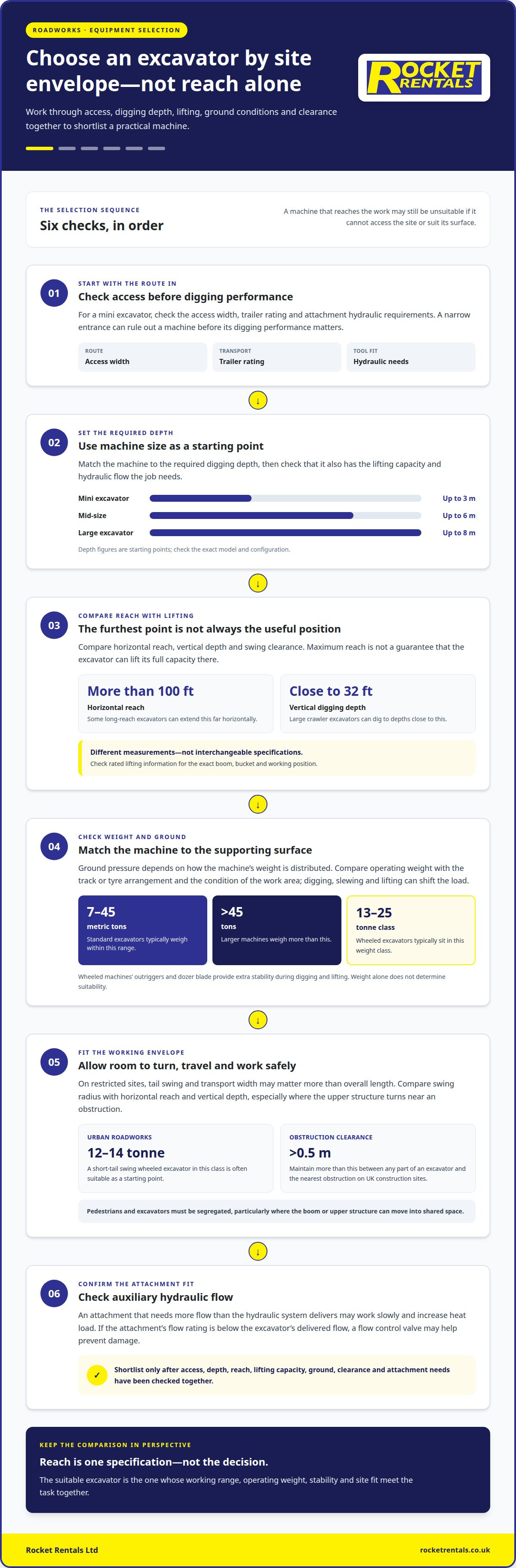
The longest reach isn’t automatically the right choice for roadworks. The right excavator outreach specifications depend on the required digging depth as well as access, working space and ground conditions. As a starting point, mini excavators can dig up to 3 metres, mid-size excavators up to 6 metres and large excavators up to 8 metres.
Look beyond the boom when comparing excavator outreach specifications. A machine that can reach the work may still be unsuitable if its operating weight, stability or ground pressure does not suit the surface or restricted site. In confined spaces, tail swing and transport width may matter more than overall length.
This guide explains how to compare reach with operating weight, stability and ground pressure, and how each specification affects a roadwork project. You’ll also learn how to match machine size to digging depth, site access and working space, helping you shortlist options with safety and practicality in mind.
Table of Contents
Operating weight, stability, and ground pressure
Operating weight affects how an excavator sits, travels and handles loads. Standard machines typically weigh 7 to 45 metric tons; larger machines weigh more than 45 tons.
Operating weight categories and applications
Weight categories group excavators by operating mass, helping you match a machine to the task and site. Standard excavators suit a broad range of construction work, while larger machines are designed for heavier tasks. A smaller machine may suit restricted access, but its lifting capacity and hydraulic performance must still meet the job’s requirements. Consider the load, digging conditions and available space together rather than choosing by weight alone. Engine power also affects performance under load, but it does not replace checking lifting limits.
Operating weight and stability
Operating weight contributes to stability by affecting how the excavator responds to digging and lifting forces. A heavier machine may offer greater capacity for demanding work, but it also places more demand on the ground. The right balance depends on the task, surface and machine configuration. For example, lifting with the boom extended changes the forces acting on the machine, so check the rated lifting capacity for that position. Assess suitability using the machine’s operating information and the actual work configuration.
Wheeled excavators typically sit in the 13 to 25-tonne weight class. Their outriggers and dozer blade provide extra stability during digging and lifting. When fully extended, outriggers can, in some situations, give stability and digging performance comparable to a crawler excavator. On roadwork, wheeled machines can also cause less damage to road surfaces than crawler excavators when travelling on public roads. Those features make weight class only one part of the decision.
Ground pressure describes how the machine’s weight is distributed across the supporting surface. A heavier machine or a smaller contact area can increase pressure on the ground, affecting suitability on soft or vulnerable surfaces. Compare operating weight with the track or tyre arrangement and the condition of the work area. Then consider how digging, slewing and lifting will shift the load. This helps assess whether the machine can work safely without placing unsuitable demands on the surface.
Long-reach excavator horizontal and vertical reach
Long-reach excavators extend the working area beyond a standard boom, with some reaching more than 100 feet horizontally. Their suitable reach depends on the task, machine configuration and ground conditions.
Boom configuration and swing radius
Boom configuration describes how the boom and arm are arranged, while swing radius indicates the space the machine needs to turn. Many wheeled excavators have a two-piece or three-piece boom, offering different working positions for tasks such as trenching or reaching over an obstruction. On a confined site, compact swing radius may matter more than extra digging depth. Compare horizontal reach, vertical depth and swing clearance together: a bucket’s furthest point is not necessarily its most useful working position.
Safety limits at maximum reach
Maximum reach is the furthest the boom can extend, not a guarantee that the machine can lift its full capacity there. Use the machine’s rated lifting information for the exact boom, bucket and working position, and keep the machine on suitable, stable ground. On UK construction sites, maintain more than 0.5 m of clearance between any part of an excavator and the nearest obstruction. Pedestrians and excavators must also be segregated, particularly where the boom or upper structure can move into shared space.
Reach by machine size and class
Reach varies by machine class, operating weight and boom design, so there is no single horizontal figure for every common size. Long-reach machines can extend more than 100 feet horizontally, while large crawler excavators can dig to depths close to 32 feet. Those figures describe different measurements, not interchangeable specifications. Compare the ground-level reach and vertical digging depth for the precise model and configuration.
For example, the Caterpillar 340 Long Reach has a listed operating weight of 48.4 tons, while the Caterpillar 352 Long Reach is listed at 64.4 tons. These weights help distinguish machine classes, but do not give their outreach. Track width affects ground contact and support, so consider terrain and stability alongside reach. For a project requiring a suitable machine, excavator hire can be a practical next step.
Selecting equipment for site restrictions
Start with the task and the site’s working envelope, not simply the smallest available machine. For a mini excavator, check access width, trailer rating and attachment hydraulic requirements first. These checks establish whether the machine can reach the work area, travel along the planned route and power the required tool. A narrow entrance, for example, can rule out a machine before its digging performance matters.
Next, establish the required digging depth. Choose a machine that can reach it while providing the necessary lifting capacity and auxiliary hydraulic flow. An attachment that needs more flow than the hydraulic system delivers may work slowly and increase heat load. If the attachment’s flow rating is below the excavator’s delivered flow, a flow control valve may help prevent damage. Compare reach specifications with these compatibility details, not in isolation.
For confined urban roadworks, minimal tail swing helps limit the space needed for the upper structure to turn. A short-tail swing wheeled excavator in the 12 to 14-tonne class is often suitable for urban roadworks. Treat this as a starting point, then assess the ground, task and access route. Consider how the excavator will move around the work area, including clearance for the boom, bucket and other site activity.
Buying a used excavator calls for different checks than choosing one for a single project. Assess its maintenance history, parts availability, emission standards and residual value. These factors affect reliability, ongoing upkeep and suitability for the intended work. For example, a machine with the right reach but limited parts availability may be less practical for a sustained programme. Make sure its reach figures also match the actual boom and arm configuration.
Engine performance alone does not determine efficiency. Compare the machine’s working capacity with the task, then match the attachment to its hydraulic system. For repeated trenching, a suitable bucket and adequate reach can keep the machine working within its intended range. On a restricted site, prioritise access and turning space before extra reach or engine power. This approach helps narrow the options without overlooking transport, attachment compatibility or site movement.
Excavator size and specification charts
A useful specification chart compares digging depth with reach, bucket capacity, operating weight and transport dimensions. Read the figures together: a compact excavator may fit a narrow route but still need sufficient depth and capacity for the job.
What are an excavator’s maximum digging depth, vertical wall digging depth and dump height? These are separate measurements, and their maximum values depend on the model and boom configuration. A chart should list each figure for the specific machine. Do not mistake maximum digging depth for vertical wall depth or dump height.
For a broad size comparison, use these typical digging-depth figures:
Mini excavators: up to 3 metres.
Mid-size excavators: up to 6 metres.
Large excavators: up to 8 metres.
These categories are useful for shortlisting, not final selection. Figures vary between models, so match the chart to the machine you are considering. A trench requiring a particular depth may rule out a smaller class, even if its transport dimensions suit the access route.
Then compare digging depth with bucket capacity and operating weight. Mini excavator bucket capacities typically range from 0.025 m³ to 0.15 m³; mid-size models range from 0.15 m³ to 1 m³; large models range from 1 m³ to 5 m³. A larger bucket can move more material per pass, but the machine must remain suitable for the work and site.
Transport dimensions deserve equal attention on restricted projects. Compare the chart’s transport width and machine dimensions with the route, entrance and working area. A machine that reaches the required depth may still be unsuitable if it cannot pass through site access. Compare the full set of specifications before deciding, rather than choosing by digging depth alone. This supports efficient planning and helps match the machine to the task.
For a machine suited to your project, explore excavator hire.
Maximum horizontal reach at ground level varies by model, so check the specification chart for the specific machine.
Maximum digging depth is typically up to 3 metres for mini excavators, 6 metres for mid-size models and 8 metres for large models. Vertical wall digging depth and dump height are separate measurements, and their maximum values depend on the model and boom configuration.
Rocket Rentals
Rocket Rentals Ltd is a local, family-run plant hire business serving customers across the UK. Once you’ve matched reach, digging depth, operating weight and access limits to the job, its hire options can help with planning. These include excavator hire, mini digger hire, roller hire and welfare unit hire.
When planning for a restricted site, share the task and key site constraints so the equipment can be matched to the work. Inspection supports attention to equipment condition alongside its specifications. Excavator attachments can also suit tasks that require a particular tool and a compatible machine.
If you’re ready to discuss excavator outreach specifications for your project, contact Rocket Rentals Ltd today.
Plan the next move with confidence
Before the machine arrives, turn your site constraints into a clear working envelope. Note where the excavator must travel and dig, and how the boom and bucket need to move during the task. This gives equipment planning a practical focus instead of relying on a single maximum-reach figure.
Include the work surface, access route and attachment requirements in your plan. If the task changes, reassess the required machine configuration before work continues. Clear information helps align equipment choice with the job and supports an organised start on site.
Use excavator outreach specifications as a planning tool, not a stand-alone measure of suitability. Discuss the work and site conditions with Rocket Rentals Ltd so the equipment choice reflects how the machine will be used.
Ask Rocket Rentals about excavators and move your project planning forward with confidence.
Frequently Asked Questions
How do I know whether a machine can fit a confined site?
Compare the machine’s transport width and height with the narrowest parts of the access route, including gates and covered entrances. Then allow for the space needed to position and turn it on site. A machine that fits through the entrance may still be unable to slew safely beside a wall or parked vehicle. Include the bucket and any fitted attachment when assessing the working envelope.
Which Specification Numbers Should You Check First?
Start with the figures that can rule a machine out: transport dimensions, required digging depth and working reach. Then compare lifting capacity at the intended working distance, operating weight and tail swing. For an attachment, match its hydraulic flow and pressure requirements to the excavator’s output. A machine may meet the depth requirement but fail the access-width test, making its other specifications less relevant.
What does excavator outreach or maximum reach mean in the specifications?
Maximum reach describes how far the bucket can extend from the machine in a stated position. It is not the same as the area where the excavator can work effectively, because reach changes with boom position and bucket placement. For a trench beside an obstruction, consider the bucket’s usable position and the machine’s clearance, not just the furthest reach shown in a chart.
How do boom and arm configurations affect excavator outreach?
Boom and arm geometry determine how the bucket moves horizontally and vertically, and where it can work around obstacles. A longer arm may extend the working envelope, while another boom arrangement may provide useful positioning options. Digging below a ledge, for example, may require more vertical reach, while placing material over a barrier needs suitable horizontal reach and dump clearance. Compare figures for the exact configuration.
Where can I find manufacturer outreach charts and dimensional specifications for excavators?
Find the technical specification sheet or operator’s manual for the exact make, model and configuration. These documents may show reach diagrams alongside digging depth, dump height, transport dimensions and lifting information. Check that the chart matches the fitted boom, arm and attachment: figures for another configuration may not describe the machine on your site. Use the manufacturer’s model designation to identify the correct document.
How do attachments such as long-reach booms affect outreach, lifting capacity and stability?
A long-reach boom extends the working envelope, but its added length and attachment weight affect the load the excavator can handle. Lifting capacity generally decreases as the load moves farther from the machine, so use rated information for the specific configuration and working position. Attachment compatibility matters too: hydraulic flow and pressure must suit the tool to prevent poor operation or damage.

Comments