
The Ultimate Guide to Telehandler Rental: Choosing the Right Machine for Your Project
Updated: Jul 10
What if the most powerful machine on the market is actually the greatest risk to your project's bottom line? Choosing the wrong telehandler rental can lead to more than just a tight squeeze on site; it often results in compromised safety and inflated costs that eat into your margins. It's a common frustration to realise, once the plant arrives, that the reach is insufficient or the chassis is too wide for your access points. Many site managers find themselves juggling the pressure of tight deadlines with the technical headache of compliance and equipment suitability.
We understand that managing a successful project requires a safe pair of hands and a deep understanding of technical specifications. This guide is designed to help you master the nuances of machine selection, from identifying the precise lift capacity you need to navigating the complexities of LOLER and safety regulations. You'll learn how to secure a reliable self-drive machine that matches your site's geometry perfectly. We will cover everything from reach calculations to avoiding hidden hire fees, giving you the confidence to manage your plant requirements with professional precision.
Table of Contents
Assessing the Versatility of Telehandler Rental for Modern Sites
The modern construction site is a fast-paced environment where space is often at a premium and schedules are non-negotiable. In these settings, a Telescopic handler, or telehandler, is often the most valuable asset in a contractor's fleet. It isn't just a forklift with a long reach; it's a sophisticated hybrid machine that performs the roles of a crane, a masted forklift, and an aerial work platform. This versatility makes telehandler rental a far more attractive option than static lifting solutions, which often lack the mobility required for dynamic, evolving site layouts.
Professional contractors typically prefer telehandler rental on a self-drive basis. This approach offers total site autonomy, allowing your own certified operators to move materials exactly when and where they're needed without waiting for an external provider's schedule. Whether you're working in traditional housebuilding or managing complex industrial installations, the ability to control your own lifting schedule is a significant operational advantage. It ensures that your team remains productive and that the machine is utilised to its full potential throughout the working day.
The Anatomy of a Telehandler: Reach and Flexibility
The defining feature of this machine is its telescopic boom. Unlike a standard masted forklift that only lifts vertically, the telehandler can extend its boom forward and upward. This capability allows operators to unload delivery vehicles from one side or place heavy materials across trenches and over obstacles that would stop other machines. Stability is maintained through a robust chassis and, on larger models, stabiliser legs that anchor the machine during high-reach operations. It's this combination of reach and power that makes it a safe pair of hands for challenging lifts.
Precision is another critical factor. Most modern machines feature 4-wheel steering, which includes specialised modes like 'crab steer' for sideways movement and 'circle steer' for tight turning circles. These features are essential when navigating the restricted perimeters of a busy site whilst maintaining a safe distance from structures and personnel. The machine's ability to manoeuvre in confined spaces is often the deciding factor for site managers working on urban developments.
Common Applications in Construction and Industry
Versatility is further enhanced through a range of attachments. By swapping standard forks for block grabs, buckets, or even lifting hooks, a single machine can be repurposed for various tasks. This adaptability ensures that your investment in hire is maximised, reducing the need for multiple specialised machines on a single project. From the initial groundworks to the final fit-out, the telehandler remains a constant, reliable presence on site.
Key Factors to Consider When Selecting Your Telehandler Forklift
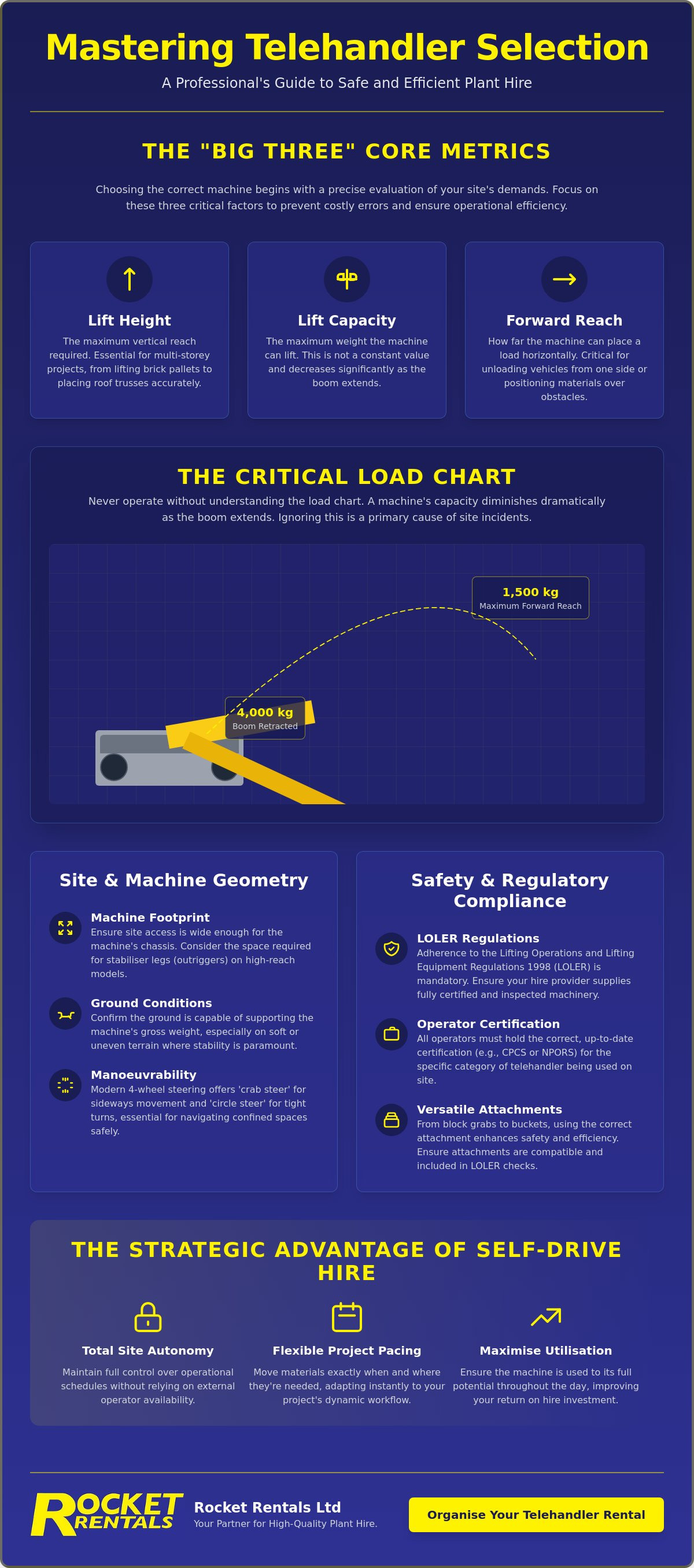
Selecting the right machine for your project involves more than just picking a height from a list. You need to focus on the "Big Three" metrics: lift height, maximum capacity, and forward reach. While lift height is the most common starting point for a telehandler rental, it's often the forward reach that dictates site efficiency. You must also consider the machine's footprint. Does the site allow for the outrigger spread required for high-reach stability? Is the ground capable of supporting the machine's gross weight? These questions define a successful hire and prevent costly mid-project swaps.
The most critical tool for any operator is the load chart. This document, found inside the cab, illustrates how the machine's lifting capacity diminishes as the boom extends. For example, a machine capable of lifting 4,000kg when the boom is retracted might only safely manage 1,500kg at its maximum forward reach. Ignoring these limits is a primary cause of site incidents. While UK regulations like LOLER are the local standard, many of the international OSHA safety and training standards provide similar foundational principles for managing these technical risks. Understanding these charts is the hallmark of a professional operator.
Understanding Lift Height vs. Forward Reach
It's a common mistake to assume a machine's maximum capacity applies across its entire range of motion. If you have a 7-metre machine, you can't necessarily lift a 3-tonne pallet at a 7-metre forward extension. Physics dictates that as the centre of gravity moves away from the wheelbase, the tipping point changes. We always recommend over-specifying slightly. If your heaviest load is 2,000kg, choosing a machine with a 2,500kg capacity provides a vital safety buffer.
Compact vs. High-Reach Telehandlers
Site access often dictates machine size. Super-compact models are designed for basement works or multi-storey car parks where height and width are restricted. Conversely, structural steel placement or roofing requires high-reach machines, typically in the 14-metre to 17-metre range. Always verify ground bearing capacity before choosing these larger units, as their weight increases significantly with the boom size. If you're unsure which model fits your site's geometry, you can view our full range of telehandlers to compare specific dimensions and weights.
Prioritising Safety and Regulatory Compliance in Plant Hire
Safety on a construction site isn't just a box-ticking exercise; it's the foundation of a professional operation. When you arrange a telehandler rental, you assume specific legal responsibilities under the Lifting Operations and Lifting Equipment Regulations (LOLER). These regulations mandate that all lifting operations are planned by a competent person, supervised appropriately, and carried out in a safe manner. It's a significant responsibility for the hirer, but choosing a well-maintained fleet from a reliable partner acts as a "safe pair of hands," significantly reducing the risk of equipment failure or site accidents.
Operator competence is the next pillar of compliance. For any self-drive hire, you must ensure your staff hold valid certifications, such as those from the Construction Plant Competence Scheme (CPCS) or the National Plant Operators Registration Scheme (NPORS). These aren't just industry preferences; they are benchmarks of safety. While local UK laws are paramount, looking at international benchmarks like the OSHA safety standards for telehandlers highlights a global consensus: an untrained operator is a hazard to themselves and everyone around them. Ensuring your team is properly trained is the most effective way to protect your project and your people.
Daily maintenance checks are your first line of defence. Before starting any shift, operators should inspect hydraulic hoses for leaks, check tyre pressures for stability, and verify that the Load Moment Indicator (LMI) is functioning correctly. A systematic approach to these "pre-start" checks ensures that minor issues don't escalate into major site delays or safety breaches. It's this level of detail that separates a professional site from a high-risk one.
LOLER Inspections and Documentation
Every piece of lifting equipment must be accompanied by a Report of Thorough Examination. This document is essentially the machine's "MOT" for lifting, proving it has been inspected by a qualified engineer. In the UK, telehandlers generally require a thorough examination every 12 months for standard lifting, or every 6 months if they are used to lift people. Don't forget that attachments, such as block grabs or buckets, also require their own separate certification. Always insist on seeing this paperwork before the machine is offloaded on your site to ensure full compliance.
Ground Conditions and Stabilisation
A machine is only as stable as the ground beneath it. Larger high-reach models rely on outriggers to distribute weight, but these are ineffective if the ground is soft or near an excavation. Using suitable spreader plates is essential to prevent the machine from sinking or overturning under load. The Load Moment Indicator (LMI) is the operator’s primary tool for preventing overloads, providing real-time data on the machine's stability as the boom moves. Assessing ground bearing capacity is a non-negotiable step in your site safety plan to prevent catastrophic failures.
The Strategic Benefits of Self-Drive Telehandler Hire
Project managers often find that the most significant bottleneck on a busy site is waiting for external resources to arrive. Choosing a self-drive telehandler rental is often the deciding factor in maintaining a lean, efficient programme. By opting for self-drive, professional contractors retain total control over their site schedule. You don't have to coordinate with a third-party operator's shift patterns or worry about their availability for an early start or a late finish. The machine remains on-site and ready to work whenever your qualified staff are, providing a level of flexibility that operated plant hire simply cannot match.
There is also the matter of professional reliability. When you partner with a provider that maintains a modern, high-quality fleet, you significantly reduce the risk of mechanical downtime. Older machines are prone to hydraulic leaks or sensor failures that can bring a project to a standstill. A "safe pair of hands" approach involves securing equipment that is ready for immediate, heavy-duty use. This standard of equipment care is exemplified by providers like Pahrump Rentals & Hardware, who offer a comprehensive range of industrial tools. This reliability is essential for maintaining the momentum of groundworks or structural installations where every hour of delay carries a financial penalty.
Cost Control and Project Management
Budgeting for long-term projects becomes much simpler when you remove the variable costs of external labour. Self-drive hire allows for precise financial planning, as you're paying for the machine itself rather than a service that includes an operator's hourly rate. This model helps you avoid the "minimum hours" charges that are standard in operated plant hire, where you might be billed for a full day even if the lift only takes two hours. By utilising your own CPCS or NPORS certified staff, you can optimise your project budget and allocate resources where they're most needed.
Site Autonomy and Efficiency
Efficiency is built on clear communication. When the telehandler operator is a permanent member of your site team, there is no communication gap between the site manager and the machine. The operator is already familiar with your specific site safety protocols, the ground conditions, and the team dynamics. This seamless integration allows the telehandler to function as a shared site resource, moving between tasks as the workflow dictates. It eliminates the friction of briefing a new operator every time a machine is delivered, ensuring that safety and productivity are prioritised from the moment the engine starts.
If you are looking to streamline your next project with high-specification equipment, you can book your self-drive telehandler rental today to ensure your site stays on track and within budget.
Organising Your Telehandler Rental with Rocket Rentals
Rocket Rentals Ltd stands as a dependable partner for contractors who require high-quality, professional-grade machinery. We focus specifically on providing self-drive equipment tailored to the rigorous demands of the construction and industrial sectors. When you arrange a telehandler rental with us, you aren't just hiring a machine; you're securing a commitment to modern, reliable plant that arrives on-site ready for immediate use. Our national delivery capability ensures that regardless of your project's location, you have access to the lifting power required to keep your schedule moving forward.
Choosing the right machine involves more than just looking at a spec sheet. If you're managing complex site geometry or varying load requirements, our team is available to provide technical advice on machine sizing. We help you interpret site drawings to ensure the chosen model offers the necessary reach and capacity without being over-sized for your access points. This proactive approach helps prevent the logistical headaches and safety risks that come with under-specified plant. We pride ourselves on being a safe pair of hands for projects of any scale.
A Fleet Built for Performance
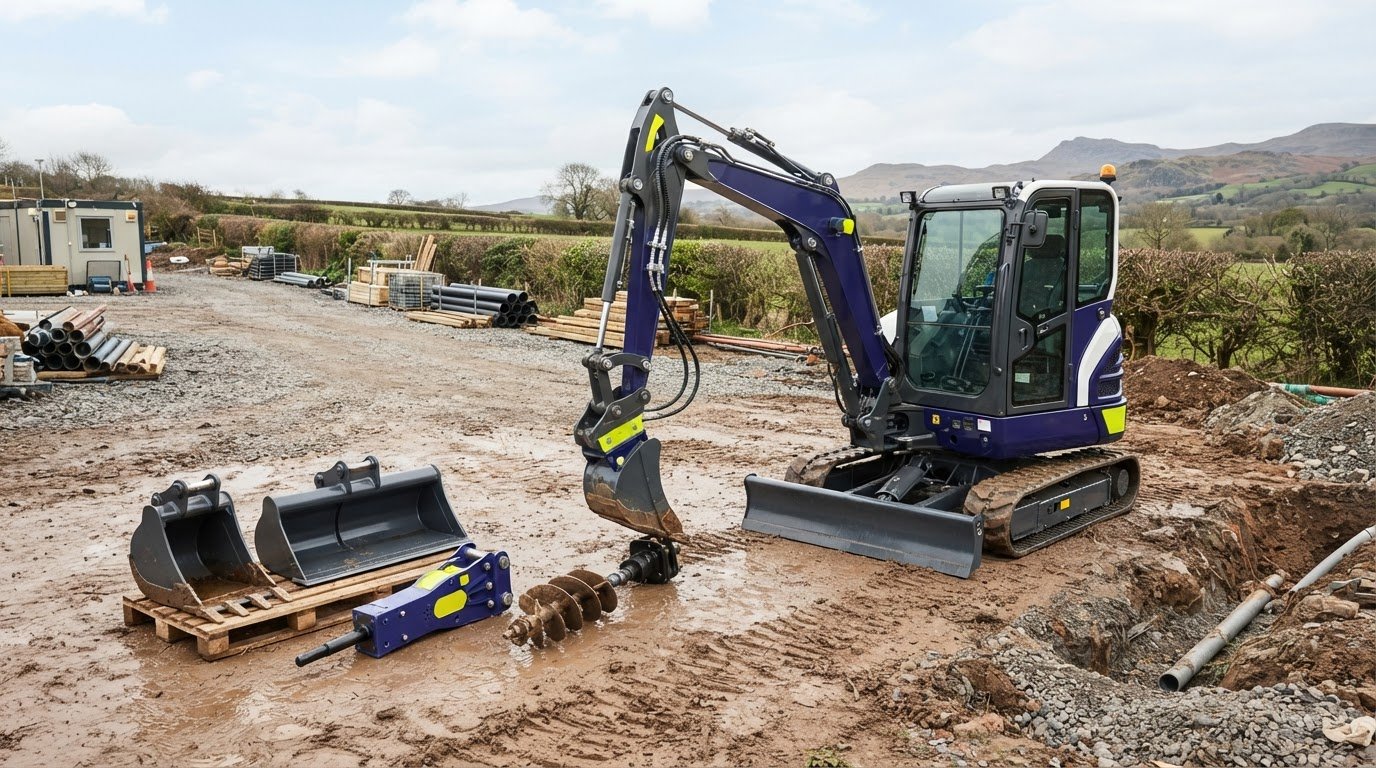
Our fleet is built around industry-leading brands known for their reliability and operator comfort. We understand that a machine is only as good as its last inspection. This is why every unit undergoes rigorous pre-hire checks to ensure it is site-ready. This commitment to quality reduces the likelihood of downtime and ensures your operators can work with confidence. To provide a complete site solution, we also offer essential additions such as welfare units and excavators. Sourcing all your primary plant from a single, trusted provider simplifies your logistics and improves site accountability.
How to Start Your Hire Process
We've designed our hire process to be as straightforward as possible for professional contractors. For ongoing projects, opening a trade account provides a streamlined way to manage multiple hires and billing cycles efficiently. Our experts are ready to consult with you, matching specific machine capabilities to your detailed site plans. This ensures that every piece of equipment we deliver is perfectly suited to the task at hand. It's about providing the right tool for the job, backed by years of industry expertise. If you're ready to secure a reliable machine for your next project, you can Enquire about telehandler hire with Rocket Rentals Ltd today.
Securing the Right Support for Your Next Lift
Success on site depends on more than just raw power. It requires a precise match between your machine's capabilities and your project's specific geometry. By focusing on accurate load chart interpretation and prioritising operator competence, you ensure that every lift is executed with professional precision. Choosing a self-drive telehandler rental empowers your team to maintain total control over your schedule, reducing the friction often found with third-party operators. This autonomy is essential for keeping complex projects on track.
Rocket Rentals has served as independent plant hire specialists since 1988. We provide a comprehensive, LOLER-compliant fleet designed to meet the highest safety standards in the industry. Our dedicated focus on professional self-drive hire means you receive equipment that is modern, reliable, and ready for immediate work. We're here to provide the safe pair of hands your project deserves, from the initial groundworks to the final structural installation.
View our range of professional telehandlers and request a quote to get your project moving with confidence. We look forward to helping you select the perfect machine for your site's unique requirements.
Frequently Asked Questions
Do I need a special licence to hire a telehandler for self-drive?
You don't need a specific category on your standard driving licence for site use, but you must hold a valid operator's qualification such as a CPCS or NPORS card. These certifications prove you've undergone the necessary training to manage the machine's technicalities safely. For any professional telehandler rental, we require proof of competence to ensure site safety and regulatory compliance.
What is the difference between a telehandler and a rough terrain forklift?
The primary difference is the telescopic boom, which allows a telehandler to provide both vertical lift and forward reach. A rough terrain forklift uses a vertical mast, meaning it can only lift loads straight up and down. The telehandler's ability to reach over obstacles or place materials across trenches makes it a much more versatile hybrid of a crane and a forklift.
Can I use a telehandler to lift people using a safety cage?
You can lift personnel only if the machine is fitted with a compatible, integrated safety cage and carries a current 6-month LOLER certificate. While standard lifting equipment is inspected every 12 months, any machine used for lifting persons requires more frequent thorough examinations. It's also essential that the operator stays in the cab whilst the platform is occupied to maintain total control.
How much weight can a 7-metre telehandler actually lift?
A standard 7-metre machine typically has a maximum capacity between 3,000kg and 4,000kg when the boom is retracted. However, this capacity decreases significantly as the boom extends forward or upward. You must always consult the specific load chart in the cab, as a load that's safe at ground level might exceed the machine's stability limits at a 4-metre forward reach.
Does the hire cost include insurance for the machine?
Standard hire rates don't typically include insurance, and it's the hirer's responsibility to provide "Hired-in Plant Insurance." This policy should cover the full replacement value of the machine in the event of theft or accidental damage. We recommend confirming this cover is active before your telehandler rental is delivered to avoid any gaps in your site's protection.
What happens if the telehandler breaks down on-site?
In the event of a mechanical issue, our technical team provides prompt on-site support to minimise your project's downtime. We maintain a modern fleet to reduce the risk of failure, but we're prepared to respond quickly if a fault occurs. Our proactive maintenance approach ensures that you have a safe pair of hands supporting your site operations at all times.
Are attachments like block grabs included in the standard hire?
Standard hire generally includes the machine and a pair of pallet forks, whilst specialised attachments are hired as separate items. You can add tools like block grabs, buckets, or lifting hooks to tailor the machine to your specific tasks. Each attachment we provide comes with its own certification of thorough examination to ensure it's fully compliant with site safety standards.
Can a telehandler be driven on public roads between sites?
A telehandler can only be driven on public roads if it is road-registered, taxed, and insured for use on the highway. The operator must also hold a valid UK driving licence. If the machine isn't road-legal, it must be moved between sites on a trailer or low-loader to comply with DVSA regulations and ensure the safety of other road users.
Comments