
17m Telehandler Hire Options: The Professional Buyer’s Guide for 2026
- Rocket Rentals
- 1 day ago
- 12 min read
You're standing on a congested site as the final roof truss placement looms; the team is ready, but you're still questioning if a 17m reach provides enough clearance for a safe lift. Navigating the various 17m telehandler hire options available for 2026 requires more than just checking a spec sheet. You must account for the stabiliser footprint on narrow plots and the specific attachments needed for high-lift tasks to avoid costly delays or safety compromises.
It's a common concern for contractors who want the verticality of a heavy-lifter without the logistical headaches of an oversized machine. This guide will show you how to select the ideal configuration and safety technology to maximise your site's efficiency and security. We'll walk through the essential site preparation steps, compatible attachments, and the latest regulatory standards to ensure your choice is a safe pair of hands for your next project.
Table of Contents
The Strategic Role of 17m Telehandler Hire in Modern Construction
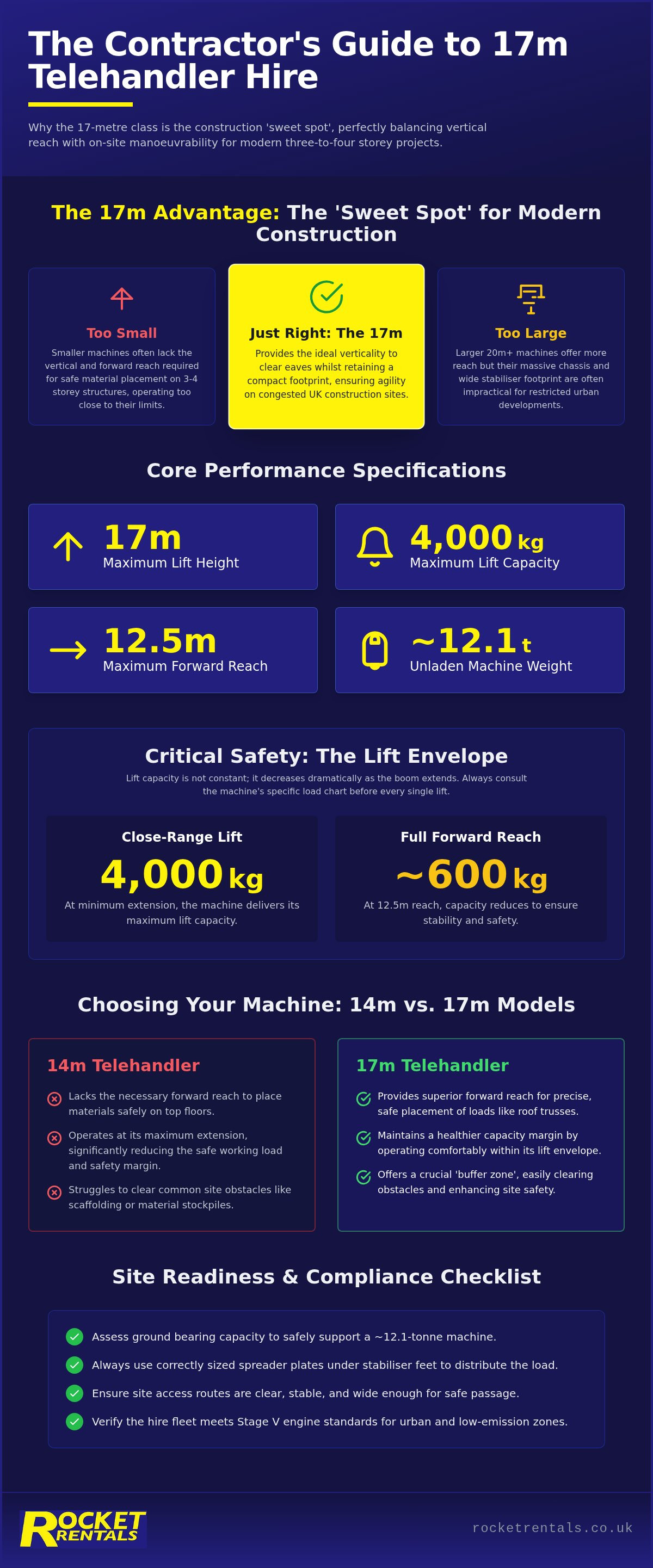
In the context of modern UK building projects, the 17m telehandler serves as a pivotal asset for material handling across three-to-four storey structures. While smaller machines handle ground-level tasks, the 17m class represents the primary solution for moving heavy loads to the higher levels of residential and commercial blocks. This specific height is often considered the 'sweet spot' for construction; it provides the necessary elevation to clear the eaves of a four-storey building whilst maintaining a manageable chassis size that doesn't overwhelm the site footprint. It's the machine that bridges the gap between standard residential builds and larger-scale industrial developments.
Choosing from the available 17m telehandler hire options ensures your team isn't working at the 'reaching limit' of the equipment. When a machine operates at its absolute maximum extension, the safe working load decreases significantly, often leaving very little margin for error. By opting for a 17m unit for a 14m lift, you maintain a safer capacity margin and ensure the boom remains stable during the lift cycle. For a deeper understanding of these machines, this Technical Overview of Telehandlers provides details on their design and common industrial applications.
When to Step Up from 14m Models
Contractors often face a choice between 14m and 17m units, particularly on sites where space is at a premium. The decision usually rests on the 'buffer zone' required for safe loading at the top floor. A 14m model may technically reach the final level, but it often lacks the forward reach necessary to place pallets safely away from the edge or over scaffolding boards. 17m models provide superior forward reach at moderate heights, which is vital for tasks like roof truss placement. These extra three metres offer the flexibility to navigate over site obstacles that shorter booms simply cannot clear, ensuring the load is placed exactly where the joiners need it.
Balancing Reach and Manoeuvrability on UK Sites
When assessing 17m telehandler hire options for your project, it's essential to contrast their footprint with larger 20m 'roto' or heavy-lift machines. While 20m units offer incredible reach, their massive chassis and wide stabiliser spread can be a liability in restricted urban environments. The 17m telehandler maintains a tighter turning circle and a more compact frame, allowing it to navigate narrow access roads and congested plots with ease. It's the standard for most UK housing development programmes because it delivers the verticality required for modern high-density housing without sacrificing the agility that site managers rely on for daily efficiency. It provides a safe pair of hands for the most demanding lifts without the logistical complexity of a larger machine.
Technical Capabilities and Performance Specifications
The standard 17m telehandler, such as the widely utilised JCB 540-170, is engineered to provide a 4,000kg maximum lift capacity. This strength is vital for the initial stages of a project, but the machine's true value lies in its 12.5m maximum forward reach. This capability allows operators to span site obstacles like perimeter fencing, drainage trenches, or stockpiles whilst delivering materials directly to the work face. When evaluating your 17m telehandler hire options, it is essential to ensure the fleet meets Stage V engine standards. This compliance is necessary for projects within urban low-emission zones and ensures your site adheres to the latest air quality regulations.
Logistics managers must also account for the machine's unladen weight, which typically sits around 12,060kg. This substantial mass requires careful consideration regarding site flooring and access routes, particularly when operating on suspended slabs or near basement structures. Our team can help you review these technical requirements when you explore our telehandler hire fleet for your next project.
Understanding the Lift Envelope and Load Charts
Safe operation hinges on a thorough understanding of the lift envelope. While the machine handles 4,000kg at lower heights, this capacity drops significantly as the boom extends. For example, at a full forward reach of 12.5m, the safe lifting limit typically reduces to approximately 600kg. Operators must consult the specific load chart for their machine before every lift to account for these variables. The Load Moment Indicator is a critical safety system that monitors the weight and position of the load to provide visual and audible warnings that prevent the machine from overbalancing.
Stability and Stabiliser Deployment Requirements
Understanding the various 17m telehandler hire options also means looking at the stability technology fitted as standard. Achieving maximum reach safely requires full stabiliser deployment, which demands a footprint width of approximately 3.55m. These machines must use stabilisers for almost all high-reach tasks to maintain a stable centre of gravity. Advanced features like sway control and chassis levelling are standard on modern units, allowing for safe operation on uneven ground. These systems allow the operator to adjust the machine's frame independently of the axles, ensuring the boom remains vertical even if the tyres are on a slight slope. This level of control is what makes the 17m class a safe pair of hands for complex multi-storey lifts.
Exploring Your 17m Telehandler Hire Options and Attachments
Selecting the right 17m telehandler hire options involves more than just picking a machine; it's about configuring the unit for the specific demands of your site. Standard fork configurations are the baseline, but adding a side-shift carriage can transform the efficiency of your lifts. This feature allows the operator to move the forks laterally without repositioning the entire machine, which is invaluable when placing loads onto high-level scaffolding where margins are tight. It reduces the need for the operator to shuffle the machine back and forth, saving time and reducing wear on the site surface.
Tyre choice is another critical factor in site performance. While pneumatic tyres offer excellent traction on soft ground, many contractors prefer gel-filled options for high-reach work. These tyres eliminate the risk of punctures and provide a more stable platform by reducing tyre bounce during heavy lifts at full extension. Safety technology has also advanced significantly for 2026. Modern fleets often feature AI camera systems that can distinguish between inanimate objects and site personnel, providing the operator with real-time alerts. When combined with white noise alarms, which provide a directional sound that's easier for workers to locate than traditional beepers, these systems create a significantly safer working environment.
Standard Forks vs Specialist Material Handling Tools
Precision is the priority when working at 17m heights. Using a roof truss jib allows for the exact placement of timber frames and roof components, reducing the manual handling required by joiners on the top level. For broader site duties, tipping skips and general-purpose buckets enable the telehandler to assist with site clearance during downtime between lifts. If your project involves oversized palletised deliveries, such as cladding panels or insulation, fork extensions provide the necessary support to ensure the load remains balanced and secure throughout the lifting cycle. These attachments ensure your machine stays productive throughout the entire build process.
Safety and Technology Options for Site Control
Securing hired plant is a constant concern for site managers. Keypad immobilisers are a simple but effective way to prevent unauthorised use, requiring a unique code to start the engine each morning. When working near overhead services or within structures, height limiters can be programmed to stop the boom before it reaches a pre-set ceiling, preventing accidental strikes. For larger projects, telematics and trackers provide essential data for fleet management, allowing you to monitor machine hours and fuel consumption whilst ensuring the equipment stays within designated site boundaries. These tools provide the transparency needed to manage a professional site effectively.
Site Readiness: Preparing for a 12-Tonne Machine
Successful projects start before the machine even leaves the depot. When evaluating 17m telehandler hire options, site managers must look beyond the machine's lift capacity and consider the logistical reality of a 12,000kg unladen weight. This mass isn't static; as the boom extends and the load shifts, the pressure exerted on individual points increases dramatically. Ensuring your site is ready for a machine of this scale is a non-negotiable requirement for maintaining both safety and project timelines. Preparation is the foundation of site safety.
Ground Conditions and Bearing Pressure Management
Calculating the point load exerted by stabilisers is essential during the planning phase. During a maximum lift at full extension, a single stabiliser foot can exert several tonnes of pressure on a very small area. This makes the use of heavy-duty spreader plates mandatory on soft or made ground to distribute the weight. You must also avoid operating near excavations or retaining walls, as the lateral pressure from a 12-tonne machine can cause structural failure or ground collapse. We recommend a formal ground assessment to confirm the bearing capacity before the machine arrives on site. This proactive step prevents the machine from sinking or tipping during critical lifts.
Access Requirements and Delivery Logistics
Logistics for a 17m machine require careful planning. These units are typically delivered on large low-loaders, which need significant space to manoeuvre and offload safely. The machine itself has a transport height of 2.69m and a width of 2.44m; you must verify that site gates, tunnels, and overhead obstacles provide sufficient clearance. The delivery vehicle also requires a wide turning circle to avoid getting stuck or damaging site boundaries. If your project is in the early stages and requires integrated groundworks support, you may also want to consider Excavator Hire in the South West to prepare the terrain before the telehandler arrives.
To ensure compliance with LOLER regulations, perform a thorough 'first-day' inspection once the machine is offloaded. This checklist provides a safe starting point for your team:
Certification: Verify the current Report of Thorough Examination is present and in date.
Documentation: Ensure the correct load chart for the specific machine model is clearly visible in the cab.
Visual Check: Inspect the condition of all tyres and check for any hydraulic fluid leaks around the boom and stabilisers.
Safety Systems: Test the Load Moment Indicator and all cab safety alarms to ensure they are fully functional.
To ensure your project has the right equipment from day one, contact us to discuss our telehandler hire solutions and site delivery requirements.
Why Professional Contractors Choose Rocket Rentals for Self-Drive Hire
Control is a primary requirement for any site manager overseeing a complex multi-storey build. Whilst many plant providers push operated hire, we focus exclusively on providing a self-drive service that allows contractors to maintain full authority over their site schedule. This approach enables you to utilise your own trusted, CPCS-qualified operators who already understand your site’s specific safety protocols and workflow. By choosing from our 17m telehandler hire options, you remove the logistical variable of an external operator, ensuring that your lifting schedule aligns perfectly with your subcontractors' needs.
Working with an independent specialist also means you benefit from a level of technical expertise that larger, more generic hire companies often struggle to match. We understand that a 17m machine is a significant investment in your site’s infrastructure. Our team is always available to provide detailed advice on specific configurations, ensuring the machine you receive is perfectly suited to the vertical reach and forward extension requirements of your project. It is this commitment to being a dependable partner that has made us a "safe pair of hands" for the UK construction industry.
The Benefits of Modern, Well-Maintained Fleets
Reliability on site is non-negotiable. Every machine in our fleet undergoes rigorous pre-hire safety checks and a meticulous maintenance regime to ensure it arrives site-ready and stays productive. We invest heavily in modern equipment, typically featuring industry-leading brands like JCB, which are known for their intuitive controls and robust build quality. These modern units are equipped with Tier 5 engines, helping your project meet strict environmental and social governance (ESG) goals and air quality standards in urban centres. For contractors looking for a complete plant solution, our The Professional Guide to Mini Excavator Hire provides further insights into coordinating different machinery types for maximum efficiency.
Streamlined Hire Process and National Support
We've designed our hire process to be as efficient as the machines we supply. Opening a trade account is a straightforward process, allowing for rapid delivery to sites across the country. We recognise that construction schedules can be fluid; if your project requirements change or a technical question arises during the hire period, our support team is only a phone call away. This national reach, combined with the personal touch of a dedicated service partner, ensures you have the support needed to keep your project moving forward without delay. When you're ready to secure your equipment, Contact Rocket Rentals for 17m telehandler hire quotes and experience a service built on professional reliability.
Elevating Site Standards with Strategic Reach
Selecting the right machinery for a multi-storey project involves more than just checking verticality. It requires a detailed assessment of forward reach, ground stability, and the specific attachments needed for precision material placement. By ensuring your site is fully prepared for 12-tonne loads and selecting Tier 5 compliant equipment, you protect both your project schedule and your environmental commitments. These technical considerations form the foundation of a safe and efficient construction site.
Reviewing the various 17m telehandler hire options is straightforward when you have a dependable partner to guide you. Rocket Rentals provides expert technical advice for site managers and a modern, meticulously maintained fleet ready for national delivery. Our focus on self-drive hire ensures you keep full control over your project's pace and personnel. We are committed to providing the reliability you need to reach the final roof truss with total confidence.
Ready to secure the vertical reach your project demands? Request a quote for 17m telehandler hire from Rocket Rentals today and let us provide the support your team deserves. We look forward to being a safe pair of hands for your next build.
Frequently Asked Questions
What is the maximum weight a 17m telehandler can lift at full height?
A 17m telehandler typically lifts approximately 2,500kg when the boom is at its maximum vertical extension on stabilisers. Whilst the maximum lift capacity of the machine is 4,000kg at lower levels, the safe working load decreases as the height increases to maintain the centre of gravity. Operators must always consult the specific load chart provided in the cab to confirm the safe weight for their specific lift angle and height.
Do I need a special licence for self-drive 17m telehandler hire?
You don't need a specific road licence for on-site use, but you must possess a valid CPCS or NPORS operator card for self-drive hire. These qualifications prove that the operator has undergone the necessary training and testing to handle high-reach machinery safely. For professional sites, a valid CITB Health, Safety and Environment test is also a prerequisite for these industry-recognised certification schemes.
What are the typical dimensions of a 17m telehandler for site access?
The transport dimensions of a standard 17m unit are approximately 2.69m in height and 2.44m in width. These measurements are critical when planning delivery via low-loader through narrow site gates or under low-hanging structures. Site managers should also account for the stabiliser spread, which requires a width of roughly 3.55m to ensure the machine is fully supported during high-reach operations.
Can a 17m telehandler be used on rough terrain or soft ground?
These machines are designed for rough terrain with 4WD and high ground clearance, but soft ground requires additional preparation. When exploring 17m telehandler hire options for uncompacted or made ground, you must use heavy-duty spreader plates under the stabiliser feet. This prevents the machine's 12,060kg unladen weight from sinking, which could lead to a loss of stability during a lift.
Are attachments like buckets or jibs included in the standard hire?
Standard pallet forks are usually included in the base hire rate, whilst specialist tools are typically treated as optional extras. You can request additional attachments such as roof truss jibs, tipping skips, or extension forks to tailor the machine to your specific project needs. It's best to discuss these requirements at the start of the hire period to ensure all tools arrive site-ready and compatible with your machine.
What is the difference between a 14m and a 17m telehandler in terms of site footprint?
The primary difference lies in the reach rather than the physical footprint, as both machines often share a similar chassis size. A 17m model provides the necessary buffer zone for four-storey work that a 14m unit lacks, even if their turning circles are comparable. However, the 17m machine is heavier and exerts higher point loads through its stabilisers, requiring more robust ground preparation on sensitive sites.
How do I ensure the ground is safe for a 12-tonne telehandler?
You ensure ground safety by conducting a formal ground assessment to determine the bearing capacity before the machine arrives. A 12-tonne telehandler exerts significant pressure, particularly when the boom is extended with a load. Using spreader plates and avoiding operations near trenches or recently filled ground are essential steps. These precautions ensure the ground can withstand the maximum possible point load during every lift.
What safety systems are standard on a JCB 540-170 telehandler?
The JCB 540-170 features a comprehensive suite of safety systems, including a Load Moment Indicator (LMI) and stabiliser interlocks. These systems prevent the operator from extending the boom beyond safe limits for the current load and configuration. Modern units also include sway control for levelling the chassis on uneven terrain and adaptive load control to maintain stability throughout the lifting cycle, providing a safe pair of hands for site operators.


Comments