
3 Ton Digger Hire Price: The Professional's 2026 Guide to UK Plant Costs
The cheapest headline rate on a 3-tonne excavator is often the most expensive choice you can make for your project. Most site managers and contractors have felt the frustration of a quote that seems perfect, only to see it inflated by delivery surcharges, fuel penalties, or the hidden cost of an older machine that fails mid-shift. Finding a fair 3 ton digger hire price shouldn't feel like a gamble with your project timeline or your budget.
At Rocket Rentals Ltd, we believe that professional plant hire should be built on transparency and technical reliability. This guide provides a comprehensive breakdown of 2026 market standards, the specific charges often buried in the small print, and how to secure a self-drive hire that offers genuine value. We'll examine everything from current CPA insurance requirements to the impact of modern, fuel-efficient engines on your bottom line. By the end of this article, you'll have the clarity needed to organise your equipment without the worry of unexpected surprises or avoidable site downtime.
Table of Contents
Understanding 3 Ton Digger Hire Rates in the UK
The 3-tonne mini digger is often considered the 'Goldilocks' machine of the plant hire industry. It provides enough power for significant groundworks while remaining small enough to access restricted sites. When you look at a 3 ton digger hire price, you're investing in a machine that balances site agility with professional-grade breakout force. It's the industry standard for everything from residential extensions to utility installations, bridging the gap between micro excavators and larger 5-tonne models.
Headline rates found on search engines are frequently just starting points for a basic machine. A formal commercial quote should account for the specific requirements of your site, including attachments and the duration of the hire. Spot hire is perfect for short, urgent tasks, but long-term project rates offer the stability needed for larger construction phases. Understanding how these rates are structured is the first step in protecting your project budget.
Daily vs. Weekly Hire: Which is More Cost-Effective?
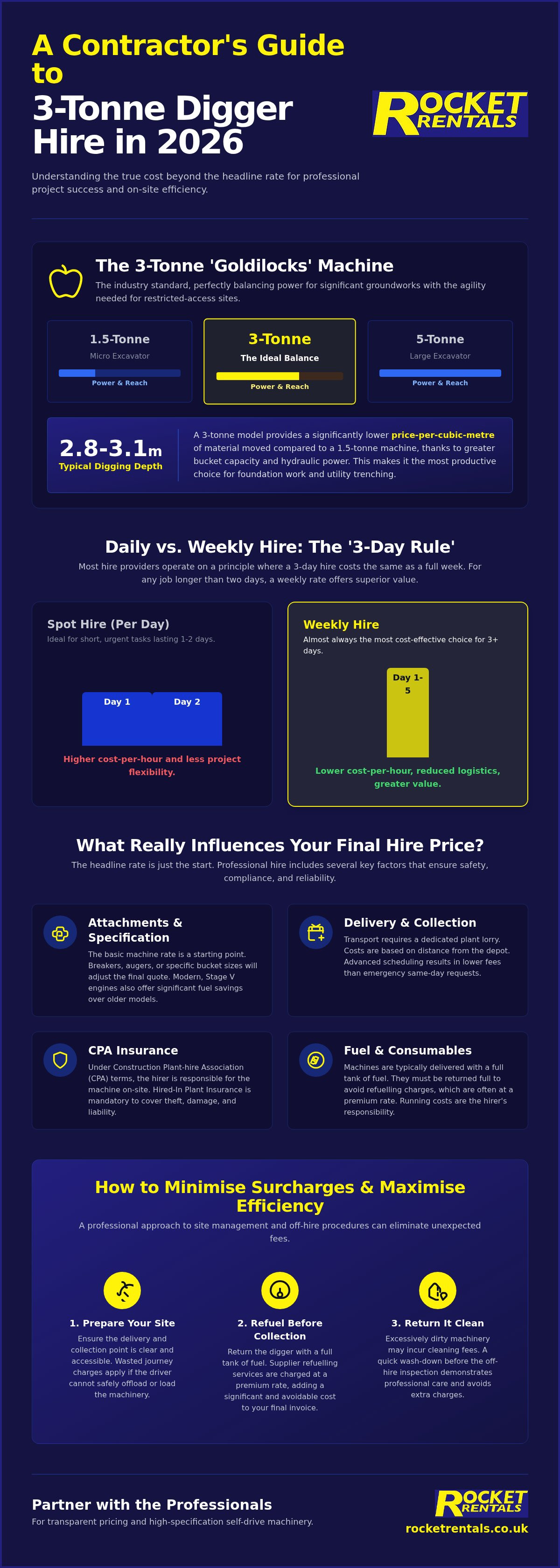
Most plant hire providers operate on a '3-day rule' where the cost of a three-day hire is equivalent to a full five-day week. If you need a machine for more than two days, the weekly rate is almost always the better financial choice. This structure encourages contractors to keep the machine on-site for the duration of the project phase, which reduces the logistical overhead of multiple deliveries and collections.
Calculating your cost-per-hour becomes much more favourable when you commit to a full week. Weekend rates usually differ from standard Monday-to-Friday commercial terms. Some providers offer a reduced weekend special, whilst others charge a flat rate for the 48-hour period. It's essential to clarify whether your 'weekly' rate covers five days or seven, as this impacts both your insurance coverage and your total spend.
The 3-Tonne Class: Power and Productivity Value
Productivity is where the 3-tonne model truly shines. While a 1.5-tonne machine might have a lower day rate, the 3-tonne alternative often provides a lower price-per-cubic-metre of material moved. This is due to its larger bucket capacity and increased hydraulic power. According to Compact excavator specifications, these machines are designed for high-torque tasks like trenching and grading. A standard 3-tonne digger typically offers a digging depth of approximately 2.8 to 3.1 metres, making it ideal for standard foundation work and utility trenching.
Fuel consumption is another critical factor in your daily running costs. Modern Stage V compliant engines are now standard in professional fleets, ensuring that the machine operates at peak efficiency. Choosing a modern 3-tonne excavator over an older, less efficient model can lead to significant savings on your fuel bill over the course of a week.
Key Factors That Influence Your Total Digger Hire Price
While the base rate is a helpful benchmark, it rarely represents the final invoice. The UK plant-hire industry operates on a complex set of variables that ensure equipment is delivered safely and maintained to a high standard. Several secondary costs will influence your final 3 ton digger hire price, ranging from logistical overheads to essential insurance coverage. Understanding these factors allows you to budget with precision and avoid the bill shock that often accompanies low-cost, non-professional hire agreements.
Delivery and Collection Logistics
Transporting a 3-tonne machine requires more than a standard trailer; it necessitates a dedicated plant lorry. The distance between the depot and your site is a primary cost driver. A scheduled delivery, organised several days in advance, allows the provider to optimise their routes, often resulting in more competitive transport fees. In contrast, emergency same-day requests usually carry a premium due to the disruption of pre-planned logistics.
Site readiness is equally important. If a driver arrives and cannot offload due to blocked access or an unprepared site, you'll likely face wasted journey charges. Ensuring the drop-off point is clear saves both time and money. For those managing complex schedules, choosing a partner with a transparent mini digger hire process ensures that transport costs are clearly defined from the outset.
Plant Insurance and Damage Waivers
Most professional hire agreements operate under Construction Plant-hire Association (CPA) conditions. These terms dictate that the responsibility for the machine passes to the hirer once it leaves the delivery vehicle. Hired-In Plant Insurance is essential for protecting against total loss or significant theft. Without it, you could be liable for the full replacement value of a modern excavator.
Many providers offer an optional damage waiver. While this covers accidental minor damage, it's vital to read the exclusions. For example, damage to tracks or hydraulic hoses caused by site negligence is frequently excluded from standard waivers. For a deeper dive into managing these site-level risks, you might find The Professional Guide to Mini Excavator Hire a useful resource.
Fuel and attachments also shift the final balance. Adding a hydraulic breaker or a specialised grading bucket will increase the daily rate. Regarding fuel, most reputable firms operate a full-to-full policy. Returning the machine with a full tank of white diesel avoids the high service charges associated with the hire company refilling it on your behalf.
Comparing 3-Tonne Performance Against 1.5 and 5-Tonne Models
Choosing the correct machine weight class is a tactical decision that impacts both your project timeline and your bottom line. Whilst the 3 ton digger hire price reflects a more capable machine than a micro or 1.5-tonne excavator, the investment often pays for itself through increased volume and reduced labour hours. Selecting the wrong size can lead to site delays if the machine is underpowered, or conversely, unnecessary expenditure on underutilised capacity. Understanding the performance gap between these classes ensures you select the most efficient tool for your specific ground conditions.
1.5t vs 3t: The Small Site Dilemma
Breakout force is the primary differentiator when comparing these two classes. If you're dealing with heavy clay, compacted hardcore, or breaking out old concrete footings, a 1.5-tonne machine may struggle, leading to increased mechanical wear and slower progress. A 3-tonne excavator typically offers double the bucket capacity of a 1.5-tonne model, significantly reducing the number of cycles required to fill a dumper. However, you must ensure the 3-tonne model can actually reach the work area. With a wider chassis and higher cab, access through narrow side gates or under low-hanging structures can be a limiting factor that dictates a smaller machine despite the productivity loss.
Transport logistics also shift once you move into the 3-tonne category. Whilst some 1.5-tonne machines can be towed by a heavy-duty 4x4, 3-tonne excavators almost always require delivery via a dedicated plant lorry. This requirement is reflected in the total 3 ton digger hire price, as the logistical overhead is higher than for smaller, trailer-towable equipment.
3t vs 5t: Scaling for Groundworks
When projects scale to multi-unit foundations or significant drainage runs, stepping up to a 5-tonne midi excavator becomes the logical choice for project ROI. These larger machines provide even greater reach and stability, though they command a higher day rate and require more space to operate. Site safety is also a critical consideration; many modern 3-tonne and 5-tonne models feature Zero Tail Swing, which allows the cab to rotate within the width of the tracks. This feature is vital for working safely near walls or in live traffic areas, adhering to UK Health and Safety Executive (HSE) guidelines regarding plant operation in confined spaces.
For a broader look at selecting the right machinery for your fleet, our Excavator Hire: The Professional’s Guide to Plant Machinery provides further technical comparisons. Ultimately, the 3-tonne model remains the most versatile choice for the majority of residential and light commercial groundworks, offering a balance of power and transportability that larger midi excavators cannot match in restricted environments.
How to Minimise Hidden Costs and Maximise On-Site Efficiency
Achieving the best value from your 3 ton digger hire price requires proactive management on-site. While the initial agreement sets the baseline, your operational habits determine the final figure on the invoice. Simple oversights, such as delayed off-hire notifications or poor fuel management, can quickly erode the savings found in a competitive day rate. By treating the machine with the same care as your own fleet, you ensure the project remains profitable and the hire process stays straightforward.
Avoiding Common Surcharges
Cleaning fees are a frequent point of friction in the plant hire industry. Spending 15 minutes at the end of the hire to wash down the tracks and bucket can save upwards of £50 in professional cleaning charges. It is equally important to master the off-hire notification. The hire period does not automatically end when you stop using the machine; you must contact the hire desk immediately to stop the clock. Failing to do so often results in extra days of charges that could have been avoided with a single phone call.
Documenting the machine's condition at the start of the hire is essential for a "safe pair of hands" approach. Take clear photographs of the tracks, rams, and bodywork during the pre-hire inspection to ensure you aren't held liable for existing wear. Regarding fuel, returning the excavator with a full tank of white diesel is far more cost-effective than paying the hire company's refuelling service rate, which often carries a significant administrative premium.
Optimising Attachment Use
Efficiency isn't just about the machine; it's about the tools you fit to it. Understanding how attachments affect the 3 ton digger hire price allows for better resource allocation across the project. Using a dedicated trenching bucket rather than a standard digging bucket for narrow runs reduces the volume of spoil moved and saves fuel. This precision is where the 3-tonne class excels, providing enough hydraulic flow to run specialist attachments effectively.
For concrete removal, hiring a hydraulic breaker is far more efficient than manual methods, even with the additional daily cost. A well-selected bucket pack, including grading and digging buckets, turns your 3-tonne excavator into a versatile multi-purpose tool. This versatility allows you to maintain the pace of the site without needing multiple machines. To ensure your project stays on track with modern, well-maintained equipment, you can view our range of excavator hire options today.
Sourcing Reliable Self-Drive Plant with Rocket Rentals Ltd
Professional contractors understand that a competitive 3 ton digger hire price is only valuable if the machine is maintained to the highest industrial standards. Rocket Rentals Ltd focuses on providing high-specification, modern machinery that meets the specific demands of the construction and industrial sectors. By specialising in self-drive hire, we provide site managers with the autonomy to control their own project pace and safety standards. This model eliminates the variables of operated hire, ensuring that your site operations remain efficient and predictable.
Our national coverage allows for a consistent service level across multiple projects, providing stability for firms working on multi-site developments. Rocket Rentals Ltd is committed to transparency in every quote, ensuring there are no hidden administrative fees or unexpected surcharges for transport. This straightforward approach to pricing allows you to manage your project budget with total confidence, knowing that the figure you are quoted is the figure you will pay.
The Self-Drive Advantage for Professionals
Experienced operators recognise that the quality of the machine directly impacts their daily productivity. Our fleet at Rocket Rentals Ltd consists of modern excavators equipped with ergonomic controls and responsive hydraulic systems, which reduce operator fatigue and improve precision. Every machine undergoes a rigorous inspection protocol before leaving our depot, ensuring that it arrives on-site ready for immediate work. By providing the latest Stage V compliant engines, we help your project reduce its environmental impact and lower overall fuel costs.
For larger sites, our 3-tonne excavators can be bundled with high-spec rollers and dumpers to create a comprehensive groundwork package. Choosing Rocket Rentals Ltd as a single-source partner simplifies your site logistics and ensures that all equipment on your project is maintained to the same professional standard. This cohesion is vital for maintaining a safe and organised working environment.
Partnering for Project Success
We believe that successful plant hire is built on a foundation of expert advice and reliable communication. Rocket Rentals Ltd supports site managers by providing accurate delivery windows and proactive updates throughout the hire duration. Beyond the equipment itself, our team offers technical guidance on selecting the most effective attachments for your specific ground conditions. This ensures that your 3 ton digger hire price translates into the highest possible on-site efficiency.
When you choose to work with us, you're partnering with a team that values long-term relationships and site safety. We pride ourselves on being a dependable partner for the UK construction industry, combining the scale of a major provider with a dedicated, personal service. Contact Rocket Rentals Ltd for a transparent 3 ton digger hire quote today and experience the difference that a professional fleet can make to your project.
Optimising Your Project Budget with Professional Plant Hire
Choosing the right equipment is a balance of technical capability and financial transparency. We've explored how a competitive 3 ton digger hire price is built on more than just a daily rate; it requires a modern, fuel-efficient fleet and a clear understanding of logistical costs. By prioritising machine reliability and following industry-standard CPA conditions, you protect your site from the downtime and hidden surcharges that often accompany bargain-tier alternatives. Effective planning, from bucket selection to accurate off-hire timing, remains the most consistent way to keep your costs under control.
As an independent plant hire specialist since 1988, Rocket Rentals provides the high-specification machinery and expert guidance needed for successful groundworks. Our commitment to maintaining a modern, self-drive fleet ensures your team has the tools to maintain site pace with total confidence. Request a Professional Plant Hire Quote from Rocket Rentals today to secure a transparent agreement for your next project. We look forward to supporting your site's success with equipment that delivers genuine value and professional performance.
Frequently Asked Questions
How much is a 3 ton digger hire per day in the UK?
Daily rates for a 3-tonne excavator are influenced by the machine's specification and the duration of the contract. Whilst headline prices vary across the UK, professional providers often structure their fees to favour longer-term projects. A standard weekly rate typically offers a lower cost-per-day than a single-day spot hire. This allows contractors to maintain a consistent 3 ton digger hire price throughout the groundwork phase of their project.
Do your 3 ton digger hire prices include VAT?
All commercial plant hire quotes are typically provided exclusive of VAT. The standard rate is applied to the final invoice, covering the machine hire, transport, and any additional attachments. It's essential for site managers to account for this when calculating their total project expenditure. Providing net figures ensures that VAT-registered businesses can clearly identify their reclaimable costs during the accounting process, maintaining transparency throughout the hire period.
What insurance do I need for self-drive digger hire?
You will generally require Hired-In Plant Insurance to cover the equipment against theft or significant damage while it is on your site. Most hire agreements operate under CPA conditions, which place the responsibility for the machine with the hirer from the point of delivery. Some providers offer a damage waiver for a small fee; however, this usually excludes specific items like tyre or track damage caused by site negligence.
Is there a delivery charge for 3 ton digger hire?
Transport fees are calculated based on the distance from the depot to your site and the availability of a dedicated plant lorry. A fixed delivery and collection charge is usually added to the 3 ton digger hire price to cover these logistical costs. Organising your hire well in advance allows for better route optimisation, which can result in more favourable transport rates compared to emergency, same-day requests.
Can I hire a 3 ton digger for a single day?
Single-day hire is available, but it is often less cost-effective than a weekly arrangement. Due to the logistical overheads of delivery and collection, many providers apply a minimum hire period or use a three-day charging structure. If your project requires the machine for more than two days, opting for a full week usually provides the best financial return and ensures the machine remains available if tasks overrun.
What happens if the digger breaks down on site?
If a machine experiences a technical fault on site, professional providers offer dedicated breakdown support to minimise your downtime. Our modern fleet undergoes rigorous pre-hire inspections and regular maintenance to prevent mechanical issues before they occur. In the rare event of a failure, a technician is dispatched to site to carry out repairs or organise a replacement machine, ensuring your project timeline remains on track without unnecessary delays.
Do I need a special licence to operate a 3 ton digger on private land?
You don't legally require a specific driving licence to operate a 3-tonne excavator on private land in the UK. However, site managers have a duty of care to ensure that all operators are competent and have received adequate safety training. For commercial sites, a recognised qualification such as a CPCS or NPORS card is often a mandatory requirement to satisfy health and safety regulations and insurance conditions.
How much fuel does a 3 ton mini digger use per hour?
A modern 3-tonne mini digger typically consumes between 2.5 and 4.5 litres of white diesel per hour depending on the intensity of the work. Tasks like heavy concrete breaking or deep trenching will result in higher fuel usage than light grading or backfilling. Using a machine with a modern Stage V compliant engine ensures maximum fuel efficiency, which can lead to noticeable savings on your daily running costs.


Comments