
3-Tonne Dumper Hire Cost: The Professional’s Guide to Rates and ROI in 2026
Could the lowest daily rate on a 3 ton swivel dumper hire actually be the most expensive mistake for your project's bottom line? It's a challenge many contractors face when trying to balance tight margins with the need for high-performance machinery. You likely already know that a cheap quote often masks the sting of hidden delivery charges or the risk of using unreliable, older equipment that leads to costly site downtime.
We believe that transparency and reliability are the foundations of a successful build. This guide provides a professional breakdown of the 3-tonne dumper market in 2026 to help you plan with confidence. You'll discover exactly how to navigate hire rates, account for shifting fuel costs, and understand the specific insurance requirements needed to protect your site and your staff.
By the end of this article, you'll have a clear framework for your plant hire budget and the knowledge to choose machinery that keeps your project moving. We'll explore the logistical factors that influence final costs and show you how to secure high-quality equipment that delivers a genuine return on investment.
Table of Contents
Understanding the Value of 3-Tonne Dumpers on Modern Sites
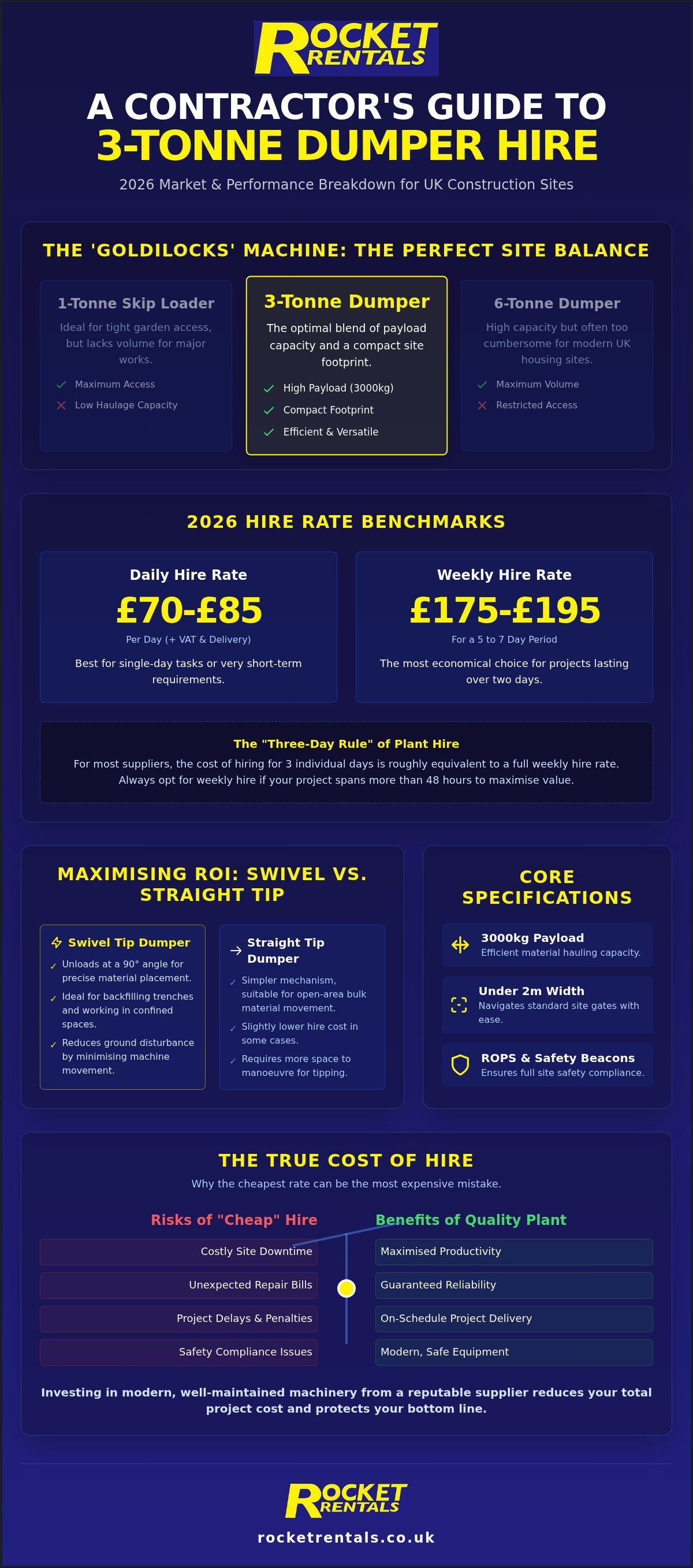
The 3-tonne dumper is often described as the "Goldilocks" of the construction site. It offers a precise balance between payload capacity and a compact footprint that larger machines simply cannot match. Whilst a 1-tonne skip loader is excellent for tight garden access, it lacks the volume required for serious groundworks. Conversely, a 6-tonne machine often proves too cumbersome for the narrow access typical of modern UK housing developments. For many professional contractors, securing a 3 ton swivel dumper hire is the default choice for landscaping, utility works, and medium-scale civil engineering projects.
Relying on high-quality, self-drive machinery is essential for maintaining tight project schedules. When you manage the equipment yourself, you gain total control over site logistics without the variables of external operators. This autonomy, paired with a modern fleet, ensures that your team stays productive from the first hour to the last.
Key Specifications That Influence Performance
Modern machinery has evolved significantly from basic site skips. Today's modern dumper designs prioritise both operator safety and mechanical efficiency. A typical 3-tonne model manages a 3000kg payload whilst maintaining a width usually under two metres. This allows it to navigate through standard site gates that would block larger plant. Permanent four-wheel drive is a standard requirement for tackling unpredictable UK terrain, ensuring that productivity doesn't stall when the weather turns. Safety remains paramount; these units come equipped with Roll-Over Protective Structures (ROPS) and green seatbelt beacons to ensure site compliance is easily monitored.
When to Choose a 3-Tonne Model Over Smaller Units
Efficiency on site is measured by how quickly material moves from point A to point B. Choosing a 3-tonne unit over a smaller skip loader can triple your haulage capacity per trip, significantly reducing fuel consumption and operator fatigue. It's also about matching your fleet. A 3-tonne dumper is the perfect partner for a 3-tonne or 5-tonne excavator. The skip size aligns with the bucket capacity, meaning the dumper is filled in fewer passes. This synchronisation prevents the "bottleneck" effect where expensive excavators sit idle waiting for a dumper to return. Additionally, the turning circle of these machines is tight enough to manoeuvre in restricted spaces without the high ground pressure that might damage prepared surfaces.
Breaking Down 3-Tonne Dumper Hire Rates: Benchmarks for 2026
Estimating the cost of a 3 ton swivel dumper hire requires looking beyond the headline figure. In the 2026 UK market, daily rates typically range between £70 and £85 depending on the provider and machine specification. Whilst these figures provide a baseline, the true value is found in the weekly rate, which usually sits between £175 and £195. This pricing structure often follows the "three-day rule", where the cost of three individual days of hire equals the total for a full week. If your project spans more than 48 hours, opting for a weekly rate is almost always the more economical choice.
Understanding these benchmarks allows you to verify that you aren't overpaying for standard equipment. It's also a signal of quality; rates that fall significantly below these averages may suggest a provider is using an older fleet with higher maintenance risks. Reliable contractors know that a few pounds saved on the daily rate can quickly be lost if the machine fails on site.
Daily vs. Weekly Hire Pricing Models
Professional hire companies typically operate on a tiered system to accommodate different project lengths. A single day hire covers the immediate overheads of logistics and administration, resulting in a higher proportional cost. Two days might see a slight reduction per day, but by the third day, most reputable firms will cap the cost at the weekly rate. For those requiring a 3 ton swivel dumper hire for weekend work, be aware that many suppliers apply a minimum two-day charge or a specific weekend premium. Professional contractors who establish a trade account often benefit from preferential rates, as long-term partnerships allow for more predictable fleet scheduling and reduced administrative burdens.
Factors That Can Inflate or Deflate Your Quote
Several variables can cause your final quote to fluctuate. Seasonal demand plays a significant role; availability often tightens during the peak summer construction months, which can lead to price increases in some regions. Conversely, many contractors find savings through volume discounts. For instance, bundling dumper hire with an excavator often reduces the total transport cost and the overall daily rate per unit.
The age of the fleet also impacts the price. While older machinery might carry a lower base rate, it often costs more in the long run through higher fuel consumption and the risk of breakdown. Modern machines from brands like Thwaites or JCB are designed to meet official safety standards regarding Roll-Over Protective Structures (ROPS) and fuel efficiency. Investing in a newer fleet ensures your site remains compliant and avoids the expensive delays associated with mechanical failure.
Beyond the Base Rate: Delivery, Insurance, and Fuel Logistics
Budgeting for a 3 ton swivel dumper hire requires a comprehensive look at the total cost of ownership during the hire period. Beyond the base rental fee, logistics such as transport, fuel, and insurance form a significant portion of your project's plant expenditure. Professional hire companies prioritise transparency in these areas, ensuring you aren't surprised by additional fees when the final invoice arrives.
Navigating Plant Hire Delivery Charges
Transporting a 3-tonne machine requires specialised plant trailers or flatbed vehicles. These delivery charges are typically quoted as a 'per movement' fee, covering both the drop-off and collection. Costs vary based on distance; for example, transport rates in 2026 often range between £1 and £5 per mile. Clear communication regarding site access is vital. If a delivery vehicle cannot safely offload due to restricted access or site unreadiness, you may face 'aborted delivery' fees. Coordinating arrival times with a site manager ensures the machine is signed for and ready for immediate use.
Insurance and Liability: Protecting Your Project
Insurance is a non-negotiable aspect of professional plant hire. Most reputable firms operate under Construction Plant-hire Association (CPA) terms, which place the responsibility for the machine's safety on the hirer once it's on-site. You will typically need 'Hired-in Plant' insurance. This cover protects against theft and accidental damage, with monthly premiums starting from approximately £15 to £21 depending on the equipment's value. Whilst some providers offer a damage waiver for a percentage of the hire fee, this often carries exclusions for gross negligence or tyre damage.
Adhering to Health and Safety Executive (HSE) guidelines regarding machine maintenance and operator checks is not just a safety requirement; it's a condition of most insurance policies. Ensuring you have the correct documentation in place before the dumper arrives prevents delays and protects your project's financial interests.
Fuel management is another variable to monitor. Most hire agreements follow a 'full-to-full' policy. If the dumper is returned with a partial tank, you'll likely be charged a premium for site refuelling, which is significantly higher than current red diesel rates. Similarly, returning a machine covered in dried concrete or excessive mud can trigger cleaning charges. Maintaining a clean site and a disciplined refuelling routine are simple ways to keep your 3 ton swivel dumper hire costs within the original budget.
Maximising Site ROI: Swivel Tip vs. Straight Tip Performance
Choosing between a swivel tip and a straight tip machine is a critical decision for site efficiency. Whilst the base rate for a 3 ton swivel dumper hire might be slightly higher than a standard forward-tip model, the return on investment often manifests in reduced cycle times and lower labour costs. The choice should be dictated by your specific site layout and the nature of the material you're moving. A well-chosen machine doesn't just move soil; it optimises the entire workflow of your groundworks team.
The Swivel Tip Advantage for Restricted Sites
The primary benefit of a swivel tip dumper is its ability to rotate the skip 180 degrees, allowing for a 90-degree discharge on either side of the chassis. On restricted sites, such as narrow housing plots or roadside utility works, this functionality is invaluable. Instead of having to manoeuvre the entire vehicle to face a trench, the operator can simply drive alongside and pivot the skip. This significantly reduces machine movement, which in turn minimises ground disturbance and tyre wear. It also enhances safety by reducing the need for complex multi-point turns in tight spaces where ground workers are present.
Straight Tip Reliability for Bulk Earthworks
Straight tip dumpers, often referred to as forward-tip models, remain the workhorse for high-volume bulk shifting on open sites. Because the skip mechanism is simpler and fixed, these machines often boast a lower centre of gravity. This provides increased stability when traversing slopes or uneven terrain with a full 3-tonne load. For large-scale earthworks where the dumper follows a straightforward path from the excavator to a stockpile, the added complexity of a swivel mechanism isn't always necessary. In these scenarios, the straight tip model offers maximum uptime and a slightly lower hire cost, making it the more efficient choice for pure tonnage-per-hour performance.
When calculating your total project cost, consider the manual handling involved. A swivel tip dumper can place material precisely where it's needed, often eliminating the need for ground workers to manually level or move material after discharge. If your site involves backfilling trenches or working in confined corridors, the time saved usually pays for the hire premium within the first day. To ensure you have the right machine for your specific ground conditions, you can explore our full range of professional dumper hire options today. Ultimately, the goal is to match the discharge method to your site's physical constraints to ensure the highest possible productivity.
Sourcing Reliable Plant: Why Quality Equipment Reduces Total Cost
The temptation to choose the lowest possible quote is understandable when managing tight construction budgets. However, a 3 ton swivel dumper hire that is priced significantly below market averages often signals a fleet that is past its prime. In the plant hire industry, the "cheapest" option frequently becomes the most expensive mistake once you account for the hidden costs of mechanical failure and site inefficiency. Reliability isn't just a luxury; it's a fundamental requirement for maintaining your project's timeline and profitability.
At Rocket Rentals Ltd, our commitment to providing modern, high-specification machinery is designed to eliminate these risks. By focusing on a well-maintained, self-drive fleet, we ensure that professional contractors receive equipment that is ready to work from the moment it arrives on site. This proactive approach to fleet management means you spend less time worrying about breakdowns and more time hitting your project milestones.
The Cost of Downtime on Professional Sites
When a dumper fails, the financial impact extends far beyond the cost of the machine itself. You must calculate the hourly loss of your groundworks team standing idle whilst waiting for a replacement. If a three-person team is unable to work, the wasted labour costs can easily exceed £60 per hour, quickly eclipsing any small saving made on the initial hire rate. Fleet age is a critical metric for any site manager to consider. Newer machines are not only more fuel-efficient but are significantly less likely to suffer from the hydraulic leaks or engine faults that plague older units. Partnering with a specialist that offers responsive support and reliable machinery is the most effective way to protect your project from these avoidable expenses.
Starting Your Next Project with Rocket Rentals Ltd
Our focus on self-drive plant hire ensures that you remain in total control of your site operations. We understand the specific demands of professional groundworks and civil engineering, which is why we provide machinery that meets the highest standards of safety and performance. If you are also planning the excavation phase of your project, you may find our resource on The Professional’s Guide to Mini Excavator Hire useful for synchronising your fleet requirements.
A successful project relies on transparent logistics and a partner who values your schedule as much as you do. Whether you are managing a single plot or a national infrastructure contract, we provide the technical expertise and high-quality plant needed to deliver results. You can contact our expert team for a transparent 3-tonne dumper hire quote that reflects the true value of reliable, professional-grade equipment.
Securing Your Site’s Success with Professional Plant Hire
Successful site management in 2026 relies on a clear understanding of total project costs. Professional budgeting requires looking beyond the daily rate to account for logistics, fuel management, and insurance. Choosing a 3 ton swivel dumper hire provides the versatility needed for complex groundworks, whilst a modern, well-maintained fleet ensures you avoid the expensive delays of mechanical failure. By matching the right discharge method to your site's physical constraints, you ensure the highest possible productivity for your team.
Rocket Rentals has served as an independent plant hire specialist since 1988, offering national self-drive equipment coverage tailored to professional contractors. Our modern, high-specification fleet is ready to support your next project with reliability and transparent pricing. You can Get a Quote for Professional 3-Tonne Dumper Hire today to secure the right machinery for your site. We look forward to partnering with you to ensure your project remains on schedule and within budget.
Frequently Asked Questions
How much does it cost to hire a 3-tonne dumper for a week?
Industry benchmarks for a weekly hire in 2026 typically range between £175 and £195. This is often the most cost-effective option for projects lasting longer than two days due to the "three-day rule", where the weekly rate is capped at the cost of three individual days. Final costs will vary based on machine specification and the length of the hire contract. We suggest requesting a formal quote to confirm current availability.
Do I need a special licence for self-drive dumper hire?
You don't technically need a driving licence to operate a dumper on private land, but most professional sites require a valid CPCS or NPORS card to prove competence. If the machine is to be used on public roads, the operator must hold a valid UK driving licence. It is advisable to check your specific site insurance and health and safety requirements before the hire commences to ensure full compliance with workplace regulations.
Is fuel included in the 3-tonne dumper hire price?
Fuel is not included in the base hire rate. We provide all machinery with a full tank of fuel, and it's the hirer's responsibility to return the unit full. If the machine returns with a partial tank, a refuelling charge will be applied at a premium rate. Using your own supply of red diesel on-site is the most economical way to manage these costs during the project and avoid unexpected surcharges.
What is the difference between a swivel tip and a power tip dumper?
A swivel tip dumper allows the skip to rotate 180 degrees, enabling material discharge to the left, right, or front of the machine. This is ideal for backfilling trenches in confined spaces. A power tip, or straight tip dumper, only tips material directly forward. Whilst straight tip models are excellent for bulk earthworks on open sites, a 3 ton swivel dumper hire offers significantly more flexibility for restricted housing plots.
What insurance do I need for hiring plant machinery?
You are responsible for the machinery once it's delivered to your site under standard CPA terms. Most professional contractors use "Hired-in Plant" insurance to cover theft and accidental damage. This insurance is separate from your standard public liability cover. We require proof of adequate insurance or the arrangement of a damage waiver before any equipment is released for self-drive hire to ensure your project is fully protected against unforeseen costs.
Can a 3-tonne dumper be used on the public road?
Yes, provided the machine is road-legal and the operator holds a valid UK driving licence. Road-legal dumpers must be equipped with number plates, mirrors, and full lighting kits. It's also essential that the vehicle is taxed and insured for road use. We advise confirming your specific requirements during the booking process, as not all machines in a standard fleet are automatically configured for public highway use under current DVLA standards.
What are the delivery charges for plant hire?
Delivery and collection charges are calculated on a "per movement" basis and vary depending on the distance from the depot to your site. In the current 2026 market, these specialised transport costs typically range from £1 to £5 per mile. To avoid additional aborted delivery fees, ensure that the site is ready for the arrival of the machinery and that clear access is available for a large plant trailer.
Do you offer discount for hiring a dumper and excavator together?
Bundling equipment often results in a more competitive overall package for professional contractors. Hiring a dumper alongside an excavator reduces total transport costs, as both machines can frequently be delivered on the same vehicle. This approach also ensures that your machinery is correctly matched in terms of bucket capacity and skip volume. Contact our team to discuss a tailored quote that reflects the full scale and duration of your specific project needs.
Comments