
360 Excavator Hire Guide: Choosing the Right Plant
Choosing the most powerful machine on the lot might seem like a shortcut to productivity, but the wrong tonnage often leads to restricted site access and costly delays. This 360 excavator hire guide is designed to help you avoid those common pitfalls by mastering the technicalities of plant selection. You likely understand that project timelines are only as reliable as the equipment you hire; it's frustrating when a machine arrives that's either too cumbersome for your site's slew radius or lacks the breakout force required for the ground conditions.
We'll ensure your project remains efficient, compliant, and strictly on schedule by exploring how to balance machine size with site constraints. We'll also cover how to maximise your daily output and maintain full safety compliance for self-drive plant. By the end of this guide, you'll have the confidence to select a machine that offers the smartest slew-to-tonnage ratio for your specific site footprint, positioning you as a dependable partner on any professional site.
Table of Contents
What is a 360 Excavator and Why is it Essential?
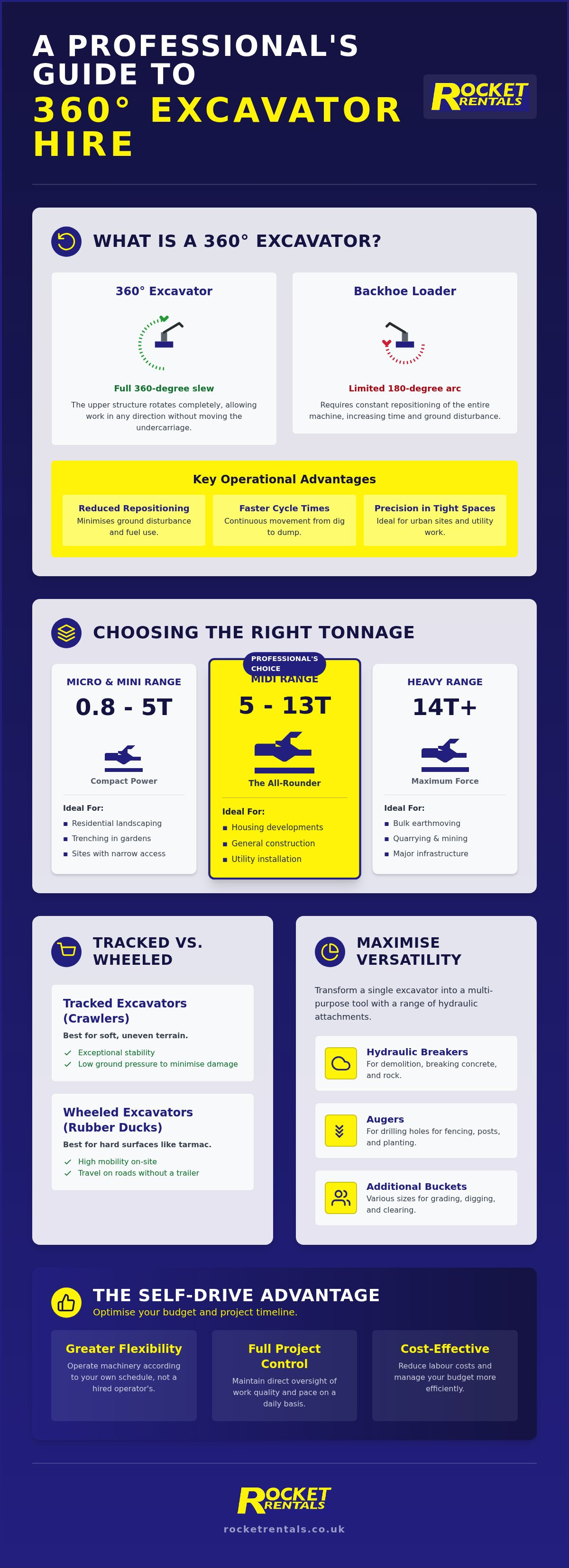
A 360 excavator is the backbone of modern earthmoving. Unlike a backhoe loader, which typically offers a 180-degree arc of operation, a 360 model features an upper structure that rotates completely on its undercarriage. This mechanical design allows the operator to dig, swing, and dump material in any direction without needing to move the tracks or wheels. It's this specific capability that makes a 360 excavator hire guide essential for anyone looking to optimise their site logistics. By eliminating the need for constant repositioning, these machines reduce ground disturbance, fuel consumption, and overall project duration.
Professional contractors favour these machines for their sheer versatility in tight spaces. Whether you are excavating deep foundations, installing complex drainage systems, or tackling a demolition project, the ability to work within a fixed footprint is invaluable. This agility is why 360 models have become the industry standard for everything from residential landscaping to major infrastructure works. They offer a level of precision that fixed-frame machinery simply cannot match, particularly when working alongside existing structures, live utility lines, or in confined urban environments.
Tracked vs Wheeled 360 Excavators
Choosing between tracks and wheels depends entirely on your site surface. Tracked models, often called crawlers, provide exceptional stability and low ground pressure for soft or uneven terrain. Conversely, wheeled excavators, or 'rubber ducks', are designed for mobility on hard standing like tarmac. These are ideal for urban projects where the machine must travel between work areas without damaging the road surface or requiring a separate transport trailer for short distances.
The Mechanics of Productivity
Efficiency on a construction site is often measured in cycle times. A 360-degree slew allows for a continuous movement pattern, significantly reducing the time spent between digging and discharging. High-quality professional plant machinery ensures that your site is ready for high-intensity tasks. This 360 excavator hire guide helps you select the right hydraulic power for your project's specific lifting and breaking requirements, ensuring that every hour on-site is productive and safe.
Choosing the Right Tonnage: From Micro to Heavy Plant
Tonnage is the most critical metric in any 360 excavator hire guide. It directly determines the machine's physical footprint, bucket capacity, and maximum dig depth. Selecting a machine that's too small leads to hydraulic strain and sluggish cycle times, whilst an oversized machine can cause unnecessary ground damage or struggle with site access. Finding the sweet spot ensures you aren't paying for unused power or wasting time with an underpowered bucket. Most projects fall into one of three primary categories based on the scale of earthmoving required.
Micro and Mini Range (0.8t - 5t): These are designed for residential landscaping, trenching in tight gardens, or sites with narrow gateways.
Midi Range (5t - 13t): Often called the "all-rounders," these machines are the standard for housing developments and utility works.
Heavy Range (14t - 50t+): These are reserved for major bulk excavation, quarrying, and large-scale infrastructure projects.
The Midi Excavator: The Professional Choice
In UK construction, the 8-tonne and 13-tonne models are consistently the most requested machines. They offer a superior balance, providing the breakout force needed for tough ground whilst remaining compact enough to be moved between sites with ease. These machines are the workhorses of housing developments because they handle heavy lifting without the logistical headache of a heavy-plant movement order. Before hiring, verify the reach and dump height specs to ensure they align with the side-height of your dumpers to avoid loading delays.
Matching Machine to Material
Ground conditions dictate your tonnage requirements as much as the project's scale. Heavy clay or rocky terrain requires the significant breakout force found in larger machines to prevent the hydraulics from overheating. On the other hand, for projects on established lawns or sensitive soil where ground compaction must be minimised, a lighter machine is often the better choice. If your project is strictly small-scale or involves indoor work, our mini excavator hire guide provides deeper insight into the 0.8t to 3t range.
You can browse our full range of excavator hire options to find the specific tonnage that matches your site's requirements and ground conditions.
Zero Tail Swing vs. Conventional Slew: Managing Site Safety
A critical decision in any 360 excavator hire guide is choosing between Zero Tail Swing (ZTS) and conventional slew configurations. ZTS machines are engineered so the rear counterweight remains within the width of the tracks as the upper structure rotates. This design is specifically intended for confined spaces where a protruding rear end would pose a risk to nearby structures or personnel. By contrast, conventional models have a counterweight that extends beyond the tracks, which can create a hazard if the site layout isn't managed correctly.
There are scenarios where ZTS isn't just a preference but a mandatory safety requirement. If your project involves working alongside live motorways, near fragile buildings, or within the constraints of single-lane traffic, ZTS is essential. It eliminates the "tail swing" risk, allowing the operator to focus entirely on the bucket's position without worrying about the back of the machine striking an obstacle. It's a simple way to reduce the complexity of your risk assessment in high-stakes environments.
However, conventional slew models shouldn't be overlooked. Because they have a larger counterweight extending beyond the tracks, they often offer superior lifting capacity and greater stability when working on slopes. If your site has ample space, a conventional machine might provide the extra breakout force needed for heavy-duty tasks. You must organise your site layout to accommodate the "slew zone," ensuring that all personnel are aware of the machine's maximum reach. Balancing this stability against the need for compact rotation is key to a productive site.
Navigating Tight Access with Zero Tail Swing
ZTS significantly reduces the risk of accidental strikes on site hoardings or temporary structures. In confined urban environments, this provides a massive psychological benefit for operators. They can work with greater confidence, knowing the machine's footprint is predictable. It's why ZTS has become the industry standard for utility and street works where pavement space is limited and pedestrians are close by.
Safety Protocols for 360 Operations
Safety goes beyond machine choice. You must establish clear "red zones" or exclusion areas around the excavator's maximum slew radius. Modern 360 plant is equipped with visibility aids like 360-degree cameras and mirrors, but these don't replace the need for a competent site banksman. For self-drive hire, it's your responsibility to ensure the operator holds the correct CPCS or NPORS certification. This competency is vital for maintaining site safety and meeting insurance requirements on a professional project.
Maximising Versatility with Excavator Attachments
A key insight in any 360 excavator hire guide is that the machine is only as capable as the tool on the end of its boom. By selecting the right attachments, you can transform a standard excavator into a multi-purpose powerhouse, often eliminating the need to hire additional specialised plant. This approach doesn't just streamline your site operations; it provides a significant boost to your project's return on investment by reducing the number of machines required on-site.
Hydraulic Breakers: these turn your excavator into a demolition specialist, essential for breaking up reinforced concrete or tarmac surfaces.
Augers: these are the professional choice for rapid post-hole digging, perfect for large-scale fencing or foundation piling projects.
Riddle Buckets: by sorting stone from soil directly on-site, you can recycle materials for sub-bases and significantly reduce your waste disposal costs.
Grabs and Grapples: these provide the precision needed for material handling, whether you're moving timber, scrap metal, or bulky site waste.
The Quick Hitch System
Modern excavators use quick hitch systems to swap between buckets and attachments in minutes. While manual hitches are common, hydraulic quick hitches allow the operator to change tools from the safety of the cab. This greatly improves site speed and safety. It's vital to ensure that any attachment is compatible with the machine’s hydraulic flow rate. If you're using a manual hitch, you must check the safety pins every single time you change a tool. A loose attachment is a severe site hazard. It's easily avoided with a disciplined check routine.
Specialist Tools for Civil Engineering
For more complex tasks, specialist attachments like tilt-rotators allow the bucket to rotate 360 degrees and tilt simultaneously. This enables complex grading and landscaping without the need to reposition the entire machine. It saves time and protects the ground surface. In demolition, shears and pulverisers offer controlled processing of steel and concrete. Choosing the right tool often replaces the need for a second machine, keeping your site footprint small and efficient. You can explore our full range of excavator attachments to customise your hire for any specific task.
The Logistics of Self-Drive 360 Excavator Hire
Choosing self-drive hire is a strategic move for contractors who already have certified operators on their payroll. It provides complete autonomy over site schedules and eliminates the premium costs associated with operated plant. In this final section of our 360 excavator hire guide, we'll look at the logistical steps required to ensure a smooth rental experience. By managing your own plant, you maintain direct control over project efficiency and daily output.
Before the machine arrives, you must ensure the delivery area is level and capable of supporting the weight of both the transport trailer and the excavator. Soft ground or steep inclines can delay offloading and potentially compromise safety. Additionally, Hired-in Plant Insurance is a non-negotiable requirement. It protects you against theft or damage, which is vital when handling high-value assets. Most professional sites won't allow a machine to be offloaded without proof of valid cover in place.
Modern Stage V compliant engines are now the standard for professional fleets to meet strict emission regulations. These machines require AdBlue alongside standard white diesel. It's the hirer's responsibility to monitor these levels to ensure the engine remains efficient and compliant with environmental standards. Neglecting fluid levels can lead to engine derating, which causes avoidable downtime on a busy site.
Planning Your Hire Period
While "spot" rentals are useful for quick tasks, long-term hire often provides better value for project budgets and allows for more predictable cost management. You should always schedule delivery to coincide with your site access windows to prevent the machine from sitting idle. When the job is finished, ensure you off-hire the equipment promptly through the correct channels to avoid unnecessary charges. Proper planning ensures the machine is on-site exactly when it's needed and not a day longer.
Maintenance and Daily Checks
Even though we provide meticulously maintained, late-model plant, the operator is responsible for basic daily maintenance. This includes greasing the boom and bucket pins, checking fluid levels, and monitoring track tension. Recognising early signs of hydraulic leaks or unusual wear is the best way to prevent significant downtime. At Rocket Rentals, we're committed to providing a reliable, professional-grade fleet. Every machine is inspected to ensure it arrives in peak condition, acting as a dependable partner for your most demanding projects.
Optimising Your Site Productivity
Selecting the right plant involves more than just picking the largest bucket. As this 360 excavator hire guide has detailed, success lies in balancing tonnage with site constraints like slew radius and ground pressure. By choosing the correct machine size and utilising versatile attachments, you can significantly reduce project timelines. Managing the logistics of self-drive hire, from insurance to Stage V fuel compliance, ensures your site remains both efficient and safe.
Rocket Rentals brings over 35 years of experience to every hire, acting as a dependable partner for your long-term projects. Our modern Stage V compliant fleet is supported by expert technical advice to help you navigate specific site challenges. We're here to ensure you have the right tools to maintain full safety compliance and peak productivity. It's about more than just machinery; it's about the security of a safe pair of hands.
Explore our full range of 360 excavators for professional self-drive hire to secure a machine that matches your project's exact requirements. With the right plant in place, your next excavation task will proceed with the precision and reliability your clients expect.
Frequently Asked Questions
Do I need a licence to hire a 360 excavator for a commercial site?
You don't need a specific government-issued driving licence to hire a machine for off-road use, but commercial site managers will require proof of competency. This is typically demonstrated through an accredited card scheme like CPCS or NPORS. A Red 'Trained Operator' card is valid for two years, whilst a Blue 'Competent Operator' card is the industry standard for experienced professionals. Ensuring your operator holds these credentials is vital for site safety.
What is the difference between a mini digger and a 360 excavator?
A mini digger is a type of 360 excavator, specifically those weighing between 0.8 and 5 tonnes. The term "360 excavator" is a broader category that includes larger midi and heavy plant machines used for bulk earthmoving. The defining feature of any 360 machine is the ability of the cab and boom to rotate a full 360 degrees independently of the tracks. This distinction is a core part of any 360 excavator hire guide.
Can I use a 360 excavator on a public road?
You can only use a 360 excavator on a public road if the machine is road-legal, taxed, and registered with the DVLA. Most tracked excavators are designed for off-road use and must be moved between sites on a low-loader or trailer. If you require a machine for road works, a wheeled excavator, often called a "rubber duck," is the more mobile choice. The operator must also hold a valid UK driving licence.
How much space does a 13-tonne excavator need for a full slew?
A conventional 13-tonne excavator typically requires a working radius of approximately 3 to 4 metres for a safe, full slew. However, this varies significantly between conventional models and Zero Tail Swing (ZTS) machines. A ZTS model keeps its counterweight within the width of its tracks, making it ideal for narrow sites. Always establish a "red zone" exclusion area that accounts for the maximum reach of the boom and the tail swing radius.
Is fuel included in the self-drive hire rate?
Fuel is not included in the standard self-drive hire rate. Machines are typically delivered with a full tank of white diesel and, for modern Stage V engines, a full tank of AdBlue. You're expected to return the machine full at the end of the hire period. If the machine is returned with a partial tank, a refuelling charge will apply. Monitoring fuel levels daily is a key part of maintaining site productivity.
What insurance do I need for self-drive plant hire?
You must have valid Hired-in Plant Insurance to cover the equipment against theft, loss, or accidental damage whilst it's in your care. Standard public liability insurance usually doesn't cover the machine itself. Most professional hire companies require proof of this specific cover before offloading any equipment. It's a non-negotiable safety measure that protects your business from significant financial liability if an incident occurs on-site or the machine is stolen.
Are 360 excavators delivered or do I collect them?
We deliver 360 excavators directly to your site using specialised plant transporters. Due to the weight and size of midi and heavy excavators, collection by the hirer isn't usually practical unless you have a suitable HGV and trailer. Delivery allows us to ensure the machine is offloaded safely on level ground by a professional driver. We'll coordinate with your site manager to ensure the delivery window fits your access constraints.
Can I hire attachments separately for a machine I already have?
Yes, you can hire excavator attachments separately to use with your own machinery. We provide an extensive range of tools, including hydraulic breakers, augers, and riddle buckets, to help you customise your fleet for specific tasks. Before hiring, you must verify that your machine's hydraulic flow rate and quick-hitch system are compatible with the attachment. Using the right tool can often replace the need for an additional machine, saving you project costs.


Comments