
6m Telehandler Hire Cost: The Complete Professional Guide [2026]
Why does a seemingly straightforward quote for a 6m telehandler hire cost often look so different on the final invoice? If you've ever managed a busy site, you'll know the frustration of unexpected delivery fees or fuel surcharges that suddenly appear at the end of a project. It's a common challenge for contractors who need reliable machinery but want to avoid the hidden variables that can quietly erode a budget.
We believe that transparency is the foundation of a successful partnership. This guide provides a professional breakdown of the 6m telehandler hire cost landscape for 2026, ensuring you can plan your logistics with absolute precision and confidence. You'll gain a clear understanding of the differences between daily and weekly hire structures whilst learning how to spot potential extra charges before they arise. We will also compare the performance of 6m units against smaller alternatives to ensure you aren't overspending on capacity you don't need or underestimating the reach your site demands.
Table of Contents
Why the 6m Telehandler is a Cost-Effective Choice for Modern Sites
The 6m telehandler is frequently defined as the versatile, compact workhorse of the modern construction site. It occupies a unique position in the plant hire market, offering a sophisticated balance between a high lift capacity and a remarkably small footprint. For many contractors, this specific size is the logical choice for projects that demand more reach than a compact loader but don't have the clearance for heavy-duty machinery. While 14m or 17m models are essential for multi-storey structural builds, they are often too cumbersome for residential renovations or tight urban infill sites. By opting for a 6m unit, you avoid the logistical headaches and the increased 6m telehandler hire cost associated with transporting and manoeuvring larger, heavier chassis.
The Versatility of the 6m Reach
A telescopic handler with a 6m boom is engineered to bridge the gap between traditional forklifts and larger cranes. These machines are ideal for loading and unloading lorries on constrained sites, where their ability to reach across a flatbed trailer saves significant time. They are equally capable of handling palletised materials, bulk bags, and even loose aggregates with the right attachment. The compact turning circle is perhaps its greatest asset; it allows operators to navigate around scaffolding and existing structures without causing site congestion. This agility ensures that material movement remains a fluid part of your site's daily rhythm rather than a bottleneck.
Self-Drive vs. Operated Hire Costs
When evaluating your 6m telehandler hire cost, the distinction between self-drive and operated hire is a critical financial consideration. Professional contractors often prefer self-drive solutions because they offer superior budget control and operational flexibility. By utilising your own CPCS or NPORS qualified operator, you can eliminate the high daily premiums typically charged for an external operator. This approach also removes the risk of paying for a specialist's time during periods of site inactivity or bad weather. It's a pragmatic decision. A self-drive hire allows the machine to become a truly integrated part of your team, available whenever your project requires it without the constraints of an external operator's shift patterns. It's a reliable way to maintain peak site efficiency whilst keeping a firm grip on the bottom line.
Calculating the Total 6m Telehandler Hire Cost: A Detailed Breakdown
Understanding the true 6m telehandler hire cost requires looking beyond the headline figure. While many providers list a simple daily rate, the final invoice is built on several pillars: the base rate, transport logistics, and fuel consumption. A damage waiver is also a critical but optional cost-mitigation tool that protects you against the financial impact of minor site accidents. By breaking these down, you can create a realistic budget that avoids the "bill shock" often associated with plant hire.
Base Hire Rates and Duration Discounts
Most hire companies operate on a weekly cycle, where the rate for five days is often the same as a full seven-day period. If you only need the machine for 48 hours, you might still find yourself paying a minimum three-day or full-week charge depending on the provider's policy. For projects spanning a month or more, you can often secure a lower daily rate by committing to a long-term hire. This stability is beneficial for both the contractor and the provider, as it reduces the logistical churn of the fleet. When you view professional telehandler hire options, it's always worth confirming whether the quoted week is based on five or seven days of usage to ensure your schedule aligns with their billing.
Mandatory and Optional Extras
The "Transport Pillar" is often where budgets get derailed. Delivery and collection charges are calculated by distance from the depot; a site thirty miles away will naturally incur higher costs than one located just around the corner. It's an unavoidable part of the logistics, but one that should be clarified at the point of order. Similarly, fuel is a significant factor. You'll typically receive the machine with a full tank and be expected to return it full, or pay a refuelling surcharge. Many modern sites now specify HVO (Hydrotreated Vegetable Oil) over standard white diesel to meet environmental targets, which can carry a price premium but offers a lower carbon footprint.
Don't forget insurance requirements. Most hire agreements follow Hire Association Europe (HAE) terms, which require the hirer to have adequate plant insurance in place from the moment the machine leaves the depot. Finally, consider your attachments. Standard pallet forks are usually included in the base 6m telehandler hire cost, but specialist tools like buckets, jibs, or sweepers will likely attract an additional daily fee. Planning these requirements in advance prevents expensive last-minute additions to your hire contract.
Comparing 6m Capability: Is it the Most Economical Choice for You?
Choosing the right machinery is a balancing act between physical capability and financial efficiency. While the 6m telehandler hire cost is generally higher than that of a 4m super-compact unit, the investment often pays for itself through reduced labour time. Selecting the wrong size can lead to "double-handling", where materials must be moved multiple times because the initial machine lacked the reach to place them correctly. This inefficiency quickly outpaces any initial savings on the hire rate.
4M Super-Compact vs. 6m Standard-Compact
The 4m "buggy" style telehandler is an essential tool for indoor work or underground car parks where height clearance is severely limited. However, for standard site work, the 6m model is often the superior economic choice. A typical 6m machine provides a lift capacity of approximately 2,500kg, which is the industry standard for full pallets of bricks or blocks. Crucially, the 6m boom allows an operator to reach across the entire width of a delivery lorry. If you opt for a 4m unit, you may find it cannot reach the far side of the trailer. This forces the driver to reposition the lorry or the operator to travel to the other side. These small delays accumulate, potentially extending your total hire duration and increasing your 6m telehandler hire cost through wasted man-hours.
9M Reach: When to Scale Up
Moving from a 6m to a 9m model involves more than just a higher lift. A 9m chassis is significantly larger and often requires stabiliser legs to maintain safety at full extension. This extra bulk makes the machine a potential cost liability on smaller sites. The increased weight can also push up the transport fees, as the delivery vehicle may require a different category of trailer. If your project involves mastering material handling with telehandler hire across a sprawling site, the 6m remains the sweet spot for agility. It navigates tight access points without the need for expensive site modifications, such as widening temporary roads or clearing larger turning circles. These modifications are often necessary for 9m or 14m models and can add thousands to a project budget. Only scale up when the vertical reach is a non-negotiable requirement of your build phase.
Strategic Planning: How to Minimise Your Hire Expenses
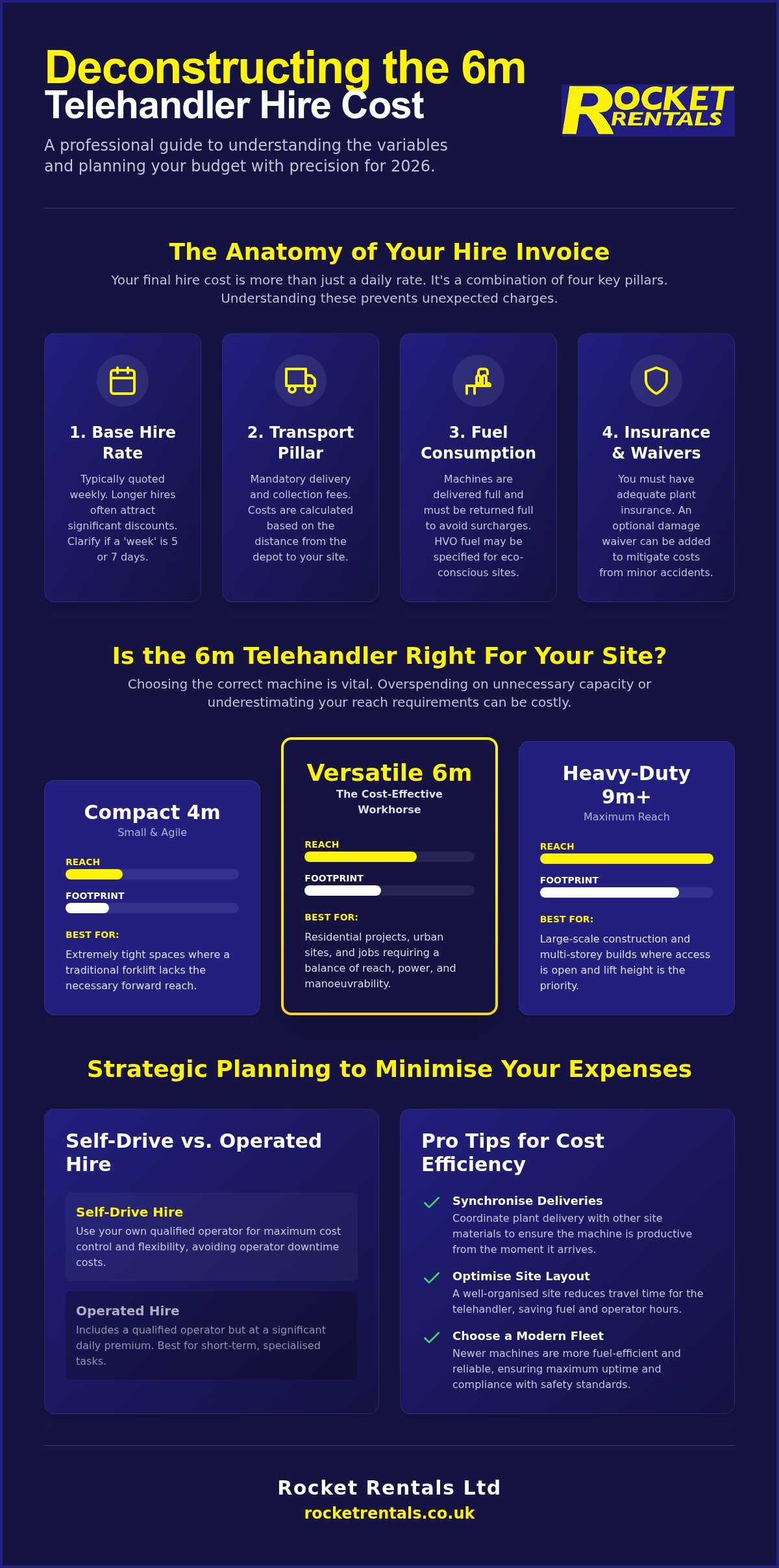
Efficient site management is the most effective way to protect your project budget. While the base 6m telehandler hire cost is a fixed element of your initial quote, the total expenditure is often dictated by how well the machine is utilised once it arrives on-site. A telehandler sitting idle for three days because a material delivery was delayed represents pure "standing time" loss. To prevent this, you should always synchronise the arrival of your plant with your primary material deliveries. Ensuring a qualified operator is present and ready to work from the first hour of the hire window is equally vital for maintaining momentum and avoiding wasted hire days.
Site layout also plays a significant role in cost control. By organising your storage areas and waste centres to minimise travel distances, you reduce fuel consumption and unnecessary wear on the machine. Performing daily checks isn't just a safety requirement; it's a financial safeguard. Identifying a minor issue before it becomes a major repair prevents expensive end-of-hire charges and ensures the machine remains productive throughout its stay.
Optimising Hire Duration
The "off-hire" process is a common area where contractors lose money through simple administrative oversight. Once your tasks are complete, you must officially notify the provider to stop the billing cycle and obtain an off-hire reference number. You can also maximise value by scheduling multiple tasks into a single window. Instead of hiring the machine twice for separate phases, coordinate your subcontractors to ensure all heavy loading, shifting, and lifting happens consecutively. This disciplined approach prevents the need for multiple delivery and collection fees, which are a major component of the overall 6m telehandler hire cost.
Fuel and Maintenance Management
Managing the fuel pillar requires a proactive stance to avoid depot surcharges. Most hire companies charge a premium for refuelling machines upon return. By topping up the tank from your own on-site supply before collection, you avoid these inflated rates. Similarly, keeping the machine clean is more than just good site practice. Heavy mud or concrete spillages can lead to "heavy cleaning" surcharges if the machine requires specialist valeting before it can be sent to the next customer. Following a clear protocol, such as The Site Manager’s Checklist: Ensuring Plant Safety, helps maintain the machine's condition and avoids unnecessary fees. For a partner that values transparency and fleet quality, you can explore our professional telehandler hire fleet to ensure your next project starts on the right foot.
Reliable Telehandler Hire Solutions with Rocket Rentals
Managing your 6m telehandler hire cost shouldn't feel like a gamble. At Rocket Rentals, we position ourselves as a dependable partner for contractors who value precision, safety, and transparent communication. We understand that site efficiency is built on the reliability of your plant. This is why we focus exclusively on high-quality, self-drive solutions. By providing the machinery and leaving the operation to your qualified team, we empower you to maintain total control over your project's logistics and daily schedule. This model is inherently more cost-effective for professional sites where an operator is already part of the core team.
Transparency is at the heart of our service. We provide clear, structured information about our hire terms whilst ensuring you have the support needed to calculate your total expenditure with absolute accuracy. This proactive approach removes the uncertainty often associated with plant hire. Our self-drive focus is a deliberate choice. It allows you to integrate the machine into your site's unique rhythm without the external constraints of operated hire. You decide the start times, the break patterns, and the priority tasks, ensuring that every hour of the hire period is used effectively.
A Fleet Built for Professional Standards
We select industry-leading brands for our 6m telehandler range because we know that quality equipment reduces the risk of downtime. Every machine in our fleet undergoes rigorous safety inspections and holds current LOLER certification. This commitment ensures that when our transport team arrives at your site, the machine is fully functional and ready to work. We don't believe in cutting corners. A well-maintained fleet is a "safe pair of hands" that protects your project timeline from the hidden costs of mechanical failure. When you hire from us, you receive a machine that meets the highest standards of readiness and maintenance.
Your Partner in National Plant Hire
Our team understands the technicalities of reach and lift. We support large-scale industrial and construction projects by offering more than just equipment; we provide expertise. Whether you're navigating the complexities of a tight urban site or managing a sprawling infrastructure project, our approachable staff are here to help you select the most economical solution for your needs. We take pride in our heritage and our focus on modern efficiency. If you're ready to secure a reliable machine for your next build, you can enquire about 6m telehandler hire today and experience a service built on professional trust and technical competence.
Secure Your Project’s Efficiency with Professional Telehandler Hire
Success on a modern construction site depends on the seamless coordination of plant and personnel. By choosing a 6m unit, you secure a machine that offers the ideal balance of reach and agility without the logistical footprint of larger models. Understanding the variables of your 6m telehandler hire cost is the first step toward a more profitable site; it requires strategic planning, from synchronising deliveries to ensuring your operator is ready on day one.
As independent plant hire specialists since 1988, Rocket Rentals provides a modern, LOLER-certified fleet designed for the rigours of professional projects. Our focus on high-quality self-drive equipment ensures you have the reliable tools needed to maintain peak site uptime and safety. When you partner with a "safe pair of hands," you can focus on the build whilst we handle the readiness of the machinery. Take the next step in your project planning by choosing a provider that values transparency and technical excellence.
View our 6m telehandler range and request a quote today to ensure your site remains on budget and on schedule.
Frequently Asked Questions
How much does it cost to hire a 6m telehandler for a week in the UK?
The 6m telehandler hire cost for a weekly period is determined by the age of the machinery and the total duration of your contract. Professional hire rates reflect the quality and maintenance standards of a modern fleet. Generally, longer hire periods of four weeks or more can secure a lower daily rate compared to short-term rentals. It is best to request a formal quote to ensure all project variables are accurately reflected in the final price.
Does the 6m telehandler hire cost include delivery and collection?
Transport charges for delivery and collection are typically calculated as a separate logistical cost. These fees are based on the distance between the plant depot and your site. Because a 6m telehandler requires a dedicated delivery vehicle, these costs are a necessary pillar of the total expenditure. Clarifying these transport fees at the point of enquiry ensures that your budget remains accurate and avoids any unexpected surcharges on your final invoice.
Are attachments like buckets or skips included in the base price?
Standard pallet forks are usually included in the base hire rate for a 6m telehandler. However, more specialised attachments such as high-capacity buckets, lifting jibs, or road sweepers will typically incur an additional daily or weekly fee. If your project requires multiple attachments, it is often more cost-effective to hire them for the full duration of the machine's stay on-site rather than requesting separate deliveries, which would involve extra transport costs.
Do I need special insurance to hire a telehandler on a self-drive basis?
Yes, hirers are responsible for the machinery from the moment it leaves the depot until it is safely collected. You will need "Hired in Plant" insurance to cover the value of the equipment against theft or damage. Most professional agreements follow the terms set by the Hire Association Europe (HAE). It is essential to verify that your current policy limits are sufficient for the replacement value of a modern, high-specification 6m telehandler.
What is the difference in cost between a 6m and a 9m telehandler?
A 9m telehandler generally commands a higher hire rate due to its larger chassis and the inclusion of a third boom section. These larger models also frequently feature stabiliser legs, which increase the complexity and weight of the machine. The 6m model remains the more economical choice for sites that only require material distribution at ground level or first-floor heights, as it avoids the price premium and increased transport costs associated with heavier 9m units.
How are fuel charges calculated at the end of the hire period?
Most hire companies operate a "full-to-full" fuel policy. The machine arrives with a full tank of white diesel or HVO, and you are expected to return it in the same condition. If the machine is returned with less than a full tank, a refuelling surcharge is applied, often at a higher rate than standard forecourt prices. Managing your own on-site fuel supply is a reliable way to keep your 6m telehandler hire cost under control.
Can I hire a 6m telehandler for a single day?
Daily hire is often available, though many providers have a minimum hire period of two or three days for larger plant equipment. While a single-day hire might seem cheaper, the delivery and collection fees remain the same regardless of the duration. This means the "cost per hour" of the machine is significantly higher for a one-day hire. Most contractors find that a full weekly hire provides much better value for money and site flexibility.
Is an operator provided with the 6m telehandler hire?
No, we specialise exclusively in self-drive plant hire. This means you must provide your own qualified operator who holds a valid CPCS or NPORS certification to use the machine on a professional site. This self-drive approach is favoured by contractors because it offers total control over site logistics and avoids the high daily premiums associated with operated hire. It ensures the machine is available exactly when your team needs it without external constraints.
Comments