
6m Telehandler Hire Specifications: A Professional Reference Guide
- Rocket Rentals
- 18 hours ago
- 12 min read
Could a miscalculation of just ten centimetres be the difference between a productive morning and a costly site delay? When you are planning a project, understanding the precise 6m telehandler hire specifications is about more than just checking a box; it is about ensuring your machinery can actually reach the work face. Whether you are navigating a tight urban alleyway or lifting 2,500 kg to a first-floor scaffold, the margin for error is remarkably slim.
We understand that nothing stalls a project faster than a machine arriving that is too wide for the access point or lacks the capacity for your specific reach. It is frustrating to deal with the ambiguity of retracted versus extended load limits when site safety is on the line. This guide provides the technical clarity you need to master 6m telehandler data, from exact dimensions for site access to the latest 2026 lifting regulations. We will break down the essential load charts and operational limits so you can source a reliable self-drive rental with absolute confidence.
Table of Contents
Defining the 6m Telehandler: Why Size Matters
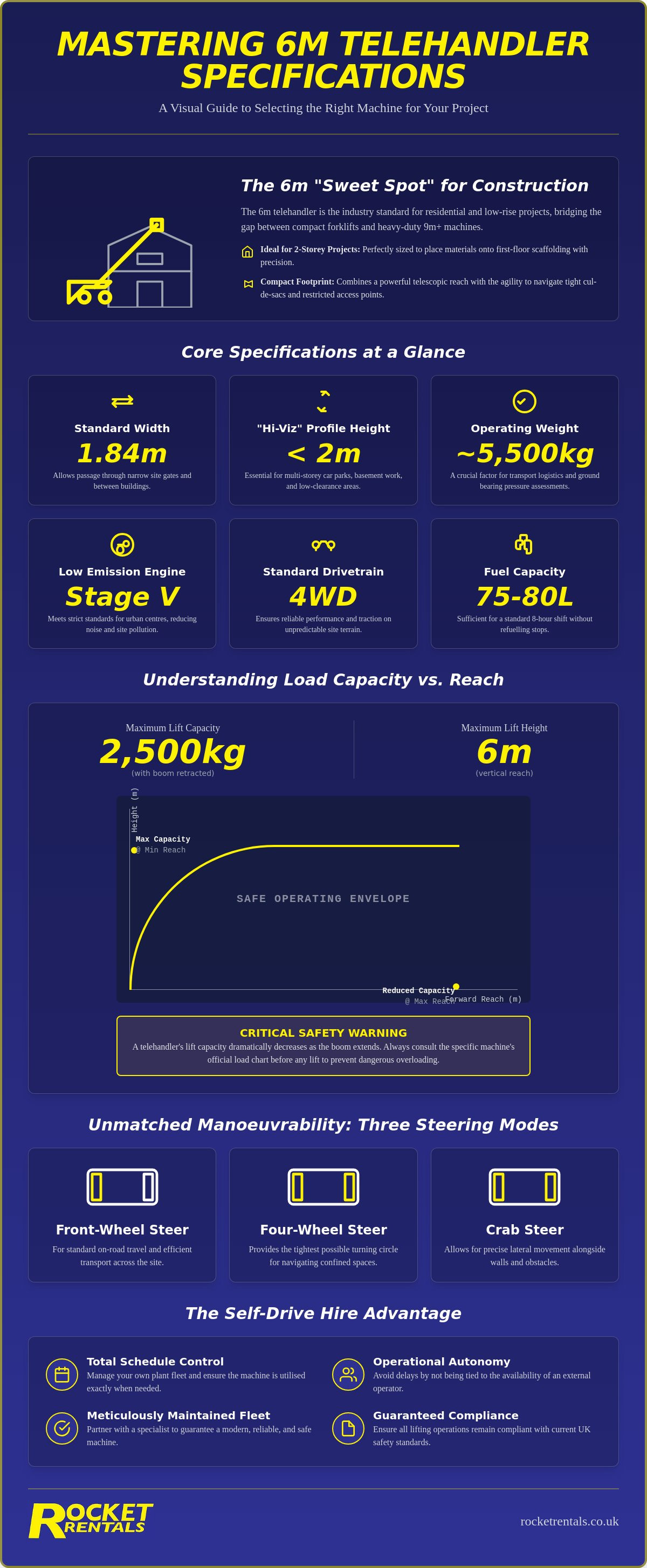
A Telescopic handler in the 6m class, often referred to as a compact loadall, serves as the recognised industry standard for residential groundworks and low-rise developments. These machines typically offer a 2,500kg maximum lift capacity, providing a robust solution for sites where space is at a premium. This specific category bridges the gap between small industrial forklifts and heavy-duty 9m+ construction telehandlers, offering the versatility required for modern building projects. When you are reviewing 6m telehandler hire specifications, the most striking advantage is how these machines combine the reach of a telescopic boom with a footprint similar to a small delivery van.
Choosing the right size isn't just about the lift height; it's about the machine's ability to navigate the reality of a working site. A 6m model provides enough power to handle heavy pallets of bricks or blocks whilst remaining agile enough to turn in tight spaces that would leave larger machines stranded. It's a "safe pair of hands" for any site manager who needs to balance high productivity with the constraints of a restricted footprint.
The "Sweet Spot" for Residential Construction
The 6m reach is specifically designed to meet the needs of two-storey building projects. It's the ideal height for placing palletised materials onto first-floor scaffolding with precision. On tight cul-de-sac developments, where access roads are narrow and parking is limited, the compact footprint of a 6m model is a significant advantage over 9m alternatives. These machines are often the first to arrive on a project, playing a vital role in the early stages of groundworks and site setup before the heavier lifting requirements of the main build begin.
Self-Drive vs. Operated Hire Considerations
Professional contractors often prefer self-drive hire because it allows for total control over site schedules and operator behaviour. By managing your own plant fleet through a specialist like Rocket Rentals Ltd, you can ensure that the machine is utilised exactly when needed, without being tied to the availability of an external operator. This level of autonomy is essential for maintaining a tight construction programme. If your project also requires earthmoving capabilities, you might find our professional guide to mini excavator hire helpful for coordinating your full plant requirements. Choosing a self-drive 6m telehandler hire specifications package ensures you have the right tool ready the moment your materials arrive on-site.
Core Technical Specifications: Dimensions and Power
When evaluating 6m telehandler hire specifications, the physical footprint of the machine is often the most critical factor for site managers. A standard unit in this class typically features a width of approximately 1.84m. This allows the machine to pass through narrow site gates or navigate between closely spaced buildings on a residential development. It is always wise to check the specific tyre options fitted to your rental, as wider flotation tyres can increase this overall width slightly, potentially impacting access to restricted areas.
Height is equally vital for indoor or subterranean projects. Low-profile "Hi-Viz" models are engineered to sit under 2m in height. This makes them the preferred choice for multi-storey car park renovations or basement works where overhead clearance is limited. Despite their compact size, these machines are built for durability. Most units weigh around 5,500kg, a figure that must be factored into your transport logistics and ground bearing pressure assessments. To ensure reliable performance across the unpredictable terrain of a UK building site, 4WD is a standard feature amongst our professional hire fleet.
Engine Performance and Fuel Efficiency
Modern 6m telehandlers are equipped with Stage V compliant engines, meeting the strict emission standards required for work in urban centres and low-emission zones. These power units are designed to minimise site noise and vibration, creating a safer and more comfortable environment for both the operator and local residents. With fuel tank capacities typically ranging between 75L and 80L, these machines can comfortably complete a standard 8-hour shift without the need for midday refuelling. If you are planning a complex project, you can view our full telehandler range to find the exact power profile for your needs.
Manoeuvrability and Steering Modes
The agility of a 6m telehandler is what truly sets it apart from other plant machinery. Operators can switch between three distinct steering modes to suit the task at hand:
Two-wheel steer: Ideal for road travel or high-speed site transit.
Four-wheel steer: Reduces the turning circle significantly, allowing the machine to out-manoeuvre a standard 4x4 vehicle in tight spaces.
Crab steer: Enables the machine to move diagonally, which is invaluable for precision placing in corners or when working alongside walls.
This level of control ensures that even in the most congested site conditions, your logistics remain fluid and efficient. The combination of a tight turning circle and specialised steering modes allows for the safe positioning of loads with centimetre-perfect accuracy. By utilising these modes correctly, operators can significantly reduce the time spent repositioning the machine, leading to a more productive site.
Load Capacity and Lift Height Analysis
Understanding the relationship between lift height and weight capacity is the most critical aspect of reviewing 6m telehandler hire specifications. Whilst a machine in this class is typically rated for a maximum lift capacity of 2,500kg, it is essential to recognise that this figure is only achievable when the boom is fully retracted and positioned at a high angle. As the boom extends upwards or outwards, the Safe Working Load (SWL) decreases to maintain the machine's centre of gravity. Operators must also distinguish between the stated "6m lift height" and the actual height of the forks. In technical terms, the 6m specification refers to the pin height; the pivot point where the forks attach to the boom. Depending on the tilt of the forks, your actual lifting height for a pallet may be slightly less than the headline figure.
Before beginning any lifting operation, you must locate and study the load chart provided inside the cab. This chart is usually found on the dashboard or the side window and provides a visual map of the machine's capabilities at various boom angles and extensions. Never rely on guesswork or memory. The load chart is your primary tool for ensuring every lift remains within safe operational limits, preventing the risk of forward tipping or structural stress.
Capacity at Maximum Reach
The "outreach" factor is where many site logistics plans encounter difficulties. When a 6m telehandler extends its boom horizontally to a full forward reach of approximately 3.3m, the lift capacity drops significantly, often to between 800kg and 1,000kg. This reduction is vital when planning how to unload delivery lorries. If you can only access a vehicle from one side, the telehandler must reach across the width of the trailer bed. If the pallet on the far side exceeds 1,000kg, the machine may reach its tipping point before the load is safely cleared. Always consider whether you need to organise site access for unloading from both sides to keep loads closer to the machine's front wheels.
Stability and Safety Systems
Modern telehandlers are equipped with sophisticated safety technology to protect the operator and site personnel. The Longitudinal Load Moment Indicator (LLMI) is a standard feature that monitors the weight on the rear axle. As a load moves further away from the machine and the rear axle lightens, the LLMI provides audible and visual warnings. If the limit is reached, many modern systems will automatically lock out further extension or lowering of the boom to prevent an accident. To ensure these systems function accurately, the machine must be operated on level ground. Where available, the chassis levelling system should be used to compensate for slight slopes, ensuring the boom remains vertical during the lift. Adhering to these 6m telehandler hire specifications ensures your site remains both productive and compliant with safety regulations.
Site Suitability: Access and Ground Conditions
Site suitability starts beneath the wheels. Even though these are compact units, the 6m telehandler hire specifications indicate a kerb weight of approximately 5,500kg. When fully loaded, the pressure exerted on the ground is substantial. You should ensure the site has stable, hardcore surfaces or utilise track mats to prevent the machine from sinking or becoming unstable during a lift. For projects requiring initial site clearance or trenching before the telehandler arrives, our guide to excavator hire South West provides an integrated approach to preparing your groundworks for heavy plant machinery.
Tyre choice is another variable that impacts site performance. Pneumatic tyres offer better traction and a smoother ride on soft, muddy terrain, whilst semi-solid tyres are the preferred option for waste sites or demolition projects where puncture risks are high. Matching the tyre to the terrain is a simple way to maintain uptime and ensure the machine operates within its design limits. If you're unsure which setup fits your terrain, contact our team today for professional advice on fleet selection.
Visibility and Urban Site Behaviour
Low-profile machines excel in urban environments. Their height, often sitting under 2m, allows for safe passage under low-hanging overhead cables and through height-restricted site entrances. This compact nature often reduces the complexity of your traffic management plans, as the machine takes up less room on the public highway during delivery and collection. Unlike some competitors who focus solely on cab comfort, the real safety advantage of modern 6m machines lies in the "Hi-Viz" design. By mounting the boom lower on the chassis, the operator's view to the rear offside is significantly improved. This is a critical safety factor when reversing in tight spaces where ground staff may be present.
Attachment Versatility for Material Handling
The utility of a 6m telehandler extends beyond simple fork work. Whilst pallet forks are the standard for unloading distribution lorries, the machine can be equipped with rehandling buckets for moving loose aggregates or tipping skips for site clearance. This versatility makes the 6m model a true "Swiss Army Knife" on site. The process of switching between these tools is made safe and efficient through the Q-Fit carriage system. This allows the operator to change attachments in minutes, ensuring the machine remains productive throughout the day without the need for additional lifting equipment. Understanding these 6m telehandler hire specifications allows you to plan a more efficient, multi-tasking site logistics strategy.
Sourcing 6m Telehandler Hire for Your Project
Sourcing the right plant is the final step in translating 6m telehandler hire specifications into site productivity. When you choose a self-drive specialist like Rocket Rentals Ltd, you're ensuring the machine arriving on your site is meticulously maintained and ready for immediate work. We focus on providing a modern fleet that meets the highest safety standards, allowing you to manage your own project timelines without the variables associated with operated plant. This autonomy is essential for maintaining control over site schedules and ensuring that machinery is utilised efficiently throughout the working day.
Logistical coordination is vital for a smooth project start. You should organise delivery and collection to align precisely with crane arrivals or lorry deliveries to avoid unnecessary site congestion. Every machine we supply comes with a valid Report of Thorough Examination (LOLER). This certification is your proof that the lifting equipment has been independently inspected and is safe for use; it's a non-negotiable requirement for any professional site. By verifying these documents upon arrival, you can proceed with your lifting operations with absolute peace of mind.
Often, a telehandler is just one part of a wider equipment strategy. You can naturally integrate your 6m telehandler hire specifications with other site essentials, such as scissor lifts for internal fit-outs or high-level maintenance. This holistic approach ensures that every phase of your project, from the first pallet of bricks to the final electrical installation, is supported by reliable, high-quality machinery from a single, trusted partner.
The Rocket Rentals Ltd Standard
Since 1988, we've built a reputation as a "safe pair of hands" in the plant hire industry. Our fleet includes industry-leading brands like JCB, chosen for their reliability and ease of operation. We don't just provide equipment; we provide the assurance that your project won't be stalled by preventable mechanical issues. Our commitment to high maintenance standards and modern engine technology makes our self-drive model the favourite amongst experienced site managers who value efficiency and safety above all else.
Next Steps: Booking Your Hire
Booking your machinery is a straightforward process designed to support your schedule. To provide an accurate quote, we'll need your site access details, the anticipated duration of the hire, and verification of your hired-in plant insurance. This preparation ensures a smooth handover and allows our team to confirm that the chosen machine perfectly matches your site's physical constraints and lifting requirements. If you're ready to secure your machinery, Enquire about 6m Telehandler Hire today to discuss your project with our expert team.
Optimising Your Site Logistics with Precision
Mastering the technical details of 6m telehandler hire specifications ensures that your project remains both safe and efficient from the moment the machine arrives on-site. By accurately assessing your access constraints and respecting the dynamic load limits of the telescopic boom, you can avoid costly delays and maintain a compliant working environment. Whether you are navigating tight urban developments or placing materials onto first-floor scaffolding, the right data allows for precise planning and flawless execution.
As independent plant hire specialists since 1988, we provide a modern, Stage V compliant fleet designed to meet the rigorous demands of professional contractors. Our expertly maintained self-drive machinery offers the reliability you need to manage your site schedules with absolute confidence. When you partner with a "safe pair of hands," you're choosing a standard of care that prioritises your project's success and the safety of your ground staff.
View our Telehandler Hire range and request a quote today to secure the ideal machine for your next build. We look forward to supporting your site logistics with the quality and reliability your project deserves.
Frequently Asked Questions
What is the maximum lift capacity of a 6m telehandler?
A 6m telehandler typically offers a maximum lift capacity of 2,500kg when the boom is fully retracted and at a high angle. This capacity decreases significantly as the boom extends horizontally; at a full forward reach of approximately 3.3m, the limit often drops to around 800kg to 1,000kg. Adhering to these 6m telehandler hire specifications is vital for maintaining site safety and ensuring the machine operates within its design limits.
Can a 6m telehandler fit through a standard garage door?
A standard 6m telehandler might struggle with a typical domestic garage door, which often measures around 2.1m in height. However, low-profile "Hi-Viz" models are specifically designed to sit under 2m, making them suitable for many commercial height-restricted entrances and multi-storey car parks. You should always measure the specific opening on your site and compare it against the machine's transport height and width of 1.84m before booking.
What is the difference between a 6m and a 7m telehandler?
The primary difference lies in the vertical reach and the physical footprint of the machine. A 7m model provides an extra metre of lift height and often a slightly higher load capacity at full reach, but it usually requires more space to manoeuvre. The 6m version is the preferred choice for tight residential sites and urban projects where a smaller turning circle and compact dimensions are the priority.
Do I need a special licence for self-drive telehandler hire?
You don't need a specific driving licence for on-site operation, but you must provide proof of competence through an accredited certification scheme such as CPCS or NPORS. If you intend to drive the machine on a public road, a valid UK Category B driving licence is mandatory. Because we specialise in self-drive hire, ensuring your operator is correctly certified is a key part of the professional booking process.
What ground conditions are required for a 6m telehandler?
These machines require stable, level ground such as compacted hardcore, tarmac, or concrete to operate safely during lifting. Because a 6m telehandler weighs approximately 5,500kg, soft soil or unmade ground can lead to instability or the machine becoming bogged down. if your site conditions are poor, we recommend using heavy-duty track mats to distribute the weight and maintain a safe, level lifting platform.
Can I use a 6m telehandler for lifting people with a basket?
You cannot use standard pallet forks to lift people in a makeshift basket as this violates strict health and safety regulations. A telehandler can only be used for lifting personnel if it is specifically configured with a purpose-built, integrated work platform that complies with MEWP standards. For dedicated high-level access, a specialised scissor lift is often a more appropriate and compliant solution for your ground staff.
How much fuel does a 6m telehandler use per day?
Fuel consumption depends on the intensity of the work, but modern Stage V engines are designed for high efficiency. With a typical fuel tank capacity of 75L to 80L, most 6m models can comfortably complete a standard 8-hour shift of material distribution on a single tank. This ensures your site remains productive without the need for frequent refuelling stops during the working day.
Are attachments like buckets included in the hire price?
Standard pallet forks are typically included as the primary attachment for unloading and distributing building materials. Other specialised tools, such as rehandling buckets, tipping skips, or crane jibs, are usually available as optional extras depending on your specific project requirements. It's best to discuss your full task list with our team to ensure you have the correct 6m telehandler hire specifications and attachments for the job.


Comments