
Ride-On Roller Hire Prices: A Professional’s Buying Guide for 2026
- Rocket Rentals
- Jul 14
- 12 min read
Is the lowest headline rate on your quote actually the final price you'll pay, or is it merely the starting point for a series of hidden extras? Most site managers have experienced the frustration of a project stalling because a budget-friendly machine arrived late or proved unreliable under pressure. When you are researching ride on roller hire prices, you aren't just looking for a number; you're looking for the certainty that your equipment will perform exactly as expected from the moment it reaches the site.
We recognise that vague insurance requirements and unexpected delivery charges can complicate even the most carefully planned groundworks. This guide provides the transparency you need to budget accurately for 2026, helping you to secure the best value for your specific project needs. We will examine the factors that influence weekly hire rates for different drum sizes, clarify essential hirer responsibilities, and show you how to streamline logistics for national delivery with a partner you can trust.
Table of Contents
Understanding Ride-On Roller Hire: Value Beyond the Day Rate
Choosing the Right Machine: 800mm vs 1200mm Twin Drum Rollers
Breaking Down Ride-On Roller Hire Prices: What to Expect in 2026
Beyond the Basic Rate: Factoring in Delivery, Fuel, and Insurance
Why Professional Contractors Choose Rocket Rentals for Compaction Equipment
Understanding Ride-On Roller Hire: Value Beyond the Day Rate
For the modern contractor, plant procurement is less about ownership and more about operational agility. Selecting a ride on roller is a strategic decision that directly impacts the structural integrity of every layer, from the sub-base to the finishing course. Whilst the initial search often focuses on the lowest ride on roller hire prices, seasoned professionals understand that the headline figure is only one part of the equation. True value lies in machine uptime, fuel efficiency, and the absence of hidden administrative burdens that can derail a project's budget.
Why do leading firms prefer hire over purchase? Owning a heavy road roller involves significant capital expenditure, ongoing maintenance costs, and the logistical headache of secure storage. Since 1988, we have seen how opting for a hire partner like Rocket Rentals allows contractors to preserve cash flow whilst ensuring access to a modern, safety-checked fleet. This approach eliminates the risk of using ageing machinery that might fail at a critical moment in your schedule, ensuring that your site remains productive and your deadlines are met.
The Role of Compaction in Groundworks Efficiency
Correct compaction is the foundation of site safety and project longevity. Whether you are preparing a sub-base with hardcore, laying a new driveway with gravel, or finishing a car park with asphalt, the density of the material must meet strict engineering standards. Poorly compacted ground leads to subsidence, cracking, and costly remedial works. Investing in high-quality compaction equipment ensures a superior finish, which ultimately protects the reputation of your business and improves the return on investment for your client. Using the right machine for the specific material is essential for achieving these results without wasted effort.
Self-Drive vs. Operated Hire: Why Professionals Choose Self-Drive
Rocket Rentals specialises in self-drive hire, a model that offers maximum flexibility for busy sites. By providing the machine without an operator, we allow you to utilise your own qualified workforce, which often proves more cost-effective than paying for a third-party driver. This setup gives you total control over your daily schedule. You aren't restricted by an external operator's hours; instead, you can organise the compaction work amongst your existing tasks. This ensures the roller is active exactly when the material arrives on site, allowing for better coordination and reduced downtime across your national projects.
When you evaluate ride on roller hire prices, consider the "Total Cost of Hire." A slightly higher rate for a modern, reliable machine from a specialist provider often results in lower overall costs by preventing delays and ensuring first-time compaction success. Reliability is not just a preference; it is a prerequisite for a profitable groundworks project.
Choosing the Right Machine: 800mm vs 1200mm Twin Drum Rollers
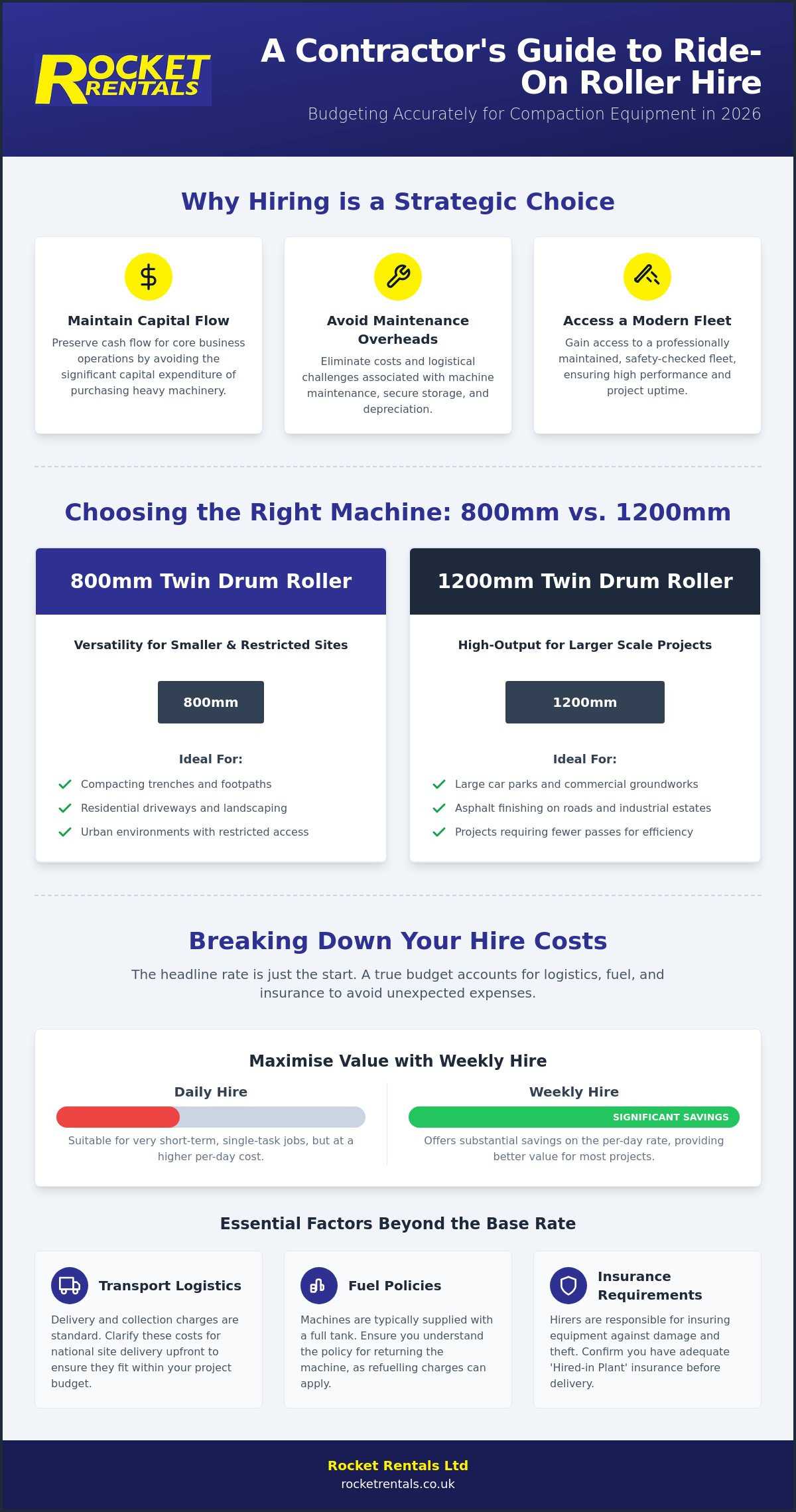
Selecting the correct drum width is a primary driver of both site efficiency and the final invoice you receive. Whilst it might be tempting to opt for the largest machine available, the physical constraints of your site and the specific compaction depth required by your engineer should dictate the choice. Machine size directly influences ride on roller hire prices, but the most expensive mistake is hiring a roller that cannot access the work area or lacks the centrifugal force to meet density specifications in a single pass.
Matching the roller's static weight and vibratory output to your material layer is essential. A machine that is too light will require excessive passes, increasing fuel consumption and labour costs. Conversely, a machine that is too heavy for a thin asphalt overlay can crush the aggregate and ruin the finish. Following established NIOSH safety guidelines regarding machine stability and operator visibility is also vital when choosing between these two common sizes, especially on sites with varying gradients.
800mm Rollers: Versatility for Smaller Sites
The 800mm twin drum roller is the preferred choice for utility contractors and residential landscapers. Its narrow footprint makes it ideal for compacting trenches, driveways, and footpaths where a larger machine simply wouldn't fit. These rollers offer exceptional manoeuvrability in restricted urban environments, allowing operators to work close to walls and kerbs. Because they are lighter and more compact, transport costs are often lower, making them a cost-effective solution for short-term projects or sites with limited access.
1200mm Rollers: High-Output Compaction for Infrastructure
When the project involves large surface areas like car parks or new road construction, the 1200mm twin drum roller is the industry standard. The increased drum width and higher centrifugal force allow for rapid coverage, significantly reducing the number of passes required to reach the desired compaction level. This speed of operation directly translates to lower labour costs. On larger groundworks projects, these machines are frequently paired with our excavator hire South West services to maintain a consistent workflow from bulk excavation through to final surface preparation.
If you are unsure which machine fits your site drawings, our team can help you select the right compaction equipment to ensure your project remains on schedule. Understanding the nuances of each model ensures you don't overpay for capacity you don't need or under-equip a high-output site. Balancing these factors is the most effective way to manage your ride on roller hire prices whilst maintaining professional standards.
Breaking Down Ride-On Roller Hire Prices: What to Expect in 2026
Accurate project forecasting depends on understanding the variables that dictate ride on roller hire prices. Whilst many providers keep their rates hidden behind a "request a quote" button, the underlying costs are driven by a predictable set of industry factors. In 2026, the primary influence on your final invoice will remain the duration of the hire. Most plant providers operate on a sliding scale where the daily rate decreases as the commitment increases. For example, a full weekly hire often represents significantly better value than two separate daily bookings, as it reduces the administrative and logistical overhead for the supplier.
You should also be wary of the "Weekend Rate" trap. Many contractors assume that hiring a machine for Saturday and Sunday will simply cost two days' worth of hire. However, because transport teams often don't work standard hours on weekends, you may find that a two-day weekend hire incurs a premium or a minimum charge to cover the specific logistics of delivery and collection outside of the standard working week. Planning your compaction schedule to align with a Monday-to-Friday window is often the most effective way to keep your ride on roller hire prices within budget.
Availability also fluctuates with the seasons. During the peak construction months of spring and summer, demand for compaction equipment can outstrip supply, leading to firmer pricing and a need for earlier bookings. Furthermore, the age of the fleet plays a role. A premium provider that invests in top-tier brands and modern machinery may charge a slightly higher base rate, but this is an investment in uptime and safety that pays dividends through site efficiency.
Tiered Pricing Structures for Professional Contractors
If you are managing multiple sites or a large-scale infrastructure project, account-based pricing offers a level of consistency that one-off retail hires cannot match. Professional contractors benefit from established relationships where "rolling" hire agreements provide fixed rates over longer periods. This transparency allows for more precise tendering. When requesting a quote, always provide your specific project timeline; a bespoke agreement tailored to a three-month project will look very different from a standard weekly rate.
Why "Cheap" Hire Can Cost More in the Long Run
The true cost of plant hire is found in the reliability of the machine. A "cheap" daily rate becomes incredibly expensive the moment a machine breaks down, leaving your groundworks team idle and your material deliveries wasted. Modern rollers equipped with Tier 5 engines not only offer better reliability but also significantly reduce on-site running costs through improved fuel efficiency. These machines meet the latest emissions standards, which is increasingly a prerequisite for major national contracts. Hire value is the balance between rate, reliability, and service.
Beyond the Basic Rate: Factoring in Delivery, Fuel, and Insurance
Understanding the headline figure is only the start of your budgeting process. When you compare ride on roller hire prices, you must account for the logistical and operational expenses that complete the total cost of hire. Transporting heavy compaction equipment requires specialised vehicles and precise scheduling. Whether you are hiring an 800mm or 1200mm model, the physical size of the machine and the distance to your site will dictate the delivery and collection fees. Planning for these variables ensures that your final ride on roller hire prices remain transparent and predictable.
Fuel management is another area where costs can escalate if not managed proactively. Most professional hire companies operate a "Full to Full" policy. This means the machine arrives with a full tank of diesel, and you are expected to return it in the same condition. If the roller returns empty, you'll likely face refuelling surcharges that are significantly higher than standard pump prices. Cleaning fees are also avoidable but common. Returning a roller with drums heavily encrusted in dried bitumen or mud requires intensive cleaning; this often results in a surcharge to cover the additional labour and specialised cleaning agents required.
Navigating National Delivery Logistics
Rocket Rentals organises timely delivery to sites across the country, ensuring your project remains on schedule regardless of location. To avoid "aborted delivery" charges, you should provide clear access instructions and ensure a qualified person is on site to sign for the equipment. Sourcing all your plant from a single, reliable partner simplifies these logistics. It reduces the administrative burden of coordinating multiple transport windows and ensures that your machinery arrives ready for immediate use.
Insurance Requirements for Professional Plant Hire
Hirers are contractually responsible for the equipment whilst it is on their site. A standard "Hired-In Plant" policy is a prerequisite. At a minimum, your policy should cover:
Total replacement value of the machine in the event of theft or total loss.
Accidental damage sustained during operation or transit on site.
Ongoing hire charges incurred whilst the machine is being repaired or replaced.
Verifying that your cover is active and adequate before the machine arrives is a critical safety step. This requirement is consistent across our range, including mini excavator hire, where similar CPA (Construction Plant-hire Association) terms apply. Before you book your next project, ensure your insurance is in order and request a comprehensive quote to see the full breakdown of your hire costs.
Why Professional Contractors Choose Rocket Rentals for Compaction Equipment
Since 1988, Rocket Rentals has positioned itself as a dependable partner for professional groundworks and civil engineering projects. We don't just supply machinery; we provide the certainty that your compaction tasks will be completed without technical failure or administrative delay. Our approach to ride on roller hire prices is built on a foundation of transparency. We ensure that the quote you receive reflects the true cost of a reliable service, removing the ambiguity that often plagues plant procurement. This allows site managers to focus on the technical execution of their projects rather than managing unexpected invoices.
Our team provides expert guidance that goes beyond simple equipment listings. We help you choose between an 800mm and a 1200mm twin drum roller by reviewing your specific site drawings. This proactive approach ensures you aren't paying for excess capacity you don't need or, conversely, struggling with a machine that lacks the centrifugal force required for your sub-base specifications. By matching the equipment to the task, we help you maintain the highest professional standards whilst keeping your ride on roller hire prices within a predictable budget.
The Benefits of a Modern, High-Spec Fleet
Investing in a modern, high-spec fleet is a cornerstone of our commitment to site efficiency. These machines feature the latest compaction technology, which naturally reduces your carbon footprint and improves on-site fuel economy compared to older models. There is also a distinct psychological benefit for your workforce. Providing clean, reliable equipment fosters a culture of pride and safety amongst your team. We focus exclusively on self-drive hire because we trust in the competence of professional operators to handle our premium machinery with the care it deserves.
Secure Your Ride-On Roller Hire for 2026
Securing your compaction equipment for the 2026 season is a straightforward process. Opening a professional hire account with us allows for streamlined billing and priority access to our national fleet. This setup is particularly beneficial for contractors managing rolling infrastructure projects where consistency of equipment and service is vital. We provide rapid, transparent quotes that allow for precise project tendering and financial planning. Don't leave your site efficiency to chance with unreliable machinery or vague pricing structures.
View our full range of rollers and request a quote today to ensure your next groundworks project is supported by a partner that values reliability and safety as much as you do.
Optimising Your Groundworks Budget for 2026
Reaching your project milestones on time requires more than just a piece of equipment; it requires a partnership built on transparency and technical expertise. By selecting the correct drum width for your specific site drawings and prioritising weekly hire durations, you can significantly reduce your operational overheads. We've established that finding the most competitive ride on roller hire prices involves looking beyond the base rate to consider machine reliability and logistical efficiency.
As independent plant hire specialists since 1988, Rocket Rentals provides a modern fleet equipped with the latest safety features and dedicated support for professional contractors. We are committed to being the "safe pair of hands" for your national projects, ensuring that hidden delivery charges or unreliable machinery never compromise your site's progress. Our team is ready to help you navigate the complexities of plant logistics with a focus on uptime and safety at every stage of the process.
Request a transparent quote for ride-on roller hire to secure the best value for your 2026 groundworks schedule. We look forward to supporting your next project with the reliability and professional care your business deserves.
Frequently Asked Questions
How much does it cost to hire a ride-on roller for a week?
Weekly hire rates depend on the drum width and the specific model required for your project. Generally, hiring for a full week offers a significantly lower daily rate compared to short-term or one-off day bookings. When calculating your total ride on roller hire prices, ensure you account for the mandatory VAT, delivery charges, and any required damage waivers that may apply to the final invoice.
Do I need a special licence for self-drive ride-on roller hire?
While you don't legally require a standard UK driving licence to operate a roller on a private, enclosed site, professional contractors usually require operators to hold a valid CPCS or NPORS card. These certifications prove the operator has undergone the necessary training to handle heavy plant safely. Ensuring your team is correctly qualified is a vital step in maintaining site safety and meeting your insurance obligations.
What is the difference between a twin drum and a single drum roller?
Twin drum rollers feature two vibrating steel drums and are the industry standard for compacting asphalt, driveways, and sub-base layers to a smooth finish. Single drum rollers have a vibrating front drum and large rear tyres, making them better suited for heavy earthworks and bulk fill compaction on larger civil engineering projects. For most urban groundworks and road surfacing, the twin drum models we provide are the most efficient choice.
Are fuel costs included in the ride-on roller hire price?
Fuel costs are not included in the base ride on roller hire prices. We supply our machinery with a full tank of white diesel, and we expect the equipment to be returned full at the end of the hire period. If the machine returns with a partial tank, a refuelling surcharge will be applied based on current fuel rates plus an administrative fee. This "full to full" policy is the most transparent way to manage on-site energy costs.
Can you deliver a ride-on roller to my site tomorrow?
Next-day delivery is frequently available depending on our current fleet capacity and your site location. We maintain a modern fleet to ensure high availability, but we always recommend booking as early as possible during the peak construction season to secure your preferred machine size. Providing clear access instructions and a site contact name when you book helps us to guarantee a smooth and timely delivery process.
What happens if the hired roller breaks down on-site?
You should contact our service desk immediately if you encounter any technical issues. We pride ourselves on machine reliability, but if a breakdown occurs, we prioritise a rapid response to minimise your site downtime. Our engineers will either repair the machine on-site or arrange for a replacement to be delivered as quickly as possible, ensuring your compaction schedule remains on track and your labour costs stay controlled.
Is insurance included in the hire rate?
Insurance is not included in the standard hire rate and remains the responsibility of the hirer. You must have adequate "Hired-In Plant" insurance that covers the full replacement value of the equipment against theft, fire, and accidental damage. It is a contractual requirement to have this cover in place before the machine is offloaded at your site. We recommend verifying your policy limits with your broker before confirming your booking.
How do I calculate the delivery cost for plant hire?
Delivery and collection fees are calculated based on the distance between our nearest depot and your site postcode. The size of the machine also dictates the type of transport vehicle required, which influences the transport rate. We provide a clear, fixed delivery quote at the point of enquiry, so you can accurately factor these logistics into your project's total groundworks budget without worrying about hidden surcharges.


Comments