
Scissor Lift vs Telehandler: Which Plant Equipment Does Your Site Need?
Choosing the most powerful machine on the lot doesn't guarantee your project will stay on schedule. In fact, selecting the wrong equipment for vertical access often leads to costly bottlenecks and unnecessary safety risks. When you're staring at a site plan, the scissor lift vs telehandler debate usually comes down to more than just how high you need to reach. You need a solution that balances lifting capacity with the specific constraints of your environment.
It's frustrating when a hire doesn't perform as expected because the ground is too soft or the platform isn't stable enough for your team. We understand that ensuring personnel safety whilst maintaining a strict timeline is your top priority. This article provides the clarity you need to hire the most efficient and cost-effective machinery for your specific project goals. We'll explore the critical differences in outreach, platform stability, and LOLER compliance to ensure your next self-drive hire is a "safe pair of hands" for your site. By the end, you'll have the confidence to choose the exact tool that maximises both your ROI and your team's productivity.
Table of Contents
Scissor Lift vs Telehandler: Defining the Roles of Vertical Access and Material Handling
Technical Specifications: Load Capacity, Reach, and Outreach Compared
Operational Environments: Assessing Site Terrain and Spatial Constraints
Safety and Certification: Meeting Compliance for Self-Drive Hire
Choosing Your Fleet: How to Organise Effective Plant Hire for Your Project
Scissor Lift vs Telehandler: Defining the Roles of Vertical Access and Material Handling
Selecting the right plant for your site isn't just about reaching a certain height; it's about the fundamental nature of the task at hand. One machine is designed to provide a stable, spacious base for personnel, while the other is a heavy-duty powerhouse built for moving materials across a site. Miscalculating this choice often leads to project delays or, more seriously, safety compromises. Identifying whether your priority is moving people or heavy loads is the first step in successful site planning.
The scissor lift vs telehandler debate usually starts with the trajectory of the lift. If your team needs to work directly above the machine's base, a vertical platform is the logical choice. However, if you need to reach over obstacles or transport materials across uneven ground, you require the horizontal outreach of a boom-based system. Matching the machine to the specific site requirement ensures you maintain professional standards whilst protecting your project's bottom line.
Defining the Scissor Lift: Pure Vertical Stability
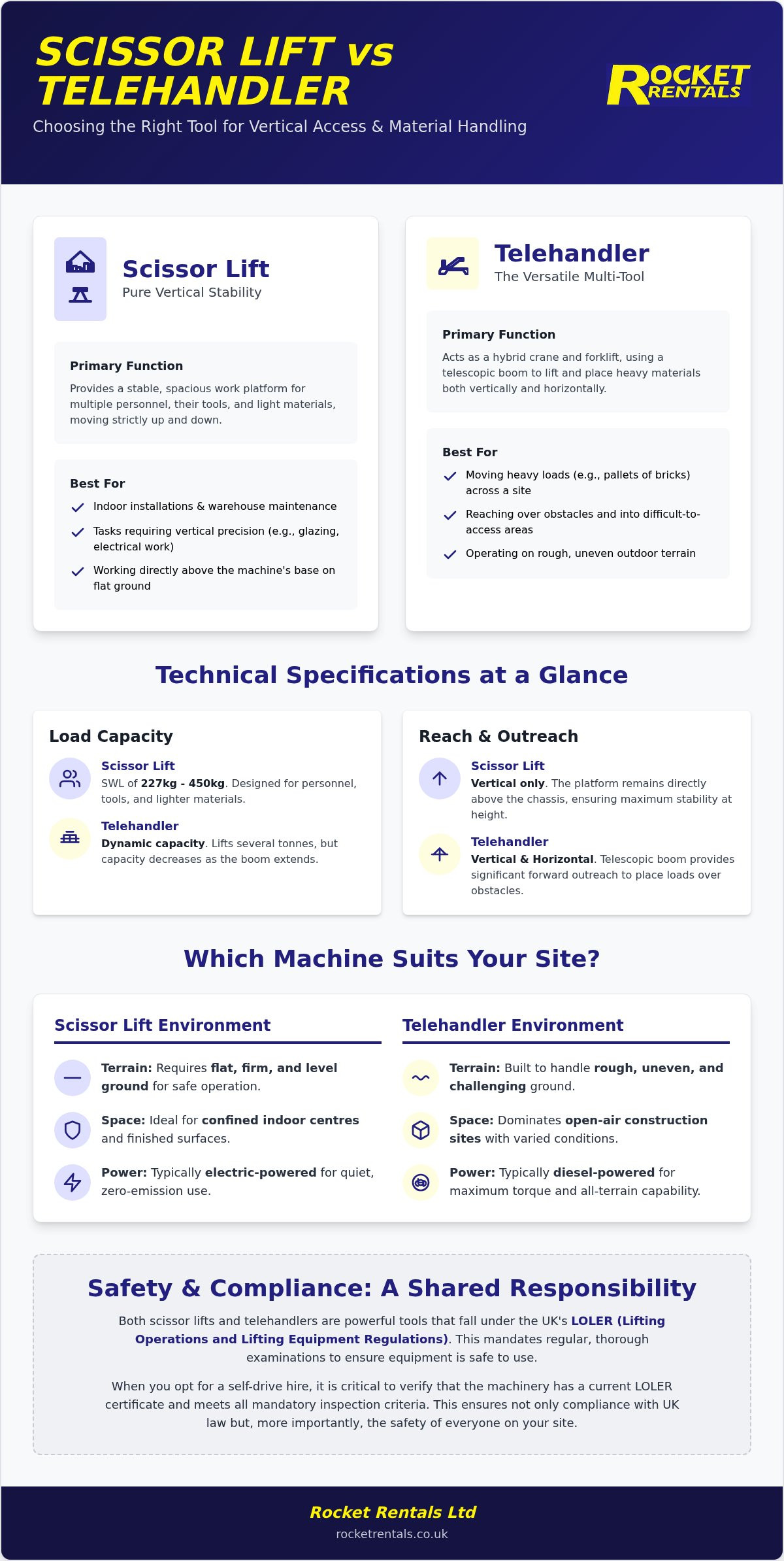
A scissor lift is a specific type of aerial work platform that moves exclusively in a vertical direction. It uses a linked, folding support mechanism in a criss-cross pattern to elevate a large platform. Because the platform stays directly above the base, it offers exceptional stability for multiple workers and their tools. These machines are the preferred choice for tasks requiring a steady workspace on flat, firm ground. You'll frequently see them used for indoor installations, warehouse maintenance, and glazing projects where vertical precision is paramount.
Defining the Telehandler: The Versatile Multi-Tool
The telehandler, or telescopic handler, functions more like a versatile multi-tool. Unlike the vertical-only movement of a scissor lift, the telehandler features a telescopic boom that can extend both upwards and forwards. This horizontal outreach is its greatest strength, allowing it to place materials into difficult-to-reach areas or lift loads over obstacles. It's essentially a hybrid of a crane and a forklift. By using various attachments like forks or lifting jibs, it handles heavy material transport across varied, rough terrain with ease. This makes it indispensable for the early stages of construction where ground conditions are often challenging.
Ultimately, the decision hinges on the load. If you need to send three electricians and their equipment straight up to a ceiling, the scissor lift provides the necessary platform space. If you need to move a pallet of bricks from a delivery lorry to a second-storey scaffold, the telehandler is the correct tool. Understanding these primary functions ensures your site remains efficient and compliant with safety standards.
Technical Specifications: Load Capacity, Reach, and Outreach Compared
When evaluating the scissor lift vs telehandler debate, technical specifications provide the objective data needed for a safe site. The most significant metric to consider is the Safe Working Load (SWL). SWL is the maximum weight a machine is certified to safely lift, including personnel, tools, and materials. Whilst both machines are designed to elevate loads, the way they distribute that weight varies significantly based on their mechanical design and intended application.
Personnel and Tool Capacity on Scissor Lifts
Scissor lifts are engineered primarily for personnel access. Typical electric models in a modern hire fleet often provide an SWL ranging from 227kg to 450kg. Rough terrain versions, designed for outdoor use, frequently offer higher capacities to accommodate more workers. One of their greatest efficiency advantages is the deck extension. These slide-out sections increase the platform area, allowing your crew to handle bulky materials like ducting or plasterboard without repositioning the base. This vertical precision makes them ideal for tasks where multiple people need to work simultaneously at the same height. However, their weight is often concentrated over a smaller footprint, so you must assess floor loading capacities when working on finished indoor surfaces.
Telehandler Lift Charts and Load Dynamics
Telehandlers offer a different dynamic because their capacity changes as the boom extends. In the plant hire industry, reach refers to the maximum vertical height, whilst outreach describes the horizontal distance from the front of the machine. As the boom extends forward, the lifting capacity drops sharply due to the principles of leverage. Every operator must consult the specific lift chart for their machine before attempting a high-reach manoeuvre. Typical fleet options range from compact 7-metre units to 17-metre heavy lifters. Whilst UK operations are governed by LOLER, international benchmarks like OSHA standard 1910.178 highlight the global importance of understanding load stability for powered industrial trucks.
Machine weight also plays a vital role in your logistics planning. Telehandlers are significantly heavier than most scissor lifts, often requiring substantial transport arrangements. Their weight is necessary for counterbalancing heavy loads at height, but it can limit their use on sensitive ground. If you're unsure which capacity meets your site's specific requirements, our team can help you choose the right self-drive hire for your project. Balancing these technical specs ensures you don't just get the job done, but you do so with the highest standards of efficiency and safety.
Operational Environments: Assessing Site Terrain and Spatial Constraints
The physical environment of your site often dictates the final choice in the scissor lift vs telehandler comparison. A machine's reach is irrelevant if the ground cannot support its weight or the corridors are too narrow for its footprint. Assessing the workspace early prevents the logistical headache of a machine arriving on-site only to find it's physically unable to reach the work zone. You must consider both the surface conditions and the spatial constraints of the route the machine will take to the task.
Machine footprint plays a vital role in manoeuvrability. Scissor lifts are typically more compact, making them the preferred choice for navigating tight site corridors or working between fixed machinery. This demand for agile, space-efficient equipment is also seen in the service sector; for instance, many hospitality, healthcare, and retail facilities now explore Monthly Robots-as-a-Service (RaaS) Subscription Fees to deploy intelligent robots that navigate busy environments. In contrast, telehandlers require a larger operating area. When these machines extend their booms to significant heights or distances, they often rely on outriggers or stabilisers to maintain a safe centre of gravity. This additional footprint must be accounted for in your site planning to ensure you don't block essential access routes whilst the machine is in operation.
Indoor Access and Clean Environment Requirements
For indoor fit-outs, retail centres, or warehouse maintenance, electric scissor lifts are almost always the favourite. Their zero-emission operation ensures air quality remains safe in enclosed spaces, whilst their non-marking tyres protect finished flooring from unsightly scuffs. These machines are designed to be narrow enough to pass through standard doorways, providing a level of accessibility that larger plant simply can't match. If you're planning an interior project, our Electric Scissor Lift Hire: The Professional Guide to Clean Access Solutions provides a deeper look at these specialised machines.
Navigating Challenging Ground and Rough Terrain
On unfinished sites where mud and loose soil are common, the telehandler excels. Equipped with four-wheel drive and oscillating axles, these machines maintain traction across uneven ground that would leave a standard electric lift stranded. However, there's a middle ground to consider. If you need vertical access on a rough site, a rough terrain scissor lift is a viable alternative. Unlike their indoor counterparts, these models feature foam-filled tyres and high ground clearance, allowing them to traverse difficult terrain whilst still providing a large, stable platform for your crew. Choosing between a rough terrain lift and a telehandler depends on whether you're navigating the terrain to move materials or to provide a static work position for personnel.
Safety and Certification: Meeting Compliance for Self-Drive Hire
Operating heavy plant on UK sites requires strict adherence to the Lifting Operations and Lifting Equipment Regulations (1998), commonly known as LOLER. These regulations mandate that all lifting equipment is fit for purpose and subject to regular, thorough examinations. When you manage a self-drive hire, the responsibility for safe operation shifts to your internal team. This necessitates a robust risk assessment that prioritises overhead hazards, ground stability, and potential crush risks. Choosing between a scissor lift vs telehandler involves understanding these distinct safety profiles to ensure your site remains incident-free and compliant with PUWER standards.
Self-drive hire offers you greater control over your project timeline, but it also requires a higher level of internal safety management. You aren't just hiring a machine; you're taking responsibility for its daily checks and the competence of the person behind the controls. This "safe pair of hands" approach is what separates a professional site from one at risk of costly delays or inspections.
Operator Qualifications: IPAF vs CPCS
The certification required depends entirely on the machine type you choose. For scissor lifts, operators typically need an International Powered Access Federation (IPAF) PAL card. Category 3a covers mobile vertical lifts, whilst 3b is required for mobile booms. Telehandler operation is governed by different bodies, usually requiring a Construction Plant Competence Scheme (CPCS) or National Plant Operators Registration Scheme (NPORS) card. A standard operator card from these accredited bodies is typically valid for a period of five years before renewal or refresher training is required. Ensuring your team holds the correct, up-to-date credentials is a non-negotiable aspect of professional site management.
Site-Specific Safety Protocols
Reliability begins with a thorough pre-use inspection every single morning. Before any work starts, your operator must check for hydraulic leaks, test emergency stop functions, and verify the integrity of the platform or boom. Managing the workspace is equally vital, particularly with telehandlers. Because these machines move materials through the air, you must establish and maintain a clear exclusion zone to protect ground workers from falling objects or swinging loads.
PPE requirements also differ based on the equipment in use. Whilst a harness and short lanyard are essential in boom-type platforms, they are often not required in a scissor lift unless a specific risk assessment identifies a peculiar fall risk. However, hard hats, high-visibility vests, and safety boots remain standard across all operations. By maintaining these high standards, you protect both your personnel and your project's reputation. To ensure your team has access to the highest quality equipment, you can view our range of self-drive hire options today.
Choosing Your Fleet: How to Organise Effective Plant Hire for Your Project
Effective site management relies on the strategic orchestration of plant equipment rather than simply selecting a single machine for every task. Whilst the scissor lift vs telehandler debate often focuses on which machine is better, the most productive sites often utilise both in a phased approach. By planning your fleet requirements around your project timeline, you ensure that materials are moved efficiently and personnel can work safely at height without one process delaying the other. This coordinated strategy minimises redundant hire costs and keeps your site moving at a steady, predictable pace.
To avoid unnecessary expenditure, you must assess exactly when each machine is required. Hiring a telehandler weeks before your materials arrive or keeping a scissor lift on-site before the floor slab is cured leads to wasted budget. A reliable, independent plant hire specialist provides the technical guidance needed to time these hires perfectly. This professional partnership ensures you have the right specification of machinery exactly when it's needed, maintaining the momentum of your build.
Maximising Site Efficiency with the Right Mix
The most efficient projects use telehandlers for the heavy lifting during the structural phase, distributing pallets of blocks, steelwork, and roofing materials across the site footprint. Once the structure is weathered in and the floors are level, scissor lifts take over for the internal fit-out, providing the stable vertical platforms needed for electrical, HVAC, and glazing installations. This transition from material handling to personnel access is a hallmark of a well-managed project. For further insights into coordinating different machine types, you can read The Professional Guide to Mini Excavator Hire: Maximising Site Efficiency. Using well-maintained, modern plant equipment across your entire fleet reduces the risk of mechanical downtime, ensuring your team remains productive from the first day of hire to the last.
The Rocket Rentals Standard for Self-Drive Plant
As an independent specialist since 1988, we're committed to providing high-specification, reliable machinery that serves as a "safe pair of hands" for your project. Our focus on self-drive hire gives you total control over your site operations, backed by a fleet maintained to the highest industry standards. Our expert team doesn't just process orders; we help you navigate the technical nuances of your site to ensure you choose the most effective machinery for your specific goals. Ready to start? Explore our telehandler and scissor lift hire options today and secure the plant you need for your next project.
Before confirming your order, use this final checklist to ensure a seamless hire experience:
Ground Conditions: Have you confirmed the surface can support the machine's weight and outrigger pressure?
Access Routes: Are all entry points and corridors wide and high enough for the machine's transport dimensions?
Operator Competence: Does your team hold the correct IPAF or CPCS certifications for the specific machine types?
Schedule Alignment: Is the delivery timed to coincide with the arrival of materials or the start of the relevant work phase?
Securing the Right Plant for Your Project Success
Choosing the right equipment ensures your site remains both productive and safe. The scissor lift vs telehandler decision rests on a clear understanding of your specific load requirements and environmental constraints. Whether you need the vertical stability of a scissor platform for internal fit-outs or the robust outreach of a telehandler for material distribution, your choice directly impacts your project's bottom line. Maintaining high standards of safety through LOLER compliance and correct operator certification is essential for any professional site manager.
We've been an independent UK specialist since 1988, providing a fleet of high-quality, modern machinery that you can trust. Our team offers expert technical support for all self-drive hires, ensuring you have the right tool for the task at hand. This commitment to quality and maintenance positions us as a dependable partner for your technical plant requirements. Contact our expert team to organise your telehandler or scissor lift hire today and take full control of your site's efficiency. With the right plant in place, you can move forward with the confidence and precision your project deserves.
Frequently Asked Questions
Can I lift people with a telehandler using a man-basket?
Lifting personnel with a telehandler is only permitted when using an integrated and approved work platform attachment. Standard forks with a loose, unsecured basket are generally prohibited on professional UK sites. The machine must be specifically configured and LOLER-inspected for personnel lifting. It is vital to check the manufacturer's guidance and ensure the telehandler has the necessary safety interlocks and emergency lowering systems before lifting any team members.
Do I need a special licence to operate a scissor lift on a construction site?
You don't need a licence in the same sense as a driving licence, but you must have proof of competence. Most UK construction sites require an IPAF PAL card, specifically Category 3a for scissor lifts. This proves you have undergone accredited training and understand the specific safety risks of vertical platforms. Employers have a legal duty under PUWER to ensure all operators are fully trained and competent before using any equipment.
What is the maximum reach of a typical site telehandler?
Typical site telehandlers in a standard self-drive hire fleet range from compact 4-metre units to large 17-metre models. Whilst some specialist machines can reach higher, the 7-metre to 14-metre range is the most common for general construction tasks. It's important to remember that as you increase the vertical height or horizontal outreach, the lifting capacity decreases significantly, as detailed on the machine's specific lift chart located in the cab.
Are scissor lifts safe to use on uneven or sloped ground?
Standard electric scissor lifts are designed exclusively for flat, level surfaces like concrete slabs or finished floors. Using them on a slope can trigger tilt sensors that cut out the lifting function for safety. If your site has uneven terrain or unfinished ground, you should opt for a rough terrain scissor lift. These models feature outriggers or hydraulic levelling jacks that allow the base to be stabilised before the platform is elevated.
What happens if the hired plant breaks down during my project?
Reliability is a core focus of our service, but mechanical issues can occasionally occur on busy sites. In the event of a breakdown, you should contact our technical support team immediately. As an independent specialist, we prioritise getting your project back on track quickly. We will either provide over-the-phone guidance for simple issues or dispatch a mobile engineer to carry out repairs or organise a replacement machine if the problem is more complex.
Is a telehandler considered a forklift or a crane for insurance purposes?
In the context of the scissor lift vs telehandler comparison, telehandlers are generally classified as telescopic handlers or powered industrial trucks. However, their classification can change depending on the attachment used. When fitted with forks, they function as a forklift; when fitted with a lifting jib or hook, they may be treated as a crane. This change in use requires different safety protocols and you must ensure your insurance cover reflects the specific application.
Can I use an electric scissor lift outdoors in wet weather?
Most electric scissor lifts are designed primarily for indoor use and carry an "indoor only" rating. This means they are not wind-rated and shouldn't be used outside if there is a risk of wind or rain affecting the electrical components. If you require outdoor vertical access, a diesel-powered rough terrain model is the safer choice. These are specifically engineered to withstand environmental conditions whilst providing the traction needed for outdoor site navigation.
How much space does a telehandler need to turn and operate safely?
Telehandlers are larger and less manoeuvrable than scissor lifts, requiring a significant turning circle for safe operation. A typical 7-metre telehandler may need a turning radius of approximately 4 metres, though this varies by model. You must also account for the space required to deploy outriggers and the swing of the boom. Site managers should always plan for wide access routes and clear operating zones before the machine arrives to avoid logistical bottlenecks.


Comments