
The Ultimate Mini Digger Attachments Guide: Maximising Site Productivity 2026
What if the 1.5-tonne machine currently on your site is only operating at half its true potential? Many contractors view a compact excavator as a simple digging tool, yet the reality is that the wrong bucket or an incompatible hydraulic breaker can lead to hours of wasted hire time and avoidable safety risks. It's a common frustration to find yourself caught between the technical requirements of a 3-tonne machine and the actual hydraulic flow of the equipment you've hired. We understand that selecting the right tools is about more than just getting the job done; it's about protecting your margins and ensuring every hour on-site is productive.
This mini digger attachments guide is designed to remove the confusion surrounding compatibility and specialised tooling. We'll show you exactly how to transform a standard mini excavator into a multi-purpose powerhouse that reduces manual labour and increases your project's return on investment. We'll cover everything from hydraulic breakers to log grabs, ensuring you have the confidence to select the perfect tool for any professional application. By following this structured approach, you can ensure your plant is always ready for the specific demands of the 2026 construction landscape.
Table of Contents
Why Mini Digger Attachments are Essential for Site Efficiency
Essential Groundworks Attachments: Buckets and Quick Couplers
Advanced Hydraulic Attachments: Breaking, Drilling, and Handling
Selection Criteria: Choosing the Right Attachment for Your Project
Optimising Your Hire: The Rocket Rentals Attachment Advantage
Why Mini Digger Attachments are Essential for Site Efficiency
A Compact excavator is far more than a one-dimensional digging machine. In the modern construction environment, these units are increasingly viewed as versatile tool carriers capable of performing a vast array of functions. A mini digger attachment is a specialised tool that interfaces with the excavator’s hydraulic system to perform non-standard tasks. By following a structured mini digger attachments guide, contractors can move beyond simple trenching to handle demolition, precise boring, and complex material handling with a single machine.
Using the correct tools directly reduces manual labour costs, which remain a primary concern on UK sites. Specialised attachments allow projects to stay on track even when deadlines are tight, ensuring that the quality of the finish isn't sacrificed for speed. It's about working smarter by letting the machine's hydraulics do the heavy lifting, which maintains a high standard of professional output across every project phase.
Transforming One Machine into a Multi-Tasker
The financial logic of multi-tool usage is straightforward. Hiring a single machine with a suite of attachments is often more economical than paying for multiple pieces of heavy plant. This strategy also addresses the common issue of site congestion. By minimising the number of units on-site, you improve manoeuvrability and safety for all operatives. A well-chosen attachment allows the machine to adapt as the project evolves, moving from initial site clearance to final landscaping with minimal disruption.
The Professional ROI of Specialised Plant
The efficiency gains from mechanical assistance are often substantial. For example, an earth drill can bore a foundation hole in a fraction of the time it takes to dig manually, providing a clear return on investment through saved man-hours. This speed doesn't just save money; it protects your workforce. Using hydraulic breakers instead of manual tools helps prevent Hand-Arm Vibration Syndrome (HAVS) and reduces physical fatigue amongst site staff. You can significantly improve the utility of your mini excavator hire by selecting attachments that replace high-strain manual tasks with reliable, mechanical power.
Essential Groundworks Attachments: Buckets and Quick Couplers
Selecting the right bucket is the first step in any successful excavation project. While a standard digging bucket is versatile, using a tool specifically designed for the task at hand is what separates a professional finish from a mediocre one. This mini digger attachments guide emphasises that precision starts at the point of contact. To maintain that precision, regular maintenance checks on bucket teeth and side cutters are vital; worn components lead to increased fuel consumption and ragged trench edges that require manual tidying.
The industry has moved significantly away from traditional manual pins, which often required heavy hammers and significant downtime to swap tools. Modern sites now demand hydraulic hitching systems that prioritise both operative safety and speed. Understanding how these interfaces work is essential for anyone looking to maximise their machine's utility without compromising on-site welfare.
A Task-Based Guide to Excavator Buckets
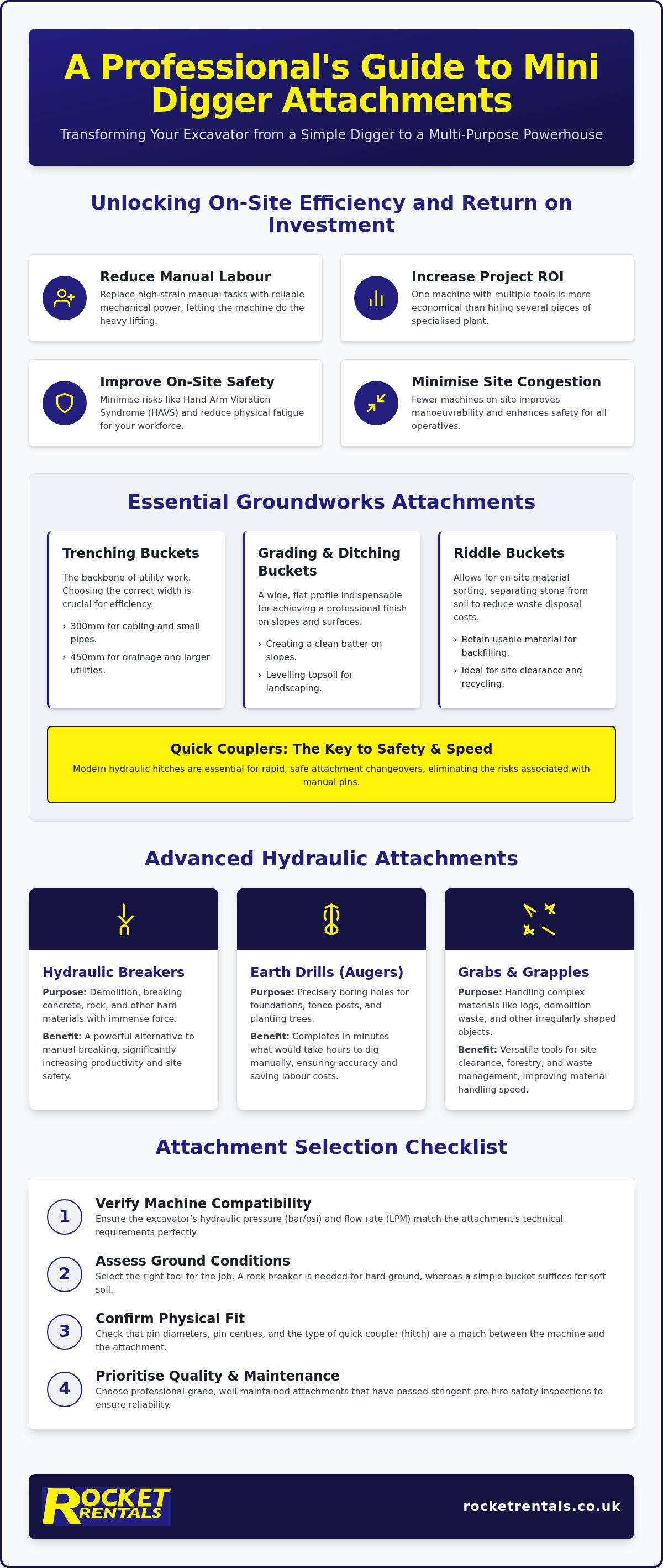
Trenching buckets are the backbone of utility work. Choosing the correct width, such as a 300mm bucket for cabling or a 450mm for drainage, ensures you aren't moving more spoil than necessary. For finishing works, grading and ditching buckets provide a wide, flat profile. These are indispensable for achieving a professional batter on slopes or levelling topsoil during landscaping. If you need to manage waste effectively, riddle buckets allow for on-site material sorting. By separating stones from clean fill, you can significantly reduce waste disposal costs whilst retaining usable material for backfilling.
Quick Coupler Safety and Compliance
The quick coupler, or hitch, is arguably the most critical interface on any machine. In the UK, safety standards are stringent to prevent accidental bucket detachment. Manual and semi-automatic hitches often require a physical safety pin to be inserted. Neglecting this step is a major site hazard that has led to serious incidents in the past. Hydraulic hitches have revolutionised this process by allowing the operator to change tools without leaving the cab, using a dedicated locking system that is often integrated with the machine's safety alarms.
When arranging your excavator hire, always ensure the machine is fitted with a compliant, modern hitch system that meets current safety regulations. A reliable hitch doesn't just save time; it provides the peace of mind that your attachments are securely locked, even under heavy loads. If you are planning a complex project, you can browse our equipment specifications to ensure your chosen machine features the latest safety-locking technology.
Advanced Hydraulic Attachments: Breaking, Drilling, and Handling
Advanced hydraulic tools represent the peak of site efficiency, allowing a single operative to perform tasks that would otherwise require a dedicated demolition or piling crew. This mini digger attachments guide focuses on the high-performance tools that interface with your machine's auxiliary lines to tackle the toughest ground conditions. It is critical to remember that all hydraulic attachments must be matched to the machine’s specific flow rate and pressure settings to prevent overheating or catastrophic component failure. Ensuring this compatibility is a fundamental step in maintaining the reliability of your hired plant.
Hydraulic Breakers and Concrete Demolition
Hydraulic breakers are the primary choice for dismantling concrete slabs, tarmac, or even frozen ground during winter months. When selecting a breaker, you must ensure the tool's weight is compatible with your excavator. For instance, a breaker designed for a 3-tonne machine will likely exceed the hydraulic capacity and stability limits of a 1.5-tonne mini digger. To maintain the longevity of the equipment, operators should avoid "blank firing" where the piston strikes the tool bit without resistance. This practice causes internal stress and can lead to premature failure. In urban settings, modern breakers are often dampened to manage noise and vibration levels, helping you stay compliant with local environmental restrictions.
Augers for Precision Boring
Augers and earth drills provide a level of precision boring that manual methods cannot match. Whether you are installing fencing, piling for foundations, or tree planting, choosing the correct flight diameter is essential for a clean finish. A reversible drive is a particularly valuable feature; it allows the operator to clear debris quickly by reversing the rotation once the hole is bored. Safety remains paramount during drilling. Always conduct a thorough service scan before boring to avoid striking underground utilities, as the torque from an auger can cause significant damage in seconds.
Grapples and Thumbs for Material Handling
Handling attachments like sorting grapples and mechanical thumbs transform a digger into a precise material handler. A mechanical thumb is a cost-effective addition that stays fixed to the dipper arm, allowing you to "pinch" objects against the bucket. In contrast, a hydraulic sorting grapple offers superior control for forestry, stone wall construction, or complex site clearance. These tools significantly improve on-site safety by reducing the need for manual lifting and handling, keeping your team away from heavy or awkward loads whilst speeding up the sorting process.
Selection Criteria: Choosing the Right Attachment for Your Project
Success on-site is rarely about the machine alone; it is about the synergy between the excavator and the tool it carries. Before selecting a tool, you must accurately assess the ground conditions. Clay, for instance, requires buckets with specific tooth profiles to prevent clogging, whereas rocky terrain demands heavy-duty side cutters and reinforced buckets. This mini digger attachments guide emphasises that matching the tool to the project scope is the only way to ensure maximum site productivity. Whether you are performing high-volume excavation or intricate landscaping, the decision must be data-driven.
Relying on professional expertise is often the best way to navigate these choices. Expert hire partners provide the technical oversight needed to ensure that pin diameters, ear widths, and hydraulic pressures are perfectly aligned. If these specifications are overlooked, you risk damaging the machine or, at the very least, wasting valuable hire time on a tool that simply doesn't fit. A professional approach to selection ensures that every piece of plant is a "safe pair of hands" for your project.
Machine Weight and Hydraulic Compatibility
It's a common misconception that attachments are universally interchangeable across compact machines. A 1.5-tonne digger operates with a significantly lower hydraulic flow and pressure than a 5-tonne midi excavator. Before hiring a tool, you must check your machine's auxiliary hydraulic circuit capacity. Overloading a small machine with a heavy grapple or a long-reach attachment doesn't just reduce efficiency; it dangerously alters the tipping load. Always verify the maximum weight limits for your specific model to maintain stability during operation.
The Site Manager’s Selection Checklist
A structured approach to equipment intake can prevent most common site delays. Use this checklist to verify compatibility before the machine begins work:
Confirm Coupler Type: Identify if the machine uses a Klac, Lehnhoff, or standard pin-on system.
Inspect Hydraulic Interfaces: Ensure all hoses and quick-release couplings are clean and undamaged to prevent system contamination.
Safety Compliance: If the attachment is used for lifting operations, verify that it carries a valid LOLER test certificate.
If you are unsure which tool best suits your specific site requirements, you can view our range of excavator attachments or speak with our team to ensure your selection is perfectly matched to your machine's specifications.
Optimising Your Hire: The Rocket Rentals Attachment Advantage
Choosing the right equipment is only half the battle; the reliability of that equipment on-site is what ultimately determines your project's success. Rocket Rentals prioritises a high-specification fleet where every attachment is treated as a critical component rather than an afterthought. By providing professional-grade tools that undergo rigorous pre-hire safety inspections, we offer the security and peace of mind that modern contractors require. This mini digger attachments guide has highlighted the technical requirements of various tools, but the underlying factor in site ROI is always the condition of the plant you hire. Our approach ensures that you aren't just hiring a tool, but securing a dependable partner for your project's duration.
Quality Maintenance for Reliable Operation
On-site downtime is often the result of poorly maintained hydraulic components or worn-out interfaces. We commit to a strict maintenance regime that ensures every hydraulic breaker, auger, and grapple operates at peak performance from the moment it arrives. Simple factors like sharp bucket teeth and properly greased pins might seem minor, but they significantly improve digging efficiency and fuel economy. When a bucket is sharp, the machine doesn't have to work as hard to penetrate the ground, which reduces wear on the engine and saves on fuel costs. A modern, well-serviced fleet eliminates the unpredictability associated with ageing plant machinery, allowing you to focus on the project at hand without worrying about equipment failure.
Professional Support for Your Next Project
Our role extends beyond providing machinery; we act as a knowledgeable guide for your project's specific challenges. Matching the right attachment to a 1.5-tonne or 8-tonne machine requires an understanding of hydraulic flow and site dynamics that our team provides as standard. This expert oversight ensures that your site remains compliant with the latest HSE plant safety guidelines, protecting both your operatives and your reputation. Our streamlined self-drive hire process is designed specifically for professional contractors who value clear communication and technical competence. We understand that time is your most valuable asset, so we ensure that every tool is ready for immediate, reliable use.
Ready to start? Contact Rocket Rentals for professional plant hire advice to ensure your next project is equipped with the most efficient tools available.
Future-Proofing Your Site Operations for 2026
Transforming a compact excavator into a multi-functional tool carrier is the most effective way to enhance site ROI and reduce reliance on manual labour. As we've detailed in this mini digger attachments guide, success relies on more than just choosing a tool; it requires a precise match between machine hydraulics and attachment specifications. Prioritising safety through modern quick couplers and maintaining a strict inspection regime ensures your projects remain both compliant and efficient.
With decades of industry-leading plant hire experience, we understand the complexities of modern groundworks. Our high-specification machinery and expertly maintained self-drive fleet are designed to meet the rigorous demands of professional sites across the UK. We take pride in being a "safe pair of hands" for your business, providing the technical support needed to select the right equipment first time. When you choose to work with us, you're choosing a partner dedicated to your project's reliability and precision.
Explore our range of professional plant and attachments and discover how the right tools can streamline your next project. We look forward to helping you achieve a more productive and safer site environment.
Frequently Asked Questions
What are the most common mini digger attachments for groundworks?
The most common tools for groundworks include a range of buckets such as trenching, grading, and riddle buckets for material sorting. Hydraulic breakers and augers are also frequently used for demolition and post-hole boring respectively. This mini digger attachments guide highlights that choosing the correct bucket width for utility services is essential for site speed. Using these specialised tools reduces manual labour and ensures a professional finish on every project phase.
Can I use any attachment on a 1.5 tonne mini digger?
No, you cannot use any attachment on a 1.5-tonne machine due to strict weight and hydraulic flow limits. Every tool must be matched to the machine's specific lifting capacity and auxiliary pressure settings. Using an oversized breaker or grapple can compromise stability and lead to component failure. Always verify that the attachment's pin diameters and ear widths are compatible with your specific mini digger model before attempting to fit it on-site.
What is a quick coupler and do I need one for my hire?
A quick coupler, or hitch, is a mechanical or hydraulic device fitted to the end of the dipper arm that allows for rapid tool changes. While not strictly mandatory for every project, they are highly recommended for any site where you need to switch between different buckets or hydraulic tools. Modern hydraulic couplers allow operators to change attachments without leaving the cab, which significantly improves both site safety and overall project productivity.
Do I need a special licence to use hydraulic attachments?
You don't need a specific separate licence for attachments, but you must be a competent operator with the correct certification for the machine itself. On professional construction sites, this usually means holding a valid CPCS or NPORS card. It is your responsibility to ensure you've received adequate training for specialised tools like hydraulic breakers or augers. This ensures you can operate the equipment safely and avoid damaging the machine's auxiliary hydraulic system.
How do I know if an attachment is compatible with my hired excavator?
To confirm compatibility, you must verify the attachment's pin diameters, ear widths, and pin centres against your machine's hitch specifications. For hydraulic tools, you also need to check that the excavator's auxiliary flow rate and pressure match the tool's requirements. Our mini digger attachments guide recommends consulting your hire provider's technical team if you're unsure. Providing the exact make and model of your hired excavator will ensure a perfect match for the task.
What maintenance is required for mini digger attachments during hire?
Daily maintenance typically involves greasing all pivot pins and ensuring that hydraulic quick-release couplings remain clean and free from grit. You should also perform a visual check of bucket teeth and side cutters to ensure they aren't excessively worn, as this can reduce digging efficiency. If you're using a hydraulic breaker, ensure the tool bit is greased every few hours of operation. Keeping these components well-maintained prevents avoidable downtime and maintains high performance levels.
Can I hire a ripper tooth for breaking up hard ground?
Yes, you can hire a ripper tooth specifically for breaking up exceptionally hard or rocky ground that a standard bucket cannot penetrate. It's an ideal tool for tarmac removal, pulling up tree roots, or loosening compacted soil before excavation begins. Using a ripper tooth protects your buckets from unnecessary wear and tear whilst speeding up the initial ground clearance phase. It's a cost-effective alternative to a hydraulic breaker for certain types of ground preparation.
Are hydraulic breakers included in the standard mini digger hire rate?
Hydraulic breakers are typically treated as a separate hire item and aren't usually included in the standard daily or weekly rate for a mini digger. This is because hydraulic tools require more intensive maintenance and have specific wear parts like chisels or points. When planning your project budget, always confirm the additional cost for any specialised hydraulic attachments you require. Hiring them alongside your machine ensures you receive a fully compatible and safety-tested package for your site.


Comments