
A Plant Hire Checklist: The Professional’s Guide to Site Equipment
Updated: Jul 30
How much does a single day of idle site time actually cost your project when a delivery fails or a machine isn't up to spec? It's a question that keeps many site managers awake, especially as the UK construction landscape becomes increasingly complex. You already know that the success of a build hinges on the reliability of your machinery, yet the logistics of hiring often feel like a minefield of hidden fuel costs and shifting safety standards. Between the 2026 reforms to the Construction Industry Scheme and the strict excavator safety regulations introduced last year, there's more to manage than ever before.
We've designed this comprehensive plant hire checklist to help you master the logistics, safety, and efficiency of your site equipment. By following this professional guide, you'll ensure seamless delivery and collection of certified machinery whilst maintaining full compliance with the latest health and safety audits. We'll walk you through everything from transport logistics and fuel policies to the essential documentation required for a productive, hassle-free site. Our goal is to provide you with the peace of mind that comes from having a reliable partner and a clear plan in place.
Table of Contents
Planning Your Plant Hire Requirements
Effective site management begins long before the first machine arrives on the low-loader. To maintain a productive schedule, your initial plant hire checklist must start with a precise evaluation of the task at hand. Whether your project involves deep excavation, material handling, or soil compaction, selecting machinery based on peak load rather than average use prevents costly mid-project swaps. When sourcing heavy construction equipment, you must first define the primary objective to ensure the machine’s power and hydraulic flow match the requirements of your attachments and terrain.
Soil type and ground conditions dictate your choice between tracked or wheeled machinery. For soft, clay-heavy, or unmade ground common in UK winters, tracked excavators and dumpers provide the low ground pressure necessary to prevent the site from becoming a quagmire. Conversely, wheeled machinery offers superior manoeuvrability and speed on hard standing or tarmac. You should also consider the environmental constraints of your location. With many urban projects now requiring Stage V diesel engines or Hydrotreated Vegetable Oil (HVO) fuel to meet local emission standards, verifying these specifications early is essential for compliance.
Calculating the required reach and lift capacity is another non-negotiable step. For telehandlers, this means plotting the weight of your heaviest pallets against the machine’s load chart at full forward reach. Underestimating these figures doesn't just cause delays; it creates significant safety risks for your operators and ground staff.
Assessing Site Conditions and Access
Before confirming any delivery, you must physically measure entrance widths and height clearances. This is particularly vital for residential or restricted urban sites where micro diggers or narrow-track mini excavators are the only viable options. Don't forget to check for overhead power lines and underground utilities using recent site surveys and CAT scanners. If the ground is particularly sensitive or prone to subsidence, identify where you'll need bog mats or temporary road plates to support the weight of the plant during transit and operation. If you require professional solutions for site access and ground stability, read more.
Selecting the Correct Machinery Class
Analyse the maximum digging depth required and compare it against the machine's technical specifications, allowing a 10% margin for safety and comfort. For work in confined spaces or alongside live traffic, zero tail-swing models are often the most sensible choice to prevent accidental collisions. For more specific sizing advice and a breakdown of weight classes, you can refer to the detailed insights in The Professional Guide to Mini Excavator Hire. Choosing the right class from the start ensures you aren't paying for excess capacity you won't use, whilst avoiding the inefficiency of a machine that's too small for the job.
The Safety and Compliance Checklist
Safety on a construction site is never a static requirement; it's a continuous commitment to legal and operational standards. When machinery arrives, your immediate priority is to ensure it meets the rigorous safety criteria defined by UK law. A robust plant hire checklist must prioritise the verification of statutory certifications before any work begins. This isn't just about avoiding fines; it's about protecting your team and ensuring that every piece of equipment is a "safe pair of hands" on your project.
You should always request the most recent LOLER (Lifting Operations and Lifting Equipment Regulations) and PUWER (Provision and Use of Work Equipment Regulations) certifications. These documents prove the machinery has undergone the necessary professional inspections. Since August 2025, it has been a legal requirement to engage safety control levers or isolation devices whenever an excavator is at rest. Failing to adhere to this can be treated as a breach of both PUWER and LOLER, so verifying that these systems are fully functional is essential. For a broader perspective on international safety benchmarks, many site managers consult resources like WorkSafe Victoria's Plant Hire Checklist to ensure their internal processes are as thorough as possible.
Modern safety aids are now standard expectations on professional sites. Ensure your hired plant features:
Green Beacons: These indicate that the operator is wearing their seatbelt, providing a quick visual safety check for site supervisors.
Reversing Cameras and Alarms: Essential for maintaining 360-degree visibility, especially on busy sites with high footfall.
Emergency Kits: Larger plant, such as heavy excavators or dumpers, should always be equipped with a fire extinguisher and a comprehensive emergency spill kit to manage environmental risks immediately.
Verifying Machine Certifications
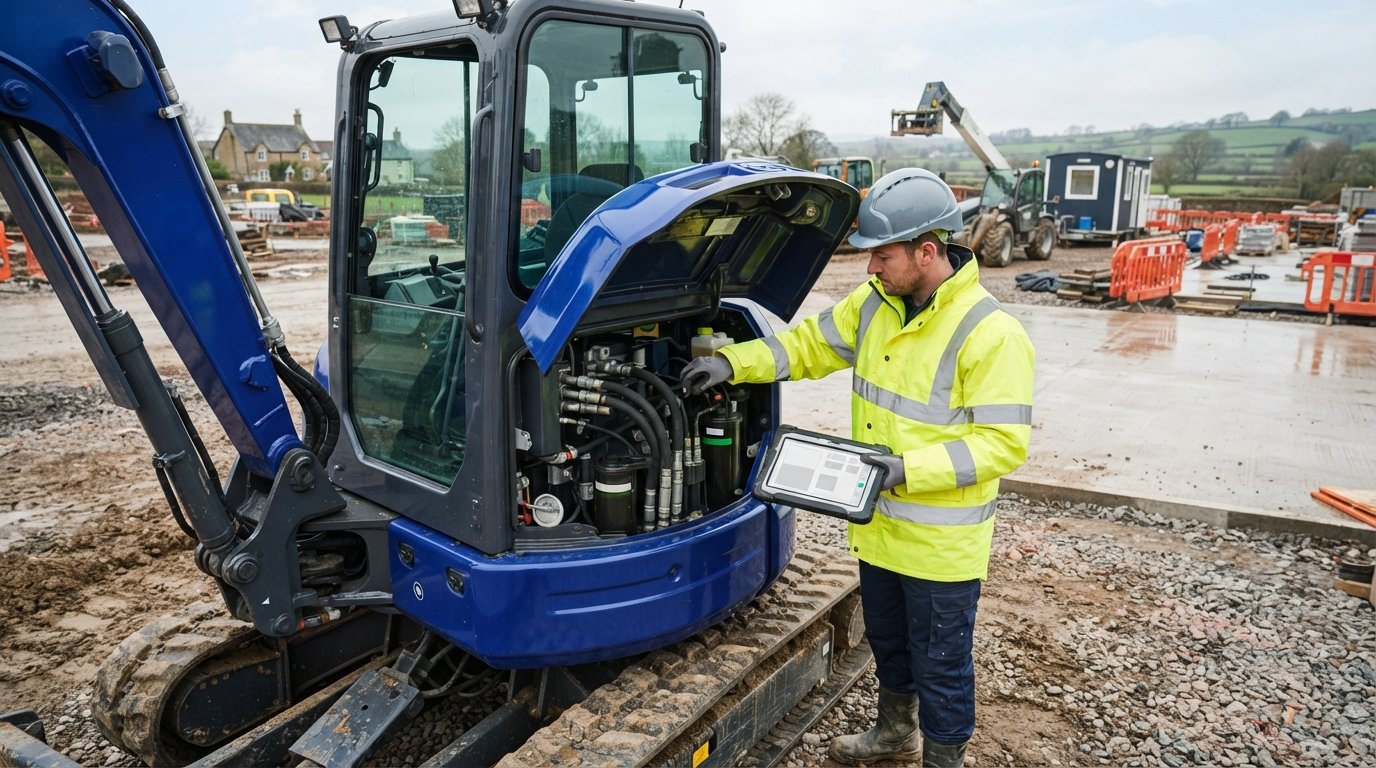
For telehandler hire, checking the validity of the "Thorough Examination" certificate is critical, as these machines perform complex lifting tasks. Beyond the paperwork, you must inspect the ROPS (Roll-Over Protective Structure) to ensure it's intact and certified. In a self-drive model, it's also wise to document any existing cosmetic damage with clear photos before the hire period starts. This protects you from disputes and ensures a transparent relationship with your provider.
Operator Competency and Self-Drive Logistics
The best machinery is only as safe as the person operating it. Verify that all operators hold a valid CPCS or NPORS card for the specific category of plant they'll be using. Once the machine is on-site, implement a site-specific induction. Even seasoned operators need a moment to familiarise themselves with the specific controls and isolation devices of a new model, ensuring they're confident before they begin their first shift.
Managing Logistics and Site Delivery
The arrival of a heavy low-loader is a high-impact moment that requires precision to avoid site paralysis. An essential part of your plant hire checklist is the management of site logistics, ensuring that the transition from transport to operation is handled without incident. Coordinating delivery times is vital. You don't want a 20-tonne excavator arriving during the morning rush or when access is restricted by local council orders. Establishing a single point of contact for the delivery driver and the hire desk ensures that any last-minute delays are communicated before they cause a bottleneck at your gates.
Fuel policies are another area where clarity saves costs. Most professional firms operate a full-to-full policy, where the machine arrives with a full tank and is expected back in the same state. With the red diesel duty rate reduced to 6.48 pence per litre as of June 2026, managing your on-site fuel storage and return levels is a straightforward way to protect your project's bottom line. Ensure a competent person is available on-site to sign for the equipment, verifying that the machine delivered matches the order and that any existing marks are noted on the delivery ticket. For a structured approach to managing these handovers, referencing the University of Queensland's Equipment Safety Procedure can provide a useful framework for risk management during the handover phase, as the core principles of inspection and maintenance documentation are universal.
Preparing the Drop-off Zone
Clear the delivery area of all debris and ensure the ground is stable enough to support the weight of a laden low-loader. You must brief the driver on site-specific hazards, such as one-way systems, tight corners, or overhead cables that could interfere with the unloading process. The ideal drop-off zone is a level, firm area with 360-degree visibility for safe unloading.
Off-Hiring and Collection Protocols
When the work is complete, providing at least 24-hour notice for off-hiring is standard practice to avoid unnecessary rental charges. You should clean the machinery and secure it in the designated collection area, ensuring it's easily accessible for the driver. Always retain the off-hire reference number provided by the hire desk; this is your primary proof of the end of the rental period and protects you from billing errors.

Optimising Productivity with Specialised Attachments
A common mistake in site planning is treating an excavator as a single-purpose tool. In reality, your plant hire checklist should include a specific review of attachments that can drastically reduce manual labour and accelerate your timeline. Why hire multiple machines when a single unit with the right hydraulic tools can handle everything from demolition to final landscaping? By selecting specialised attachments, you transform a standard excavator into a versatile workhorse, ensuring you get the maximum value from every hour the engine is running.
If your project involves breaking up existing concrete slabs or tackling bedrock, a hydraulic breaker is an essential addition. It's far more efficient than manual methods and keeps your project on track. For fencing or foundation work, augers provide the precision needed for post-holes, ensuring consistency that manual digging simply cannot match. When it's time for site finishing, grading buckets allow for smooth, level surfaces with minimal passes. Even the choice of trenching bucket matters; selecting the exact width required for your pipes or cables reduces the volume of spoil you need to remove and the amount of expensive backfill you have to purchase.
Beyond the Bucket: Enhancing Versatility
Versatility doesn't stop at digging. Pallet forks can be fitted to many excavators, turning them into temporary material handlers for unloading deliveries in tight spaces where a telehandler might struggle to manoeuvre. For sites with high volumes of mixed waste, riddling buckets allow you to sort materials on-site. By separating soil from hardcore, you can significantly lower your waste disposal costs and potentially reuse materials for sub-bases. To maintain site safety, always ensure all attachments are compatible with the machine's quick-hitch system, allowing for secure, rapid changes without the operator leaving the cab.
Calculating ROI through Site Efficiency
When evaluating the cost of an attachment, compare it against the man-hours saved. A specialised tool that costs a fraction of a daily labour rate but doubles the speed of a task is a sound investment. By reducing the total number of machines on-site, you also simplify logistics and lower your overall fuel consumption. For deeper insights into managing a versatile fleet, our guide on Excavator Hire in the South West details how the right equipment choice impacts project success. If you're ready to improve your site's performance, view our full range of excavator attachments to find the perfect match for your next project.
Partnering with a Reliable Plant Hire Specialist
The final and perhaps most critical element of your plant hire checklist is the selection of the hire partner itself. While technical specifications and site logistics are vital, their successful implementation depends entirely on the reliability of your provider. A professional site manager needs more than just a machinery supplier; they require a proactive partner who acts as a "safe pair of hands" throughout the project lifecycle. Choosing a specialist that understands the unique pressures of professional contracting ensures that when challenges arise, you have direct access to expert advice and rapid solutions.
A modern, well-maintained fleet is the best insurance against project delays. When you prioritise firms that invest in the latest Stage V machinery and adhere to rigorous service schedules, you significantly minimise the risk of on-site breakdowns. It's also beneficial to partner with a provider that offers a comprehensive range of support equipment. Having a single point of contact for everything from welfare unit hire to scissor lifts simplifies your administration and ensures consistent safety standards across your entire fleet of rented assets.
Why Independent Hire Firms Offer Better Flexibility
Independent hire firms often outperform national corporations by providing a level of agility that large-scale entities struggle to match. When you're facing a sudden change in site requirements or a short-notice request, being able to speak directly with decision-makers is invaluable. You aren't bound by rigid corporate hierarchies or automated call centres; instead, you receive a tailored service designed around your specific timeline. Independent hire specialists often provide higher maintenance standards due to smaller, more closely managed fleets. This focus on quality over quantity means the machine arriving on your site has been personally inspected by a team that takes pride in its operational readiness.
The Rocket Rentals Ltd Standard for 2026
At Rocket Rentals Ltd, we've built our reputation on providing professional contractors with the quiet confidence they need to succeed. Our 2026 fleet represents the pinnacle of modern efficiency, offering everything from heavy excavators and dumpers to high-reach telehandlers. We understand that site requirements are rarely static, which is why our expert team is always available to help you refine your equipment choices as your project evolves. For those managing indoor projects or urban sites with strict emission limits, our guide to Electric Scissor Lift Hire provides essential insights into clean, quiet access solutions. By choosing a partner committed to excellence, you ensure that every item on your checklist is ticked with precision, keeping your site safe, compliant, and productive.
Securing Site Efficiency and Compliance
Securing the success of a project requires more than just machinery; it demands a strategic approach to site integration. By following this professional plant hire checklist, you've established a framework for managing complex safety regulations, logistics, and equipment selection. You've learned how to mitigate project delays through proactive planning and how to maximise the utility of your fleet with specialised attachments. These elements combined create a safer, more efficient site environment that allows your team to focus on delivery rather than troubleshooting equipment failures.
At Rocket Rentals Ltd, we've operated as a privately owned independent specialist since 1988, offering a "safe pair of hands" for professional contractors. Our comprehensive fleet, ranging from excavators and telehandlers to essential site welfare, is backed by expert technical support to ensure your operations remain seamless. Explore our full range of professional plant hire today and discover how a dedicated partner can enhance your site productivity. We look forward to supporting your next build with the reliability and expertise your project demands.
Frequently Asked Questions
What is the difference between operated and self-drive plant hire?
Self-drive hire requires the hirer to provide their own qualified operator, whilst operated hire includes a driver provided by the hire company. We specialise exclusively in self-drive options, which allows professional contractors to maintain full control over their site personnel and project schedules. It's often the most cost-effective choice for firms that already have skilled, card-holding operators in their team.
Do I need a special licence to hire a 1.5-tonne mini digger?
You don't legally require a driving licence to operate a mini digger on private land or a secured construction site. However, for professional projects, you must demonstrate operator competence to comply with health and safety regulations. Most site managers include a check for valid CPCS or NPORS cards in their plant hire checklist to ensure all personnel meet the required industry standards.
How much does a plant hire cost for a standard working week?
The cost of hiring plant machinery depends on the machine's weight class, the duration of the contract, and any specialised attachments you require. Weekly rates generally offer better value than daily rentals for longer projects such as foundation digging or material handling. To ensure you receive an accurate quote tailored to your specific site needs, it's best to contact our hire desk directly.
Is insurance included in the plant hire rate?
Insurance is not typically included in the standard hire rate and remains the responsibility of the hirer. You'll usually need "Hired-in Plant Insurance" to protect the equipment against theft, fire, or accidental damage whilst it's on your site. We recommend checking your existing policy's coverage limits before the machinery arrives to ensure you have the necessary protection in place.
What happens if the hired machinery breaks down on-site?
If you experience any technical issues, you should contact our hire desk immediately so we can provide expert support. Our priority is to minimise your downtime through technical guidance or by arranging a replacement machine if the fault cannot be quickly resolved. Promptly reporting any issues helps keep your project on track and ensures the machinery remains safe for continued use.
Can I hire plant machinery for a single day?
Single-day hire is often available for specific tasks, though many professional contractors find that weekly rates provide more flexibility for their schedules. Whilst a one-day rental is useful for quick excavations, longer hire periods often result in a lower daily cost. We can help you evaluate your project timeline to determine the most efficient and economical hire duration for your site.
Do you provide welfare units alongside heavy machinery?
We provide a range of welfare unit hire options to ensure your site meets all legal health and safety requirements for your workforce. These units provide essential facilities, including toilets, drying rooms, and rest areas, which are vital for maintaining a productive and compliant site. Sourcing your welfare units and heavy plant from a single provider simplifies your logistics and delivery coordination.
What safety documentation should I expect with my plant hire?
You should expect every machine to be delivered with the latest LOLER and PUWER certifications to prove it has undergone a thorough professional examination. We also provide pre-start inspection logs and recent service records so you can verify the equipment's maintenance history. These documents are essential for your site's safety audits and should be stored safely for the duration of the hire period.
Comments