
Excavator for Tree Stump Removal: Choosing the Right Hire Option
The biggest excavator isn’t automatically the best choice for removing a tree stump. An excavator for tree stump removal may suit a large stump with an extensive root system, but restricted access, soft ground or nearby structures can make another method more practical. A stump grinder, for example, cuts down the stump without excavating the surrounding ground in the same way.
The stump, roots and available working space all affect your choice, as does the machine you can safely position and operate. This guide compares excavator removal with stump grinding and manual removal, then explains how to choose self-drive excavator hire and prepare your site. Rocket Rentals Ltd is an independent, family-run plant hire company offering excavator, mini digger and excavator attachment hire. Equipment inspection is part of its approach. Use the practical checks below to plan the work and choose equipment that fits the site.
Table of Contents
Excavator for Tree Stump Removal: When Is It a Suitable Choice?
Excavator stump removal uses the machine’s digging force to expose a stump and lift it out with accessible connected roots. An excavator for tree stump removal may suit a substantial stump or a site where you want to clear more of the root mass. It needs room to work and can disturb a wider area of ground than grinding.
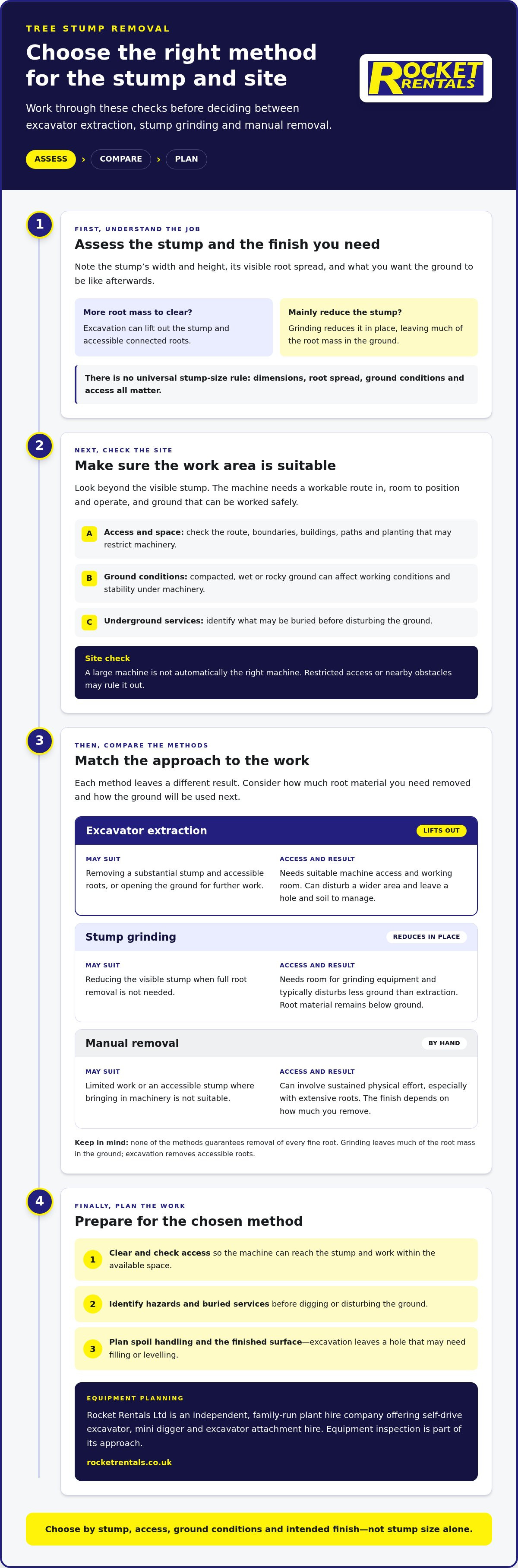
No single method suits every site. Base your decision on the stump’s dimensions and root spread, the route for bringing a machine into position, the ground conditions and the finish you need. A small stump in a confined garden may call for a different approach from a large stump in an open area. Assess the whole work area, not just the visible stump.
What affects whether an excavator can remove a stump?
A wide stump or extensive roots can require more excavation and working space. Soil conditions matter too. Compacted, wet or rocky ground can affect how easily you can work the soil and how stable the area feels under machinery. The excavator needs to reach the stump and have enough space to move without its operation being restricted.
Check beyond the stump itself. Boundaries, buildings, paths and planting can limit where the machine can travel or dig. Buried services also need attention before you disturb the ground. If you don’t know what lies underground, make locating services part of the site preparation rather than treating the job as a simple lift-out task.
What is the difference between excavation and stump grinding?
Excavation aims to loosen and lift out the stump, along with roots that can be reached during the work. Grinding reduces the stump in place, leaving much of the root mass in the ground. The better fit depends on what you plan to do with the area next, as well as the site’s access and constraints.
Grinding may disturb less surrounding soil, although the resulting wood material still needs handling. Excavation usually disturbs a wider area and leaves a hole that may need filling or levelling. Neither method guarantees removal of every fine root. For an overview of stump removal methods, including mechanical approaches, see Wikipedia.
Let the intended finish guide your choice. If you need the ground opened up for further work, extraction may be worth considering. If your aim is to reduce the stump while limiting excavation, grinding may be more suitable. Nearby obstacles, soil conditions and available space all affect what is practical, so don’t choose based only on stump diameter.
Assess the stump: note its width, height and visible root spread.
Check the approach: consider the access route and the room needed to position and operate machinery.
Plan the finish: decide whether you need the stump and accessible roots removed or simply reduced.
This initial assessment helps you compare methods against the needs of the site before deciding on a machine and attachment.
Excavator, Stump Grinder or Manual Removal: Compare the Options
The right method depends on what you need the ground to be like afterwards. An excavator can lift out a stump and accessible roots, while a grinder reduces the stump in place. Manual removal avoids bringing in machinery but can require sustained physical effort, particularly where roots are extensive. Compare the practical differences before settling on a plan.
When might excavator extraction make sense?
Consider excavation if you want to remove a substantial stump and accessible roots, or if the ground will be used for further work where leaving the stump in place won’t suit. The excavator must be able to reach the work area and have enough room to operate without being constrained by boundaries or nearby obstacles.
There’s no universal stump-size rule. Dimensions matter, but so do root spread, ground conditions and the route into the site. A smaller stump can be difficult to reach in a confined space, while a larger one may be workable where access and working room are suitable. Assess all of these factors before choosing a method.
When might grinding or manual removal be a better fit?
Grinding may suit you if reducing the visible stump meets your plans and you don’t need to extract the same root mass. Think about what comes next: a surface that will be covered or replanted may have different requirements from ground being prepared for further construction.
Manual removal can be practical for limited work or an accessible stump, but it may take substantial effort to expose and work through the roots. Consider how much root material can remain and whether the finished ground will meet your needs. If excavation looks suitable, explore self-drive excavator hire as an option for planning the work around your site.
How to Match Excavator and Attachment to Stump and Site
Choose the excavator and attachment as part of the same plan. A machine that looks suitable for the stump may still be too large for the access route or working area. The attachment must also fit the excavator and suit the task. Use this sequence to gather the details that will shape your hire choice.
Start with the stump and desired finish. Note its approximate width and height, along with any visible root spread. Decide whether you want to extract the stump and accessible roots or whether reducing the stump is enough. The intended finish affects how much excavation the job may involve and what you need the machine to do.
Measure the access route. Check gates, narrow paths, turns and overhead restrictions along the route to the stump. Allow room to position and manoeuvre the excavator at the work area, not just to pass through the entrance. Choose a machine that suits these restrictions and the working space, rather than basing the decision on stump dimensions alone.
Map the surroundings. Mark nearby fences, buildings, trees and other features that could limit movement or be affected by digging. Include known underground services in your site notes. This helps you plan where the excavator can travel and work, and where extra care or a different approach may be needed.
Consider the ground and spoil. Note whether the work area is firm, soft, wet or uneven, and decide where loosened soil and root material will go. Ground conditions can affect access and how excavation proceeds. Planning spoil handling helps keep the working area organised as the stump is exposed.
Match the attachment to the excavator and task. Attachments need to be compatible with the machine and appropriate for the work. A bucket is a general industry example for digging; other attachment types may suit different tasks. Don’t assume an attachment will fit every excavator or suit every stump. Describe the stump, access, ground and intended finish when discussing project-specific hire requirements.
Keep the assessment practical. A wide stump with visible roots may mean more excavation, but a tight entrance or restricted working space can make a smaller machine more suitable than the stump size alone suggests. Balance reach and working room against the site’s constraints.
Before arranging an excavator for tree stump removal, have your measurements, access notes and desired finish ready. These details give you a clearer basis for discussing self-drive excavator hire and attachments, and help avoid choosing equipment based on the stump while overlooking the conditions that shape the job.
Prepare the Site and Plan Excavator Stump Removal Safely
Good preparation helps you assess whether the site is ready for the planned work and identify its main constraints. Before using an excavator for tree stump removal, check the route, working area, nearby features and where excavated material will go. Follow the machine’s operating guidance and use a competent operator who is familiar with the equipment.
A clear site plan helps make stump removal safer and more controlled.
Clear access and identify site constraints
Walk the route from the delivery point to the stump, then inspect the working area. Remove loose obstacles that could obstruct movement, and note slopes, soft or uneven ground, tight turns and surfaces that could be damaged. Check there is enough room to position and operate the excavator without encroaching on nearby features.
Mark fences, buildings, trees and known underground service routes on your plan. Keep excavation away from areas where service locations are unverified. Don’t assume an area is clear because no equipment or surface marker is visible. If a service location is uncertain, resolve that before digging rather than relying on guesswork.
Plan excavation, spoil and the finished ground
Plan how the stump and accessible roots will be approached, loosened and lifted, allowing for the space needed to work around them. Decide where excavated soil and stump material will go before starting. A designated spoil area can help prevent material from blocking access or narrowing the excavator’s working space as the job progresses.
Set the intended finish too. The area may need to be left ready for landscaping, planting or other work, which affects how you manage the hole and surrounding soil. Don’t assume lifting out the stump leaves a level surface. Include the disturbed ground and how it will be reinstated in your job plan.
Use this sequence to turn your site check into a practical work plan:
Inspect the area. Note ground conditions, slopes, restricted turning space and nearby structures or planting.
Prepare the route. Clear loose obstacles and check that the machine can reach the stump with room to position and work.
Identify hazards. Mark known underground services and keep digging away from locations that have not been verified.
Plan the work area. Decide where the machine will operate and where soil and stump material will be placed.
Check the operating plan. Ensure the operator understands the task and follows the equipment guidance throughout.
These details are useful when arranging self-drive plant hire because they help match the equipment and work plan to the site. For self-drive excavator hire, prepare your access notes, site constraints and intended finish so you can plan the project around the relevant hire options.
Hire an Excavator for Tree Stump Removal with Rocket Rentals Ltd
Once you’ve considered the removal method, site access and intended finish, plan equipment hire around the job. Rocket Rentals Ltd offers self-drive excavator and mini digger hire, along with excavator attachments. The right combination depends on the stump, working area and result you need. No single machine choice suits every site.
Share clear project details to shape the hire discussion. For an excavator for tree stump removal, explain the task and describe the site as it is, including any restrictions that could affect machine access or operation.
What to include in a stump-removal hire enquiry
Give the stump’s approximate dimensions and describe the visible root area. Summarise the access route, including narrow entrances or restricted turning space, then note ground conditions and nearby features such as buildings, fences and trees. Include the intended outcome, such as removing the stump and accessible roots or preparing the ground for later work. A brief spoil-handling plan is useful too: say where you expect excavated soil and stump material to go.
These details connect your project requirements with the relevant excavator, mini digger and attachment hire options. They also help identify practical questions about the available space and finished ground before you plan the work.
Plan self-drive hire around the project
With self-drive hire, you plan the work and operate the hired equipment yourself. Make sure the person operating it is competent and follows the machine’s operating guidance. Rocket Rentals Ltd is an independent, family-run plant hire company, and equipment inspection is a practical trust point when arranging machinery for a planned job. Use the information you’ve gathered to plan a hire that fits the site and the intended work sequence, not just the stump.
If you’re also considering a mini digger, The Professional Guide to Mini Excavator Hire: Maximising Site Efficiency offers broader guidance on planning mini excavator hire. For stump removal, keep the specific conditions in view: stump dimensions and root area, the access route, ground conditions, nearby constraints and your plan for excavated material.
A measured, site-led approach gives you a clearer basis for selecting self-drive equipment and planning the work. Explore excavator hire with Rocket Rentals Ltd for your project.
Make Your Next Step a Clear Hire Plan
Before arranging an excavator for tree stump removal, turn your site assessment into a short hire brief. State the outcome you want and note any constraints that could affect the work. This gives you a practical starting point for planning the job and choosing equipment that fits the site, rather than making the decision based on the stump alone.
Use the brief to identify unanswered questions before work begins. Preparing in advance can help you avoid last-minute changes and keep the project focused on the result you need. Keep the intended use of the ground in mind so the removal plan supports what comes next.
With your plan ready, explore self-drive excavator hire with Rocket Rentals Ltd for your stump-removal project.
Frequently Asked Questions
Can an excavator remove a tree stump without removing every root?
Yes. An excavator can remove the stump and accessible roots without extracting every root. Fine roots may extend well beyond the main root mass, so removing them all could mean disturbing a much larger area. Decide how much root material needs to go based on what you plan to do with the ground. Roots left behind may decay over time, but the process and ground conditions can vary.
What happens to the stump and soil after excavator removal?
The stump and any roots lifted out need to be moved away from the excavation area and managed separately from the displaced soil. You can then fill and level the open space if that suits your plans. Keep reusable soil apart from woody material, and decide in advance where each will go. The amount of spoil depends on how much ground is opened up during the work.
Can you replant a tree where an old stump was removed?
You may be able to replant in the same area, but first consider remaining roots, the size of the planting space and the condition of the disturbed soil. A new tree needs room for its root ball and future growth. A nearby position may be more suitable if old roots or the filled excavation leave too little clear ground for planting.
Will excavator stump removal damage the surrounding lawn?
It can disturb the lawn, particularly where the machine needs to travel, turn or work on soft ground. The affected area may extend beyond the stump, so assess the access route as well as the excavation itself. If the lawn matters, identify sensitive sections before work starts and plan how to limit machine travel across them. The final condition depends on the site and the work required.
How long does excavator tree stump removal take?
There’s no reliable set duration for an excavator for tree stump removal. The time depends on factors such as stump and root size, ground conditions, access, the machine and attachment used, and how excavated material is handled. Preparation and clearing the area afterwards take time too. A single accessible stump in workable ground is a different task from several stumps on a restricted or uneven site.
Is an excavator suitable for removing a stump close to a building?
It may be possible, but proximity to a building makes access, machine positioning and the extent of digging especially important. Excavation could affect nearby ground, and buried services may also be present. Don’t assume the visible gap provides a safe working distance. Assess the space around the stump and building before choosing a method, and avoid digging where underground service locations remain uncertain.
Should I remove the whole root system before landscaping?
Not necessarily. The right amount of root removal depends on your landscaping plans. Turfing or planting elsewhere may not need the same level of clearance as preparing a spot for a new tree or creating a level area for another use. Consider whether remaining roots could obstruct the next work or affect the finish. Plan for the intended use rather than assuming every root must come out.


Comments