
Long Reach Excavator Hire: The Professional’s Guide to Specialist Plant Rental (2026)
- Rocket Rentals
- Aug 1
- 12 min read
Could a single metre of miscalculated reach derail your entire project timeline? When you are managing complex dredging, embankment works, or deep excavation, the difference between a successful shift and a costly site delay often comes down to the initial machine specification. You already know that long reach excavator hire is about more than just arm length. It is a delicate balance of machine stability, ground pressure, and operator precision that defines the safety of your environment.
This professional guide helps you master these complexities with expert insights into the 2026 plant rental market. We will help you identify the exact specifications required for your project whilst ensuring you remain fully compliant with the August 2025 HSE safety updates regarding mandatory isolation devices. By the end of this article, you will understand how to select the right self-drive equipment to maximise your site productivity, protect sensitive ground, and meet the highest national safety standards. Whether you are navigating complex LOLER regulations or assessing reach geometry, we provide the technical clarity needed for a successful hire.
Table of Contents
Understanding Long Reach Excavator Hire for Specialist Projects
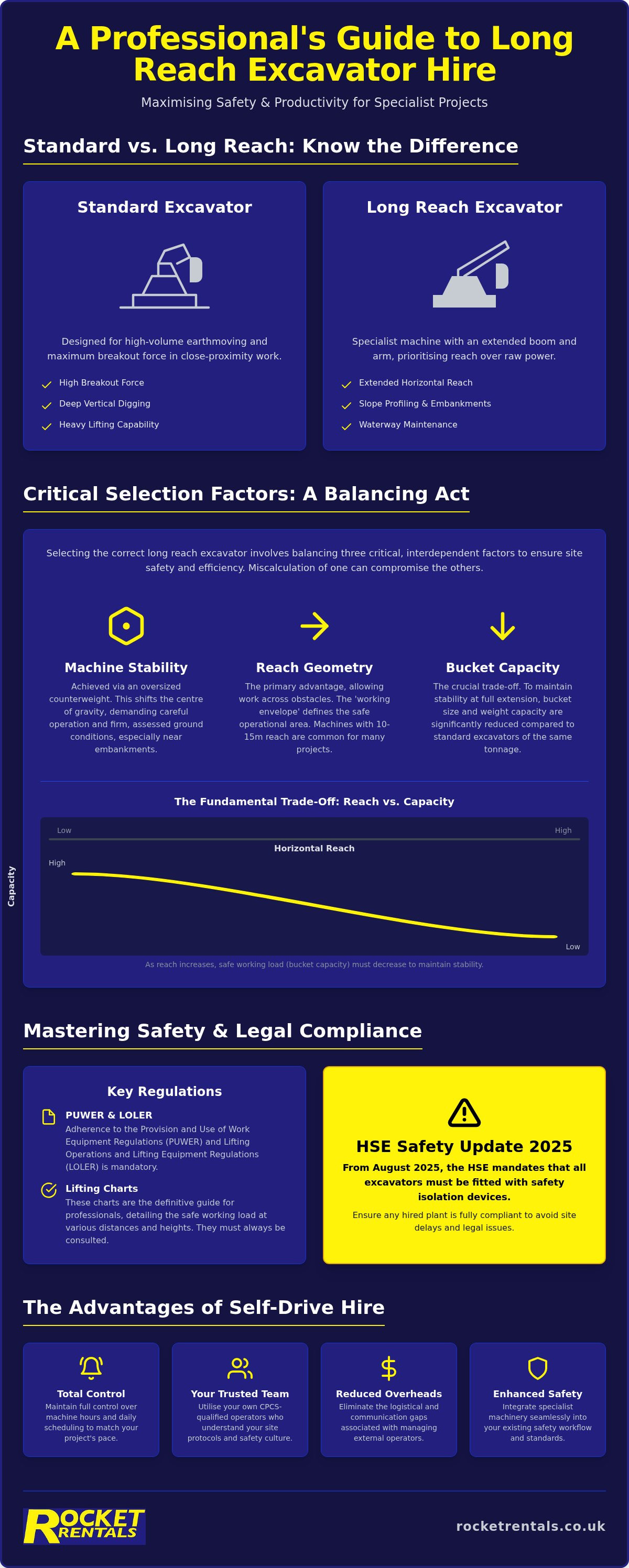
A Long reach excavator is a highly specialised development of the standard hydraulic excavator. Unlike conventional machines designed for high-volume earthmoving and maximum breakout force, these variants feature a significantly extended boom and arm assembly. This configuration allows for an impressive working range, often reaching distances that standard plant simply cannot achieve. For any professional considering long reach excavator hire, it is vital to understand that this extended capability necessitates a fundamental engineering trade-off. To maintain stability at full extension, bucket capacity is typically reduced compared to a standard machine of the same tonnage. This ensures the machine remains balanced whilst working at its maximum horizontal or vertical limits.
Stability is the primary concern for any site manager. Standard excavators rely on a balanced weight distribution for digging power close to the tracks. In contrast, long reach models require a much heavier, often oversized counterweight. This design ensures the machine remains firmly planted when the arm is fully extended over a waterway or a steep embankment. This shift in the centre of gravity requires a different operational approach, as the momentum of a loaded bucket at 15 or 20 metres exerts significant leverage on the machine's chassis. Selecting the correct specification is not just about reach; it is about ensuring the machine has the footprint and ballast to operate safely in your specific environment.
Standard vs. Long Reach: When to Make the Switch
Determining when your site requires a specialist machine depends on the geometry of the task. Standard excavators excel at deep vertical digging and heavy lifting. However, if your project involves horizontal reach across a river or profiling a slope from a fixed position at the top, the long reach variant becomes essential. It drastically reduces the need for constant site repositioning, which protects the ground from excessive track wear and compaction. Whilst the daily hire rate for specialist plant reflects its higher capital value, the efficiency gains in reduced downtime and improved site safety mean the machine often pays for itself by accelerating the project timeline.
The Advantages of Self-Drive Specialist Plant
Choosing self-drive long reach excavator hire allows you to integrate high-specification machinery directly into your existing team. You don't have to manage external operators who may be unfamiliar with your specific site protocols or safety culture. By using your own trusted, CPCS-qualified operators, you eliminate the logistical overhead and communication gaps often found with operated hire. This approach ensures you maintain total control over machine hours and daily scheduling. It positions the plant as a tool within your own workflow, allowing your project to progress exactly according to your established professional standards.
Selecting the Right Specification: Reach, Weight, and Capacity
Choosing the correct machine for long reach excavator hire is a technical exercise that balances outreach with the physical laws of leverage. It's a common mistake to specify a machine based solely on its maximum reach without consulting the lifting charts. These charts are the definitive guide for any professional, detailing the safe working load at various distances and heights. As the arm extends, the capacity of the bucket must decrease to maintain the centre of gravity within the machine's footprint. Ignoring these limits doesn't just strain the hydraulic system; it risks a catastrophic tip, especially when working on uneven or soft ground.
Stability is inherently linked to how you manage the excavation site. Following OSHA excavation safety guidelines or the UK-equivalent HSE standards ensures that the ground beneath the tracks is assessed before the boom is even raised. This is particularly important when working near the edge of embankments where the added weight of a long-reach counterweight increases the risk of a bank collapse. If you're unsure which weight class suits your site's topography, reviewing a modern excavator hire fleet can help you compare specifications side-by-side.
Understanding Reach Lengths and Working Envelopes
Reach geometry dictates the entire footprint of your working area. Machines with a 10m to 15m reach are usually the standard for smaller dredging tasks and embankment profiling. When projects involve deep excavations or major waterway works, you will likely need to move into the 18m to 22m+ category. However, operators must account for the "dead zone," which is the area immediately surrounding the machine base where the long arm cannot physically dig. Planning your machine's position is vital to ensure you don't leave sections of the site unreachable.
Weight Classes and Ground Pressure Considerations
The relationship between machine tonnage and stability is non-negotiable. A 13-tonne machine offers excellent transportability but lacks the ballast for extreme reach. In contrast, a 35-tonne model provides the necessary stability for 20-metre extensions but exerts significantly higher ground pressure. For work amongst soft terrain or marshy ground, you should specify wide tracks, often called swamp tracks, to spread the load. Always verify that your chosen machine's weight is compatible with the access roads and bridges leading to your site to avoid logistical delays.
Key Applications: From Waterway Maintenance to Deep Excavation
Specialist long reach excavator hire is often the only viable solution for projects where physical access is restricted by terrain or environmental sensitivity. These machines are the problem-solvers of the construction industry, bridging the gap between land-based operations and hard-to-reach work zones. By utilising an extended working envelope, contractors can complete complex tasks without the need for temporary haul roads or expensive floating pontoons, significantly reducing both the project's carbon footprint and its total cost.
Dredging and waterway management represent perhaps the most common applications. Maintaining river channels, canals, and drainage ditches requires precision and a long reach to clear silt and debris from the centre of the watercourse whilst keeping the machine's tracks on stable, dry land. This method prevents the disturbance of the riverbed that occurs when machines enter the water, protecting the local ecology. Similarly, for demolition tasks, the increased height and reach allow operators to dismantle structures from a safe distance, keeping the plant well outside the immediate debris fall zone.
Marine and Environmental Project Requirements
Working near water courses demands a high level of environmental responsibility. When you arrange long reach excavator hire for marine projects, it's often a requirement to specify the use of biodegradable hydraulic oils. This precaution ensures that in the unlikely event of a hose failure, the impact on sensitive aquatic ecosystems is minimised. Managing silt removal also requires specialised attachments, such as perforated weed buckets or high-capacity ditching buckets, which allow water to drain away whilst retaining the material to be removed. These tools ensure the machine's weight remains manageable and site hygiene is maintained.
Civil Engineering and Infrastructure Utility
In the world of infrastructure, precision profiling is a primary requirement for motorway embankments and railway cuttings. Long reach plant allows for the accurate grading of slopes from a fixed position at either the top or the bottom of the incline. This capability is essential for ensuring long-term slope stability and preventing landslides. For projects across the country, integrating this specialist plant with broader excavator hire solutions from Rocket Rentals Ltd ensures that all aspects of the site, from initial bulk earthworks to final deep foundation excavations, are handled by a single, reliable partner. This streamlined approach to plant management reduces logistical friction and helps maintain strict project timelines.
Operational Guidance for Professional Self-Drive Hire
Managing a self-drive long reach excavator hire requires a disciplined approach to both operation and maintenance. Because the responsibility for the machine's daily welfare rests with your site team, it's vital to recognise that these machines behave differently to standard excavators. The momentum generated by a loaded bucket at a 15 or 20-metre extension creates significant kinetic energy. Operators must be specifically trained to manage this unique centre of gravity, as sudden movements or "snatching" at the controls can cause the machine to rock or lose stability. Smooth, progressive movements are the hallmark of a professional operator working with specialist long-reach plant.
Daily maintenance is equally critical. The extended boom and arm put immense pressure on the boom pivot points and hydraulic seals. Your team should conduct thorough daily inspections, focusing on grease points along the entire length of the arm to prevent premature wear. Given the August 2025 HSE safety guidance update, it is now a legal requirement under PUWER and LOLER for operators to use safety control levers or isolation devices whenever the machine is at rest. Ensuring your team follows these protocols isn't just about safety; it's about maintaining full legal compliance on your site. If you're ready to secure a machine for your next project, you can browse our specialist fleet to find the right specification.
Site Preparation and Access Logistics
Transporting over-sized specialist machinery to a site involves more than just booking a low loader. You must survey the delivery route for width and weight restrictions well in advance of the hire start date. Once the machine arrives, creating a stable, level working platform is non-negotiable. Any slight incline at the track level is magnified tenfold at the end of a 22-metre boom, which can lead to a tipping risk. Many contractors find that coordinating mini excavator hire alongside the long reach machine is an effective way to handle support tasks, such as clearing access paths or managing small-scale spoil heaps, without moving the larger plant unnecessarily.
Safety Compliance and Risk Management
Safety for long reach operations extends beyond standard digging risks. You must conduct specific risk assessments for "over-the-side" lifting, especially if the machine is equipped with check valves and acoustic warning systems for lifting operations. If you're working near overhead lines or railways, implementing height and slew restrictors is a standard requirement to prevent accidental contact with infrastructure. Finally, ensure all self-drive operators hold the correct CPCS or NPORS categories specifically for the weight class of the machine you've hired. This verification protects your business and ensures the equipment is handled with the expertise it requires.
Why Rocket Rentals is the Preferred Choice for Specialist Plant
Selecting a partner for long reach excavator hire is a decision that impacts both your site's safety record and your project's bottom line. At Rocket Rentals Ltd, we have built our reputation on providing high-specification, self-drive plant that allows professional contractors to maintain total control over their operations. We understand that in the current 2026 construction environment, where national output continues to show steady growth, site efficiency is paramount. Our fleet is not merely a collection of machines; it is a meticulously maintained resource designed to minimise downtime and maximise your team's productivity on the most demanding specialist projects.
Our exclusive focus on self-drive hire is a deliberate choice. We recognise that professional contractors often have their own trusted, highly skilled operators who understand the specific nuances of their site. By providing the machinery without the operator, we allow you to manage your own personnel and schedules without the logistical friction of external staffing. This transparency extends to our national delivery capabilities. Whether your project is a major infrastructure development or a sensitive environmental dredging task, our transport team ensures your long reach excavator hire arrives on site exactly when required, keeping your project timeline on track.
Our Commitment to Fleet Maintenance and Safety
Safety is the cornerstone of our service. Every machine in our fleet undergoes rigorous pre-hire inspections to ensure it arrives in peak condition and fully compliant with the latest regulations. This includes the August 2025 HSE mandate for safety isolation devices, which we have integrated across our excavator range. We invest heavily in the latest Stage V engine technology, ensuring our plant meets the strictest emissions standards for work in sensitive or urban environments. Furthermore, we provide a comprehensive range of excavator attachments, from specialised dredging buckets to profiling tools, allowing you to customise the machine's capability to the specific geometry of your task.
National Service with a Professional Touch
We pride ourselves on offering the scale of a national provider with the personal service of a dedicated partner. Our team provides expert advice during the selection process, helping you interpret lifting charts and reach specifications to ensure you never over-specify or under-perform. This technical support is backed by transparent hire terms. We believe in clear communication with no hidden costs, allowing professional users to budget with total confidence. From the initial enquiry through to final collection, we provide a seamless experience that positions us as a reliable "safe pair of hands" for your specialist plant requirements.
Securing Precision for Your Next Specialist Project
Success in specialist excavation depends on the careful alignment of machine geometry, site safety, and operator discipline. You now understand that selecting the right plant involves more than just measuring distance; it requires a technical assessment of stability and lifting capacity. By prioritising modern safety standards and ensuring your team is prepared for the unique centre of gravity of these machines, you can significantly reduce site downtime whilst protecting the surrounding environment.
It's a strategic investment to choose a partner for long reach excavator hire who provides access to the latest Stage V engine technology and a fleet maintained to the highest professional standards. Whether your project involves complex waterway management or deep foundation work, having a reliable machine delivered nationally to your site provides the peace of mind needed to maintain your schedule. Our specialist self-drive experts are ready to support your project with technical insights and high-specification equipment.
Enquire about long reach excavator hire with Rocket Rentals today to discuss your specific reach requirements. We look forward to helping you achieve a productive and safe outcome on your next project.
Frequently Asked Questions
What is the maximum reach available for long reach excavator hire?
Reach lengths typically range from 10 metres for 13-tonne models up to 22 metres or more for larger 35-tonne specialist machines. For instance, a common 21-tonne machine like the Komatsu PC210 provides a horizontal reach of approximately 15.25 metres. It's vital to select a specification that allows your operator to reach the furthest working point without over-extending the hydraulic rams to their mechanical limits, which can compromise stability.
Do I need a specific licence to operate a long reach excavator on a self-drive basis?
Operators must hold a valid CPCS or NPORS card for the specific weight category of the machine being hired. Whilst there isn't a separate "long reach" licence, the operator must be competent and have received familiarisation training on the machine’s unique centre of gravity. Under PUWER regulations, it's your responsibility to ensure the operator understands the stability challenges associated with an extended boom and the heavier counterweight used in long reach excavator hire.
Can long reach excavators be used for heavy lifting tasks?
These machines can perform lifting tasks, but their capacity is significantly reduced compared to standard excavators of the same tonnage. You must strictly follow the manufacturer’s lifting charts, which specify the safe working load at various distances and heights. To comply with LOLER, any machine used for lifting must be fitted with check valves and an acoustic warning system. It also requires a thorough examination by a competent person at least every 12 months.
How is a long reach excavator transported to my site?
Specialist low loaders are required to transport these machines due to the extended length of the boom and arm assembly. Even with the arm tucked in for transit, the footprint is larger than standard plant. You should survey your site access for width and weight restrictions well before the delivery date. Professional hire providers manage these logistics to ensure the machine arrives safely whilst remaining within UK road transport regulations for over-sized loads.
Are specialist attachments like grabs or shears available for long reach machines?
A wide range of attachments, including dredging buckets, weed rakes, and grabs, can be fitted to long reach machines to suit specific tasks. However, you must account for the weight of the attachment when calculating your safe working range. Heavier tools like hydraulic shears or breakers exert significant leverage at full extension, which can reduce the maximum safe reach. Always consult the machine's lifting chart before fitting non-standard tools to ensure site safety.
What are the main safety risks associated with long reach excavation?
The primary risks involve machine instability and the potential for the ground to fail under the machine's tracks. Because the reach is extended, the leverage on the chassis is immense, increasing the risk of a tipping incident or a bank collapse. Operators must also be vigilant regarding overhead power lines. Following the August 2025 HSE update, it's now a legal requirement to use safety isolation devices whenever the machine is at rest to prevent accidental movement.
Can these machines work on soft or marshy ground?
Long reach excavators are ideal for marshy ground, provided they are specified with wide "swamp tracks" to reduce ground pressure. These wider tracks spread the machine's weight over a larger surface area, preventing it from sinking in soft terrain near water courses. For particularly sensitive sites, using bog mats alongside long reach excavator hire provides an additional layer of stability and protects the ground from excessive compaction during the project.
What is the difference between a long reach and a high reach excavator?
The difference lies in the boom geometry and the intended direction of work. A long reach excavator is designed for horizontal distance and deep digging, making it the standard choice for dredging and embankment profiling. A high reach excavator is a specialist demolition machine designed for vertical height. High reach models often feature tilting cabs and modular booms to help the operator dismantle tall structures safely, whereas long reach models prioritise stability for low-level tasks.


Comments