
Mini Digger Attachments Hire: The Professional Guide to Maximising Site Versatility
- Rocket Rentals
- 1 day ago
- 14 min read
The mini digger sitting on your site is only as capable as the attachment fitted to it. That's a straightforward truth that experienced site managers understand well, yet it's one that catches many projects off guard when the wrong tool meets the wrong ground, or an incompatible quick-hitch system brings an entire morning's work to a standstill. When it comes to mini digger attachments hire, the decision isn't simply about finding something that fits; it's about selecting the right combination of machine and attachment to genuinely drive productivity, maintain safety, and protect your project timeline.
You already know that delays cost money and that using underpowered or mismatched equipment creates real risks on site. Those frustrations are entirely valid, and they're far more common than they should be. This guide is designed to change that. Here, you'll find clear, practical guidance on how to match attachments to your specific excavator, what hydraulic and mechanical compatibility actually means in practice, and how a well-chosen attachment fleet can transform a single machine into a multi-purpose asset capable of breaking, digging, grading, and lifting. From hydraulic breakers to ditching buckets and beyond, we'll walk you through everything you need to make confident, informed decisions before your hire begins.
Table of Contents
Understanding Mini Digger Attachments: Why Versatility is Key to Project Success
Essential Mini Digger Attachments for Construction and Groundworks
Compatibility and Performance: Matching Attachments to Your Hire Fleet
Best Practice and Safety Protocols for Excavator Attachment Operation
Professional Plant Hire: Why Choose Rocket Rentals for Your Attachment Needs
Understanding Mini Digger Attachments: Why Versatility is Key to Project Success
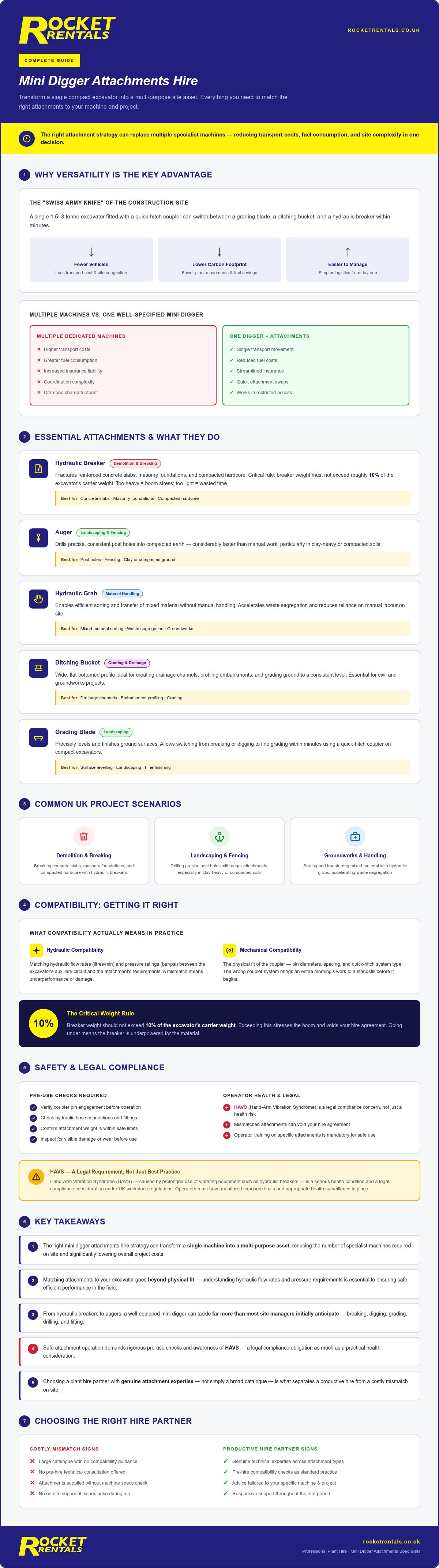
Mini digger attachments are interchangeable tools designed to be fitted to the arm or coupler of a compact excavator, each engineered to perform a specific task that a standard digging bucket simply cannot. A hydraulic breaker fractures reinforced concrete. An auger bores precise holes into compacted earth. A hydraulic grab sorts and transfers loose material without manual handling. Each attachment transforms the same base machine into an entirely different specialist tool, and that capacity for transformation is what makes the attachment-based approach so compelling for modern site managers.
The economic argument is straightforward. Bringing multiple dedicated machines to site multiplies transport costs, fuel consumption, insurance liability, and the logistical complexity of coordinating different plant on a shared footprint. A single well-specified mini digger, paired with the right selection of attachments through a considered mini digger attachments hire strategy, can absorb several of those roles. The result is fewer vehicles, a reduced carbon footprint from plant movements, and a site that's easier to manage from the moment work begins.
The "Swiss Army Knife" of the Construction Site
Compact excavators are already valued for their ability to operate in restricted access areas where larger plant cannot reach. Add a versatile attachment fleet to that manoeuvrability and the machine's value multiplies considerably. A 1.5-tonne or 3-tonne excavator fitted with a quick-hitch coupler can switch between a grading blade, a ditching bucket, and a hydraulic breaker within minutes, freeing up physical space on tight urban plots and reducing the number of separate site movements required. For a broader understanding of excavator attachments and applications across construction disciplines, the range of tasks these machines can perform is genuinely extensive.
Common Project Scenarios for Attachment Use
The practical applications span a wide range of UK construction and civil engineering projects:
Demolition and breaking work: Hydraulic breakers are routinely used to break up concrete slabs, masonry foundations, and compacted hardcore where standard digging would be ineffective or unsafe.
Landscaping and fencing: Auger attachments allow contractors to drill precise, consistent post holes into ground that would take considerably longer to work manually, particularly in clay-heavy or compacted soils.
Groundworks and material handling: Hydraulic grabs enable efficient sorting and transfer of mixed material, reducing reliance on manual labour and accelerating waste segregation on site.
These aren't niche scenarios. They represent the everyday reality of groundworks, landscaping, and civil engineering projects across the UK, and they illustrate precisely why mini digger attachments hire has become an integral part of how professional contractors plan and resource their projects.
Essential Mini Digger Attachments for Construction and Groundworks
Knowing which attachments exist is one thing. Understanding which ones genuinely earn their place on your project is another. The attachments covered here represent the core toolkit that professional groundworkers, landscapers, and civil engineering contractors reach for repeatedly, each one solving a specific problem that a standard bucket simply cannot address.
Hydraulic Breakers and Concrete Crushers
Hydraulic breakers are the workhorses of demolition and breaking work, but selecting the right breaker size is critical. A breaker that's too heavy for your excavator's carrier weight will stress the boom and void your hire agreement; one that's underpowered for the material will stall progress and waste time. As a general principle, breaker weight should not exceed roughly ten percent of the excavator's operating weight. For a 1.5-tonne machine, that points toward a compact, low-impact class breaker suited to concrete slabs and kerb removal. A 3-tonne machine can carry a mid-range breaker capable of tackling reinforced foundations and dense masonry.
Noise suppression is a practical consideration that's often underestimated until a complaint arrives. Silenced breaker housings reduce operational noise significantly, which matters considerably on urban residential projects where permitted working hours are tightly governed by local authority conditions. Always confirm whether a noise-suppressed variant is available when planning mini digger attachments hire in built-up areas.
Throughout a hire period, breakers require daily greasing of the tool steel and regular checks of the hydraulic connections. Neglecting this shortens tool life and risks hydraulic fluid contamination, which becomes a cost issue that falls squarely on the hirer.
Augers, Drills, and Post Drivers
Auger attachments are indispensable for fencing installation, tree planting, and pylon or sign post work. Bit diameter selection should be driven by the specific application: a 150mm bit suits standard fence post work, whilst 300mm to 450mm diameters are more appropriate for larger structural posts or tree pit preparation in compacted ground. Matching the auger's torque rating to the excavator's hydraulic output is equally important; mismatched torque can cause the auger to stall or, in extreme cases, rotate the machine rather than the bit.
Post drivers offer a faster alternative for agricultural fencing and light industrial boundary work, driving posts directly without the need for pre-drilled holes. They're particularly effective in softer ground conditions where speed of installation is the priority.
One consideration that cannot be overstated: always obtain a utility survey and use CAT scanning before any powered drilling operation. Underground services present a serious risk, and no productivity gain justifies bypassing this step.
Grapples, Grabs, Ripper Teeth, and Specialist Buckets
Beyond breaking and drilling, a well-considered attachment selection extends considerably further:
Hydraulic grabs and grapples: Invaluable during demolition clearance and waste segregation, these attachments allow operators to sort, lift, and transfer mixed material without manual handling. They reduce physical risk on site and accelerate waste management workflows that would otherwise require additional labour.
Ripper teeth: A single-tooth ripper fitted to the excavator arm can break through heavily compacted subsoil, stubborn root systems, and frost-hardened ground that would blunt a standard bucket or simply resist it altogether. They're a low-cost addition that can save considerable time at the start of a dig.
Ditching and grading buckets: Wider than a standard digging bucket and flat-bottomed, ditching buckets are designed for drainage channel formation and precise gradient work. Skeletal or riddle buckets, by contrast, allow fine material to fall through whilst retaining larger aggregate, making them useful for topsoil separation and material grading on landscaping projects.
Taken together, this range of attachments illustrates why a thoughtful mini digger attachments hire strategy, rather than a last-minute decision, consistently delivers better outcomes on site. If you're planning a project that spans multiple task types, explore the excavator attachments available to confirm which combinations suit your specific machine and ground conditions before work begins.
Compatibility and Performance: Matching Attachments to Your Hire Fleet
Selecting the right attachment is only half the equation. The other half is ensuring that attachment is genuinely compatible with the machine carrying it. Physical fit matters, but hydraulic performance and mechanical connection integrity matter just as much. A mismatch in any one of these areas doesn't simply reduce productivity; it can compromise machine stability, damage hydraulic components, and create safety risks that no project timeline is worth.
Machine tonnage is the starting point for every compatibility decision. Attachments are engineered within defined carrier weight ranges, and operating outside those ranges places stress on the excavator's boom, arm, and slew ring that accumulates invisibly until something fails. An oversized hydraulic breaker fitted to a 1.5-tonne machine won't simply underperform; it will transfer excessive vibration and shock loading into the boom structure, accelerating wear and potentially voiding the hire agreement. Always confirm the manufacturer's recommended carrier weight range before finalising any mini digger attachments hire arrangement.
Hydraulic Requirements and Flow Rates
Every hydraulic attachment requires a specific flow rate, measured in litres per minute, and a minimum operating pressure, measured in BAR. These figures are non-negotiable. A hydraulic grab that requires 40 L/min will perform sluggishly or not at all on a machine delivering 25 L/min from its auxiliary circuit. Before hire, request the machine's auxiliary hydraulic specification sheet and compare it directly against the attachment's stated requirements.
It's also worth understanding the difference between single-acting and double-acting hydraulic circuits. Single-acting circuits supply flow in one direction only, relying on gravity or a spring return for the reverse movement. Double-acting circuits supply and return flow under pressure, which is required for attachments like hydraulic grabs and tiltrotators that need powered movement in both directions. Fitting a double-acting attachment to a machine with only a single-acting auxiliary circuit will result in incomplete or uncontrolled movement.
Signs of hydraulic mismatch are usually apparent within the first few minutes of operation. Watch for:
Overheating: The hydraulic oil temperature rising rapidly, triggering warning indicators or causing a noticeable drop in system pressure.
Sluggish response: The attachment moving slowly or hesitating, indicating insufficient flow reaching the tool.
Excessive vibration: Pressure spikes caused by a flow rate that exceeds what the attachment's valve block can manage safely.
If any of these symptoms appear, stop work and consult your hire supplier before continuing.
Pin Sizes and Quick-Hitch Compatibility
Physical connection is governed by pin diameter and dipper gap, both of which vary across machine weight classes. As a general guide, 1.5-tonne mini diggers typically use 25mm pins, 3-tonne machines commonly use 30mm pins, and 5-tonne machines generally require 35mm pins, though manufacturers do vary. The dipper gap, which is the distance between the two bracket ears on the excavator arm, must match the attachment's mounting width precisely. Too narrow and the attachment won't seat; too wide and it will rock under load.
Quick-hitch systems add a further layer of compatibility consideration. Mechanical quick-hitches are simple, robust, and require no additional hydraulic connections, making them reliable for straightforward attachment changes. Hydraulic quick-hitches allow the operator to change attachments from the cab without leaving the seat, which improves efficiency on sites requiring frequent tool changes. The trade-off is that hydraulic hitches require a dedicated auxiliary circuit and introduce an additional point of potential hydraulic failure. Whichever system your hired machine uses, always verify that the attachment's mounting bracket is designed for that specific coupler standard before delivery. A well-specified mini digger attachments hire package should confirm this compatibility before the equipment leaves the depot.
Best Practice and Safety Protocols for Excavator Attachment Operation
Productivity on site depends on equipment performing reliably, but reliable performance only follows from disciplined pre-operation checks. Before any attachment is put to work, the operator should inspect hydraulic hoses for signs of chafing, cracking, or weeping fluid at the connection points. Couplings must be fully seated and locking pins visually confirmed in position. A loose or partially engaged attachment doesn't simply underperform; it creates a genuine risk of detachment under load, with consequences that no project schedule can accommodate.
Hand-Arm Vibration Syndrome is a legal compliance matter, not merely a welfare consideration. Prolonged use of hydraulic breakers exposes operators to sustained vibration levels that can cause permanent nerve and vascular damage. The Control of Vibration at Work Regulations 2005 set a daily exposure action value of 2.5 m/s² and an exposure limit value of 5 m/s², both of which can be reached quickly during intensive breaking work. Responsible site managers monitor cumulative exposure, rotate operators to limit individual daily contact time, and maintain records that demonstrate compliance. Any mini digger attachments hire arrangement involving hydraulic breakers should prompt a HAVS risk assessment before work begins, not after the first complaint.
Lifting operations introduce a separate regulatory framework. Using an excavator attachment to lift and position materials falls under the Lifting Operations and Lifting Equipment Regulations 1998 (LOLER). This requires a documented lifting plan, a competent appointed person overseeing the operation, and confirmation that the attachment being used is rated and certified for lifting duty. A standard digging bucket is not a lifting accessory. Attempting to use one as such without the appropriate certification and planning is both a regulatory breach and an unacceptable safety risk.
HSE Compliance and Site Regulations
Every hired attachment should arrive with a valid Report of Thorough Examination under the Provision and Use of Work Equipment Regulations 1998 (PUWER). Operators working with specialist attachments such as augers, hydraulic shears, or tiltrotators require documented training appropriate to that equipment. In residential areas, noise from breaker operations must comply with local authority conditions and the Control of Noise at Work Regulations 2005; silenced housings reduce exposure at the source, but permitted working hours must still be observed.
The "Safe Stop" and Quick-Hitch Safety
Attachment changes must follow a structured Safe Stop procedure: engine off, hydraulic pressure fully released, and the machine on level ground before any coupling work begins. On manual quick-hitch systems, the safety pin is the final line of defence against accidental release and must be physically inserted and confirmed, never assumed. Always conduct a "bump test" immediately after coupling, lifting the attachment clear of the ground and applying downward pressure to verify full engagement before commencing work. The cab guard must be in place throughout any breaking or demolition operation; no exceptions.
If you'd like to confirm which attachments in our fleet carry current thorough examination certification, speak to the Rocket Rentals team before your hire begins.
Professional Plant Hire: Why Choose Rocket Rentals for Your Attachment Needs
A successful project relies on more than just the machine sitting on the delivery trailer. It requires the right combination of high-specification plant and precision-engineered tools, backed by technical expertise that ensures they perform as expected from the first hour. By focusing on high-quality, self-drive equipment, we give professional contractors the control they need over their site operations, providing a reliable partnership for even the most complex mini digger attachments hire requirements.
Our approach is built on the understanding that downtime is the single greatest threat to your project's ROI. We don't simply supply equipment; we provide a fleet that has been meticulously maintained and technically verified for the specific challenges of your site. This commitment to quality ensures that when a hydraulic breaker or auger arrives at your gate, it's ready to work at its full rated capacity, with all necessary certifications and safety documentation in place.
The Rocket Rentals Reliable Fleet
We organise our maintenance schedules with rigorous attention to detail, ensuring every machine and attachment in our fleet undergoes thorough inspection before and after every hire. This proactive approach minimises the risk of hydraulic leaks, pin wear, or performance drops that can stall a project. We invest in the latest technology in plant attachments, ensuring our clients have access to modern, noise-suppressed, and high-efficiency tools that meet current UK site standards. For those seeking a broader perspective on machine selection and output, our Professional Guide to Mini Excavator Hire provides deeper insights into maximising site efficiency through smart plant choices.
How to Organise Your Next Attachment Hire
Adding specialist tools to your existing excavator hire is a straightforward process, but it's one that benefits from early consultation. Our team works closely with you to verify technical compatibility, checking flow rates and pin sizes to ensure a seamless match between the carrier and the attachment. This prevents the common frustrations of site delays caused by incompatible quick-hitch systems or insufficient auxiliary pressure. Whether you require a single machine for a short-term task or a complex fleet for excavator hire in the South West, we ensure the equipment arrives ready for work.
Providing national delivery and support for professional contractors, we pride ourselves on being more than just a supplier. We're a dependable partner in your project's success. If you're ready to discuss your specific mini digger attachments hire needs, our knowledgeable team is here to provide the technical guidance and reliable plant required to keep your project moving forward with confidence.
Make Your Next Project Work Harder From Day One
A single well-specified mini digger, paired with the right attachments, can genuinely replace several dedicated machines on site. That's not a theoretical benefit; it's a practical outcome that reduces transport costs, simplifies site logistics, and keeps your project moving. The key is getting the compatibility right before work begins, not after a mismatch has already cost you a morning's productivity.
Hydraulic compatibility, pin sizing, safe operating protocols, and HSE compliance aren't optional considerations. They're the foundation of any mini digger attachments hire arrangement that actually delivers on its promise. Get those fundamentals right, and the machine becomes a genuinely versatile asset across breaking, drilling, grading, and material handling tasks.
Rocket Rentals provides national self-drive hire backed by expert technical support and an HSE-compliant, modern machinery fleet. Our team will confirm compatibility before anything leaves the depot, so you can start with confidence rather than guesswork. Enquire about mini digger attachments hire today and let's make sure your next project has exactly the right tools from the first day on site.
Frequently Asked Questions About Mini Digger Attachments Hire
Do I need a special licence to use mini digger attachments?
There's no single statutory licence required to operate a mini digger with attachments in the UK, but that doesn't mean anyone can simply climb in and start work. Operators are expected to hold recognised plant operator training, such as a CPCS or NPORS card, and specific attachments like hydraulic breakers or lifting accessories require documented competency training for that tool. Employers have a legal duty under PUWER to ensure operators are adequately trained before using any work equipment.
Will a 3-tonne breaker fit on a 1.5-tonne mini digger?
No, and attempting it creates a genuine safety risk. Breaker weight should not exceed roughly ten percent of the excavator's operating weight, which means a 1.5-tonne machine is suited only to compact, low-impact class breakers. Fitting an oversized breaker transfers excessive shock loading into the boom and slew ring, accelerating structural wear and almost certainly voiding your hire agreement. Always confirm the recommended carrier weight range with your supplier before selecting a breaker size.
How do I know if my hired digger has the correct hydraulic circuit for an auger?
Request the machine's auxiliary hydraulic specification sheet from your hire supplier before the equipment is delivered. Augers require a double-acting hydraulic circuit with sufficient flow, typically measured in litres per minute, to match the auger motor's stated requirement. If the machine only provides a single-acting auxiliary circuit, the auger won't function correctly. For any mini digger attachments hire involving powered rotary tools, confirming this specification upfront prevents costly delays on the first morning of work.
Are all mini digger buckets and attachments interchangeable between brands?
They're not. Pin diameter and dipper gap dimensions vary between manufacturers and machine weight classes, meaning an attachment designed for one brand may not seat correctly on another, even if the machines appear similar in size. Quick-hitch coupler standards also differ, so a bucket mounted on a Kubota-style coupler won't necessarily fit a Yanmar or Takeuchi system. Always verify pin size, dipper gap, and coupler compatibility with your hire supplier before assuming an attachment will transfer between machines.
What should I do if a hydraulic hose on an attachment starts leaking?
Stop work immediately and follow the Safe Stop procedure: lower the attachment to the ground, switch off the engine, and release residual hydraulic pressure before approaching the connection. Don't attempt to locate a high-pressure leak with your bare hands; hydraulic fluid injection injuries are serious medical emergencies. Isolate the machine, report the fault to your hire supplier, and don't resume operation until the hose has been inspected and replaced by a qualified person. Document the fault and the time it was reported.
Can I use a mini digger attachment for lifting heavy materials on site?
Only if the attachment is specifically rated and certified for lifting duty and the operation is planned in accordance with LOLER 1998. A standard digging bucket is not a lifting accessory and must not be used as one. Any lifting operation requires a documented lifting plan and a competent appointed person overseeing it. If you need to lift and position materials on site, confirm with your hire supplier which attachments in the fleet carry the appropriate lifting certification before work begins.
How do I calculate the HAVS exposure time for a hydraulic breaker?
Start with the breaker manufacturer's stated vibration magnitude, expressed in m/s², then use the HSE's ready-reckoner tool to calculate how long an operator can work before reaching the daily exposure action value of 2.5 m/s² or the limit value of 5 m/s². Vibration levels vary significantly between breaker models, so using the actual figure for your hired tool matters. Rotate operators to distribute exposure, keep records of daily contact time, and conduct a HAVS risk assessment before breaking work starts rather than retrospectively.
What is the difference between a mechanical and hydraulic quick-hitch?
A mechanical quick-hitch uses a manually operated locking mechanism that requires the operator to leave the cab to insert and confirm the safety pin. It's simple, robust, and doesn't require an additional hydraulic circuit. A hydraulic quick-hitch allows attachment changes from inside the cab under power, which improves efficiency on sites requiring frequent tool swaps. The trade-off is that hydraulic hitches introduce an extra hydraulic connection point and require a dedicated auxiliary circuit. Whichever system your hired machine uses, always perform a bump test after coupling to confirm full engagement before commencing work.


Comments