
Mini Digger Attachments Hire: The Professional Guide to Maximising Site Versatility
Your mini digger is only as productive as the tool on the end of its arm. While a standard bucket is essential, it is the specialist tools that truly dictate your project's return on investment. Many contractors find themselves facing costly delays when a hydraulic breaker isn't compatible with their machine or a quick-hitch system fails to engage safely on site. It's a common frustration that can stall a tight programme and compromise safety standards.
We understand that you need a fleet that works as hard as you do. By choosing the right mini digger attachments hire, you can transform a single excavator into a versatile powerhouse capable of breaking, digging, and lifting with precision. This guide provides the professional insight needed to navigate hydraulic flow rates and UK site safety regulations whilst ensuring your machinery remains productive. You'll learn how to match specific tools to ground conditions and avoid the technical mismatches that lead to unnecessary downtime. Let's explore how to maximise your site's potential with total confidence and professional reliability.
Table of Contents
Understanding Mini Digger Attachments: Why Versatility is Key to Project Success
Essential Mini Digger Attachments for Construction and Groundworks
Compatibility and Performance: Matching Attachments to Your Hire Fleet
Best Practice and Safety Protocols for Excavator Attachment Operation
Professional Plant Hire: Why Choose Rocket Rentals for Your Attachment Needs
Understanding Mini Digger Attachments: Why Versatility is Key to Project Success
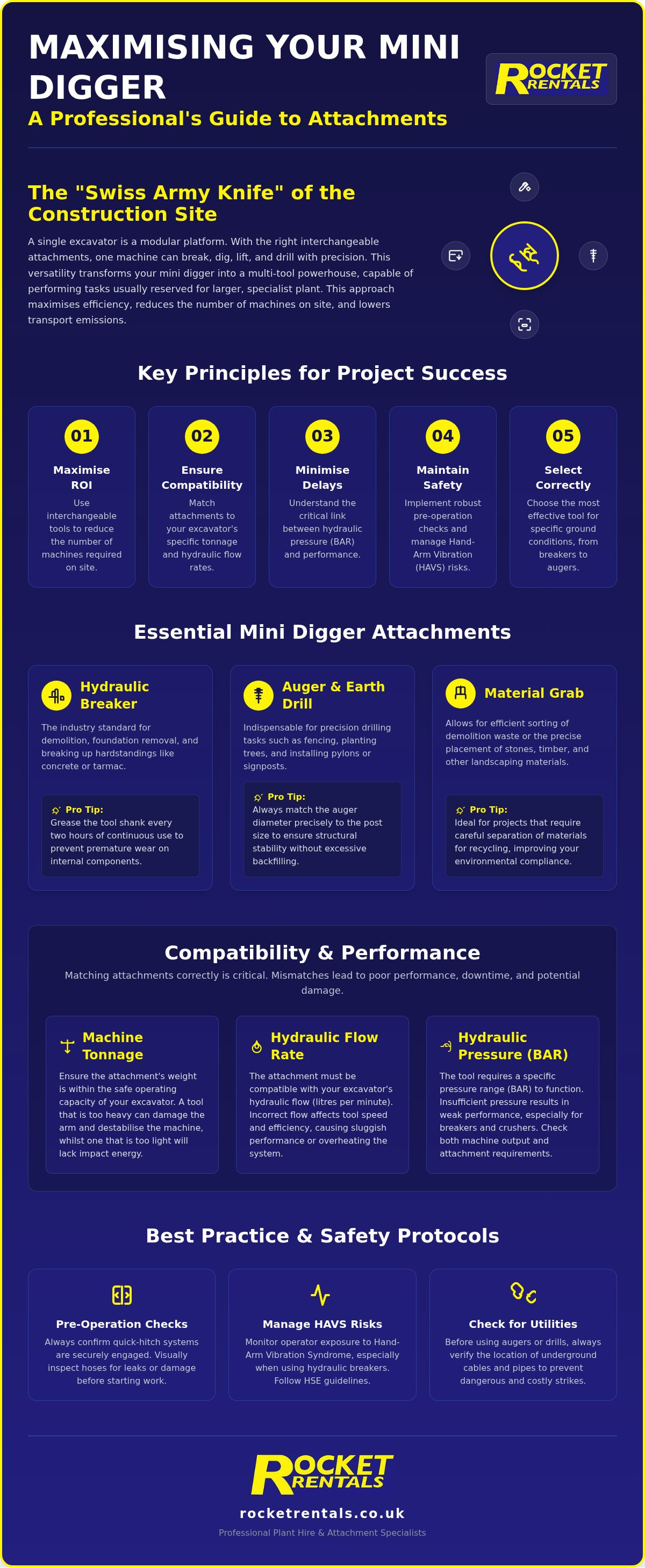
A Compact excavator is a formidable piece of engineering, but its true potential is unlocked through its versatility. Rather than viewing a machine as a static asset, professional contractors see it as a modular platform. By utilising a range of interchangeable tools, a standard excavator can transition from a digging machine to a precision demolition unit in minutes. This adaptability is the core reason why mini digger attachments hire has become a standard practice for modern UK groundworks and civil engineering projects. It allows a standard 1.5-tonne or 3-tonne machine to perform tasks usually reserved for much larger, specialist plant.
The economic logic is sound. Using one machine to perform three tasks is far more efficient than hiring three separate units. This approach minimises delivery charges and simplifies site management. When you invest in mini digger attachments hire, you're essentially customising your fleet for the specific challenges of the day. It increases your output without the overhead of a bloated plant list, ensuring your project remains profitable and on schedule.
The "Swiss Army Knife" of the Construction Site
Think of your excavator as the "Swiss Army Knife" of the site. On many UK projects, especially within urban centres, space is a premium commodity. Having three different machines on a residential driveway isn't just expensive; it's often physically impossible. Using one mini digger with several attachments solves this logistical puzzle whilst freeing up valuable space for other trades. It also supports your environmental targets. Fewer machines mean a lower carbon footprint and reduced transport emissions. This helps you meet modern sustainability standards without sacrificing any on-site productivity.
Common Project Scenarios for Attachment Use
Practical application is where these tools prove their worth. In demolition, a hydraulic breaker is essential for removing old foundations or concrete paths. For landscaping or fencing, an auger provides the precision needed for post-holes, completing in minutes what would take hours by hand. Within groundworks, material grabs allow for efficient sorting of waste or the precise placement of stones and timber. These scenarios demonstrate how the right tool ensures a project stays on schedule. Choosing the correct attachment means you aren't forcing a tool to do a job it wasn't designed for; this protects both the machine and the operator from unnecessary strain.
Essential Mini Digger Attachments for Construction and Groundworks
Selecting the right equipment is a matter of matching technical capability to the specific demands of your site. While a standard bucket is the default starting point, the right mini digger attachments hire converts a general-purpose machine into a precision instrument. For most UK groundworks, a core selection of tools provides the necessary coverage for demolition, excavation, and material handling. Using the correct tool doesn't just speed up the job; it protects the machine's hydraulic system from unnecessary stress.
Hydraulic Breakers and Concrete Crushers
Hydraulic breakers are the industry standard for foundation removal and breaking up hardstandings. It's vital to select a breaker that matches your machine's tonnage. Using a breaker that's too heavy can damage the excavator's arm, whilst one that is too light will lack the impact energy required for thick concrete. In urban residential areas, prioritising silenced breakers is essential to ensure compliance with local noise regulations. For consistent performance, operators should remember to grease the tool shank every two hours of use to prevent premature wear on the internal components.
Augers, Drills, and Post Drivers
Augers and earth drills are indispensable for fencing and pylon installation. The diameter of the auger bit must be precisely matched to the post size to ensure structural stability without excessive backfilling. Before drilling, always verify the location of underground utilities to maintain site safety, following the guidance last updated in January 2024. Using a post driver attachment in agricultural or industrial settings can significantly speed up the installation of long fence lines. These tools are particularly effective on 1.5-tonne machines, which offer the right balance of reach and stability for drilling tasks.
Beyond drilling and breaking, ripper teeth are highly effective for tackling frozen ground or stubborn tree roots that a standard bucket might struggle to penetrate. For waste management and demolition, grapples and grabs improve site safety by allowing operators to sort materials and load skips directly from the cab. Finally, specialist buckets like grading or skeletal buckets allow for precise levelling and on-site material sorting. This reduces the amount of waste sent to landfill and can lower your overall project costs. If you're unsure which tool is best suited for your specific soil type, our team can help you select the most effective excavator attachments for your project.
Compatibility and Performance: Matching Attachments to Your Hire Fleet
A successful project relies on the harmonious operation of the machine and its tool. Simply securing a piece of equipment to the arm is not enough to guarantee performance. Professional plant management requires a deep understanding of how machine tonnage and hydraulic capacity dictate the effectiveness of your mini digger attachments hire. If these elements are misaligned, you risk poor productivity, equipment damage, or even site accidents.
Machine tonnage is the first filter for selection. A 1.5-tonne mini digger lacks the counterweight and structural integrity to support a heavy-duty breaker designed for a 5-tonne machine. Attempting to use an oversized attachment shifts the centre of gravity, leading to dangerous instability during operation. It also places immense strain on the hydraulic pumps, which can lead to costly failures and project delays. Matching the tool to the machine's weight class ensures the excavator remains a stable platform for precision work.
Hydraulic Requirements and Flow Rates
Your excavator's hydraulic system is its lifeblood. Every attachment has specific requirements for hydraulic flow, measured in L/min, and pressure, measured in BAR. You must verify that your hired mini digger has sufficient auxiliary flow to power the tool effectively. Most modern machines feature auxiliary circuits, but you must distinguish between single-acting circuits, common for breakers, and double-acting circuits, which are required for rotating grabs or augers. Signs of a hydraulic mismatch include overheating, sluggish performance, or excessive vibration that can strain the machine's seals.
Pin Sizes and Quick-Hitch Compatibility
The physical connection is governed by pin diameters and the dipper gap. For a secure fit, the attachment's brackets must match the machine's pin sizes exactly. Typical industry standards include:
1.5-tonne machines: Usually utilise 25mm pins.
3-tonne machines: Typically require 30mm pins.
5-tonne machines: Generally move up to 35mm pins.
Quick-hitch systems have revolutionised tool changes on site. Mechanical hitches are reliable and cost-effective, though they require the operator to leave the cab to manually secure a safety pin. Hydraulic hitches allow for changes from the seat, significantly reducing downtime during complex tasks. Regardless of the system used, always verify the "dipper gap", the width between the ears of the attachment, to ensure the arm fits snugly. A loose connection causes rapid wear on the pins and bushings, compromising the precision and safety of your work.
Best Practice and Safety Protocols for Excavator Attachment Operation
Safety on a construction site is never a matter of chance; it is the result of rigorous protocols and well-maintained equipment. When you arrange for mini digger attachments hire, the responsibility for safe operation begins before the engine is even started. A thorough pre-operation check is a mandatory requirement for every shift. You should inspect all hydraulic hoses for signs of abrasion or bulging, ensure that couplings are free from grit, and verify that all locking pins are correctly seated. These simple steps prevent the hydraulic failures that lead to both project delays and site accidents.
One of the most significant health risks for operators is Hand-Arm Vibration (HAVS), particularly when using hydraulic breakers. You must monitor trigger times and ensure your team takes regular breaks to stay within the legal exposure limits set by the HSE. Failure to manage vibration levels can lead to permanent health issues for staff and significant legal liabilities for your business. Furthermore, any lifting operations must be conducted in strict accordance with the Lifting Operations and Lifting Equipment Regulations 1998 (LOLER). If you are using a grab or a lifting hook, the attachment must be rated for the specific load and accompanied by the correct certification.
HSE Compliance and Site Regulations
Every attachment used on a commercial project must have a valid Report of Thorough Examination. This document is your proof that the tool has been inspected by a competent person and meets the required safety standards under PUWER or LOLER. Without this paperwork, you may find your site shut down during a spot inspection. Operator competency is equally vital. Do your operators hold the relevant CPCS or NPORS certifications for specialist tools like augers or shears? Ensuring your team is properly trained is the most effective way to maintain a safe working environment. You should also consider noise levels when working amongst residential properties, as local authority contracts often mandate the use of silenced breakers to minimise community disruption.
The "Safe Stop" and Quick-Hitch Safety
The "Safe Stop" procedure is a non-negotiable part of changing any tool. Before the operator leaves the cab to inspect a connection, they must engage the park brake, neutralise the controls, and turn off the engine. If your mini digger attachments hire includes a manual quick-hitch system, the safety pin must be inserted and locked manually. Never rely on the hydraulic pressure of the hitch alone. To confirm a secure connection, always perform a "bump test" by applying downward pressure on the attachment against the ground whilst checking for any movement. This simple physical check ensures the tool is fully engaged and won't detach during work. Finally, ensure that the machine's cab guards are in place whenever you are using high-impact tools like breakers. For machinery that meets the highest safety and maintenance standards, view our full range of excavator hire options.
Professional Plant Hire: Why Choose Rocket Rentals for Your Attachment Needs
Efficiency on site is the product of two factors: high-performance machinery and the technical expertise to support it. At Rocket Rentals, we specialise in providing self-drive equipment that gives professional contractors total control over their groundworks. Our approach to mini digger attachments hire is built on the belief that a hire partner should be a safe pair of hands, not just a supplier. We don't just deliver a tool; we deliver a solution that has been rigorously maintained and technically vetted for your specific project requirements.
The Rocket Rentals Reliable Fleet
Our fleet comprises modern, high-specification machines that are subjected to strict maintenance schedules. We understand that downtime is the enemy of profit. By organising our servicing around proactive inspections rather than reactive repairs, we ensure our equipment arrives on your site ready for immediate, heavy-duty use. This commitment extends to our range of attachments, where we invest in the latest hydraulic technology to provide superior breaking, drilling, and material handling capabilities. For a deeper look into selecting the right base machine, consult The Professional Guide to Mini Excavator Hire.
How to Organise Your Next Attachment Hire
Adding a specialist tool to your existing plant list is a straightforward process. When you arrange your mini digger attachments hire, we don't just take an order. We consult with you to verify the technical compatibility of the machine and attachment, checking hydraulic flow rates and pin diameters to prevent the performance issues discussed in earlier sections. This proactive service is particularly valuable for complex industrial projects where precision is paramount. Whether you are managing a residential development or a large-scale civil engineering task, we provide national support with a local touch. To learn more about our regional operations, see our guide on Excavator Hire in the South West.
Choosing Rocket Rentals means choosing a partner that values site safety and operational excellence as much as you do. We provide the technical competence you expect from a major provider whilst maintaining the personal service that ensures your specific needs are met every time. Our goal is to help you maximise site versatility without compromising on reliability.
Future-Proof Your Site Productivity with Specialist Attachments
Maximising site versatility is a strategic decision that directly impacts your project's bottom line. As we have explored, transforming a standard excavator into a multi-purpose powerhouse requires a precise understanding of hydraulic compatibility and rigorous safety standards. When you prioritise technical alignment and HSE compliance, you don't just complete the job faster; you protect your team from unnecessary risk. It's the difference between merely finishing a task and achieving professional excellence through machine multi-tasking.
A successful project relies on partnering with a specialist who understands the nuances of your machinery's flow rates and pin sizes. We are national self-drive hire specialists, providing expert technical support for all plant attachments alongside a modern, HSE-compliant fleet. We ensure that every piece of equipment meets our high maintenance standards, giving you total peace of mind on site. This commitment to quality ensures your machinery remains a "safe pair of hands" for any groundworks challenge.
Are you ready to enhance your machine's capabilities and reduce downtime? Enquire about mini digger attachments hire today to discover how our fleet can support your project goals. We look forward to providing the reliable machinery you need for a successful build.
Frequently Asked Questions
Do I need a special licence to use mini digger attachments?
No special licence is required to operate mini digger attachments on private land, but commercial sites and public roads demand specific certifications. Most professional projects require operators to hold a valid CPCS or NPORS card. These qualifications demonstrate that the user has undergone the necessary training to manage the technical and safety complexities of auxiliary tools. When you organise your mini digger attachments hire for a commercial site, ensuring your operators have these credentials is a key part of your safety planning.
Will a 3-tonne breaker fit on a 1.5-tonne mini digger?
A 3-tonne breaker is not compatible with a 1.5-tonne machine and should never be used. Attachments must be matched to the machine's weight class to maintain stability and prevent hydraulic failure. An oversized breaker shifts the excavator's centre of gravity, creating a significant tipping risk. Additionally, the 1.5-tonne machine's hydraulic pump cannot provide the flow rate required to power a larger breaker, leading to sluggish performance and potential equipment damage.
How do I know if my hired digger has the correct hydraulic circuit for an auger?
You must verify that your excavator is equipped with a double-acting auxiliary hydraulic circuit. Unlike a breaker, which only requires one-way flow, an auger needs two-way flow to rotate in both directions for drilling and extraction. You can usually identify this by checking for two hydraulic pipes on the dipper arm. When arranging your mini digger attachments hire, our technical team will confirm your machine's circuit type to ensure it supports the specific tool you require.
Are all mini digger buckets and attachments interchangeable between brands?
Attachments are not universally interchangeable across all brands because pin diameters and dipper widths vary between manufacturers. Whilst many modern machines follow common industry standards, a bucket designed for a Kubota may not fit a JCB without a specific hitch. It is essential to match the attachment's pin size, such as 25mm or 30mm, and the dipper gap to your machine's specifications to ensure a secure and safe connection.
What should I do if a hydraulic hose on an attachment starts leaking?
If you discover a hydraulic leak, you must perform a "Safe Stop" immediately by turning off the engine and lowering the attachment to the ground. Do not attempt to find the leak with your hands, as high-pressure fluid can cause severe injuries. Once the machine is safe, depressurise the hydraulic system by moving the controls. You should then report the fault to our support team, who will arrange for a repair or replacement to prevent site contamination.
Can I use a mini digger attachment for lifting heavy materials on site?
You can use specific attachments for lifting, provided they are rated for the load and comply with LOLER regulations. Any tool used for lifting must have a valid Report of Thorough Examination and be fitted with a certified lifting eye or hook. It is vital to consult the machine's load chart to ensure the combined weight of the attachment and the material does not exceed the safe working limit, especially at full reach.
How do I calculate the HAVS exposure time for a hydraulic breaker?
To calculate Hand-Arm Vibration (HAVS) exposure, you must use the vibration magnitude provided in the attachment's technical manual alongside an HSE vibration calculator. This determines the maximum trigger time an operator can spend using the breaker before reaching legal exposure action levels. Monitoring these times is a critical safety requirement. We provide well-maintained tools with lower vibration signatures to help you manage these risks effectively and stay compliant with site health and safety regulations.
What is the difference between a mechanical and hydraulic quick-hitch?
The primary difference lies in how the attachment is secured and released. A mechanical quick-hitch requires the operator to leave the cab and manually turn a screw or lever, then insert a safety pin. A hydraulic quick-hitch allows the operator to change tools from within the cab using hydraulic pressure. Whilst hydraulic systems improve efficiency, they still require a visual check or a bump test to ensure the locking mechanism has fully engaged before work begins.


Comments