
Plant Hire Myths Debunked: A Professional Guide to Site Efficiency in 2026
- Rocket Rentals
- Jul 1
- 12 min read
Is the lowest day rate on a plant hire agreement actually saving you money, or is it a quiet drain on your project's bottom line? You've likely experienced the frustration of a "bargain" dumper that arrives late or a mini digger that lacks the latest safety features. It's understandable to feel cautious when hidden costs and complex compliance requirements seem to be the industry norm. We know that your priority is keeping the site moving without unexpected financial shocks or avoidable downtime.
This guide will dismantle the most persistent myths surrounding plant hire in 2026, showing you how to secure high-spec machinery that protects your budget whilst ensuring maximum site safety. We'll explore the true cost of equipment rental, the impact of Stage V emissions standards on your procurement, and how to streamline your workflow for better reliability. By the end, you'll have the confidence to choose a fleet that delivers performance and peace of mind from day one.
Table of Contents
Debunking the 'Lowest Day Rate' Myth: Calculating the True Cost of Plant Hire
Self-Drive vs. Operated Plant: Why the Professional Choice is Often Misunderstood
The 'Hiring is Only for Short-Term' Myth: Analysing Long-Term Project ROI
Misconceptions Around Site Efficiency: More Than Just a Digger
Partnering for Success: How to Organise Your Next National Plant Hire
Debunking the 'Lowest Day Rate' Myth: Calculating the True Cost of Plant Hire
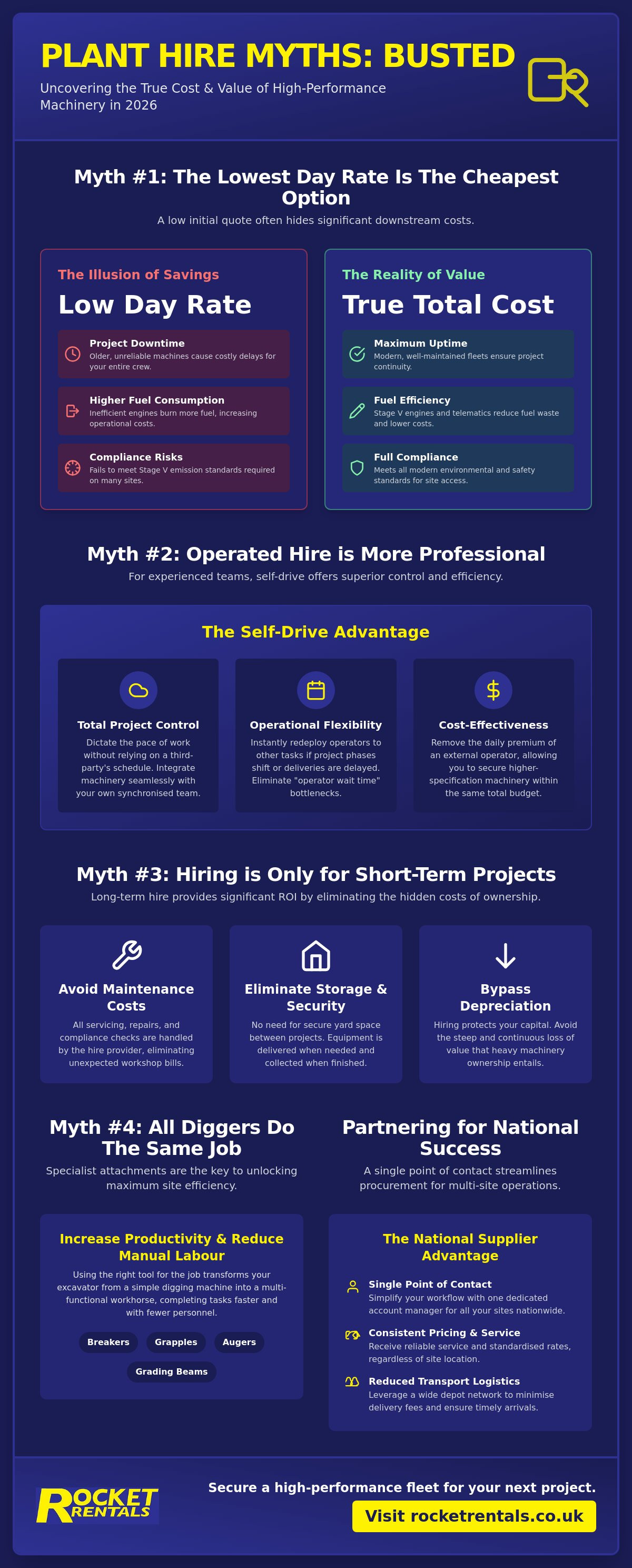
Selecting a plant hire partner based solely on the daily rate is a common oversight that often leads to budget overruns. While a lower figure on a quote looks attractive, it rarely tells the whole story of the total cost of hire. The equipment rental industry has evolved to a point where reliability and efficiency are the primary drivers of value, yet many procurement processes still focus on the wrong metrics. A cheap machine that arrives late or lacks the necessary safety features will quickly erode any initial savings through project delays and administrative friction.
National reach is another critical factor that impacts your final invoice. A plant hire provider with a wide network of depots can offer consistent pricing and reduced transport logistics costs. When a supplier has to move machinery across several counties, those transport fees are passed directly to you. Choosing a partner with a local presence backed by national scale ensures you aren't paying a premium for the delivery truck's fuel. It also provides a level of accountability that smaller, fragmented brokers often struggle to match.
The Downtime Dilemma: Reliability vs. Rental Price
Price becomes irrelevant the moment a machine stops working. If a low-cost excavator fails on-site, you aren't just losing the daily rental fee; you're paying for the hourly labour of a standing crew. The financial impact of six workers waiting for a replacement machine can reach hundreds of pounds per hour. Modern, well-maintained fleets significantly reduce this risk. Reliability isn't just a preference; it's a budget protection strategy that ensures your project remains on schedule whilst keeping your team productive.
Fuel Efficiency and Environmental Compliance
Older machinery often comes with a lower rental price, but it frequently consumes more fuel and fails to meet modern environmental standards. As of June 2026, meeting Stage V emission standards is a mandatory requirement for many sites to limit pollutants. Modern machines use advanced telematics to monitor fuel waste and idling time, providing data that helps you lower operational costs. When you factor in the 6.48 pence per litre duty rate for red diesel, the efficiency of a newer engine becomes a major financial advantage.
Before signing any agreement, use this "Hidden Extra" checklist to ensure you're comparing like-for-like quotes:
Fuel Management: Does the provider offer a fair "full-to-full" policy or inflated refuelling charges?
Insurance Requirements: Are you covered under standard CPA conditions, or do you need additional site-specific protection?
Damage Waivers: What's the excess in the event of an accidental dent or scratch?
Transport Fees: Are delivery and collection charges clearly stated for both directions?
Self-Drive vs. Operated Plant: Why the Professional Choice is Often Misunderstood
A common misconception in the construction industry is that operated plant hire represents the only truly professional option for large-scale projects. While operated hire has its place for highly specialised, one-off tasks, many seasoned site managers find that self-drive options offer superior flexibility and control. The idea that a third-party operator is a hallmark of 'professionalism' often ignores the logistical reality of modern site management. When you manage your own qualified team, you're not just hiring a machine; you're integrating a tool into a cohesive, already-synchronised workforce.
Choosing self-drive allows you to dictate the pace of work without being beholden to a third-party's schedule. If a project phase finishes early or a delivery is delayed, your own operators can be redeployed immediately to other tasks. This level of autonomy is vital for maintaining momentum. For multi-week projects, the cost-benefit of self-drive becomes even more apparent. By removing the daily premium of an external operator, you can often secure higher-specification machinery for the same total budget, provided you have the talent already on your payroll. Reviewing our range of self-drive excavators and dumpers can help you determine the best fit for your next multi-week project.
Autonomy and Site Coordination
Site conditions change fast. On a dynamic project, the "operator wait time" associated with third-party staff can become a significant bottleneck. If an operated machine finishes its specific task, that operator might sit idle until the next scheduled phase. In contrast, integrating hired machinery into your existing team workflows means your staff can jump between machines as needed. Experienced contractors prefer this flexibility because it keeps the site moving. It eliminates the friction of managing external personnel who may not be familiar with your specific site safety protocols or team culture.
Liability and Safety in Self-Drive Hire
Safety is never a secondary concern. Some believe that operated hire shifts the burden of liability, but under current UK safety regulations, the responsibility for ensuring equipment is used safely and by competent people remains a shared priority. For self-drive hire, this means ensuring your operators hold the correct CPCS or NPORS certifications. The role of the hire partner is to provide modern, safety-compliant machinery that is ready for work. To help your team maintain these high standards, we've developed a Mini Digger Safety Checklist for Contractors that covers the essential daily checks required for self-drive operations. This proactive approach ensures your site remains both efficient and fully compliant with national standards.
The 'Hiring is Only for Short-Term' Myth: Analysing Long-Term Project ROI
Many contractors assume that if a project extends beyond a year, purchasing machinery is the only logical financial decision. This perspective often overlooks the complex reality of the total cost of ownership. While buying equipment might appear to build equity, the rapid depreciation of heavy machinery and the rising costs of secure storage can quickly offset any perceived gains. Choosing long-term plant hire transforms unpredictable capital expenditure into a manageable operational cost, providing a clearer picture of project ROI from start to finish.
Tax efficiency plays a significant role in this calculation. Operational hire costs are typically fully deductible as business expenses, whereas capital purchases involve complex depreciation schedules that may not align with your project's cash flow. By hiring, you preserve your capital for other strategic investments, such as skilled labour or business expansion, rather than tying it up in a static asset that loses value the moment it leaves the showroom. It's a strategy that provides financial breathing room whilst maintaining a modern, high-performance fleet.
The Flexibility Factor in Groundworks
Project requirements rarely stay the same for twelve months. A site often begins with a need for mini excavator hire for initial trenching and utility work before scaling up to 13-tonne excavators and large telehandlers. Owning a fleet creates a "wrong machine" trap, where you're forced to use equipment that isn't perfectly suited for the task simply because it's available. Long-term plant hire allows you to swap machinery as project phases evolve, ensuring you always have the most efficient tool for the specific job at hand. This agility is particularly valuable for managing seasonal demand, as you aren't burdened with the costs of idle machinery during winter lulls or planning delays.
Maintenance and Compliance Burden
Ownership brings a heavy administrative and technical load that many businesses underestimate. Under the Provision and Use of Work Equipment Regulations 1998 (PUWER), the user must ensure equipment is safe and well-maintained. When you hire, the responsibility for statutory LOLER and PUWER inspections rests with the supplier. This eliminates the need for expensive internal workshops, specialist plant fitters, and the logistical headache of tracking service intervals across multiple sites. You gain consistent access to the latest safety technology and Stage V compliant engines without the long-term liability of maintaining an ageing fleet. This shift from owner to user allows your team to focus entirely on project delivery rather than mechanical upkeep.
Misconceptions Around Site Efficiency: More Than Just a Digger
Many site managers operate under the assumption that a single, versatile excavator is the answer to every groundwork challenge. While a digger is undeniably the workhorse of the site, relying on it to perform every task often creates significant bottlenecks. True site efficiency is found in a coordinated ecosystem where plant hire includes a strategic mix of dumpers, telehandlers, and rollers to maintain a constant material flow. A dumper ensures the excavator never waits on a growing pile of spoil, while a telehandler manages site logistics, preventing the "stop-start" rhythm that plagues poorly planned projects.
Integrating these machines into a single workflow allows for a level of productivity that a lone machine cannot match. For instance, using a telehandler to distribute materials across a site frees up the excavator to focus entirely on its primary task: digging. This separation of duties reduces wear on your primary assets and ensures that every minute of operator time is spent on high-value activity. It's a methodical approach that turns a collection of machines into a high-performance team.
Maximising Excavator Utility
The productivity of an excavator is often limited by the attachment at the end of the arm. Using a standard bucket for tasks like rock breaking or heavy-duty screening is inefficient and risks unnecessary mechanical stress. Specialist excavator attachments, such as hydraulic breakers, augers, and riddling buckets, allow one operator to perform the work that would otherwise require hours of manual labour. Modern quick-hitch systems have revolutionised this process. These systems allow for rapid attachment changes in seconds, often without the operator needing to leave the cab. This capability means you can adapt to shifting ground conditions, such as moving from soft clay to hard rock, without any significant delay in your timeline.
The Impact of Site Welfare on Productivity
Welfare units are sometimes dismissed as a luxury "extra," yet they are a fundamental regulatory necessity under HSE requirements. Providing a clean, warm, and well-equipped space for breaks is directly linked to worker morale and overall site safety. A cold or fatigued team is significantly more prone to errors and lapses in concentration. Choosing between static and towable welfare solutions depends on your project's footprint. Towable units are particularly effective for linear projects, such as roadworks or utility laying, as they can follow the work as it progresses. This ensures that facilities are always within a reasonable distance, minimising transit time and keeping the team focused on the task at hand.
Optimising your equipment mix is about more than just numbers; it's about providing your team with the right tools and environment to succeed. To see how the right combination of machinery and attachments can transform your next project, explore our full range of site equipment and welfare units today.
Partnering for Success: How to Organise Your Next National Plant Hire
Moving beyond the myths of plant hire requires a shift in how contractors view their suppliers. A transactional approach often leads to the hidden costs and reliability issues discussed earlier in this guide. Instead, developing a long-term relationship with a reliable national supplier provides the stability needed for complex project timelines. This is especially true for multi-site operations where consistency in machinery quality and safety standards is paramount. Having a single point of contact simplifies communication, ensuring that project managers spend less time on the phone and more time overseeing site progress.
Streamlining the booking process is a hallmark of a professional partnership. When your supplier understands your specific site requirements and preferred fleet configurations, the procurement process becomes an asset rather than an administrative burden. At Rocket Rentals Ltd, we ensure this level of coordination allows for rapid deployment, so the right equipment is always ready for the next phase of groundworks. It's about creating a "safe pair of hands" that supports your project's momentum from the first dig to the final compaction.
Setting Up Your Hire Account
Efficiency begins before the first machine arrives on site. To ensure a smooth experience, professional contractors should prepare essential documentation early. This typically includes company registration details and proof of "Hired In Plant" insurance. Understanding your credit limits and payment terms is also vital for maintaining a healthy project budget. By organising these details upfront, you eliminate the friction that often delays equipment delivery on new projects. It also allows you to take advantage of more flexible booking options as your relationship with the supplier matures.
The Rocket Rentals Ltd Difference
At Rocket Rentals Ltd, we focus on providing high-spec, self-drive excellence for contractors who value control and reliability. Our commitment to maintaining a modern, high-performance fleet ensures that every machine meets the latest Stage V emission standards and safety requirements. We don't just provide equipment; we offer the technical expertise needed to help you choose the most efficient tools for your specific ground conditions. Whether you need a single mini digger or a comprehensive fleet for a national contract, we're here to provide the professional support your project deserves.
Ready to optimise your site efficiency for 2026? View our full plant hire catalogue to explore our range of excavators, dumpers, and specialist attachments.
Optimising Your Project Strategy for Long-Term Success
Recognising that modern site efficiency relies on more than just the lowest initial quote is the first step toward a more profitable project. By focusing on the total cost of hire, embracing the autonomy of self-drive operations, and leveraging specialist attachments, you can eliminate the hidden drains on your budget. This methodical approach allows you to maintain consistent progress whilst avoiding the common pitfalls of unreliable machinery or unexpected downtime. These strategic choices ensure your team remains productive and your site stays compliant with the latest safety regulations.
Since our founding circa 1988, we've provided the industry expertise needed to navigate these complex procurement decisions. We specialise in high-quality, self-drive machinery that empowers site managers to take full control of their timelines. With comprehensive national coverage for professional contractors, we're ready to support your next project with a fleet built for modern standards. Explore our range of professional plant hire solutions to secure a dependable partner for your site. We look forward to helping you achieve a safer, more efficient workflow.
Frequently Asked Questions
Do I need a special licence for self-drive plant hire?
You don't need a specific UK driving licence for work on private sites, but you must demonstrate operator competence. Most professional contractors require valid CPCS or NPORS certification to ensure safety standards are met. If the machinery needs to be driven on public roads, the operator must hold a valid UK driving licence with the appropriate categories for the vehicle's weight.
How much does it cost to hire an excavator for a week?
Weekly rates for excavator hire depend on the machine's tonnage, specification, and the total duration of the agreement. While daily rates are available, longer-term bookings often provide better value for money by reducing the proportional cost of transport and administrative fees. We recommend contacting our team for a tailored quote that reflects your specific project requirements.
What happens if the hired machinery breaks down on site?
If a machine fails, our technical support team provides a rapid response to minimise your site downtime. Because we maintain a modern fleet with rigorous servicing schedules, mechanical issues are rare. In the event of a significant fault that cannot be repaired on-site, we organise a replacement machine to keep your project moving.
Is insurance included in the plant hire rate?
Standard plant hire rates typically don't include insurance. Most professional hire agreements require the customer to have "Hired In Plant" insurance to cover the equipment against theft, loss, or damage whilst it is in their care. It's essential to verify your coverage limits before the machinery is delivered to your site.
Can I hire plant machinery for a project anywhere in the UK?
Yes, we provide comprehensive national coverage for professional contractors across the UK. Our network allows us to deliver high-spec machinery to various locations, ensuring you have a single point of contact for multi-site projects. This logistical reach helps maintain consistent service standards and pricing regardless of your project's geography.
What is the difference between a mini digger and a micro digger?
The primary difference lies in the machine's weight and physical dimensions. A micro digger typically weighs less than one tonne and features a retractable undercarriage, allowing it to pass through a standard doorway. A mini digger usually ranges from 1.5 to 5 tonnes, offering greater digging depth and lifting capacity for more demanding groundworks.
Are attachments included with the excavator hire?
A standard set of digging buckets is usually included with every plant hire agreement for excavators. Specialist attachments such as hydraulic breakers, augers, or riddling buckets are available as additional options. Matching the right attachment to your specific ground conditions is key to maximising the productivity of the machine on-site.
Do you provide welfare units for remote site locations?
We provide both static and towable welfare units that are ideal for remote or mobile site locations. These units are fully self-contained, providing the necessary facilities for your team to meet HSE requirements without needing a mains water or power connection. Our towable options are particularly useful for projects that progress along a specific route.


Comments