
Scissor Lift Hire Cost: A Professional Guide to Budgeting for 2026
- Rocket Rentals
- 1 day ago
- 12 min read
The lowest daily rate on a quote often leads to the most expensive project invoice. Whilst a headline figure might look attractive, the true scissor lift hire cost is frequently obscured by hidden transport fees, complex insurance mandates, and the risk of site downtime from sub-standard equipment. It's a common frustration for site managers who find themselves paying for over-specced machines that don't actually improve their bottom line.
We understand that you need transparency and reliability to keep your project on track. This professional guide provides a clear framework for budgeting in 2026, helping you navigate the variables that drive prices up. You'll learn how to select the most cost-efficient self-drive machine for your specific requirements and how to secure reliable, well-maintained equipment that ensures maximum site productivity. From understanding delivery logistics to clarifying your insurance obligations, we'll ensure you have the expertise to manage your powered access budget with total confidence.
Table of Contents
Understanding the Factors Influencing Scissor Lift Hire Cost
Calculating an accurate budget for powered access requires a clear understanding of your site's technical demands. The total scissor lift hire cost isn't a static figure; it's a calculation based on machine capability, logistics, and time. Every mobile elevating work platform (MEWP) is designed for a specific environment, and choosing the wrong category can lead to unnecessary expenses or site delays. By aligning the machine's specifications with the actual tasks at hand, you can avoid the common pitfall of paying for unused capacity.
The Relationship Between Working Height and Price
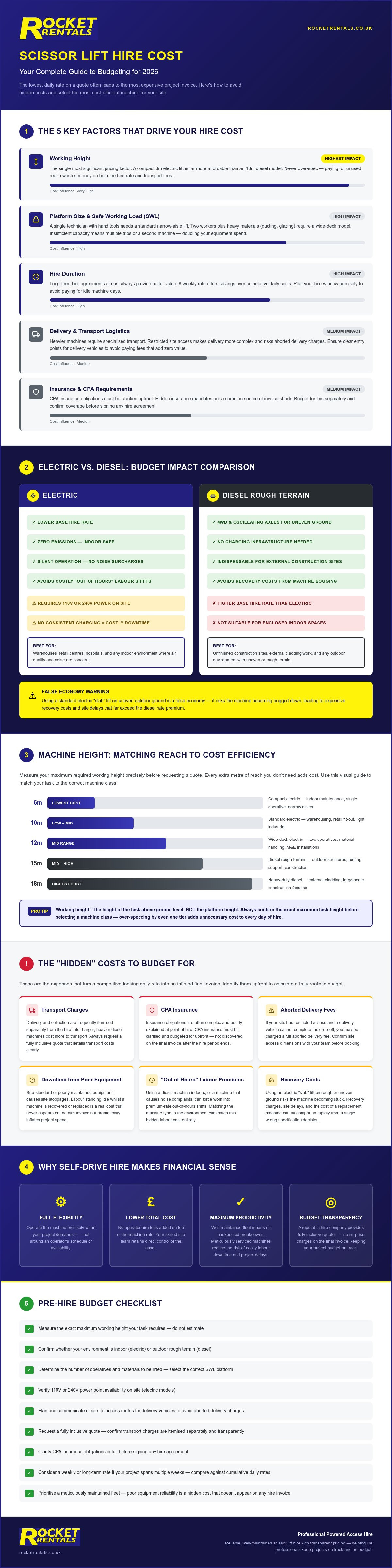
Height is the most significant factor in pricing. A compact 6-metre electric lift designed for indoor maintenance is far more affordable than a heavy-duty 18-metre diesel model built for external cladding work. Many contractors fall into the trap of "over-speccing" their requirements, hiring a machine with far more reach than they actually need. This leads to a higher rental rate and potentially higher transport fees due to the increased weight of the larger unit. Whilst higher reach costs more, it ensures site safety by providing a stable and appropriate platform for the task at hand. It's vital to measure your maximum required working height precisely before requesting a quote.
Platform Dimensions and Lift Capacity
The size of the platform and its Safe Working Load (SWL) also dictate the hire rate. If you only need to lift a single technician with basic hand tools, a standard narrow-aisle lift is the most cost-effective choice. However, if your project requires two workers plus heavy materials like ducting or glazing units, you'll need a wide-deck model with a higher weight capacity. Budgeting for these larger machines is essential when material handling is part of the job. Choosing a machine with insufficient capacity doesn't just slow down the work; it often leads to multiple trips or the need for a second machine, which doubles your equipment spend.
Hire duration and logistics are the final pieces of the puzzle. Long-term hire agreements almost always provide better value than short-term rentals. If your project spans several weeks, a weekly rate usually offers a saving over the cumulative daily cost. You should also consider site access. Heavier machines require specialised transport, and if your site has restricted access, the delivery logistics become more complex. Ensuring you have clear entry points for delivery vehicles helps you avoid aborted delivery charges, which can quickly inflate your total scissor lift hire cost without adding any value to the project.
Comparing Electric vs. Diesel: Impact on Your Project Budget
Choosing the right power source is a pivotal decision for your project's financial efficiency. Whilst the base scissor lift hire cost for electric models is often lower than diesel equivalents, the true impact on your budget depends on your site infrastructure. You must look beyond the initial rental invoice to understand how energy consumption and machine capability influence your total expenditure. Selecting a machine that doesn't match your environment leads to wasted labour hours and potential recovery fees.
Financial Advantages of Electric Powered Access
Electric scissor lifts are the primary choice for indoor environments such as warehouses, retail centres, and hospitals. Their silent operation and zero emissions allow for work to continue during standard hours without the risk of noise complaints or air quality issues. This prevents the need for expensive "out of hours" shifts which can carry significant labour premiums. When opting for electric scissor lift hire, your primary budget consideration is charging infrastructure. You must ensure your site has accessible 110V or 240V power points. Without a consistent charging schedule, your team faces costly downtime whilst waiting for batteries to replenish.
When Diesel Rough Terrain is Worth the Premium
Diesel rough terrain models are engineered for the demanding conditions of an unfinished construction site. These machines command a higher hire rate, yet this premium is easily justified by their four-wheel drive systems and oscillating axles. Attempting to use a standard "slab" electric lift on uneven ground is a false economy. It often results in the machine becoming bogged down, leading to expensive recovery costs and site delays. Adhering to international safety standards for scissor lifts requires using equipment rated for the specific terrain, which is why diesel models are indispensable for external cladding or masonry work.
One variable often overlooked in the scissor lift hire cost is the price of fuel. Unlike electric units, diesel engines are subject to fluctuating market prices. For larger projects, you should also account for the logistics of bulk fuel delivery and secure on-site storage. However, diesel models offer significantly larger deck sizes and higher weight capacities, which can improve site productivity by allowing more materials to be lifted in a single trip. A modern, well-maintained fleet ensures these machines operate at peak efficiency with minimal risk of mechanical failure. To ensure your project stays on schedule, you can browse our reliable self-drive fleet to find the most cost-effective power solution for your site.
The "Hidden" Costs of Powered Access Hire
Whilst the daily rental rate is the most visible part of your budget, the total scissor lift hire cost often includes several essential ancillary charges. Many contractors overlook these secondary expenses, leading to unexpected figures on the final invoice. A transparent budgeting process requires you to account for logistics, protection, and fuel management from the very beginning of your project planning.
Logistics and Transport Fees
Transporting a scissor lift is a specialised task that requires heavy-duty vehicles, typically beaver-tail lorries equipped with ramps and winches. Unlike smaller tools, these machines cannot be moved with a standard van, meaning delivery and collection fees are a significant part of the logistics chain. Delivery fees are generally calculated based on the distance from the depot to the site and the size of the transport vehicle required for the specific machine. If you are managing a large-scale project, you can often reduce the average cost per unit by organising multiple machine deliveries simultaneously. This approach maximises the efficiency of the transport vehicle and reduces the total number of site visits required.
Protecting Your Assets: Insurance and Waivers
Self-drive hire agreements usually operate under Construction Plant-hire Association (CPA) terms, which place the responsibility for the machine firmly with the hirer. This means you must have adequate "Hired-in Plant" insurance to cover the replacement value of the equipment in the event of theft or total loss. Many firms find that damage waiver schemes are a cost-effective safety net, as they limit your financial liability for accidental damage that might occur during daily site operations. Current equipment rental market trends show that these waivers are becoming standard practice for professional contractors who want to avoid the administrative burden of small-scale insurance claims.
Maintaining the machine during the hire period is another way to protect your budget. Whilst "fair wear and tear" is expected, excessive dirt, paint over-spray, or plaster splashes can result in additional cleaning charges at the end of the contract. It's much cheaper to spend ten minutes cleaning the platform at the end of each shift than to pay for professional valeting. Finally, consider your fuel management strategy. Most providers operate a "full-to-full" policy for diesel machines. Refilling the tank yourself before the machine is collected is almost always more economical than paying for an on-site refuelling service, which often carries a premium for the convenience. By addressing these details, you ensure your scissor lift hire cost remains predictable and manageable.
Selection Guide: Matching Machine Height to Cost-Efficiency
Matching the machine to the task is the most effective way to control your scissor lift hire cost. A methodical selection process prevents the two most common budget leaks: paying for a machine that is over-specced, or worse, paying for a machine that cannot physically reach the work area. Follow these four steps to ensure your choice is both safe and cost-efficient.
Step 1: Measure the exact working height. Remember that working height is typically two metres above the platform floor. Don't guess; an extra metre of reach can push you into a higher price bracket.
Step 2: Assess the terrain. Slab wheels are designed for finished, level floors. Rough terrain wheels are essential for unfinished ground. Choosing the wrong type leads to site damage or a bogged machine.
Step 3: Determine the required platform width. If you're working in narrow racking, a standard width machine won't fit. If you're installing large panels, a narrow platform will require more repositioning, which wastes labour hours.
Step 4: Check site access points. Measure every doorway and gate the machine must pass through. Check for weight limits on mezzanine floors or suspended slabs before delivery.
Avoiding the Cost of Incorrect Machine Choice
If a machine arrives and cannot fit through the site entrance, you're looking at the financial drain of an aborted delivery and a second transport charge for the correct unit. This effectively doubles your transport-related scissor lift hire cost before work even begins. For internal fit-outs, narrow-aisle scissor lifts are often the best solution, reducing labour time by allowing access to tight spaces without dismantling site furniture. Many contractors find that coordinating their access needs alongside mini excavator hire for groundworks allows for a more streamlined delivery schedule and better site management.
Maximising Uptime with Professional Self-Drive
Site productivity depends on the machine working the moment it's unloaded. Professional providers ensure every unit undergoes rigorous pre-hire inspections so that you don't lose time to mechanical faults. Using high-quality brands like Genie and Skyjack offers a better return on investment because these machines are engineered for heavy professional use. They provide consistent performance even in demanding conditions. However, the machine is only as efficient as the person using it. Ensure your operators hold a valid IPAF PAL card; untrained staff often cause accidental damage or operational delays that can derail your project budget. To ensure you get the right machine for your next project, you can view our full range of scissor lifts and speak with our expert team.
Why Professional Self-Drive Hire from Rocket Rentals Makes Financial Sense
The true value of a plant partner is measured by the productivity they enable on your site. Whilst we've explored the technical variables that dictate the scissor lift hire cost, the most significant financial risk to any project is equipment failure. A machine that arrives late or breaks down mid-shift doesn't just stall progress; it leaves your skilled labour force standing idle whilst the clock continues to run on your project budget. Choosing a partner that prioritises fleet maintenance and transparent communication is the most effective way to safeguard your bottom line.
The Rocket Rentals Commitment to Reliability
We've built our reputation as a "safe pair of hands" for professional contractors since 1988. Unlike generic hire aggregators who often act as middlemen with little control over the machines they supply, we are independent specialists. This independence allows us to offer tailored advice that prioritises your specific project budget over a standard sales quota. We maintain a modern fleet of high-quality Genie and Skyjack machines, ensuring that every unit delivered to your site is ready for immediate, heavy-duty use. This focus on equipment readiness is why seasoned veterans in the construction and industrial sectors trust us to support their national projects.
Our self-drive model is designed for flexibility. It gives you total control over your site schedule without the added expense of operated plant. By managing the machine yourself, you avoid the rigid shift patterns and additional labour costs associated with external operators. We combine this flexibility with transparent billing. You won't find unexpected "add-ons" or hidden administrative fees at the end of the month. Every part of the scissor lift hire cost is discussed upfront, from transport logistics to insurance requirements, so you can manage your cash flow with absolute precision.
Securing Your Scissor Lift Hire Today
Organising your access equipment should be a straightforward process that supports your project timeline. We've streamlined our account opening procedure to ensure professional contractors can secure the machinery they need without unnecessary delays. Whether you're planning a complex multi-site rollout or a specialised warehouse fit-out, our team provides the technical expertise to ensure you receive the most cost-effective machine for the task. We offer national coverage delivered with the personal touch of a business that values long-term professional relationships.
Our experts are ready to provide a comprehensive, transparent quote based on your specific reach and terrain requirements. By aligning our independent expertise with your project goals, we help you master the complexities of powered access pricing. To take the next step in your project planning, you can enquire about scissor lift hire with Rocket Rentals today and experience the reliability of a meticulously maintained fleet.
Optimising Your Access Budget for 2026
Effective budgeting for powered access depends on aligning technical requirements with project realities. By accurately measuring working heights and selecting the appropriate power source, you prevent the unnecessary expenditure of over-speccing. Managing the total scissor lift hire cost also requires a proactive approach to logistics and insurance, ensuring that secondary expenses don't disrupt your financial planning.
As independent plant hire specialists since 1988, we understand that site productivity is your highest priority. Our comprehensive fleet of high-quality Genie and Skyjack machines is meticulously maintained to ensure zero wasted labour hours. We remain dedicated to professional self-drive reliability, providing the transparent pricing and expert guidance needed for a successful project outcome.
If you're ready to secure dependable equipment for your next national project, our team is here to help. You can request a bespoke quote for your scissor lift hire to receive tailored advice that prioritises your specific site needs. We look forward to supporting your team with the high standards of care and technical competence your project deserves.
Frequently Asked Questions
How much does it typically cost to hire a scissor lift for a week?
Weekly hire rates are determined by the machine's working height, power source, and the specific terrain it's designed to handle. Generally, a weekly agreement offers a more economical average daily rate compared to short-term hire. This allows site managers to better manage their scissor lift hire cost over the duration of a project. We provide detailed quotes that account for these variables to ensure your budget remains accurate and predictable.
Do I need a special licence to hire a scissor lift on a self-drive basis?
You don't need a government-issued driving licence, but operators must demonstrate competence to comply with health and safety regulations. We require proof of a valid IPAF PAL (Powered Access Licence) card for the relevant category, such as 3A for scissor lifts. This ensures that the self-drive equipment is operated safely and efficiently on your site. Having trained staff prevents project delays and reduces the risk of accidental damage.
Is insurance included in the standard scissor lift hire rate?
Standard hire rates usually exclude insurance, as the responsibility for the equipment transitions to the hirer under CPA terms. You'll need Hired-in Plant insurance to cover the full replacement value of the machine against theft or total loss. Some providers offer damage waivers as a supplementary safety net to limit financial liability for accidental site damage. It's essential to confirm your coverage details before the machine is delivered to avoid unexpected liabilities.
What happens if the scissor lift breaks down during the hire period?
What happens if a machine fails mid-shift? Our meticulously maintained fleet of Genie and Skyjack machines is designed to ensure maximum uptime on your site. If a mechanical issue occurs, our technical team provides prompt support to diagnose and resolve the problem. We prioritise getting your project back on track by either repairing the unit or arranging a swift replacement. This commitment to reliability helps you avoid the high labour costs associated with downtime.
Are there extra charges for delivery and collection of the machine?
Yes, delivery and collection are separate charges that reflect the logistical requirements of moving heavy plant equipment. These fees are calculated based on the machine's weight, dimensions, and the distance between our depot and your site. Because we use specialised beaver-tail lorries, these costs are a necessary part of the total scissor lift hire cost. Planning for multiple machine deliveries at once can often improve the logistical efficiency of your project budget.
Can I hire a scissor lift for a single day or is there a minimum period?
Whilst single-day hire is often possible, many professional projects benefit from a minimum hire period, such as two days or a full week, to secure the best value. Short-term hire still incurs the same fixed transport costs for delivery and collection, which can make the daily rate feel higher for very brief tasks. We recommend reviewing your project schedule to see if a longer hire period offers a more sustainable solution for your budget.
What is the difference in cost between electric and diesel scissor lifts?
Which power source offers the best return on investment? Electric models generally carry a lower hire rate and it's more economical to run them if you have on-site charging points. Diesel rough terrain models command a premium due to their complex four-wheel-drive systems and ability to navigate unfinished ground. When calculating your total expenditure, you must also account for fuel price fluctuations for diesel units. Choosing the machine that matches your terrain prevents expensive site delays.
Do you offer trade discounts for long-term industrial projects?
We provide bespoke pricing structures for long-term industrial projects and repeat trade requirements. As independent specialists, we have the flexibility to create tailored agreements that prioritise your specific project budget and duration. Long-term hire significantly reduces the average daily cost of the equipment, making it a financially sensible choice for large-scale construction or maintenance programmes. Contact our team to discuss your project timeline and receive a comprehensive, transparent quote.


Comments