
Scissor Lift Hire: The Professional’s Guide to Safe Vertical Access (2026)
- Rocket Rentals
- Aug 3
- 12 min read
Vertical access efficiency is determined by site-specific technical calibration, not just platform height. You've likely experienced the frustration of a project schedule slipping because of equipment downtime or a delivery that didn't arrive when promised. Securing a reliable scissor lift hire is about more than just reaching the required height; it's about finding a dependable partner that ensures every minute on site is productive and compliant.
We understand that navigating the complexities of LOLER inspections and the 2026 secondary guarding mandates can be a significant administrative burden. This guide provides a professional roadmap to help you master the technicalities of vertical access. We'll examine how to select the right machinery for your specific environment, ensuring you maintain 100% safety compliance whilst minimising operational costs. From understanding IPAF standards to evaluating fleet maintenance, you'll gain the knowledge needed to source a safe pair of hands for your next project.
Table of Contents
Understanding Scissor Lift Hire for Industrial and Construction Projects
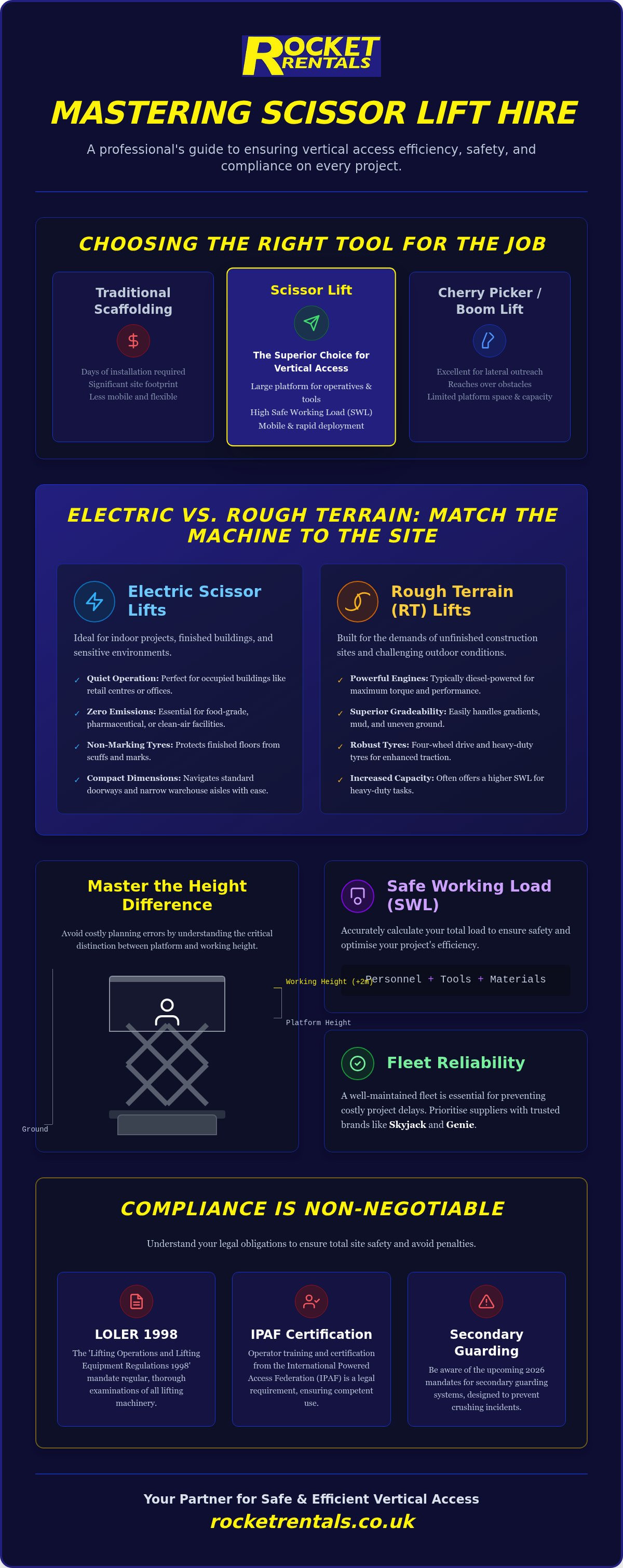
A scissor lift is a specific category of Aerial Work Platform (AWP) designed for vertical elevation. Unlike other access solutions that offer lateral outreach, these machines use a linked, folding support system in a criss-cross pattern. This mechanical design allows for a larger platform area, providing a stable base for multiple operatives and their equipment. For many professional contractors, securing a reliable scissor lift hire is the first step in organising a safe and efficient work site.
Traditional scaffolding often requires days of installation and a significant footprint commitment. In contrast, a scissor lift is mobile and ready for operation within minutes of arrival. This flexibility is particularly useful for internal fit-outs or external cladding where the work area moves as the project progresses. By opting for a self-drive or dry hire model, site managers maintain full control over their equipment. You aren't reliant on an external operator's schedule; your own qualified team manages the machine to suit the project's real-time needs.
The Role of Scissor Lifts in Modern Site Management
Speed of deployment is a primary driver for choosing mechanical access. A single operative can position the machine and reach the working height in a fraction of the time it takes to climb a ladder or assemble a tower. This efficiency directly impacts the bottom line by reducing labour hours on repetitive tasks such as electrical installations or warehouse racking. Safety is also enhanced. By providing a secure, railed environment, these platforms significantly reduce the risks associated with manual handling at height. Operatives can keep their tools within reach on the platform, minimising the need to move heavy items up and down whilst working.
Scissor Lifts vs. Other Access Equipment
It's vital to choose the right tool for the specific task. Whilst cherry pickers are excellent for reaching over obstacles, they lack the platform space and lifting capacity of a scissor lift. If your task requires moving straight up and down, the scissor lift hire is almost always the superior choice. It offers a much higher Safe Working Load (SWL), allowing for more materials to be elevated simultaneously. You might consider a telehandler for purely moving pallets or heavy materials across a site, but for personnel access, the scissor lift provides a dedicated, safe environment. The generous platform dimensions mean two workers can often work side-by-side comfortably, which is rarely possible in the compact basket of a boom lift.
Evaluating Electric vs Rough Terrain Scissor Lifts for Your Site
Selecting the correct machine for your scissor lift hire depends entirely on the ground conditions and the specific environment of your project. The distinction between electric and rough terrain (RT) models isn't just about the power source; it involves critical factors like floor loading, tyre specifications, and air quality requirements. For internal projects in finished buildings, electric units are often the only viable choice. Conversely, an unfinished construction site with mud and gradients demands the mechanical grit of a diesel-powered rough terrain lift.
Environmental constraints often dictate the specification. In food-grade or pharmaceutical facilities, zero-emission operation is a mandatory safety requirement to prevent contamination. Electric lifts meet these standards whilst offering the benefit of non-marking tyres. These specialised tyres are made from a distinct rubber compound that leaves no scuffs on polished concrete or resin floors. Technical resources regarding Scaffolding - Scissor Lifts emphasise the importance of proper positioning and stabilisation, which varies significantly between these two categories.
Indoor Access: The Power of Electric Scissor Lifts
Electric models excel in retail, office, and warehouse environments where noise must be kept to a minimum. Their quiet operation allows your team to work in occupied buildings without causing a nuisance to tenants or the public. These machines are designed with compact dimensions, often narrow enough to navigate standard aisles or pass through single doorways. Whilst they offer excellent agility, battery management is a key operational consideration. Most modern units require a dedicated charging point and typically need an eight-hour overnight charge to ensure a full shift of productivity the following day.
Outdoor Performance: Rough Terrain and Diesel Solutions
When the tarmac ends, rough terrain scissor lifts take over. These machines feature 4x4 drive systems and oscillating axles, providing the torque needed to traverse soft soil and uneven gradients. A defining feature of larger RT models is the inclusion of hydraulic outriggers. These legs extend to level the machine on sloped surfaces, providing a perfectly vertical lift even when the chassis is on an incline. Diesel engines provide the raw power for these demanding tasks, offering unlimited runtime provided the fuel tank is maintained. If your project involves challenging external ground, you can browse our specialised scissor lift hire fleet to find a machine capable of handling the terrain.
Technical Considerations: Platform Capacity, Reach, and Dimensions
Technical specifications are the foundation of a successful project plan. Selecting a scissor lift hire based on height alone often leads to operational hurdles once the machine arrives on site. You must consider the interplay between reach, load capacity, and the physical constraints of your work environment to ensure the machine is fit for purpose. Understanding these variables prevents equipment from being underutilised or, worse, becoming a safety hazard. Detailed planning ensures the machinery you receive can actually perform the task intended.
A common error in site planning is conflating platform height with working height. Platform height refers to the distance from the ground to the floor of the deck when fully elevated. Working height is typically calculated by adding 2 metres to the platform height, representing the average reach of an operative. If your task requires working at 12 metres, you require a machine with a 10-metre platform. Miscalculating this figure can result in operatives overreaching, which is a primary cause of instability and falls. It's a small distinction that makes a significant difference to site safety.
Safe Working Load (SWL) is another critical metric that requires precise calculation. This figure represents the total weight the machine can safely elevate, including personnel, hand tools, and materials. It's not enough to simply account for the workers; you must weigh the equipment and any cladding or pipework being installed. Technical resources like the OSHA Scissor Lift Safety Guidelines highlight that exceeding these limits can compromise the machine's centre of gravity, especially when the platform is fully extended. Modern machines are fitted with load sensors that prevent operation if the SWL is exceeded, which can lead to frustrating downtime if not planned for correctly.
Calculating Your Required Reach and Capacity
Accurate measurement is essential before booking your hire. Use a laser measure to determine the exact height of the work point. Consider whether your project requires extension decks. These slide-out sections provide additional horizontal workspace, allowing operatives to reach over fixed obstacles like machinery or pipework. However, you should be aware that the SWL often decreases on the extended portion of the deck. Always check the machine's load chart to ensure your combined weight remains within safe limits for the specific configuration you're using. This is particularly vital when two operatives are working together on the same platform.
Site Access and Manoeuvrability
Before the machine can work, it must reach the work area. Check the stowed dimensions, particularly the height and width, against every doorway and corridor on the route. Turning circles are equally important in tight industrial spaces; a machine that's too long may be unable to navigate narrow warehouse aisles. Finally, consider floor loading. On mezzanine floors or suspended slabs, the point load (the weight exerted by a single wheel) is often more critical than the total machine weight. Modern scissor lift hire options include lightweight models designed specifically for these sensitive surfaces, ensuring you don't exceed the structural limits of your building.
Safety Regulations and Operator Requirements for Plant Hire
Safety in vertical access is governed by a strict legal framework designed to protect operatives and site personnel. When you arrange a scissor lift hire, the primary legislation you must adhere to is the Lifting Operations and Lifting Equipment Regulations (LOLER) 1998. These regulations mandate that all lifting equipment is fit for purpose, appropriate for the task, and subject to regular "thorough examinations." For a site manager, this means ensuring that every machine on-site arrives with a valid LOLER certificate, typically renewed every six months for personnel-lifting machinery.
The legal burden doesn't end with the machine's mechanical state. Under the Provision and Use of Work Equipment Regulations (PUWER), employers are responsible for ensuring that anyone operating the machinery has received adequate training. Whilst the law doesn't name a specific card, the International Powered Access Federation (IPAF) PAL card is the recognised industry standard for demonstrating competence. Operating a scissor lift without documented proof of training isn't just a safety risk; it's a significant legal liability for your business.
IPAF Categories and Operator Competence
For scissor lifts, operators specifically require the IPAF Category 3a (Mobile Vertical) certification. This training ensures the operative understands the machine's stabilising features, emergency controls, and weight limits. Because we provide a self-drive model, the responsibility for verifying operator competence rests with the hirer. Even a highly experienced operator should undergo model-specific familiarisation. A Skyjack machine may have slightly different control layouts or emergency lowering procedures than a Genie model. Taking ten minutes to walk through the specific machine's manual and controls before the first ascent can prevent costly operational errors.
LOLER Compliance and Site Safety Checklists
A safe site begins with a robust Risk Assessment and Method Statement (RAMS). This document should be site-specific, addressing ground stability and overhead hazards like power lines. Daily pre-use inspections are a mandatory part of this process. Operators must check the hydraulic systems for leaks, ensure the pothole protectors deploy correctly, and verify that the emergency stop functions are operational. These checks must be recorded; a verbal confirmation isn't sufficient for a safety audit.
Environmental factors also play a critical role in your daily safety decisions. Most scissor lifts are rated for a maximum wind speed of 12.5 metres per second (approximately 28 mph). Beyond this point, the platform acts as a sail, significantly increasing the risk of a tip-over. Always check the machine's Beaufort scale rating, as some specialised indoor models are not rated for any wind at all. Ensuring your site remains compliant starts with choosing a provider that prioritises rigorous machinery maintenance. You can view our fully LOLER-compliant scissor lift hire fleet to find the right machine for your project.
Finally, never overlook the rescue plan. If a machine fails whilst elevated, your ground crew must be trained in the emergency lowering procedures. This involves knowing the location of the manual bleed valves or auxiliary power units. A rescue plan that hasn't been practiced is not a plan; it's a gamble. Make sure your ground team is as familiar with the machine's safety features as the operator in the sky.
Why Independent Plant Specialists Offer the Best Scissor Lift Hire Solutions
National hire chains often lean on sheer volume, but independent specialists focus on the precision and readiness of their fleet. When you secure a scissor lift hire, the mechanical condition of that specific machine determines your site's safety and pace. Dealing with a specialist means you aren't just an entry in a database; you have a direct line to technicians who understand the specific operational nuances of Skyjack and Genie units. This expert support is invaluable when you need immediate guidance on machine capabilities or site-specific challenges.
Personalised service extends to the reliability of delivery windows. Large national providers often struggle with overstretched logistics, leading to vague arrival times that disrupt your workforce. An independent partner provides more accurate scheduling, ensuring your team isn't standing idle. This direct communication ensures that if your project requirements change, you're speaking to someone with the authority to adjust your hire terms or swap machinery quickly, keeping your project fluid and responsive.
Maintenance Standards and Reliability
A rigorous multi-point check is performed on every machine between contracts. This isn't a cursory glance; it's a deep mechanical evaluation that ensures every hydraulic seal and electrical sensor is functioning perfectly. Proactive fleet investment means you're always working with modern, low-hour machinery, which significantly reduces the risk of mid-project breakdowns. This "Safe Pair of Hands" philosophy is what ultimately keeps your project on budget. Reliability is the most effective tool for controlling costs, as a machine that works without fault is always more valuable than a cheaper, less-maintained alternative.
Integrating Scissor Lifts into Your Plant Strategy
Effective site management often requires coordinating various types of heavy equipment simultaneously. You can streamline your logistics by aligning your access requirements with your groundworks schedule. For example, many contractors find it more efficient to book their excavator hire alongside their vertical platforms. This unified approach reduces delivery costs and ensures that all machinery on-site meets the same high maintenance standards.
If your project demands zero emissions or quiet operation in sensitive areas, exploring electric scissor lift hire is essential. These units integrate perfectly with mini excavator hire for urban projects where space and environmental impact are critical. Rocket Rentals Ltd supports complex industrial projects with a comprehensive plant range, providing the reliability and personalised service needed to keep professional projects moving forward.
Securing Your Vertical Access Strategy
Successful vertical access is about more than just reaching a certain height. It requires a methodical approach to selecting the right machine for the specific ground conditions and ensuring every operative is trained to the highest standards. By prioritising technical specifications and safety regulations, you protect both your team and your project timeline from avoidable delays. A well-executed plan ensures that your site remains productive whilst maintaining 100% compliance with current legislation.
Choosing the right partner for your scissor lift hire is the final piece of the puzzle. Independent specialists offer a level of care and maintenance that national chains often struggle to match. With a modern fleet featuring industry-leading brands like Skyjack and Genie, you can be certain that your equipment is ready for immediate site deployment. We provide a comprehensive range of self-drive plant for professional contractors who value reliability and technical expertise.
If you're ready to master your site's vertical access with a safe pair of hands, enquire about professional scissor lift hire today. We look forward to supporting your next project with the safety and precision it deserves.
Frequently Asked Questions
What is the difference between working height and platform height?
Working height is generally 2 metres higher than the platform height. Platform height measures the distance from the ground to the floor of the deck when fully elevated. Working height accounts for the reach of the operator standing on that deck. When arranging a scissor lift hire, it's vital to specify the height of the task itself rather than just the machine's maximum elevation to ensure your team can work comfortably.
Do I need a special licence to hire and operate a scissor lift?
You don't need a government-issued driving licence, but you must demonstrate operator competence to comply with PUWER and WAHR regulations. The industry standard for this is the IPAF PAL card, specifically Category 3a for mobile vertical platforms. As a self-drive hire specialist, we require the hirer to ensure that the designated operator is fully trained and holds a valid certification to manage the machine safely on-site.
Can I use an electric scissor lift outdoors on a construction site?
You can use an electric scissor lift outdoors provided the ground is perfectly level and the machine is rated for wind. Many electric models are strictly for indoor use because they lack the stability to handle wind speeds or the torque for uneven surfaces. If your outdoor project is on a finished slab, an electric model with non-marking tyres is suitable, but always check the manufacturer's rating for outdoor use before deployment.
What happens if the scissor lift breaks down whilst on hire?
If a machine develops a fault, you should stop work immediately and contact our technical support team for assistance. Our fleet undergoes rigorous maintenance, but mechanical issues can occasionally occur. As an independent specialist, we provide direct access to experts who can often diagnose issues over the phone or arrange a rapid site visit. We prioritise getting your project back on track to minimise any disruption to your schedule.
Are LOLER certificates included with the scissor lift hire?
Yes, every machine we supply comes with a valid Report of Thorough Examination as required by LOLER 1998. These certificates are renewed every six months for equipment used to lift personnel. We maintain digital records of all inspections, ensuring that your scissor lift hire is fully compliant with health and safety audits from the moment it arrives on your site, providing you with total peace of mind.
How much wind is too much for a scissor lift to operate safely?
Most outdoor-rated scissor lifts have a maximum safe operating wind speed of 12.5 metres per second, which is approximately 28 mph. Operating above this limit is extremely dangerous as the platform can act like a sail, leading to instability or a tip-over. Always consult the machine's Beaufort scale rating, as indoor-only models are often rated for zero wind and should never be used in exposed environments where gusts can occur.
What is the "Safe Working Load" (SWL) and why does it matter?
The Safe Working Load is the maximum total weight that the machine can safely elevate during operation. This figure must include the combined weight of the operator, their hand tools, and any materials being installed. Exceeding the SWL can trigger safety sensors that disable the machine, but more importantly, it compromises the unit's stability. Always calculate your total load requirements before selecting a specific model for your project.
Can I hire a scissor lift for a one-day project?
We offer flexible hire periods to suit the specific needs of professional contractors, including short-term requirements. Whilst many industrial projects require long-term access, we understand that some maintenance tasks or installations only take a single day. We recommend discussing your project timeline with us in advance to coordinate delivery and collection, ensuring the machine is on-site exactly when your team is ready to start work.


Comments