
Telehandler Hire: A Practical Guide to Choosing the Right Machine
What if the telehandler with the greatest reach isn’t the right machine for your job? For any site task, the right choice depends on the load, where it needs to go and whether the machine can work safely in the site conditions.
It’s easy to focus on headline lift capacity, but that alone won’t tell you whether a telehandler can reach over an obstacle or manoeuvre in a restricted area. You also need to know what information to provide when enquiring and what to confirm before arranging self-drive hire, including who will operate the machine.
This guide explains how to assess reach, load requirements and site access before choosing a machine. It also covers practical details to discuss when you enquire, so you can check suitability, inspection information and hire arrangements with Rocket Rentals Ltd, an independent plant hire specialist.
Key Takeaways
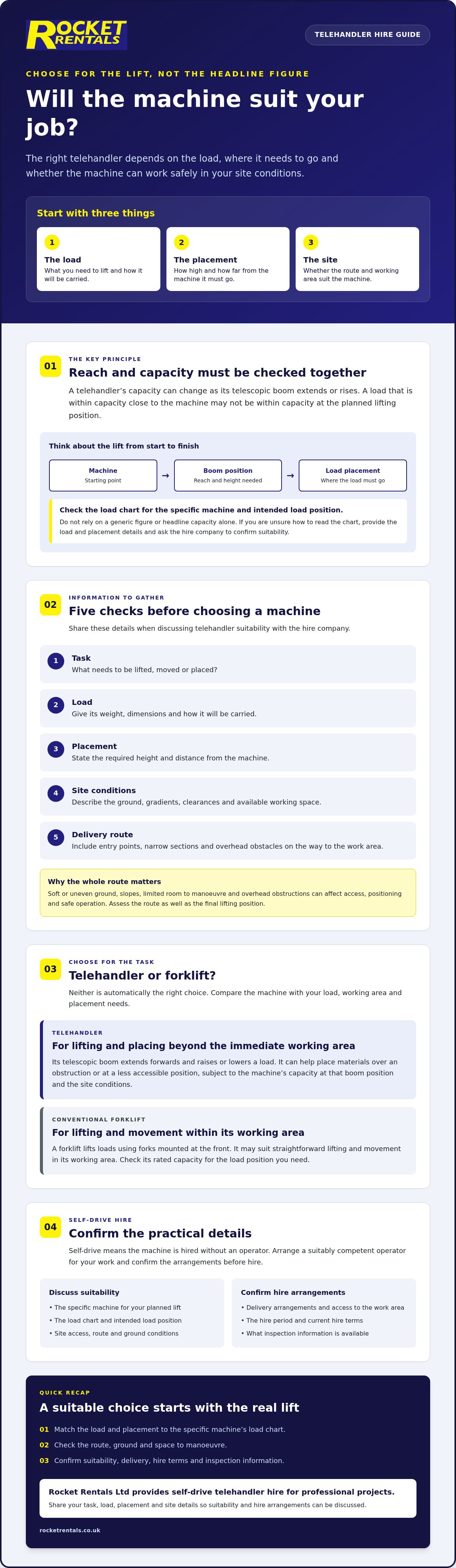
Start with the load and where it needs to be placed, then compare machine reach and capacity rather than relying on headline figures.
Check the relevant load chart, as a telehandler’s capacity can change when its boom extends.
Compare telehandlers and forklifts against your task, working area and placement needs. Neither is automatically the right choice for every site.
Before arranging self-drive telehandler hire, prepare details about the task, load, placement, route, ground conditions and hire period.
Rocket Rentals provides self-drive telehandler hire for professional projects. Confirm machine suitability, delivery arrangements and current hire terms directly, and ask what inspection information is available.
Table of Contents: telehandler hire South West
What telehandler hire is for: lifting and placing materials on site
A telehandler is a machine with a telescopic boom, an arm that extends forwards and raises or lowers a load. This design can help an operator lift and place materials beyond the reach of a conventional forklift. It doesn’t mean every load can be lifted at every height or distance. Capacity depends on the specific telehandler and the load’s position as the boom moves.
The Telescopic handler overview explains the machine’s basic design and its use across industries. On construction sites, telehandlers are commonly used to move palletised materials and place loads where they’re needed. The right machine still depends on the task, the load and the site conditions.
How a telehandler differs from a forklift
A conventional forklift lifts loads using forks mounted at the front. A telehandler can also use forks or another suitable attachment, but its telescopic boom extends forwards as well as lifting. That can help place materials over an obstruction or at a less accessible position. A forklift may suit straightforward lifting and movement within its working area. Neither is automatically the better option. Check the machine’s rated capacity for the load position you need, rather than relying on its headline capacity alone.
When telehandler hire may suit a site task
Consider a telehandler if your task involves moving materials around a construction site and placing them where the machine must reach forwards or upwards. Assess the whole route, not just the final lifting position. Restricted access, uneven or soft ground, overhead obstacles and limited room to manoeuvre can all affect whether a machine is suitable.
Rocket Rentals Ltd provides self-drive telehandler hire, which means the machine is hired without an operator. You’ll need to arrange a suitably competent operator for your work and confirm the machine’s suitability and hire arrangements directly. When you enquire, share the load, intended placement and site conditions so the hire team has useful details to discuss.
How to assess telehandler reach, load capacity and site conditions
Choose a telehandler around the lift you need to complete, not a single headline capacity or maximum reach figure. A load may be within a machine’s capacity close to the vehicle but exceed it once the boom extends or rises to the planned position. Note the load and placement details, then ask the hire company to confirm whether a specific machine is suitable.
What the load chart tells you
A load chart shows the lifting capability of a particular machine at different boom positions. Capacity can change as the boom extends or rises. Check the chart for the specific machine and intended load position, rather than relying on a generic figure. If you’re unsure how to read the chart, give the hire company the load details and placement requirements and ask it to confirm suitability.
Which site conditions can affect machine choice?
Ground conditions matter. Soft or uneven ground and slopes may affect where the machine can travel or set up. Check for space to turn and manoeuvre, clearances along the route and overhead obstructions near the lifting area. Include the route from the delivery point to the work area, not just the final position. The Construction Plant-hire Association’s guidance covers planning, selection and training of personnel for telehandler use.
Before arranging self-drive telehandler hire, share your task, load, placement and site information with the hire company. Ask it to confirm that the specific machine suits the planned lift, access route and ground conditions. You can also review Rocket Rentals telehandler hire as you prepare your enquiry.
Telehandler or forklift: which option fits your material-handling task?
A telehandler and a forklift can both lift and move materials, but their designs suit different working situations. A forklift may be appropriate for handling loads within a clear, accessible area. A telehandler’s telescopic boom extends forwards and raises loads, which may help when the placement point is further away or higher up. Neither machine is automatically the better choice for every site.
Let the task guide your comparison. Consider the load, where it needs to go, how much room there is to work and what the route looks like. Headline reach alone doesn’t confirm safe capacity at the required position. Check the capacity for the planned load and boom position against information for the specific machine, then confirm suitability with the hire company.
When a telehandler’s telescopic boom may be useful
If materials need to be placed beyond the machine’s immediate position or raised to a particular point, a telehandler may be worth considering. For example, a task might involve moving a load across an open working area before positioning it at height. Suitability depends on the load, boom position and verified information for the specific machine. A longer stated reach doesn’t, by itself, establish that the lift is suitable.
When to consider a different lifting option
Restricted access, limited manoeuvring room or a placement requirement that doesn’t suit a telehandler may point to another option. Explain the load, route and intended placement before deciding. The Construction Plant-hire Association’s CPA telehandler safety guidance is a useful reference for planning and selection. If your wider project also involves digging, consider whether excavator hire may be relevant alongside your material-handling needs. Ask the hire company to discuss the task and confirm whether the proposed equipment suits the work.
What to confirm before arranging self-drive telehandler hire
A clear enquiry helps the hire company assess the job and discuss a suitable machine. Rocket Rentals provides self-drive telehandler hire, so you arrange the operator. Before enquiring, gather the information below and be ready to confirm delivery, collection and hire terms directly with the supplier.
Information to have ready when you enquire
Task: Explain what you need the telehandler to do and where the work will take place.
Load: Share the load’s weight and dimensions, and how it will be carried. If you don’t know the exact weight, say so rather than guessing.
Placement: Describe where the load needs to go, including the required height and distance from the machine.
Route: Note access widths, turning space, overhead clearances and any restrictions between the delivery point and work area.
Ground: Describe the surface and any slopes, soft areas or uneven sections along the route and at the working position.
Hire period: Give your expected start and finish dates, then confirm the current hire terms with the supplier.
Ask which machine details the hire company needs to confirm suitability. It may need further information about the load, its position or the site layout. Don’t assume a machine is suitable based on a general reach or capacity figure. Ask for confirmation against your planned lift.
Preparing the site for delivery and use
Check the delivery route as well as the work area. Consider gates, narrow sections, overhead obstacles, turning space and ground conditions. Tell the supplier about any known restrictions, and confirm delivery timing and collection arrangements directly. Avoid making site plans around an unconfirmed delivery time.
Before the hire starts, clarify what familiarisation information and machine documentation will be provided. Ask what inspection information is available, and follow the supplier’s guidance on pre-use checks and safe operation. As the hire is self-drive, confirm what operator competence is required for your work and make sure you have an appropriate operator arranged.
Having these details ready makes your enquiry more useful and the arrangements clearer. Contact Rocket Rentals to discuss self-drive telehandler hire and confirm machine suitability, delivery, collection and current hire terms.
Arrange self-drive telehandler hire with Rocket Rentals
Once you’ve matched the task to the machine requirements, discuss the job with the hire company. Rocket Rentals provides self-drive telehandler hire for professional construction, civil engineering and industrial projects. The equipment is supplied without an operator, so you’ll need to arrange someone competent to operate it for your work.
Rocket Rentals is an independent plant hire specialist. Ask what inspection information is available for the specific machine you’re considering, and raise any questions before confirming the hire.
What to expect from a self-drive hire enquiry
Give the team a clear picture of the job. Useful details include what you need to lift, the load’s weight and dimensions, where it needs to be placed, and the ground and access conditions. If you’re uncertain about a detail, say so. The hire company can then ask for any further information it needs to discuss whether a specific machine may suit the planned work.
Self-drive hire means the equipment is hired without a supplied operator. Confirm the current hire terms directly, including the hire period, delivery timing and collection arrangements. Discuss site access restrictions in advance so the delivery plan can be considered alongside the machine’s intended use. Don’t assume a particular machine, delivery time or hire arrangement until it has been confirmed.
A straightforward next step for your project
Before you get in touch, have your planned hire period and site details ready. A short, accurate description of the task is more useful than choosing a machine based on a general reach or capacity figure. Be prepared to discuss the load, placement, route and working area, then confirm suitability and arrangements with the team.
If you’re considering telehandler hire South West, contact Rocket Rentals to discuss your project requirements and the equipment that may fit the task. Confirm the machine’s suitability, current hire terms, delivery and collection details directly before arranging self-drive hire.
Choose the right machine and plan your hire
A suitable telehandler depends on more than its headline reach or lifting capacity. Match the machine to the load and placement, then consider the ground, access route and space available to manoeuvre. Check the load chart for the specific machine and ask the hire company to confirm it suits your planned lift. A forklift may be a better fit for some tasks, so compare the equipment against the work you need to do.
Before arranging self-drive hire, have your task and site details ready, and confirm the hire period, delivery and collection arrangements. Rocket Rentals provides self-drive plant hire, so you’ll need to arrange an operator. Ask what inspection information is available for the machine under consideration.
If you’re planning telehandler hire South West, discuss your requirements with Rocket Rentals before choosing a machine. Share the load, placement and site conditions, and confirm the current hire terms directly. Discuss your telehandler hire requirements with Rocket Rentals and take the next step with a clearer plan for your project.
Frequently Asked Questions
What is a telehandler used for?
A telehandler is used to lift, move and place materials with a telescopic boom that extends forwards and raises or lowers the load. On construction and industrial sites, it may help move palletised materials or position loads at a required point. Whether it’s suitable depends on the specific machine, the load and its position. Check the machine’s load chart and discuss the planned task with the hire company.
How do I choose the right telehandler for a site?
Choose a telehandler by matching the machine to the load and exact placement point. Note the load’s weight and dimensions, the required height and distance, and the route to the work area. Check ground conditions, slopes, overhead clearances and room to manoeuvre. For telehandler hire South West, as with any hire, provide these details to the supplier and ask it to confirm whether a specific machine suits the planned work.
Can a telehandler lift any load within its stated capacity?
No. A stated capacity figure doesn’t mean the machine can lift that load at every height or reach. Lifting capacity can change as the boom extends or moves, so a load that may be within capacity close to the machine could exceed the limit at a different position. Check the load chart for the specific telehandler and planned lift. If anything is unclear, ask the hire company to confirm suitability.
What is the difference between a telehandler and a forklift?
A telehandler has a telescopic boom that extends forwards and raises or lowers a load. A conventional forklift lifts using forks at the front and may suit moving loads within an accessible working area. The boom can give a telehandler more options for placing a load at a distance or height, but it doesn’t make it the right choice for every task. Compare the site, route and load requirements before choosing.
Do I need an operator when I hire a telehandler from Rocket Rentals?
Yes, you need to arrange the operator. Rocket Rentals provides self-drive telehandler hire, which means the hire is for the machine, not an operator. Before booking, make sure you have an operator with the competence needed for your work and the specific equipment. If you’re unsure what information or documentation to check, ask the supplier before confirming the hire arrangements.
What should I check before a telehandler is delivered to site?
Check the route from the delivery point to the working area, including access width, turning space, ground conditions and overhead obstacles. Make sure the planned work area has room for the machine to manoeuvre. Tell the supplier about restrictions and confirm delivery timing, collection arrangements and current hire terms directly. Ask what machine information or inspection details are available, and follow the supplier’s guidance before using the equipment.
How do I confirm whether a telehandler can reach the required position?
Work out the height and distance from the machine to the load’s intended position, then share these details with the hire company. Include the load’s weight and dimensions. Ask to check the load chart for the specific machine at the planned boom position, as capacity can change as the boom extends or rises. The hire company should confirm whether that machine is suitable for your planned lift.
Comments