
Telehandler Hire Cost: The Professional Guide to Rates and Project ROI
Is the lowest weekly rate on your quote actually costing your project more in lost productivity and unexpected surcharges? When you are managing a complex site, calculating the true telehandler hire cost often feels like a moving target. You likely already recognise that the base rental price is only the starting point, yet unforeseen delivery fees or fuel expenses can quickly erode your projected margins.
We understand that transparency is vital for maintaining a profitable site. This professional guide promises to help you look beyond the initial figure to identify the core factors that influence rental pricing. You will learn how to optimise your budget whilst ensuring your material handling remains as efficient as possible.
We will provide a clear breakdown of hire rate structures, explain how to navigate complex CPA insurance requirements, and offer practical advice on avoiding common pitfalls like over-speccing your machinery. By the end of this article, you will have the confidence to select the most cost-effective machine size for your specific tasks, keeping your project on track and within budget.
Table of Contents
Understanding the Variables: What Drives Telehandler Hire Costs?
Calculating a telehandler hire cost involves more than just selecting a machine from a list. Pricing reflects the technical complexity of the equipment and the logistical requirements of getting it to your site. Every project has unique demands, and the rate you pay is influenced by how those demands match the machine's capabilities. Beyond the machine itself, modern factors like Stage V engine technology now play a role. These advanced engines meet strict emissions standards often required on major infrastructure projects. Whilst the hire rate for a newer machine might be higher, the reduction in fuel consumption and compliance risks often provides a better return on investment.
Reach vs Capacity: Finding the Sweet Spot
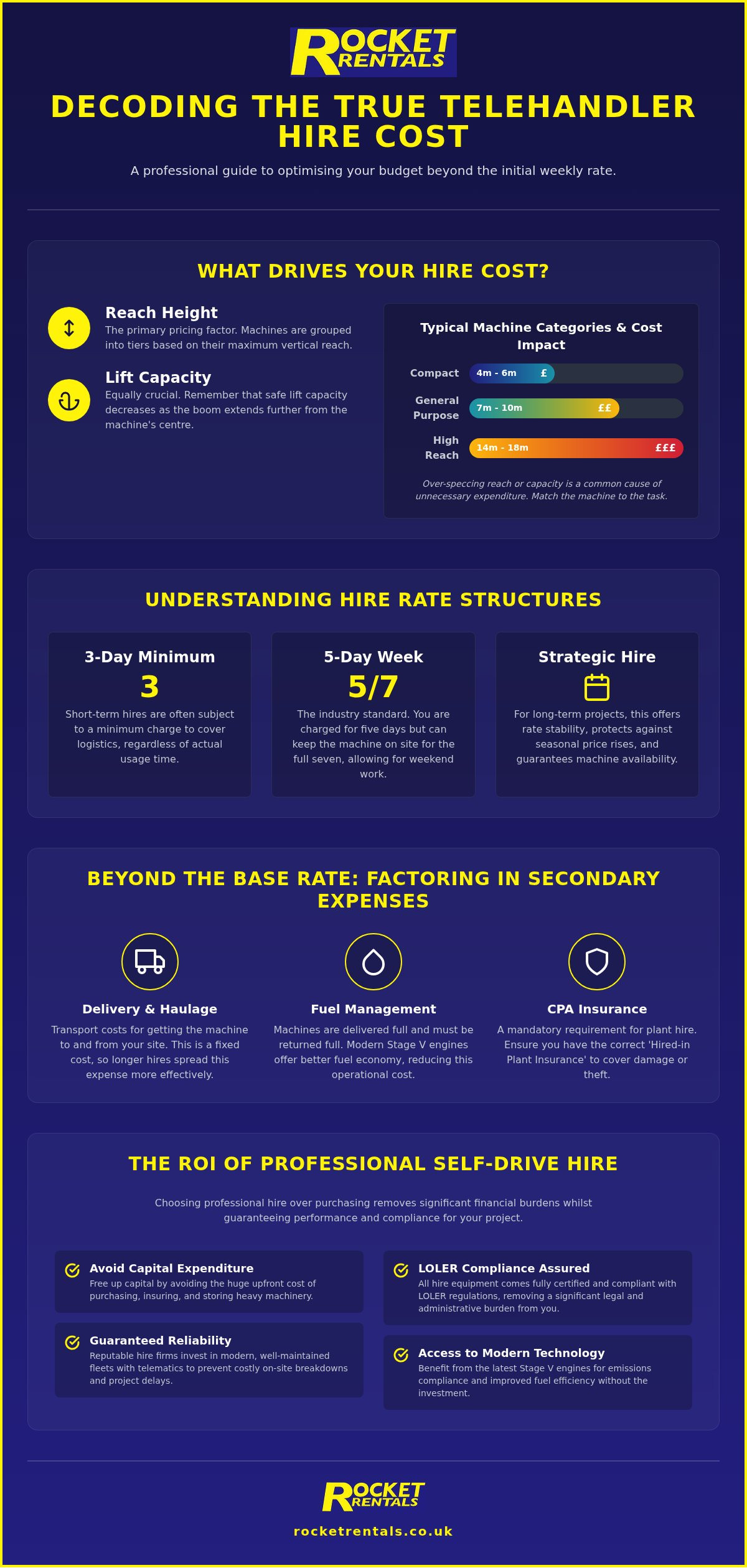
Reach height is the primary pricing bracket in the industry. Machines are typically grouped into categories such as 4m to 6m compacts, 7m to 10m general-purpose handlers, and 14m to 18m high-reach models. However, the lift capacity at that height is equally important. It is a common mistake to focus only on the maximum tonnage. You must also consider the load centre; as the boom extends further away from the machine, the safe lifting capacity drops. If you over-spec the reach to be "safe" without checking load charts, you may pay for a larger, more expensive machine that is less efficient for your site footprint. Matching the tonnage to your heaviest pallet and the reach to your highest point prevents unnecessary expenditure.
The Role of Machine Age and Reliability
A lower base rate often masks the risk of using an older fleet. In the plant hire industry, reliability is the true currency of value. Modern machines equipped with telematics allow for proactive maintenance, ensuring that the equipment is ready for work the moment it arrives. This technology helps fleet managers identify potential issues before they cause a stoppage on your site.
Breakdown risks represent a significant hidden telehandler hire cost. If a machine fails, your entire material handling chain stops, but your site labour costs continue to mount. Choosing a provider that invests in a modern, well-maintained fleet offers peace of mind that a cheaper, older alternative cannot match. It is about securing a "safe pair of hands" for your project. Additionally, specialised attachments like buckets or jibs can be added to the hire package. While these increase the base rate, they can replace the need for additional machinery, ultimately lowering the total cost of your plant requirements.
Typical Hire Rate Structures: Daily, Weekly, and Long-Term
Understanding the framework of rental agreements is essential for accurate budgeting. Most professional plant hire firms operate on a standard "5-day week" model. This means the weekly telehandler hire cost is usually capped at the price of five working days, even if you keep the machine for seven. It's a structure designed to support the typical Monday-to-Friday site rhythm whilst providing flexibility for weekend work. If your project runs over the initial week, subsequent days are typically charged at a pro-rata rate of one-fifth of the weekly cost.
You'll often encounter a "3-day minimum" rule for shorter projects. This exists because the logistical effort of delivering and collecting a telehandler is the same regardless of how long it stays on site. If you only need a machine for a single afternoon, you'll likely still pay for three days. Planning your material distribution to happen in a single, intense window can help you stay within these minimum thresholds and avoid paying for idle time.
Short-term vs Strategic Hire
The break-even point between daily and weekly rates is usually around day three or four. If your project extends beyond this, switching to a weekly rate is almost always more economical. For major groundworks or long-term developments, strategic hire offers even greater stability. These agreements often include fixed rates that protect you from seasonal price fluctuations. During peak construction seasons, fleet availability tightens significantly. Securing your machine early through a strategic agreement ensures you aren't left waiting when your team is ready to start.
Volume Discounts and Repeat Business
Consolidating your plant requirements with a single partner often unlocks significant value. When you coordinate a telehandler arrival alongside mini excavator hire, you reduce the overall transport burden on your budget. Haulage is a major component of any invoice; synchronising deliveries means fewer low-loader trips to your site, which directly lowers your carbon footprint and your expenses.
Professional contracting firms often benefit from account-based pricing. This isn't just about a lower daily rate. It's about having a dedicated partner who understands your site's specific challenges and can provide the right machine at the right time. If you're planning multiple phases of work, discussing your long-term schedule with a specialist can help you secure more competitive terms across your entire fleet. This collaborative approach ensures you have a reliable "safe pair of hands" throughout the project's duration.
Beyond the Base Rate: Factoring in Delivery, Fuel, and Insurance
The final invoice for your project often includes several essential components that sit outside the base rental price. Failing to account for these variables can lead to budget overruns that compromise your project's ROI. One of the most significant factors in your telehandler hire cost is the insurance requirement. Most professional hire agreements operate under CPA (Construction Plant-hire Association) conditions. These terms mean the primary responsibility for insurance lies with the hirer. You'll need to ensure your hired-in plant insurance is valid for the full value of the machine. Alternatively, you might consider a damage waiver. This protects your budget from unforeseen repair costs or end-of-hire cleaning charges that arise from heavy site use.
Logistics and Transport Efficiency
Transport fees are dictated by both the distance from the depot and the physical weight of the machine. A compact 6-tonne model is significantly easier to transport than a high-reach handler weighing over 12 tonnes. The larger machine requires a specialised heavy-haulage low-loader, which naturally carries a higher haulage fee. You can optimise these costs by ensuring your site has clear, unrestricted access. If a driver is delayed due to poor site organisation or restricted entry points, you may incur waiting time charges. We recommend organising 'back-loads' where possible. By scheduling a machine collection to coincide with a delivery in the same geographical area, you can often negotiate reduced transport rates, further lowering the total telehandler hire cost.
Fuel Sustainability and Compliance
Fuel management is a critical modern cost factor. Whilst most providers offer a 'Full-to-Full' policy, the type of fuel you choose impacts both your budget and your environmental compliance. Standard white diesel remains the baseline, but many urban sites now require HVO (Hydrotreated Vegetable Oil). HVO can reduce CO2 emissions by up to 90%, though it typically carries a higher per-litre price. Modern fleets often feature Stage V engines with advanced idling technology. These systems automatically shut down the engine during periods of inactivity. This can save a significant percentage of your daily fuel spend over a long-term project. Balancing these environmental requirements against your budget is a key step in professional site management.
Maximising Value: Matching Machine Specification to Site Requirements
Selecting the correct machine is a strategic decision that directly impacts your overall telehandler hire cost. Site managers often face the temptation to hire a larger machine "just in case" the project scope expands. However, this approach often leads to higher rental rates and increased fuel consumption without providing a tangible benefit to the project timeline. Professional site planning involves a precise assessment of the maximum lift height and the heaviest load required at full extension. By matching the machine's specific power curve to your site's physical demands, you ensure that every pound spent on plant hire contributes directly to productivity.
For multi-storey residential or commercial developments, high-reach handlers (14m to 18m) are essential. These machines allow for efficient material distribution across multiple floor levels, reducing the need for secondary handling or manual lifting. In contrast, heavy-lift handlers are the preferred choice for civil engineering or industrial applications where the weight of the load is the primary challenge. Using a machine that is purpose-built for the task prevents the mechanical strain that leads to downtime, ultimately protecting your project's bottom line.
The Compact Advantage
In tight urban environments or on sites with restricted access, compact telehandlers offer a distinct financial advantage. These smaller, lighter machines, typically in the 4m to 6m range, are far easier to manoeuvre amongst existing structures and parked vehicles. Because they weigh less, they often fall into a lower haulage bracket, which reduces your delivery and collection expenses. Their smaller engines are also more fuel-efficient in 'stop-start' site environments. This can lead to significant savings over a long-term project. When site space is at a premium, a compact unit often provides a better ROI than a larger machine that spends half its time idling because it cannot safely reach the work area.
Attachments as Budget Optimisers
A telehandler is a versatile tool carrier, not just a forklift. By utilising various attachments, you can turn a single machine into a multi-purpose asset, potentially eliminating the need to hire additional equipment. For example, adding a bucket allows for light earthmoving, whilst a lifting hook can replace a small crane for specific tasks. This versatility reduces the total number of machines on site, lowering your transport costs and simplifying your logistics. You might also consider how electric scissor lift hire complements your material handling strategy by providing clean, stable access for high-level installations. Using the right combination of tools reduces manual handling time and labour costs, ensuring your project remains on schedule. To find the most efficient machine for your next project, you can view our full range of self-drive telehandlers and attachments.
Securing Your Fleet: Why Professional Plant Hire Outperforms Purchase
The decision between purchasing a machine and opting for professional rental is often a question of long-term capital strategy versus immediate project agility. While ownership might seem to offer more control, it introduces significant financial burdens that can inflate your total telehandler hire cost if not managed correctly. Depreciation is a silent drain on project margins; a machine loses value the moment it leaves the showroom, yet a hire agreement ensures you only pay for the equipment when it's actively generating value on site. By choosing to rent, you eliminate the massive upfront capital expenditure, allowing you to reallocate those funds into other areas of your business growth.
Maintenance and Compliance Savings
Owning a fleet requires a dedicated infrastructure for maintenance and legal compliance. Every telehandler must undergo mandatory LOLER (Lifting Operations and Lifting Equipment Regulations) inspections every six months, alongside regular PUWER servicing. These aren't just administrative hurdles; they are critical safety requirements that carry significant costs in both labour and documentation. When you partner with a specialist provider, these responsibilities are managed for you. We absorb the risk of mechanical failure and the associated downtime. If a machine requires attention, it's our priority to ensure your site stays operational, providing a level of reliability that's hard to maintain with a small, privately owned fleet.
Strategic Flexibility for Contractors
Project requirements rarely stay static. You might need a compact handler for the initial groundworks and a 14m high-reach model for the structural phase. Professional hire allows you to scale your fleet size and machine specifications up or down as the programme changes. This flexibility prevents the "dead money" associated with machinery sitting idle in a yard between jobs. From an accounting perspective, hire costs are easily allocated to specific project budgets, making it simpler to track true profitability. Dry hire is the most flexible option for teams with in-house operators, as it provides the equipment without the added expense of an external driver.
This "safe pair of hands" approach ensures you always have access to the latest Stage V technology and well-maintained machinery without the long-term liabilities of ownership. It turns your telehandler hire cost into a predictable, manageable expense that supports, rather than hinders, your project's ROI. By leveraging a modern hire fleet, you ensure your site remains compliant, efficient, and focused on delivery.
Optimising Your Site Budget for Long-Term Success
Mastering your telehandler hire cost requires a strategic view of site efficiency rather than just a comparison of base rates. By precisely matching machine specifications to your project's physical demands and accounting for logistical factors like CPA insurance and fuel management, you'll secure a better return on your plant investment. A modern, well-maintained fleet is more than a convenience; it's a safeguard against the hidden costs of downtime and non-compliance.
As self-drive specialists and proud CPA members, we provide the technical expertise and reliable machinery needed for professional-grade results. Our commitment to excellence ensures you have a safe pair of hands supporting your project from delivery to collection. We're ready to help you keep your site moving forward with confidence and clarity.
Ready to streamline your material handling? Request a Professional Telehandler Hire Quote from Rocket Rentals today. We look forward to helping you achieve maximum efficiency on your next project.
Frequently Asked Questions
What is the average weekly cost of telehandler hire in the UK?
Weekly rates for machinery fluctuate based on machine size, reach height, and the duration of the contract. Generally, the industry follows a five-day week pricing structure, where the weekly rate is capped at the cost of five working days. Larger machines with higher lift capacities or specialised Stage V engines command higher rates. To get an accurate figure for your project, it is best to request a bespoke quote tailored to your specific site requirements.
Does telehandler hire include an operator?
No, we provide high-quality machinery on a self-drive basis only. This service is designed for professional contractors who have their own qualified personnel on site. Choosing self-drive hire is often the most cost-effective option for projects with their own operators, as it avoids the premium costs associated with operated plant. You must ensure your operator holds a valid CPCS or NPORS category for the specific machine size you hire.
What insurance do I need to hire a telehandler for my site?
Hirers are typically responsible for insurance under CPA (Construction Plant-hire Association) Model Conditions. You will need "hired-in plant" insurance that covers the full replacement value of the equipment against theft, damage, or loss. It is vital to check that your policy limits are sufficient for the specific tonnage and value of the handler you are renting. Some providers offer damage waivers to help manage smaller repair risks during the hire period.
Are there additional charges for telehandler attachments like buckets or jibs?
Standard pallet forks are usually included in the base rate, but specialised attachments like buckets, jibs, or lifting hooks normally incur additional charges. These tools turn your machine into a multi-purpose asset, which can actually lower your overall telehandler hire cost by reducing the need for other equipment. Always specify which attachments you require at the quoting stage to ensure they are available and compatible with your chosen machine.
How much does delivery and collection typically cost for plant hire?
Transport fees are calculated based on the distance between the depot and your site, alongside the weight of the machine. Smaller, compact models are easier to transport and typically carry lower haulage fees than high-reach handlers that require heavy-haulage low-loaders. To avoid unexpected charges, ensure your site has clear, unrestricted access. If a delivery driver is delayed by restricted entry points, waiting time charges may be applied to your final invoice.
Can I hire a telehandler for just one day?
While one-day hire is possible, most industry providers apply a three-day minimum hire period. This policy reflects the significant logistical effort and transport costs involved in delivering and collecting heavy machinery. If your project only requires a machine for a few hours, it is often more economical to organise your site schedule so that all material handling tasks are consolidated into a single, productive three-day window to maximise the value of the minimum hire.
What fuel is used in modern telehandlers, and is it included in the price?
Modern telehandlers use white diesel or HVO (Hydrotreated Vegetable Oil) and are typically delivered with a full tank. Fuel is not included in the base hire rate; instead, most agreements operate on a 'Full-to-Full' basis. You are expected to return the machine with a full tank of the correct fuel type. If the machine is returned with less fuel than it arrived with, you will be charged for the refuelling service and the fuel itself.
Who is responsible for daily maintenance during the hire period?
The hirer is responsible for performing basic daily maintenance and safety checks. This includes monitoring engine oil, coolant, and hydraulic fluid levels, as well as checking tyre pressures and greasing the boom sections. These simple tasks are essential for ensuring the machine remains safe and efficient. Major servicing, breakdown support, and mandatory LOLER inspections remain the responsibility of the hire provider, ensuring your fleet is always compliant and ready for work.


Comments