
Telehandler vs Forklift: Which Material Handler is Right for Your Site?
What if the standard forklift you've hired is actually the primary reason your project is falling behind schedule? When weighing up a telehandler vs forklift, it's a common frustration for site managers to find their equipment bogged down in mud or unable to reach the second storey safely. You need tools that adapt to the environment, not machinery that dictates what you can't do.
We understand that this choice often feels like a simple trade-off, but the wrong decision leads to wasted budget on over-specced equipment or compromised safety at height. You want a machine that works as hard as your team without the risk of instability or mechanical failure. This article will clarify the critical differences in reach, terrain capability, and versatility; ensuring you hire the most efficient machinery for your specific project. We'll examine how each machine handles rough terrain, compare their lifting heights, and look at the latest safety standards to help you secure a reliable self-drive hire partner for your next job.
Table of Contents
Understanding the Fundamental Differences Between Telehandlers and Forklifts
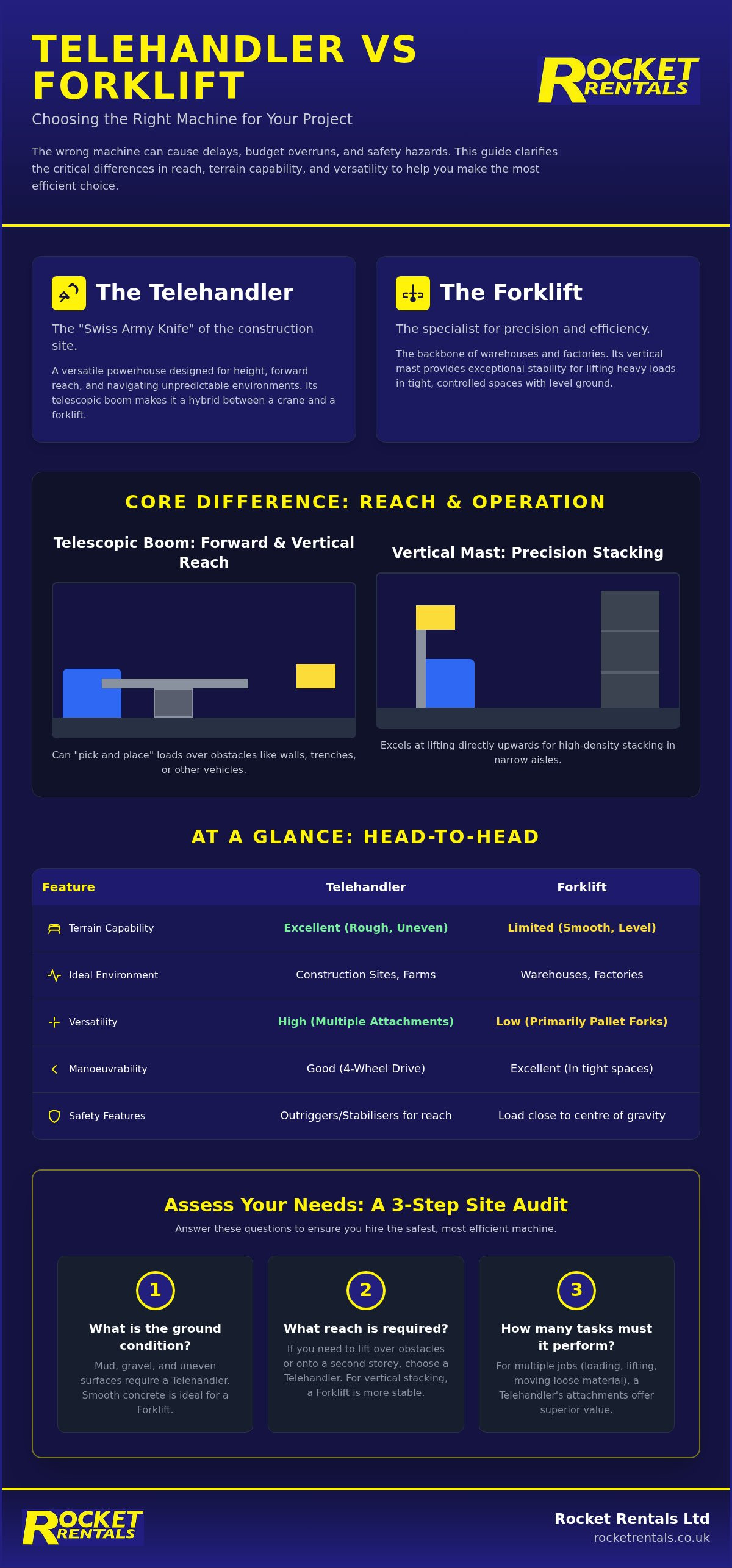
Choosing between a telehandler and a forklift isn't just about moving weight; it's about the geometry and terrain of your project. While they share the common goal of material handling, their mechanical blueprints are fundamentally different. At its core, a forklift is designed for vertical precision on stable ground, whereas a telehandler vs forklift comparison reveals that the former is a variable-reach machine equipped with a telescopic boom. This distinction dictates where the machine can go and what it can safely lift.
The "Vertical vs. Forward" reach remains the primary differentiator between these two classes of machinery. If you mistakenly hire a standard forklift for a site that requires reaching over a trench or onto a second-storey scaffolding, your project will stall immediately. Choosing the wrong machine often leads to operators attempting to stretch the capabilities of the equipment, which creates significant safety risks regarding load stability at height. A well-planned hire ensures your site remains safe, your timelines stay on track, and your equipment isn't pushed beyond its intended design limits.
The Vertical Mast: How a Forklift Operates
The traditional forklift relies on a fixed vertical mast and a carriage that moves strictly in a straight line. This mechanical simplicity is its greatest strength. It allows for incredible stability and precision, particularly when working in tight indoor spaces. You'll find these machines are the backbone of warehouses, distribution centres, and factories where every centimetre of aisle space is valuable. Because the weight stays close to the machine's centre of gravity, they excel at high-density stacking on concrete floors where manoeuvrability is essential for daily efficiency.
The Telescopic Boom: The Telehandler Advantage
The Telescopic handler offers a level of versatility that a standard forklift cannot match. Its extendable arm provides both height and forward reach, allowing operators to "pick and place" loads over obstacles like fences, ditches, or walls. This hybrid nature bridges the gap between a forklift and a crane, making it an essential tool for outdoor construction projects. Whether you're unloading a lorry from just one side or lifting materials to an elevated work platform, the boom provides the flexibility required for unpredictable site conditions. It provides the reach of a crane with the pallet-handling ease of a forklift, making it a dependable partner for complex builds.
The Telehandler: A Versatile Powerhouse for Construction Sites
Choosing between a telehandler vs forklift often comes down to the specific terrain you'll be working on. On UK building sites, the telehandler has earned a reputation as the 'Swiss Army Knife' of plant machinery. These machines come equipped with four-wheel drive and heavy-duty rough terrain tyres as standard, allowing them to navigate deep mud and uneven surfaces. This capability is essential during the early stages of a build when paved roads aren't yet available. When you're managing a busy site, having a machine that moves effortlessly between a delivery area and the active build zone is vital for maintaining momentum.
Unrivalled Reach and Manoeuvrability
The ability to unload a delivery lorry from just one side is a significant advantage in tight site layouts. Instead of moving the lorry or driving the machine around it, the telescopic boom reaches across the trailer to grab pallets. Once the load is secured, the machine can place materials directly onto scaffolding or upper storeys. To ensure safety during these high-reach manoeuvres, most models feature front-mounted stabilisers or outriggers. These provide a wider footprint, which is critical for maintaining load stability when the boom is fully extended. Manoeuvring on unpaved ground becomes a standard operation rather than a risk, ensuring your project doesn't stall due to poor weather.
Beyond Pallets: The Power of Attachments
What truly separates the telehandler from other equipment is its ability to swap tools in minutes. While it's primarily used for pallets, it can be transformed into a crane with a lifting jib or a loader with a high-capacity bucket. This versatility means one machine often performs several different roles on-site, reducing the need for additional plant hire. This adaptability is likely why a recent survey indicated that 85% of contractors prefer telehandlers for their efficiency. If you've already explored our guide to excavator attachments, you'll know that the right tool makes any machine more efficient. From specialised forks to sweepers, the telehandler handles tasks far beyond simple lifting.
Opting for self-drive hire gives site managers total control over their logistics without the overhead of an external operator. This flexibility requires a solid understanding of safety standards. Even though they look like forklifts, they're often classified differently; for instance, certain OSHA regulations for telehandlers place them in a specific category for rough terrain operation. When considering a telehandler vs forklift, the telehandler's ability to adapt to changing ground conditions makes it the superior choice for active construction sites. For those looking to improve site efficiency, our telehandler hire options provide the modern, well-maintained fleet you need to get the job done safely.
The Traditional Forklift: Precision and Efficiency for Industrial Use
Whilst the telehandler is the specialist for rugged construction sites, the traditional forklift remains the king of high-density storage and flat-surface loading. In any telehandler vs forklift comparison, the forklift's primary advantage is its compact footprint. It's engineered to operate in narrow aisles and confined spaces where larger machinery simply cannot turn. By placing the weight of the engine and a heavy iron block at the rear, the machine uses a counterbalance system to keep the load secure without the need for a long, heavy chassis.
This design makes the forklift a precision tool. Because the mast moves only vertically, there's no risk of the load shifting forward or backward as it rises; a common concern with telescopic booms. For repetitive tasks like unloading palletised goods in a yard or stacking crates in a warehouse, this vertical stability allows for faster cycle times and improved site safety. It's a dependable choice for projects that have moved past the groundwork phase and onto finished concrete or tarmac surfaces where manoeuvrability is the priority.
Indoor Specialisation and Narrow Aisle Access
Operating indoors requires a specific focus on air quality and noise levels. Electric forklifts are the standard choice here; they produce zero emissions and operate quietly, making them ideal for distribution centres and food processing plants. Their turning circles are significantly tighter than those of a telehandler, allowing them to navigate 90-degree corners in aisles only a few metres wide. Whilst a telehandler's boom might flex slightly at full extension, the rigid vertical mast of a forklift provides superior stability for repetitive high-shelf stacking, ensuring every pallet is placed with millimetre precision.
Cost-Effectiveness for Repetitive Tasks
From a hire perspective, the traditional forklift is often the more economical choice for simple yard duties. These machines generally have lower fuel consumption and fewer maintenance requirements than their four-wheel-drive counterparts. Because they're less mechanically complex, the training required for operators is often more straightforward, and many site staff already hold the necessary certifications. Choosing a forklift over a telehandler prevents you from wasting budget on rough-terrain capabilities you don't actually need. It's about matching the tool to the task to ensure maximum efficiency on a stable footing.
Critical Comparison: Reach, Terrain, and Operational Safety
When you compare a telehandler vs forklift side-by-side, the most striking difference is the reach profile. A standard industrial forklift provides vertical lift, usually capping at around 6 metres. In contrast, a telehandler can extend significantly further, with many models in our fleet reaching 14 metres or more. This forward reach changes the physics of the lift entirely. A telehandler's capacity isn't fixed; it fluctuates based on the boom angle and extension. This makes the load chart the most important document in the cab. Operators must understand that as the boom extends, the machine's lifting capacity drops significantly to prevent tipping.
Visibility also differs between the two machines. A forklift operator has a clear view of the forks but a mast that partially blocks the forward line of sight. A telehandler operator sits in an enclosed cab, often positioned to the side of the boom. This provides a panoramic view of the site but requires greater awareness of the 'blind side' when the boom is raised. Understanding these nuances is essential for site safety, especially on busy projects where multiple trades move simultaneously. Choosing the right machine in the telehandler vs forklift debate depends heavily on your specific ground conditions and the height of your build.
Terrain and Surface Requirements
Solid tyres on a forklift are a liability on a typical UK building site. They offer no traction in mud and have a high ground pressure that causes them to sink into soft soil. Telehandlers solve this with larger, pneumatic or foam-filled tyres and oscillating axles. These axles allow the wheels to follow the contours of rutted ground whilst the chassis remains level. If you're working on a site with sharp debris, foam-filled tyres are the best choice; they provide the puncture resistance of a solid tyre with the flotation needed for unpaved surfaces.
Safety Standards and LOLER Compliance
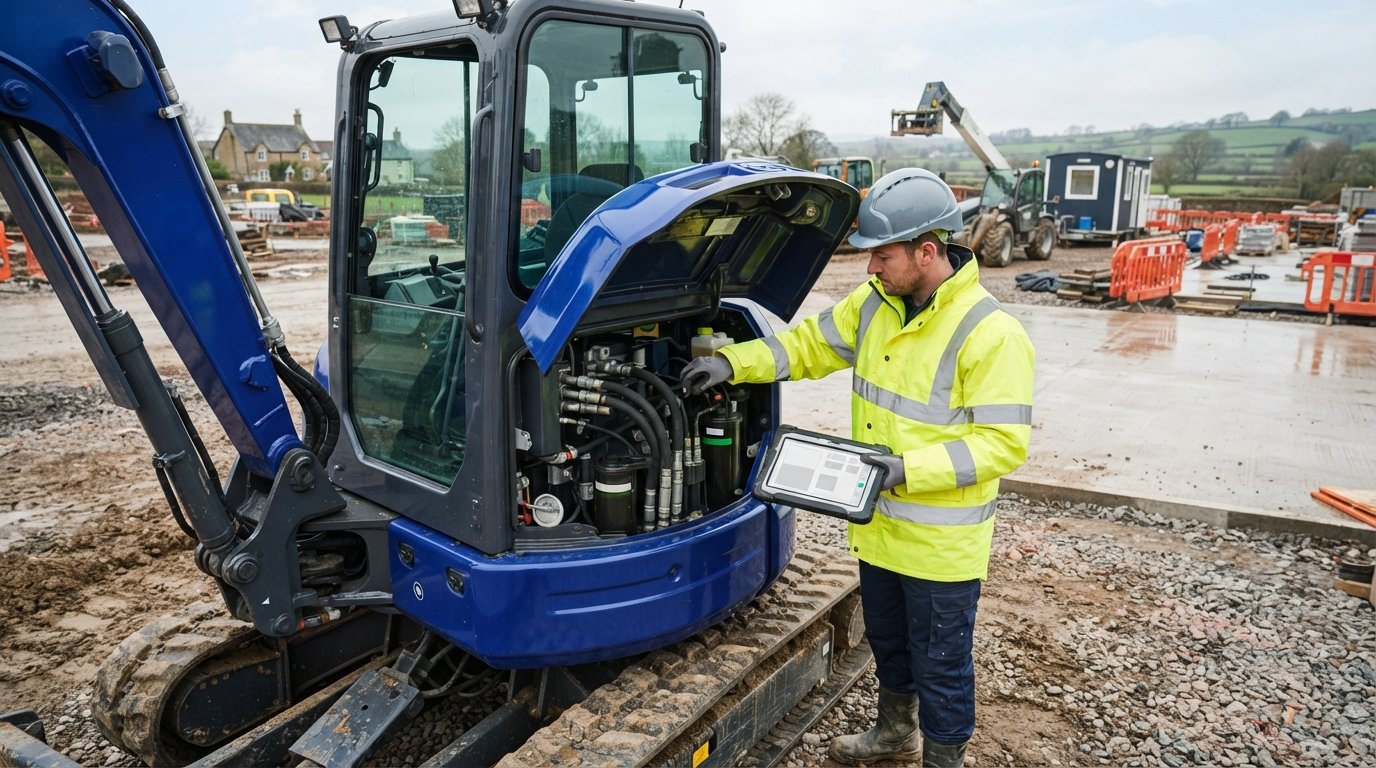
In the UK, safety isn't optional. All hired lifting equipment must undergo a 'thorough examination' under LOLER (Lifting Operations and Lifting Equipment Regulations). This ensures the machine is mechanically sound and safe to operate at height. For self-drive hire, the responsibility for daily pre-use checks falls to the operator. Following a structured safety checklist for contractors is an excellent way to ensure nothing is missed, from hydraulic leaks to tyre pressure. You can view our latest fleet and book your telehandler hire online to ensure your site meets these rigorous standards.
Making the Choice: How to Select the Ideal Hire Equipment
Deciding on a telehandler vs forklift often feels like a choice between power and precision. To avoid wasting budget on over-specced machinery or suffering site delays, you must evaluate the environment as it will exist throughout the hire period, not just on day one. A site that begins with a clean tarmac pad can quickly become a mud-filled challenge after a week of British rain. Choosing a machine that can handle these changing conditions is essential for maintaining a steady workflow and ensuring your project stays on schedule.
Evaluating Your Site Logistics
Before you commit to a hire agreement, we recommend conducting a brief three-question "Site Audit" to confirm your requirements. This helps prevent the common pain point of equipment arriving on-site only to find it cannot reach the necessary drop-off points. Consider these factors:
Is there an obstacle between the machine and the drop-off point? If you need to lift over a trench, fence, or wall, the forward reach of a telehandler is mandatory.
What is the maximum weight and height required? Ensure the load chart of your chosen machine covers your heaviest pallet at its maximum required extension.
Will the machine travel across unmade ground? If the answer is yes, the four-wheel drive and high ground clearance of a telehandler are vital to avoid becoming bogged down.
The Advantages of Professional Self-Drive Hire
Partnering with a dedicated plant hire specialist ensures you receive machinery that is modern, reliable, and compliant with current safety standards. Access to modern plant hire provides your site with the latest Stage V engine technology, which reduces emissions and improves fuel efficiency compared to older fleets. Self-drive hire offers the ultimate flexibility; it allows you to manage your own project schedule and utilise your own qualified operators without being tied to a third-party's availability.
Since 1988, Rocket Rentals has positioned itself as a "safe pair of hands" for contractors across the country. We focus on providing high-quality, well-maintained equipment that reduces the risk of site downtime. By considering the full project lifecycle when booking your hire, you can ensure you have the right material handler for every phase of construction. Whether you require the vertical precision of a forklift or the rugged versatility of a telehandler, selecting a dependable partner is the first step toward a successful and safe project.
Optimising Your Site Productivity with the Right Material Handler
Selecting the correct machine involves balancing the need for vertical stability against the necessity for rough terrain flotation and forward reach. The telehandler vs forklift debate is ultimately settled by your site's ground conditions and the specific geometry of your lifts. Whilst a traditional forklift provides unmatched precision in narrow, paved environments, the telehandler remains the essential tool for navigating the unpredictable landscapes of an active construction site.
As independent UK plant hire specialists since 1988, we provide a modern Stage V compliant fleet backed by comprehensive LOLER-compliant maintenance. This commitment to quality ensures your equipment is ready to perform safely from the moment it arrives. View our range of professional telehandlers and plant for hire to secure the most efficient machinery for your next project. By choosing a partner that prioritises reliability and modern technology, you can eliminate site delays and keep your build moving forward with absolute confidence.
Frequently Asked Questions
Is a telehandler better than a forklift for construction sites?
A telehandler is typically the superior choice for active construction sites due to its four-wheel drive and rough terrain tyres. While a forklift excels on flat surfaces, the telehandler handles mud and uneven ground with ease. Its telescopic boom allows you to lift materials over obstacles and onto higher storeys, providing versatility that a vertical-mast forklift cannot match. For most outdoor builds, the telehandler's adaptability makes it the more efficient material handler.
Do I need a special licence to operate a hired telehandler?
Yes, you must hold a valid operator's certificate to operate a telehandler on a professional site. In the UK, this usually means a CPCS or NPORS card specifically for telescopic handlers. If you plan to use the machine on public roads, the operator also needs a valid UK driving licence. As we specialise in self-drive hire, it's the hirer's responsibility to ensure their operator is fully trained and competent to handle the specific machinery safely.
Can a telehandler be used as a crane on site?
A telehandler can perform crane-like duties when fitted with a lifting hook or jib attachment. This allows it to suspend loads and place them with precision, bridging the gap between a forklift and a crane. However, it's vital to consult the machine's specific load chart for suspended loads, as the lifting capacity changes when using different attachments. Proper planning and a lifting schedule are essential to maintain site safety during these operations.
What is the maximum height a telehandler can reach?
Maximum lift heights vary significantly depending on the model you hire. Compact telehandlers often reach around 4 to 6 metres, while larger site models can extend to 14 or 18 metres. When considering a telehandler vs forklift, it's important to remember that as height increases, the forward reach also becomes a factor. Always check the manufacturer's specifications to ensure the machine can safely reach your highest required drop-off point with the intended load.
Are forklifts cheaper to hire than telehandlers?
Generally, a traditional forklift is more economical to hire for simple tasks on level ground. These machines are less mechanically complex than telehandlers, which often translates to lower hire rates and reduced fuel consumption. If your project involves repetitive pallet movements in a yard or warehouse, a forklift provides a cost-effective solution. However, if your site has any uneven terrain or requires forward reach, the extra investment in a telehandler vs forklift prevents costly delays or safety risks.
What safety checks are required for hired plant machinery?
All hired plant requires daily pre-use inspections to ensure safe operation. These checks should cover fluid levels, tyre condition, hydraulic hoses, and the functionality of safety lights and alarms. Additionally, all lifting equipment must have a valid LOLER certificate, which confirms it has undergone a thorough examination by a competent person. Keeping a written log of these daily checks is a professional standard that helps maintain site safety and demonstrates compliance with health and safety regulations.
Can I use a forklift on rough or uneven ground?
Standard industrial forklifts shouldn't be used on rough or uneven ground. Their small, solid tyres and low ground clearance make them prone to getting stuck or tipping on soft surfaces. If your site isn't paved, you'll need a dedicated rough terrain forklift or, more commonly, a telehandler. Using the wrong equipment on unstable ground creates significant safety hazards and can lead to expensive site downtime or damage to the hired machinery.
What attachments can I hire with a telehandler?
Telehandlers are incredibly versatile because they accept a wide range of attachments. Beyond standard pallet forks, you can hire lifting jibs for suspended loads, buckets for moving loose materials, and even power sweepers for site cleaning. We also provide various excavator attachments that complement our wider plant fleet. Swapping these tools allows one machine to perform multiple roles on your site, which reduces the total number of machines you need to hire and manage.
Comments