
The Professional Guide to Mini Excavator Hire: Maximising Site Efficiency
Updated: Jun 22
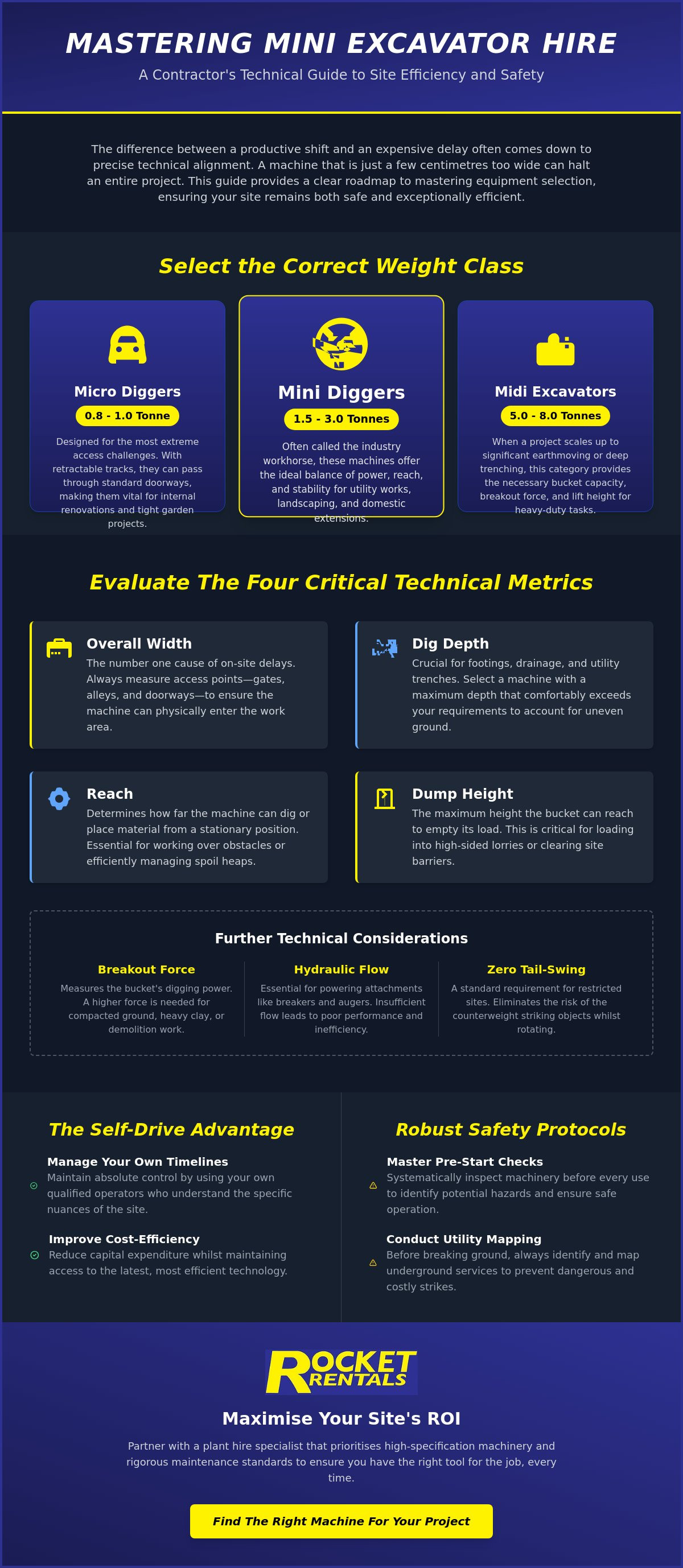
What if the most significant cost to your project isn't the equipment rate, but the four inches of width you failed to account for? It's a common scenario where a machine arrives on-site only to find it cannot pass through a restricted access point or lacks the breakout force required for heavy ground. When you arrange a mini excavator hire, the difference between a productive shift and an expensive delay usually comes down to precise technical alignment and foresight.
We understand that managing complex safety regulations and ensuring your plant is fully compliant can feel like a full-time job. This guide provides a clear roadmap to mastering equipment selection, from understanding specific weight classes to meeting the stringent 2026 construction product standards. You'll learn how to identify a reliable national partner and select machinery that delivers the highest possible return on investment. By the end of this article, you'll have the technical confidence to ensure your site remains both safe and exceptionally efficient.
Table of Contents
Understanding the Role of Mini Excavators in Modern Construction
Mini excavators are the versatile backbone of the UK’s compact plant sector. These machines typically range from 0.8 to 5 tonnes and have become the primary choice for projects where space is a luxury. In the current market, which is projected to grow by up to 4.5% through 2026, the demand for high-performance compact machinery has never been higher. This surge is driven by a collective shift towards rental over ownership; contractors are increasingly choosing to lease equipment to reduce capital expenditure whilst maintaining access to the latest technology.
For professional site managers, a mini excavator hire isn't just about digging a hole. It's about selecting a tool that can navigate the logistical constraints of urban groundworks. Whether you're working on a city-centre utility repair or a restricted residential extension, these machines provide the surgical precision required to work around existing infrastructure without causing damage. This level of accuracy is essential when excavating for new heating systems or gas mains, where companies like Plumbing & Boilers London rely on precise groundworks to complete their installations safely. Most professional contractors now favour a self-drive model, allowing them to maintain absolute control over their project timelines by using their own qualified operators who understand the specific nuances of the site.
The Evolution of Compact Plant Machinery
Modern hydraulic systems have significantly narrowed the gap between compact machines and their larger counterparts. By reviewing the technical specifications of crawler excavators, it's clear how engineering has evolved to pack greater breakout force into a smaller chassis. This advancement allows a 3-tonne machine to perform tasks that once required a much heavier unit. Zero tail-swing models are now a standard requirement for many site plans. They eliminate the risk of the counterweight striking walls or pedestrians whilst rotating. Additionally, the latest fleets prioritize lower-emission engines, helping firms meet increasingly strict environmental regulations on urban sites.
Micro vs Mini Diggers: Weight Classes Explained
Choosing the correct weight class is essential for site efficiency. Each category serves a distinct purpose:
Micro Diggers (0.8t - 1t): These are designed for the most extreme access challenges. With retractable tracks, they can pass through standard doorways, making them vital for internal renovations.
Mini Diggers (1.5t - 3t): Often called the industry workhorse, these machines offer the ideal balance of reach and stability for utility works and domestic extensions.
Midi Excavators (5t - 8t): When a project scales up to significant earthmoving or deep trenching, contractors move into this category for increased bucket capacity and lift height.
Selecting the right mini excavator hire ensures that your plant is neither underpowered for the task nor too cumbersome for the environment. It's a technical decision that directly impacts your site's safety and overall productivity.
Key Technical Specifications: Choosing the Right Machine
Selecting a machine for professional use requires a data-driven approach. It isn't enough to simply hire based on weight class; you must evaluate four critical metrics: dig depth, reach, dump height, and overall width. These specifications dictate whether a machine can physically enter the site and effectively complete the task at hand. Breakout force is the specific measure of a bucket’s digging power, which determines how the machine handles compacted ground or heavy clay.
Beyond physical dimensions, hydraulic flow rates are essential if you plan to use specialised excavator attachments like breakers or augers. A machine with insufficient flow will struggle to power these tools, leading to inefficiency and potential equipment wear. Finally, never overlook the cab environment. Ergonomic designs with intuitive controls reduce operator fatigue, which is a direct contributor to site safety and productivity. Balancing machine weight with ground pressure is equally important; choosing a machine with wide rubber tracks can prevent damage to sensitive surfaces or landscaped areas.
Digging Depth and Reach Requirements
Accurate calculations for footings, drainage, or utility trenches are the first step in any successful mini excavator hire. If you are digging a trench for a 1.2-metre deep utility line, selecting a machine with a maximum dig depth of 1.5 metres might seem sufficient on paper. However, this leaves very little margin for site unevenness or the positioning of spoil. Long-reach arms can mitigate these issues by allowing the operator to work from a safer distance, though they may slightly reduce the total breakout force. Professional site managers avoid over-specifying machine size, as an unnecessarily large excavator increases hire costs and creates congestion on restricted sites.
Dimensions and Site Access Constraints
Site access is often the primary constraint in urban projects. Retractable tracks are a vital feature for 0.8-tonne and 1.5-tonne models, allowing them to shrink their width to navigate narrow alleyways or standard doorways before expanding for stability during operation. You must also consider height restrictions. Many compact machines feature ROPS (Roll-Over Protective Structures) frames that can be folded down to pass under low ceilings or scaffolding. This flexibility ensures that the mini excavator hire remains viable even when the working environment is severely enclosed.
The Strategic Benefits of Self-Drive Mini Excavator Hire
Professional contractors often find that the traditional operated plant model introduces too many variables into a sensitive project schedule. By opting for a self-drive mini excavator hire, you effectively remove the dependency on external personnel who may not be familiar with your specific site safety protocols or work ethic. This model places the machinery directly under your supervision, allowing your in-house qualified operators to integrate the equipment into the daily workflow seamlessly. It fosters a more cohesive environment amongst your existing team, as everyone works towards the same internal milestones without the friction of managing a third-party operator.
Full Control Over Project Timelines
One of the most significant risks in groundworks is the "operator no-show." When a project depends on an external driver, a single absence can derail an entire week of scheduled pours or utility installations. Self-drive hire eliminates this vulnerability. It gives you the flexibility to organise work shifts around unpredictable British weather or sudden site deliveries. If a window of clear weather opens up on a Tuesday evening, your team can capitalise on it immediately. This level of autonomy allows for instant adjustments to the digging plan as ground conditions reveal themselves, ensuring that site momentum is never lost to administrative delays.
Cost Management and ROI for Contractors
From a financial perspective, the ROI on a self-drive mini excavator hire is often superior for long-term projects. Whilst the initial day rate of an operated plant might seem convenient, the hidden costs of "standing time" can be substantial. If a project is delayed by other trades or a late material delivery, you're still paying a premium for the operator’s time. With dry hire, you only pay for the machinery. This makes it far easier to manage budgets when comparing day rates against the premium of operated plant. It’s a pragmatic approach to cost control that ensures your plant spend is aligned with actual productivity rather than just attendance. For a deeper look at budgeting, it is helpful to consider Understanding Excavator Hire Rates and Costs within your wider project planning.
Having a machine on-site 24/7 also means you aren't restricted by the standard eight-hour window of an external operator. If a task requires a late finish to secure a trench or prepare for a morning inspection, the equipment is ready when you are. This readiness is a hallmark of a professional site where efficiency is measured by results, not just hours on a clock.
Site Preparation and Safety Protocols for Excavator Hire
Safety on a professional site is never an afterthought; it is the framework within which every task is performed. Before the tracks even touch the spoil, a series of rigorous pre-start checks is essential to ensure the machinery is in peak operational condition. Operators should systematically inspect hydraulic hoses for leaks, check fluid levels, and verify that the track tension is correct. These minutes spent at the start of a shift are an investment in preventing mechanical failure and ensuring the safety of everyone in the vicinity of the machine.
Beyond the machine itself, understanding what lies beneath the surface is critical. Striking an underground utility can lead to severe injury and significant financial penalties. Utilising services like "Linesearchbeforeudig" and conducting thorough utility mapping with CAT and Genny tools is non-negotiable for professional contractors. All hired plant must comply with PUWER and LOLER regulations as of 2026. Securing the site at the end of the day is just as important as the morning inspection. A professional shut-down procedure should include:
Lowering the bucket and dozer blade to the ground to relieve hydraulic pressure.
Engaging the safety lock lever and removing the ignition key.
Clearing the undercarriage and tracks of mud and debris to prevent buildup.
Checking for any new damage that may have occurred during the shift.
Ensuring the machine is parked on level ground, well away from the edges of open excavations.
Ground Conditions and Stabilisation
Assessing the terrain is a vital part of site preparation. Is the soil clay-heavy, sandy, or waterlogged? On softer ground, the use of bog mats or ground protection boards is necessary to distribute the machine's weight and prevent it from becoming bogged down. When working on slopes, always operate with the heavy end of the machine uphill and use the dozer blade to provide a stable anchor point. It’s equally important to identify overhead hazards, such as power lines or low-hanging branches, before extending the arm to its full reach.
Maximising Utility with Excavator Attachments
The versatility of a mini excavator hire is truly unlocked through its attachments. Selecting the right tool for the job doesn't just improve efficiency; it enhances safety by ensuring the machine isn't being forced to perform a task it wasn't designed for. Grading buckets are ideal for finishing surfaces, whilst trenching buckets provide the precision needed for narrow footings. If you are dealing with rocky ground or concrete, a hydraulic breaker is essential for controlled demolition.
Augers and post-hole borers can transform an excavator into a high-speed tool for fencing or piling projects, significantly reducing the manual labour required. To ensure you have the right equipment for your specific application, you can view our range of excavator attachments designed for professional site requirements. Using a riddle bucket to sort materials on-site can also help in recycling spoil, which reduces the cost of waste removal and improves the project's overall ROI. This strategic use of attachments ensures that your mini excavator hire remains a multi-functional asset throughout the project lifecycle.
Partnering with Rocket Rentals for National Plant Solutions
A successful project relies on more than just the right machinery; it requires a partnership built on trust and professional reliability. Choosing a plant provider is a strategic decision that affects your site’s safety, timeline, and bottom line. We position ourselves as a "safe pair of hands" for contractors, providing a high-specification fleet backed by a commitment to excellence. This approach ensures that every mini excavator hire is supported by technical expertise and a deep understanding of the pressures facing modern construction sites.
Managing multi-site projects requires a logistics partner capable of delivering consistent quality across the country. Our national reach allows us to support large-scale infrastructure projects whilst maintaining the personal, dedicated service of an independent specialist. We have designed our booking process to be direct and efficient, acknowledging that busy construction professionals don't have time for administrative friction. From initial enquiry to site delivery, the focus remains on readiness and clear communication.
Why Fleet Quality Matters for Site Productivity
There is a direct correlation between the age of a fleet and the frequency of on-site downtime. Older machines are statistically more likely to suffer from hydraulic leaks or sensor failures, which can halt work for hours or even days. By investing in late-model machinery, we ensure that our clients benefit from the latest advancements in breakout force and fuel efficiency. Every machine undergoes a rigorous inspection and maintenance schedule before leaving our depot, ensuring it arrives site-ready and fully compliant with all safety standards.
Modern engine technology also plays a vital role in meeting environmental targets. Our fleet incorporates fuel-efficient engines that produce lower emissions, helping contractors satisfy the increasingly stringent requirements of urban Low Emission Zones. This commitment to quality means your operators can work with confidence, knowing the equipment is capable of meeting the technical demands of the project without compromise.
Streamlined Hire for Professional Contractors
Working with an independent specialist provides a level of agility that larger, more rigid hire companies often struggle to match. We offer expert advice to help you match the specific machine to your project’s unique constraints, whether that involves complex ground conditions or restricted access. This consultative approach ensures you aren't just hiring a machine, but implementing a logistical solution tailored to your site’s needs. If you are ready to secure high-performance plant for your next project, you can Contact Rocket Rentals Ltd today to organise your next mini excavator hire. Our team is standing by to provide the reliable support and high-quality machinery your professional site deserves.
Maximising Your Next Project with Precision Plant
Success on a modern construction site depends on the precise alignment of machinery capability and project requirements. You've seen how mastering technical specifications and prioritising self-drive flexibility ensures your project remains both profitable and safe. By choosing machinery that matches your specific site constraints, you're able to eliminate the risk of underpowered performance or restricted access delays. It's clear that a professional mini excavator hire is a strategic investment in site momentum, provided it's supported by rigorous pre-start protocols and the correct use of attachments.
We maintain a high-specification, modern self-drive fleet that strictly adheres to PUWER and LOLER safety standards. As an independent specialist, we offer the expert advice needed to navigate complex project requirements with confidence and clarity. We invite you to browse our full range of professional mini excavators for hire to find the ideal solution for your site.
With a reliable partner and the right equipment in place, you're ready to deliver excellence on every project with total peace of mind.
Frequently Asked Questions
Do I need a special licence for mini excavator hire?
No specific operator licence is legally required for use on private land, although the hirer must be competent and trained to operate the machinery safely. If the machine needs to be driven on public highways, the operator must hold a valid UK driving licence and the equipment must be road-legal. Most professional construction sites will require operators to hold a recognised qualification, such as a CPCS or NPORS card, to comply with their internal health and safety standards.
What is the difference between a micro digger and a mini excavator?
The primary distinction lies in the weight class and physical dimensions of the machine. Micro diggers generally weigh under 1 tonne and feature retractable tracks, allowing them to pass through a standard 760mm doorway for internal works. A mini excavator typically ranges from 1.5 to 5 tonnes, providing significantly more breakout force and digging depth for external groundworks whilst still being compact enough for restricted urban sites.
Is insurance included in the mini excavator hire rate?
Insurance is not typically included in the standard hire rate and is the responsibility of the hirer to arrange. You must ensure you have "Hired-in Plant" insurance that covers the full replacement value of the machinery against theft, loss, or damage. We recommend checking your existing commercial insurance policy or arranging specific short-term plant cover before the equipment is delivered to your site.
Can a mini excavator be delivered to a site with restricted access?
Delivery to sites with limited access is achievable provided the entry dimensions are confirmed during the booking process. Our delivery vehicles are experienced in navigating tight locations, but you must account for the width of the machine and the clearance required for the transport lorry. Choosing a model with a folding ROPS frame and retractable tracks is often the most effective solution for reaching enclosed working areas safely.
What attachments are available for a 1.5 tonne mini digger?
A 1.5 tonne machine is highly versatile and can be fitted with various attachments, including grading buckets, narrow trenching buckets, and hydraulic breakers for demolition. You can also utilise augers for post-hole boring or riddle buckets for sorting site spoil. Selecting the correct tools is an essential part of mini excavator hire, as it allows a single machine to perform multiple specialised tasks with precision.
What are the responsibilities of the hirer for daily maintenance?
The hirer is responsible for conducting basic daily checks to ensure the machinery remains in safe working order throughout the project. This includes monitoring engine oil and coolant levels, inspecting hydraulic hoses for potential leaks, and greasing the main pivot points. It is also important to clear the tracks and undercarriage of mud and debris at the end of each shift to prevent mechanical buildup and maintain operational efficiency.
Can I hire a mini excavator for a single day?
Single-day hire is available for many of our compact models, offering a flexible solution for short-term groundworks or utility repairs. Whilst a 24-hour hire is possible, many professional contractors opt for a weekly mini excavator hire to provide a buffer against unpredictable weather or site delays. We can help you determine the most efficient hire duration based on your specific project timeline and budget requirements.
What happens if the hired machinery breaks down on-site?
In the unlikely event of a mechanical fault, you should stop operation immediately and contact our support team for assistance. We maintain a modern, high-specification fleet to minimise the risk of downtime, but if a component fails, we will arrange for a technical repair or a replacement machine. Prompt reporting of any warning lights or unusual behaviour helps us ensure the equipment is restored to full productivity as quickly as possible.


Comments