
Tight Access Construction Equipment: Professional Guide
Have you ever watched a project stall because a machine was just a few millimetres too wide for a side alley? It's a frustrating scenario that often leads to costly downtime and back-breaking manual labour. As a professional, you know that restricted sites demand precision, yet underestimating weight limits or risking damage to existing structures remains a constant worry. Selecting the right construction equipment for tight access is about finding that perfect balance between compact dimensions and raw performance.
At Rocket Rentals Ltd, we understand these challenges intimately. As a family-run business with decades of experience in self-drive plant hire, we know that success on a confined site is found in the details. This guide will teach you how to evaluate machine specifications with confidence, ensuring you pick a solution that fits your workspace perfectly. We'll explore how to minimise manual tasks through mechanical access hire and why rigorous routine maintenance is essential for safety in close quarters. By the end, you'll have a clear strategy for navigating narrow paths without sacrificing the power your project requires.
Table of Contents
Navigating the Challenges of Restricted Site Access
In a professional construction context, tight access represents any environment where spatial limitations dictate your choice of machinery. This includes narrow brick gateways, low structural ceilings, and weight-sensitive ground surfaces. Relying on standard plant machinery in these spaces frequently leads to costly site damage or serious safety breaches. Historically, contractors resorted to manual labour to bypass these physical barriers, but this approach compromises project timelines and strains your workforce. The modern industry has shifted heavily toward specialised access hire to maintain efficiency. When planning these projects, the primary metric you must evaluate is the machine footprint. Selecting the ideal construction equipment for tight access requires a strict understanding of how a machine's physical dimensions interact with the site boundary.
The Risks of Using Incorrectly Sized Plant
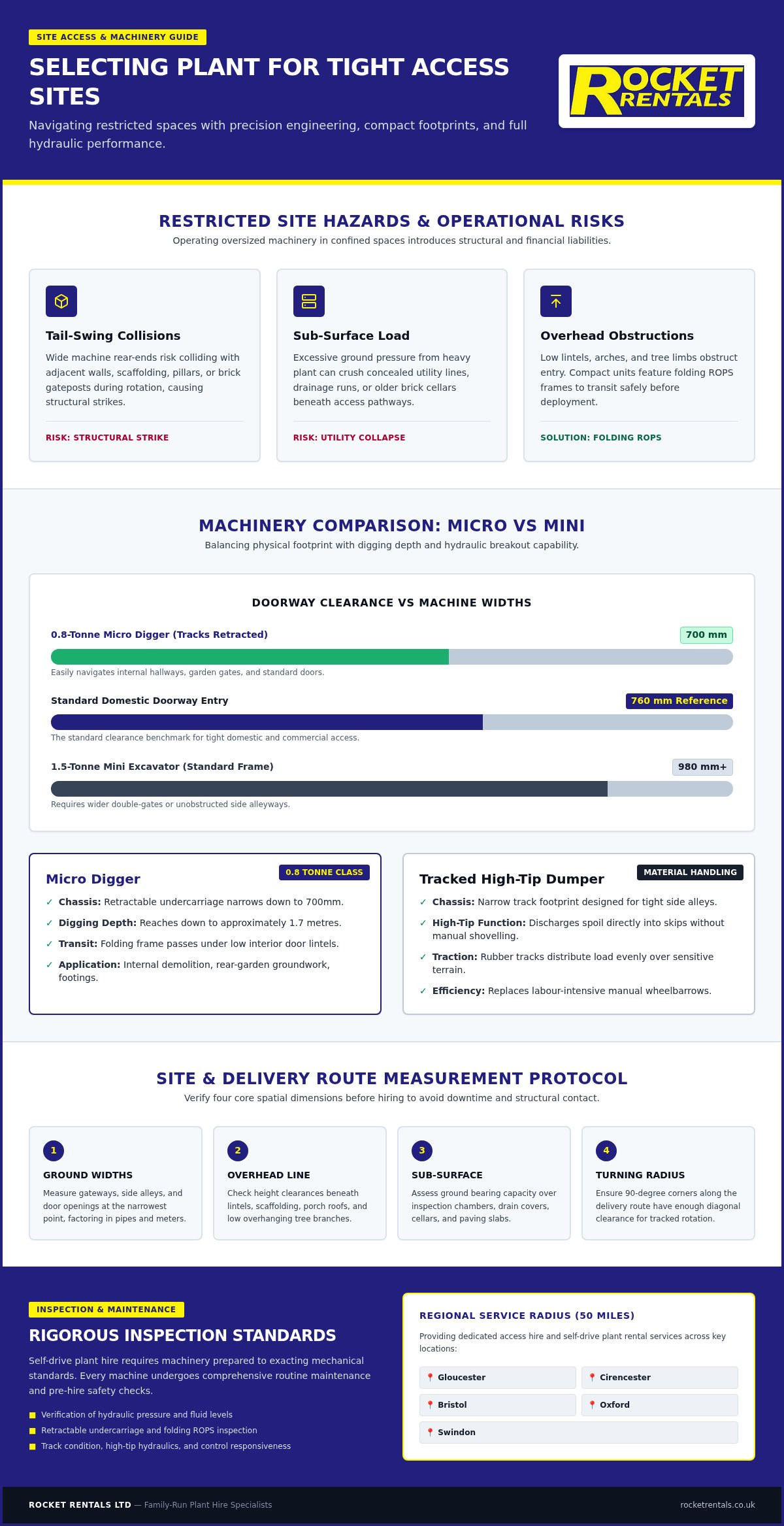
Operating oversized machinery in confined spaces introduces severe liabilities. The most common hazard is a structural strike caused by a wide tail-swing, where the rear of the machine collides with walls, pillars, or scaffolding during rotation. Beyond visible structures, excessive ground pressure from heavy plant can easily crush hidden utilities, drainage pipes, or older brick cellars beneath narrow paths. Height restrictions add another layer of complexity. Professional contractors look for compact machinery equipped with folding ROPS (Roll-Over Protective Structures). This critical feature allows the machine to clear low lintels, arches, or tree limbs safely during transit before being raised back into position for safe operation.
Balancing Compact Size with Hydraulic Power
A common misconception amongst site managers is that smaller machinery lacks the breakout force required for challenging ground conditions. Modern engineering solves this issue completely. A high-quality compact or mini excavator maintains exceptional hydraulic performance despite a narrow chassis. These professional-grade micro machines are engineered for continuous daily use, delivering the necessary power to tear through compacted clay and concrete without stalling. By choosing a self-drive model from a trusted plant hire specialist, your operators retain full control over this hydraulic capability. This ensures you achieve maximum productivity out of a minimal machine footprint, proving that selecting the right construction equipment for tight access doesn't mean you have to sacrifice power to fit into tight spaces.
Micro and Mini Excavators: The Core of Tight Access Hire
When you face a site where every centimetre counts, your choice of excavator becomes the deciding factor between progress and paralysis. While standard mini excavators are the workhorses of general construction, micro diggers offer a specialised solution for internal work or rear-garden groundworks. The primary distinction lies in the machine's width and weight. A micro digger typically weighs around 0.8 tonnes, whereas standard mini excavators often start at 1.5 tonnes and above. Choosing the correct construction equipment for tight access means evaluating these dimensions against your narrowest entry point.
A key feature for navigating restricted paths is the retractable undercarriage. Many micro models can narrow their tracks to just 700mm, allowing them to pass through a standard 760mm doorway. Once through the opening, the operator extends the tracks back to their full width to provide stability during operation. This mechanical flexibility is essential for safety and efficiency.
You must also match the machine's digging depth to your project requirements. A micro digger might reach down to 1.7 metres, which is sufficient for many utility trenches or small foundations. However, if your task requires deeper excavation or a larger bucket capacity, you'll need to balance that need against the physical space available on site. For more detailed insights, you can read The Professional Guide to Mini Excavator Hire to help you decide which machine fits your specific workload.
The Versatility of the Micro Digger
For internal demolition or rear-garden landscaping, the 0.8-tonne micro digger is unmatched. Its compact build allows it to navigate through hallways or side alleys that larger plant simply cannot enter. These machines often feature folding frames, which are crucial for passing under low scaffolding or through interior door frames. Because these machines frequently work in confined, poorly ventilated areas, checking fluid levels and adhering to strict routine maintenance is vital for both machine longevity and operator safety. Following industry best practices ensures that even the smallest machines operate at peak efficiency without risking breakdowns in difficult-to-reach spots.
When to Step Up to a 1.5 Tonne Mini Excavator
You'll reach a threshold where the extra reach and bucket capacity of a 1.5-tonne machine become necessary for site productivity. While slightly wider, many of these models feature zero tail-swing. This design ensures the rear of the machine stays within the width of its tracks during rotation, protecting site boundaries and existing structures from accidental strikes. When working on narrow-trench applications, choosing specific excavator attachments can further improve efficiency. Whether you need a grading bucket or a breaker, selecting the right tool for your mini digger hire ensures your project remains on schedule despite the spatial constraints.
Material Handling and Compaction in Narrow Spaces
Efficiency on a restricted site depends on your ability to move material as quickly as you excavate it. While a micro digger can successfully break ground in a rear garden, the project will stall if you don't have a mechanical way to transport the spoil through the same narrow access point. Selecting the right construction equipment for tight access must include narrow-chassis dumpers that can follow the exact path of your digging machinery. Relying on manual wheelbarrows is labour-intensive and significantly extends your project timeline. Integrating specialised material handling machinery into your fleet ensures that the flow of work remains steady, even when working within the confines of a narrow side-path or an internal demolition zone.
Tracked Dumpers vs Wheel Dumpers for Restricted Sites
Tracked dumpers are often the preferred choice for restricted sites due to their exceptional stability and low ground pressure. Unlike wheeled variants, tracked models distribute weight more evenly, which is critical when traversing soft or uneven ground in narrow alleys. For professional contractors, the tracked dumper with high-tip functionality is a significant asset. This feature allows the operator to raise the skip and deposit spoil directly into a standard waste container or over a fence, eliminating the need for secondary handling. By choosing a dumper with a narrow chassis that matches the footprint of your micro digger, you ensure the entire delivery and removal process is seamless. This coordination is a hallmark of well-planned construction equipment for tight access.
Compaction Tools for Narrow Trenches
Once the excavation and pipework are complete, achieving the correct soil density is essential for ground stability. In narrow trenches where a twin-drum roller simply cannot travel, a trench rammer becomes the professional choice. The process of ramming provides the high-impact force necessary to compact cohesive soils in restricted footings or utility trenches. Because these tools are often subjected to intense vibration and dust, routine maintenance and regular filter replacements are vital to keep them operational. Ensuring your compaction kit is in peak condition prevents unexpected downtime and guarantees that the backfill meets the required structural standards. At Rocket Rentals Ltd, our family-run team ensures every piece of plant undergoes a rigorous inspection before it reaches your site, giving you total confidence in your self-drive solution.
Measuring Your Site: A Practical Checklist for Access Hire
Successful site management begins long before the machine arrives. Selecting the right construction equipment for tight access requires more than just looking at a spec sheet; it demands a thorough physical assessment of your workspace. You must measure the narrowest point of the entire delivery route, not just the final excavation area. A micro digger might fit through a back gate, but if the side alley has a protruding gas meter or a sharp corner, your project will stall. Precision is your best tool for avoiding costly downtime.
The Three-Point Measurement Rule
To ensure your chosen plant reaches the job safely, follow this simple measurement protocol:
Step 1: Measuring the narrowest width. Identify the tightest points, such as garden gateways, alleyways, or gaps between buildings. Don't forget to account for door handles, downpipes, or wall-mounted units that reduce the effective clearance.
Step 2: Checking the lowest height. Look for obstructions like doorframes, low-hanging eaves, and temporary structures. If you're hiring a machine with a folding ROPS, ensure you have enough vertical clearance to raise the structure once the machine is in its working position.
Step 3: Assessing the cornering radius. A machine's width is only part of the equation. You must determine if the chassis can physically make the turn from a narrow street into a driveway or around a building corner without striking boundary walls.
Beyond these physical barriers, you must verify ground load-bearing capacities. This is especially critical for projects involving basement excavations or work on podium decks. Heavy plant, even compact models, exerts significant pressure. Failure to account for this risks structural damage to hidden utility vaults or cellar ceilings. Always check for overhead obstructions like low-hanging power cables or tree limbs that could snag the boom during transit.
Site Preparation for Delivery
Preparation ensures a smooth handover and protects your site. Clear the delivery path of all debris, such as loose bricks, timber, or overgrown vegetation, which could affect track grip or narrow the available path. You also need to verify that the delivery vehicle has a safe, legal area to unload the plant hire. Blocking a narrow road without prior planning can lead to unnecessary stress and delays.
Once the equipment is off the trailer, perform a quick visual inspection. Confirm all fluid levels are checked upon arrival to ensure the machine is ready for immediate operation. As a family-run specialist, Rocket Rentals Ltd ensures every machine leaves our depot only after a rigorous inspection, but a final on-site check is a professional habit that maintains project safety. If you need assistance choosing the right construction equipment for tight access, contact our expert team today to discuss your site dimensions.
Why Professional Contractors Choose Rocket Rentals for Specialist Plant
Selecting a partner for plant hire involves more than just browsing a catalogue; it requires finding a team that understands the stakes of your project. Professional contractors need absolute certainty that their construction equipment for tight access will perform without hesitation. Rocket Rentals Ltd has operated as a family-run business since 1988, and that heritage brings a personal commitment to quality that is rare in the modern market. By choosing a self-drive model, you keep total control over your site operations and project timelines. This flexibility allows you to avoid the heavy capital costs of buying machinery whilst ensuring you always have the right tool for the specific constraints of your workspace.
Commitment to Reliable, Site-Ready Machinery
Reliability is the foundation of safety, especially when you're working in confined areas where there is no room for error. Our primary strength lies in our rigorous inspection process. Every machine, from micro excavators to tracked dumpers, undergoes a detailed examination before it leaves our depot. We prioritise routine maintenance to ensure that fluid levels are correct and mechanical components are in peak condition. This proactive approach significantly reduces the risk of mid-project downtime, which can be devastating for tight-access projects with narrow windows of opportunity.
When our equipment arrives on your site, it's clean, fuelled, and ready for work. We also maintain detailed service records for our entire fleet, providing you with the documentation needed for site health and safety compliance. If you're struggling to match a machine's footprint to your site measurements, we offer expert advice to help you spec the most effective solution for your project.
National Coverage with a Personal Touch
We provide the logistical reach of a nationwide provider while maintaining the approachable nature of a local specialist. This balance is vital for contractors who need reliable plant across various locations but want a partner they can actually talk to. For professional account holders, our hiring process is designed to be direct and efficient, removing unnecessary administrative hurdles. We understand the technical challenges of restricted sites and are always available to answer queries regarding narrow-access machinery or specific attachments.
Choosing the right construction equipment for tight access is a decision that impacts your project's safety and profitability. Working with a dedicated specialist ensures you have a "safe pair of hands" supporting your work from delivery to off-hire. If you have technical questions about our compact fleet or wish to open an account, contact our expert team today to discuss your requirements.
Mastering Your Next Restricted Site Project
Success on a confined site is determined by the millimetres. By applying the three-point measurement rule and selecting machines with retractable tracks, you eliminate the guesswork that often leads to structural damage or project delays. Matching your digging capacity with specialised material handling ensures that your project maintains its momentum without the need for costly manual labour. Choosing the right construction equipment for tight access isn't just about size; it's about ensuring every piece of plant is site-ready and reliable.
Rocket Rentals Ltd remains a family-run independent specialist, providing professional contractors with the peace of mind that comes from a rigorous pre-hire inspection. Whether you need a micro digger for internal work or a tracked dumper for narrow paths, our national delivery service ensures your fleet arrives fuelled and ready for immediate use. Don't let spatial constraints compromise your efficiency or safety standards. We're here to provide the technical expertise and high-quality machinery your project demands. View our range of tight access plant and book your hire today to take full control of your next project.
Frequently Asked Questions
What is the narrowest width a micro digger can pass through?
A micro digger with retractable tracks can typically narrow its footprint to approximately 700mm. This allows the machine to pass through a standard 760mm doorway or a narrow side gate with ease. Once you've reached the work area, you extend the tracks back to their full width to ensure maximum stability. This versatility makes the micro digger the primary choice of construction equipment for tight access where every centimetre counts.
Can a mini excavator be used for indoor demolition projects?
Yes, mini and micro excavators are frequently used for internal demolition. These machines often feature folding ROPS (Roll-Over Protective Structures) that allow them to clear interior doorframes and low ceilings safely. Their compact chassis and zero tail-swing capabilities protect interior walls from accidental strikes. When working indoors, you must ensure adequate ventilation and follow all site-specific safety protocols regarding exhaust emissions or use electric variants where available for cleaner operation.
Do I need a special licence for self-drive plant hire on a private site?
You don't need a standard DVLA driving licence to operate plant on a private site. However, under PUWER regulations, you must be competent and have received adequate training to operate the machinery safely. As we provide self-drive plant hire, the responsibility for ensuring the operator is trained rests with the hirer. If you intend to use the equipment on a public highway, different legal requirements and specific certifications will apply to the operator.
What happens if the equipment I hire is too large for the access point?
If the hired equipment is too large for your access point, you'll face significant downtime and potential delivery costs for a replacement machine. This is why we stress the importance of measuring the narrowest point of your entire delivery route before booking. Selecting the correct construction equipment for tight access is a critical planning step. Our team is always available to discuss dimensions, but the final responsibility for site access rests with you.
How does a tracked dumper differ from a standard site dumper?
A tracked dumper uses rubber tracks instead of wheels, providing superior stability and much lower ground pressure on soft or uneven surfaces. This makes them ideal for narrow garden paths where a wheeled dumper might sink or damage the terrain. Many tracked models also feature high-tip skip functionality, allowing you to deposit spoil directly into a waste container. This is a significant advantage when space for secondary material handling is limited on a restricted site.
Why is a trench rammer necessary for narrow excavations?
A trench rammer is essential because standard rollers are too wide to enter narrow excavations or utility trenches. The process of ramming delivers high-impact force to compact cohesive soils in restricted footings, ensuring the ground is structurally sound. Without this tool, you risk future ground subsidence. It's the professional choice for increasing soil density in areas where larger compaction equipment simply cannot travel due to spatial constraints or narrow trench widths.
Are service records provided with the hired machinery?
Yes, we provide comprehensive service records with all our hired machinery. At Rocket Rentals Ltd, we pride ourselves on our rigorous inspection standards and routine maintenance protocols. Providing these documents ensures you remain compliant with site health and safety regulations and LOLER requirements. Having physical evidence of a machine's last thorough examination gives you confidence in the reliability and safety of the plant you've hired for your specific professional project.
What should I check regarding fluid levels before starting work?
Before starting work each day, you should check the engine oil, coolant, and hydraulic fluid levels. Maintaining these levels is a critical part of routine maintenance that prevents mechanical failure and costly downtime. You should also inspect for any visible leaks around the hoses or cylinders. If levels are low, always use the manufacturer-recommended fluids to ensure the machine continues to operate at peak hydraulic performance throughout your entire hire period.


Comments