
Dumper Payload Capacity: Choose the Right Machine
A larger dumper isn’t always the better choice. A skip can look far from full yet carry too much weight when the material is dense or wet. This dumper payload capacity guide explains why skip volume is not the same as rated payload, and how to estimate whether a load is within the machine’s limit.
Payload, skip volume and the amount carried in each bucket are different measures. To estimate the load, consider the material type and condition as well as its volume. That gives you a more useful comparison with the dumper’s rating than appearance alone.
The right capacity also depends on the job around the machine. Site access, terrain, travel distance and the number of trips in your work cycle all affect which dumper is suitable. We’ll cover these factors so you can plan for safe operation. Rocket Rentals is a family-run plant hire specialist providing self-drive dumper hire, with equipment inspection as part of its approach to equipment selection.
Table of Contents
Dumper payload capacity explained: what the rating tells you
Choosing a dumper by skip size alone can lead to the wrong machine. The skip may have room for more material than the dumper is rated to carry by weight. Compare the expected load with the payload rating for the exact machine you’ll use.
Payload rating is the maximum load weight a specific dumper is rated to carry, while skip volume is the space available for material. Tonnes measure weight; cubic metres measure volume. You can’t convert one into the other without knowing the material’s density.
The term “dumper” can cover different machinery, including the wider range of vehicles described in this overview of the dump truck. A site dumper’s payload rating, however, must come from information for that particular machine.
Payload, load volume and machine weight: what is the difference?
Payload is the weight of the load the dumper is rated to carry. Skip volume is the space available for material. Unladen machine weight is the weight of the dumper without its load. These figures describe different things. A larger skip does not, by itself, mean the machine can carry more weight.
Illustrative example, not a machine specification: Two loads each occupy 1 cubic metre, but one weighs 0.8 tonnes and the other 1.2 tonnes. They take up the same space, yet the heavier load puts more weight on the dumper. Material type and condition determine whether either load is within the machine’s rated payload.
Where do you find a dumper’s rated payload?
Check the machine information, operator documentation and load markings for the rated payload. Confirm that the figure applies to the exact dumper being used. Don’t rely on a general rating for a type of dumper or assume a similar-looking machine has the same capacity.
This is the first practical step in a dumper payload capacity guide: identify the machine’s rating before estimating the load. When you hire, equipment selection and inspection help you start with the right information for the machine on site.
How material type and density change the load a dumper can carry
A skip’s volume tells you how much material fits, but not how heavy it is. Equal volumes of dry soil, wet clay or aggregate can have different weights because their densities differ. That affects how much you can carry within the dumper’s rated payload.
Estimate the material’s weight and compare it with the rated payload of the exact dumper before loading. Equal volumes of different materials can place very different demands on the machine. This explanation of how material density affects payload illustrates why volume alone doesn’t tell you how much a dumper can carry.
How do you estimate a load’s weight from its volume?
Use this basic calculation:
Volume × material density = estimated weight
For example, estimate the volume of excavated soil in cubic metres, then use a reliable density reference for that material in matching units, such as tonnes per cubic metre. The result is an estimated weight in tonnes. If the material type or condition is uncertain, treat the result as an estimate rather than a precise measurement.
Compare that estimate with the rated payload stated for the dumper. The calculation helps you plan, but it doesn’t change the machine’s rating or replace information provided for the specific dumper. A practical dumper payload capacity guide uses the material estimate and machine rating together, not skip volume alone.
Why can wet or mixed material weigh more than expected?
Water adds weight, so soil that has absorbed rain or water can weigh more than the same volume in a drier condition. Compaction affects how much material occupies a given space, and a mixed load may contain materials with different densities. Excavated soil with stones, for example, may not behave like a consistent, single material.
Reassess your estimate if the material changes during the job, such as when digging moves from dry ground into wetter soil or the load composition varies. Don’t assume the same bucket volume represents the same weight on every trip.
When planning your project, explore self-drive dumper hire from family-run plant hire specialist Rocket Rentals. Consider the material you’ll be moving when selecting equipment.
Compare dumper types and payload needs against the site task
Rated payload is only one part of choosing a dumper. Its configuration affects how it moves around the site and where it can discharge material. Map the journey from loading point to tipping area. Note narrow access, soft or uneven ground, gradients, tight turns and the space available to position the machine. The best fit is a dumper suited to both the load and the full work cycle.
When might a tracked or wheeled dumper suit the site?
Neither format is automatically right for every job. A wheeled dumper may suit a route with a firm running surface and room to manoeuvre. A tracked option may be worth considering where ground conditions call for a different type of travel. Account for the whole journey, not just the loading area. Check access width, surface changes, distance and turning points, then match the machine’s own rating to the load.
How do tipping direction and travel route affect selection?
Consider where the load needs to go. A swivel configuration may suit a layout with limited room to turn into position, while a forward-tip dumper needs a clear approach to the discharge point. Gradients, bends and the distance between loading and tipping areas can all affect the work cycle. A higher payload rating alone won’t make a machine the best fit if its configuration slows or complicates each trip.
Include the route and tipping area in your site assessment. The HSE dumper safety guidelines cover dumper hazards and safe working. Use this dumper payload capacity guide alongside the information for the specific machine, and consider how its configuration fits the task as well as its rated payload.
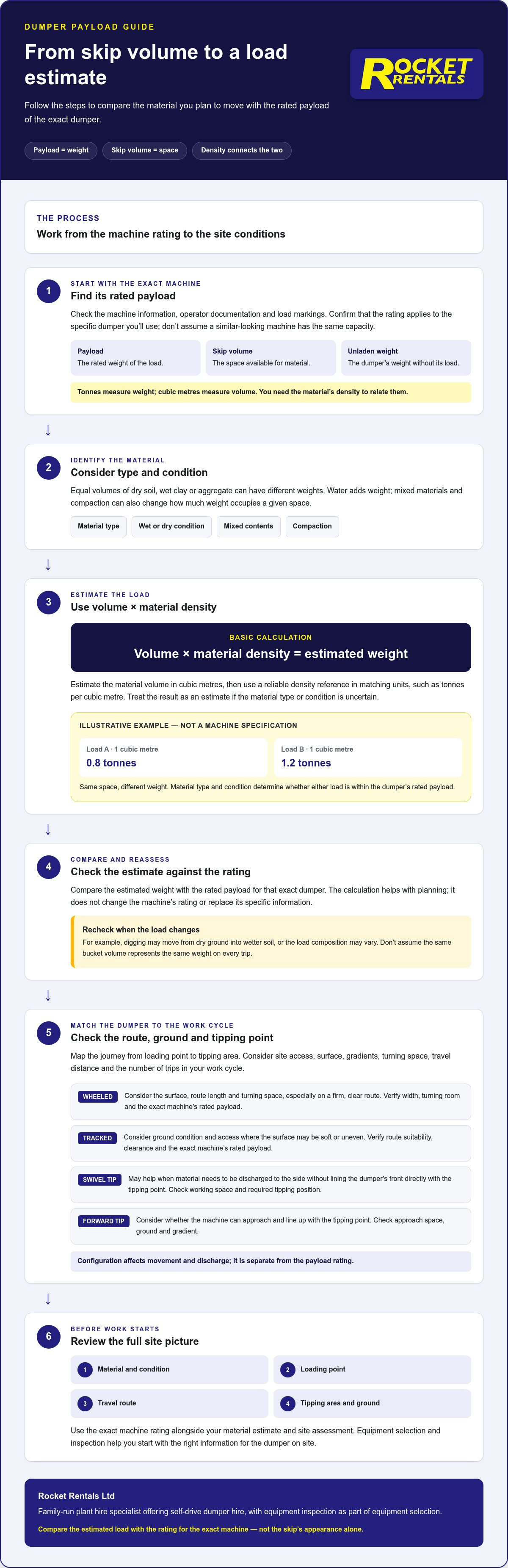
Choose dumper payload capacity safely: a practical site checklist
A pre-use check helps you match the material, machine and route before work starts. Use this sequence as a planning aid alongside the dumper’s instructions and the operator’s training. It does not replace either.
What should you check before loading a dumper?
Identify the exact machine and find its rated payload in the machine information, operator documentation or load markings. Then assess what you’ll carry: note the material type, whether it’s wet or mixed, and whether it can be loaded consistently. Check access, turning space, gradients and ground conditions at the loading area, along the travel route and at the tipping point.
Identify the machine: Match its rating to the specific dumper being used.
Assess the material: Consider its estimated weight, consistency and moisture.
Review the route: Include loading and tipping areas, surface condition and manoeuvring space.
How can you reduce the risk of overloading?
Load in controlled amounts and compare your estimate with the dumper’s rated limit. Don’t use skip volume or appearance as a guide to weight. Keep the load evenly distributed and below the top edge of the skip, following the HSE’s dumper guidance. If the material becomes wetter, denser or more mixed, pause and reassess before continuing.
Conditions can change during a shift. Review your assessment if the ground conditions change, the tipping position moves or the load differs from what you planned. Follow the machine-specific instructions for loading, travelling and tipping, and make sure the operator is trained for the machine. This dumper payload capacity guide supports sound planning, but it can’t replace the instructions or training.
Rocket Rentals is a family-run plant hire specialist providing self-drive dumper hire, with inspection as part of its approach to equipment selection. Arrange self-drive dumper hire for your project.
Match dumper hire to your project with Rocket Rentals
Choosing a dumper means bringing together four factors: the material you’re moving, the machine’s rated payload, its configuration and the route between loading and tipping. Use the information you’ve gathered to describe the task clearly. Don’t choose by skip size or payload figure alone. A suitable machine needs to fit both the load and the way work will move across your site.
What project information helps match a dumper to the work?
Before arranging hire, note the material and how its condition may vary. Include how it will be loaded, where it needs to be tipped and the route it must travel. Access width, surface, gradients, turning space and distance between the loading and tipping points all help describe the job.
Use verified task information to set the capacity requirement. Compare the estimated load weight with the rated payload for the specific dumper, and consider whether its configuration suits the site layout. Clear details support considered equipment selection without relying on assumptions about a machine’s capabilities.
Material: What you’ll move, including any variation in moisture or composition.
Loading: Where and how material will be placed in the skip.
Route: Access, ground conditions, gradients, turning points and travel distance.
Tipping: The discharge location and room available to position the dumper.
Capacity: The verified load requirement compared with the chosen machine’s rating.
How does dumper hire fit into a self-drive project plan?
Self-drive hire gives you access to plant equipment for project work without buying a machine outright. Plant equipment is available on a weekly hire basis. A dumper can form one part of the site plan, while a mini excavator has a different role. Consider how the machines will work together, including where material is loaded and moved.
Rocket Rentals is a family-run, independent plant hire specialist. Dumper hire is part of its self-drive plant equipment offering, with inspection recognised as a business strength. Use the information in this dumper payload capacity guide to describe your job and set clear expectations for equipment selection.
Plan self-drive dumper hire with Rocket Rentals. Get in touch to discuss your project requirements and choose plant hire that fits the work.
Choose a dumper that fits your project
The right dumper depends on more than skip size. Match the machine’s rated payload to the estimated weight of your material, then consider the dumper format, site access, ground conditions and route to the tipping point. Wet or mixed material can change the load weight, so review your estimate if conditions shift.
Use the machine-specific information and instructions when planning loads, and include the loading area, travel route and tipping location in your assessment. This dumper payload capacity guide gives you a practical starting point for choosing equipment and setting clear expectations for the work.
Rocket Rentals is an independent, family-run plant hire specialist. Its self-drive dumper hire is supported by inspection as a stated business strength, giving you a practical alternative to buying equipment for a project.
Explore dumper hire for your project and take the next step towards choosing plant that suits your site and task. With the right information in hand, you can plan your dumper hire with confidence.
Frequently Asked Questions
What does dumper payload capacity mean?
A dumper’s payload capacity is the maximum load weight its specific rating allows it to carry. It differs from skip volume, which describes the space available for material, and from the machine’s own weight. Check the information for the exact dumper you’re using, then compare the expected material weight with its rated payload. Don’t rely on a generic figure or judge capacity by how full the skip looks.
How do you calculate the weight of a dumper load?
Estimate the material’s volume and multiply it by a reliable density figure for that material to get an estimated weight. Use matching units, such as cubic metres and tonnes per cubic metre. This is a planning estimate, not a confirmed load weight: moisture, compaction and mixed contents can change the result. Compare the estimate with the selected dumper’s rated payload and reassess if material conditions change.
Can wet soil exceed a dumper’s payload capacity?
Yes. Wet soil can weigh more than the same volume of drier soil, so a load that appears modest may be heavier than expected. Density references can help you estimate the weight, but treat the result as an estimate, particularly if moisture varies across the site. Check the rating for the exact dumper and don’t use the filled skip’s appearance to judge whether the load is within capacity.
Is dumper payload capacity the same as skip volume?
No. Payload capacity refers to the rated weight the dumper can carry; skip volume refers to the space available for material. The measures aren’t interchangeable. Dense material may reach the machine’s weight limit before the skip is full, while a lighter load may occupy more space without reaching that limit. Consider both skip volume and estimated material weight against the dumper’s rating.
How do I choose a dumper capacity for my site?
Identify the material and estimate the weight of each load, then compare it with the rated payload of the specific dumper. Consider site access, ground conditions, travel distance, turning space and where material must be tipped. A higher payload rating alone doesn’t make a dumper suitable for every route or task.
Can you overload a dumper by filling the skip?
Yes. A full skip can exceed the dumper’s rated payload, especially if it contains dense, wet or mixed material. Estimate the load weight using reliable material information, then compare it with the rating for the exact machine. Load evenly and follow the dumper’s instructions. If the material or site conditions change, pause and reassess your plan, using applicable safety guidance alongside the machine-specific instructions.


Comments