
Operating a Telehandler Across Uneven Ground Safely
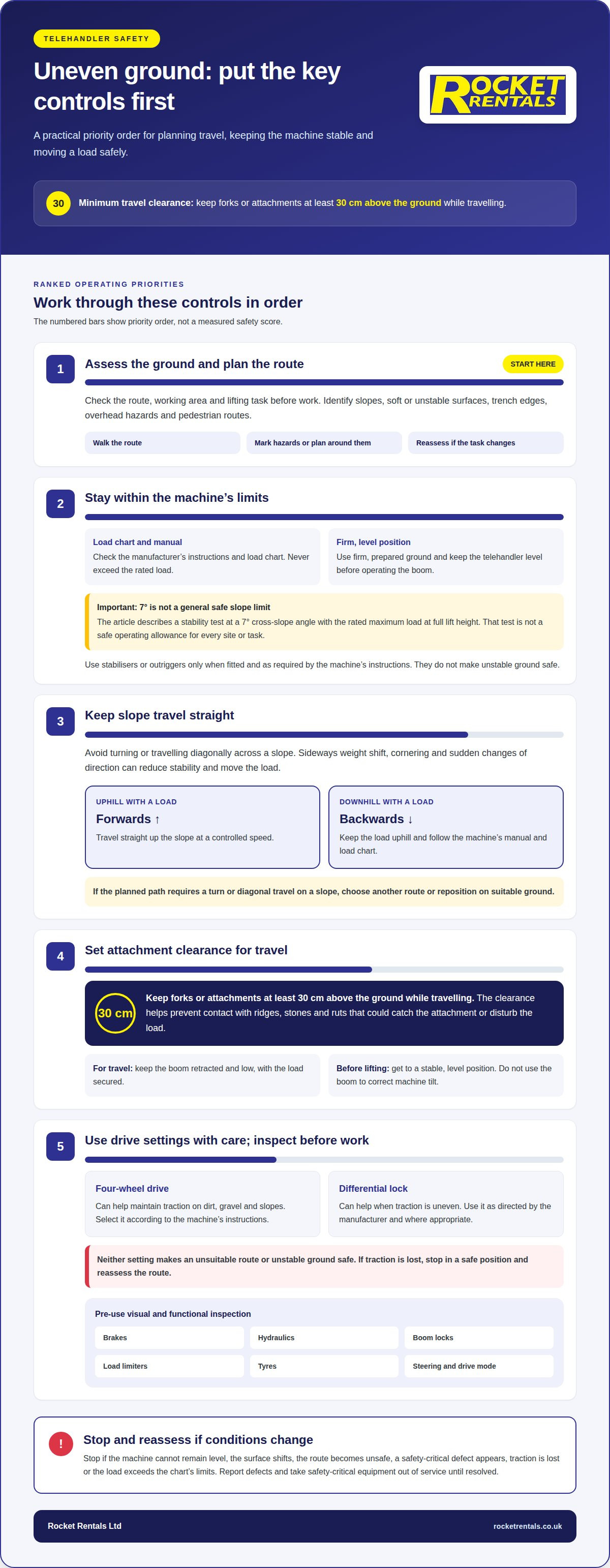
Keeping the forks or attachment low isn’t always the safest choice. When operating a telehandler on uneven ground, keep them at least 30 cm above the ground while travelling, and follow the machine’s load limits and guidance for slopes. A raised load can affect stability, so the route, terrain and load all matter.
It’s understandable to focus on grip when the ground is rough, but four-wheel drive and differential lock don’t remove the risks of a slope or unstable surface. This guide explains how to assess operating limits, travel uphill safely, select drive settings and maintain attachment clearance. It also covers why travelling diagonally or turning on a slope can be hazardous, and how to plan for ground conditions before lifting or moving a load.
Table of Contents
1. Operational limits of rough-terrain lift trucks
Before operating a telehandler on uneven ground, assess the route, working area and planned lifting task. A UK risk assessment should identify slopes, soft or unstable surfaces, trench edges, overhead hazards and pedestrian routes, then define suitable controls. Walk the route, mark hazards or plan around them, and reassess if the telehandler will travel or lift on a slope.
PUWER 1998 Regulation 4 requires employers to provide equipment suitable for its intended work. LOLER Regulation 8 requires lifting operations to be planned by a competent person, appropriately supervised and carried out safely. HSE guidance supports assessing site risks and using suitable controls. The manufacturer’s manual and load chart set the machine’s limits; never exceed its rated load. One stated stability test uses a 7° cross-slope angle with the rated maximum load at full lift height. That test is not a safe operating allowance for every site or task.
Position the telehandler on firm, prepared ground and keep it level before operating the boom. Use stabilisers or outriggers if fitted and required by the machine’s instructions. Terrain-rated tyres, deep tread, four-wheel drive and differential lock may help on demanding surfaces, but they don’t make unstable ground safe. Match the telehandler and compatible attachment to the site and lifting task.
Adapt speed and steering to the terrain, load and weather. Rough ground, a heavy load or poor conditions call for controlled driving, without sudden starts, stops or changes of direction. Apply the cardan shaft handbrake when parking, but don’t treat it as a substitute for a stable parking position on a slope.
Complete a visual and functional inspection before work, including the brakes, hydraulics, boom locks, load limiters and tyres. When operating a telehandler on uneven ground, stop if the machine cannot remain level, the surface shifts, the route becomes unsafe, a safety-critical defect appears or the load exceeds the chart’s limits. Report defects and take safety-critical equipment out of service until they are resolved.
2. Avoid turning or travelling diagonally on slopes
Keep the telehandler travelling straight up or down a slope. Turning or crossing diagonally can shift the machine’s weight sideways, increasing the risk of an overturn, particularly on an embankment or soft surface. Cornering can also push the load towards the outside of the turn and reduce stability. Plan a route that avoids turning on sloping ground.
For uphill travel, proceed straight forwards at a controlled speed. If carrying a load on a slope, keep it uphill: travel forwards uphill and backwards downhill. Follow the machine’s manual and load chart, because permitted loads depend on boom position, attachment and terrain. Avoid sudden steering, braking or acceleration, which can unsettle the telehandler and its load.
Keep the boom retracted and low for travel, with the load secured. Don’t extend or operate the boom while the machine is tilted sideways, forwards or backwards. Before lifting, bring the telehandler to a stable, level position. If the surface prevents this, change the work position rather than trying to correct the tilt with the boom.
Use stabilisers or outriggers when the telehandler is equipped with them and the machine’s instructions or task require them. They may be needed to improve stability on uneven or sloped ground, but they don’t make an unsuitable surface safe. Set them only as directed for that machine, and make sure the supporting ground can bear the load.
Check the slope and route before moving, including soft patches, ruts, trench edges and changes in gradient. If the planned path requires diagonal travel or a turn on the slope, choose another route or reposition on suitable ground. Stop if the surface shifts, traction is lost, the machine leans unexpectedly or the load moves. Continue only when the telehandler is stable and the correct travel path is clear.
3. Four-wheel drive and differential lock
Four-wheel drive can help a telehandler maintain traction on dirt, gravel and slopes. Select it for the terrain according to the machine’s operating instructions, not as a way to cross unstable ground. It can support controlled travel, but it cannot prevent an overturn or make an unsuitable route safe.
A differential lock helps the wheels turn together when traction is uneven, which can improve drive across loose or slippery surfaces. Engage it as directed by the manufacturer and use it where appropriate. It doesn’t replace a suitable route, steady speed or correct load handling. Avoid abrupt steering or acceleration, which can unsettle the machine on rough ground.
Steering modes also affect how a telehandler moves. If the machine has selectable modes, use the setting specified for the task and ground conditions. Check the mode before moving, especially after switching between tight manoeuvres and straight travel. A visual check of wheel direction can help confirm that the machine will follow the intended path.
On an uphill route, drive slowly and straight forwards. Keep to the planned path; don’t turn across the slope or change direction suddenly. If the surface becomes soft or the tyres lose grip, stop in a safe position and reassess the route instead of relying on four-wheel drive or differential lock to pull through.
Drive settings are only useful when the operator understands the machine. Employers must assess operators’ competence and provide training where needed. Training should cover the specific telehandler, its steering controls, drive settings and instructions for the attachment being used. Before work, the operator should know how to select four-wheel drive and differential lock, and when the manual requires them to be disengaged. This preparation helps the operator choose the right setting for each section of the route and maintain control as conditions change.
4. Keep forks or attachments raised above uneven ground
While travelling, keep forks or attachments at least 30 cm above the ground. This clearance helps prevent contact with ridges, stones and ruts that could catch the attachment or disturb the load. It is a travel position, not permission to drive over ground that cannot safely support the machine.
Uneven surfaces can bring the ground closer to the forks as wheels cross dips or rise over bumps. Check the route ahead and keep the attachment low enough to limit boom movement, but high enough to clear obstacles. Travel slowly, as speed can make the attachment bounce and reduce control.
With a load, keep it secured and within the telehandler’s load chart. When travelling uphill, raise the forks and tilt them backwards to support the load and reduce the chance of ground contact. On a slope, keep the load uphill, travelling forwards uphill and backwards downhill, as directed by the machine’s instructions.
Attachment position changes the machine’s balance and lifting capacity. Use only an attachment rated for the task, securely fitted and compatible with that telehandler model. A bucket, fork or other attachment can alter the load centre, so consult the load chart for the chosen attachment and boom position. Never assume the machine’s maximum rated load applies unchanged.
Before setting off, check the attachment is locked in place and the forks are level enough to carry the load securely. Recheck clearance after crossing a rut or changing gradient. If the attachment strikes the ground, stop and assess it and the load before continuing. For site preparation alongside lifting, explore Rocket Rentals’ excavator attachments.
Rocket Rentals Ltd: Telehandler Hire
Rocket Rentals Ltd is a local, family-run plant hire company offering telehandler hire for construction and site work involving uneven terrain. Choosing a machine that suits the ground, lifting task and compatible attachment is a key part of safe planning. Use the manufacturer’s load chart and operating instructions to assess the requirements before work begins. Telehandlers are available on a weekly hire basis.
Where a project also needs ground preparation, Rocket Rentals Ltd offers Mini Digger Hire, Excavator hire and Roller Hire. These options can support related site tasks, while the telehandler handles material movement and lifting within its operating limits.
If your project requires a telehandler for uneven ground, contact Rocket Rentals Ltd to discuss your hire requirements.
Plan the next move on site
Before work begins, connect the lifting task to the wider site plan. Decide where materials need to go, how they will get there and which other machinery the project requires. A clear sequence helps you plan equipment around the work rather than treating each task in isolation.
When planning to operate a telehandler on uneven ground, include the route and working area in the discussion. Share the lifting task and ground conditions so the equipment choice reflects the demands of the job. If your project also involves ground preparation or levelling, Rocket Rentals Ltd offers Mini Digger Hire, Excavator hire and Roller Hire.
Set out your project requirements, then call 01453 51 95 51 or contact Rocket Rentals Ltd for advice. A well-planned job gives you a clearer starting point for safe, organised site work.
Frequently Asked Questions
What ground slope can a telehandler safely operate on?
There isn’t one slope angle that is safe for every telehandler, load and task. Use the manufacturer’s manual and load chart for the specific machine and operating configuration. A 7° cross-slope appears in a stated stability test with the rated maximum load at full lift height; it is not a general permission to work on a 7° slope. Don’t treat test results as site limits.
How do you assess ground bearing capacity and stability before using a telehandler?
Assess whether the ground can support the telehandler and load without sinking, shifting or collapsing. Walk the planned route and working area, looking for soft patches, standing water, ruts, cracks, recently disturbed ground and edges near trenches. Consider how rain or site activity could change the surface. Mark hazards, avoid suspect areas and reassess if conditions change before or during the task.
How do slope, boom extension and load weight affect telehandler stability?
A slope can shift the machine and load away from a level position, while extending the boom increases reach and changes the load chart capacity. A heavier load puts greater demand on the machine, and an attachment can alter the lifting configuration. Check the chart for the actual boom position, attachment and load; never assume the maximum capacity applies at full reach.
What is the safe method for travelling a telehandler across sloping or rough ground?
Choose a route that avoids cross-slope travel, sharp turns and sudden direction changes. Travel steadily, keep the boom retracted and the load secure, and maintain clearance over bumps without raising the load unnecessarily. On a slope, keep the load uphill and follow the machine’s instructions. If a rut or surface change makes the planned route unsafe, stop and reassess.
What are the main rollover and load-falling risks when using a telehandler on uneven ground?
Rollover risks include soft or collapsing ground, a sideways lean, excessive speed, turning on a slope and exceeding the load chart. A load may shift or fall if it isn’t secured, the attachment is unsuitable or the machine jolts over rough ground. Keep people clear of the load and don’t lift or travel when the telehandler’s stability is uncertain.
What checks should operators make before and during telehandler use on uneven terrain?
Before starting, inspect the tyres, brakes, steering, hydraulics, boom and attachment, then confirm the load chart and controls suit the task. During work, watch for changing ground, unexpected lean, slipping, load movement or new obstructions. Pause after heavy rain, ground disturbance or a route change to reassess conditions. Report defects promptly and stop using safety-critical equipment until repaired.
Comments