
How much can a 1.5 ton digger lift at different reaches
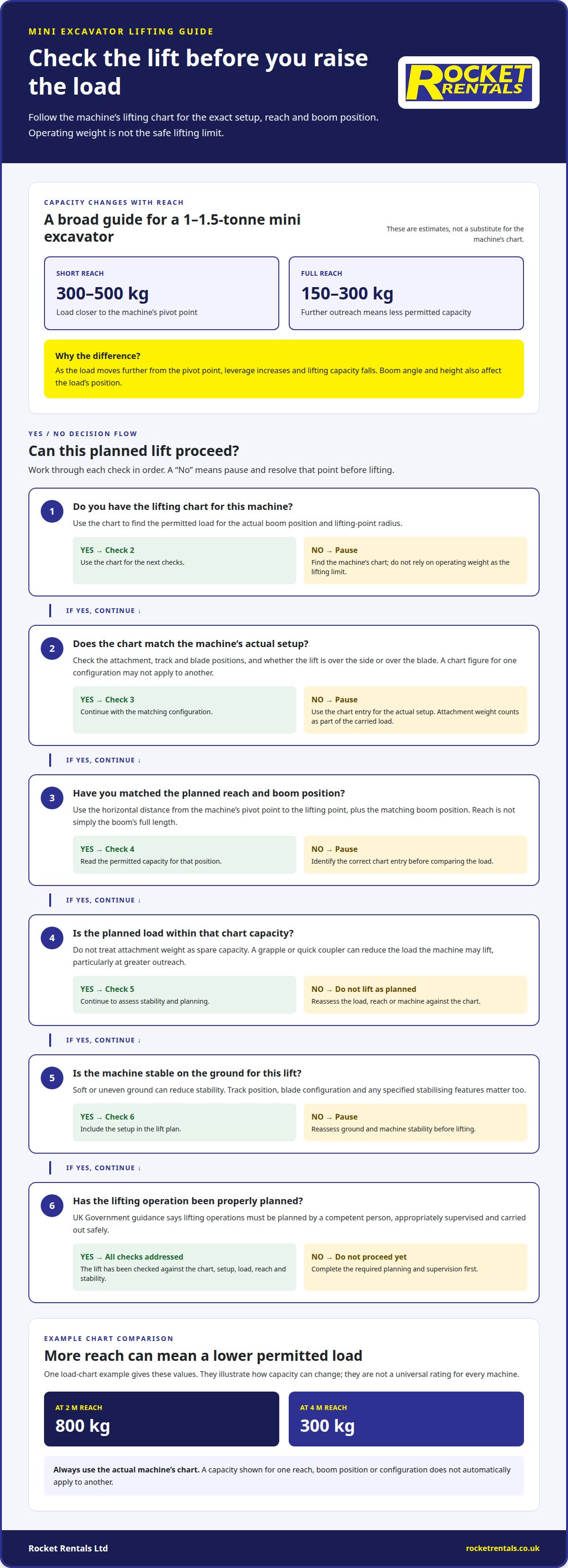
A 1.5-ton digger doesn’t automatically lift a 1.5-ton load. How much a 1.5-ton digger can lift is generally around 500 to 750 kg, depending on the model, but capacity falls as the load moves further from the machine. For a 1-1.5-ton mini excavator, estimated capacity is 300-500 kg at short reach and 150-300 kg at full reach. These are broad ranges; the machine’s lifting chart gives the capacity for its specific boom position and reach.
That difference matters when planning a lift on site. This guide explains how attachments, load distance, boom position, extra weight, stabilisers and ground conditions affect lifting capacity, and why a digger’s operating weight is not its safe lifting limit. You’ll also learn how to read a lifting chart and see how capacity changes at different reaches, helping you choose a suitable machine for the job.
Table of Contents
Do attachments affect the lift capacity?
Yes. Attachments, standard equipment, track and blade positions, and ground conditions all affect a mini excavator’s lifting capacity. A grapple or quick coupler adds weight at the end of the arm, leaving less capacity for the load. Soft or uneven ground can also reduce stability.
An attachment changes the weight and balance of the machine’s working setup. A bucket may allow a higher lift than a hydraulic breaker, while a grapple or quick coupler can reduce the permitted load, particularly at greater outreach. The attachment’s weight counts as part of the load the machine is carrying, not as spare lifting capacity.
Standard equipment matters too. The lifting chart applies to specific machine configurations, so a capacity figure for one setup may not apply when you change the attachment or position the blade differently. For example, the Kubota KX015-4 chart lists 0.37 tonnes at a 2 m lifting-point radius in the over-side, blade-up configuration. That figure describes that setup, not every lift the model can make.
Attachment: a bucket, breaker or grapple changes the weight at the end of the arm.
Tracks: track position affects the machine’s stance and stability.
Blade and ground: blade configuration and soft or uneven ground affect support during a lift.
Extra weight and stabilisers can improve stability, but they do not make every load safe to lift. Treat a counterweight or stabiliser as part of the machine’s specified configuration, not as a reason to exceed its chart. Capacity still depends on the load’s position, boom angle and reach.
UK Government guidance says lifting operations must be properly planned by a competent person, appropriately supervised and carried out safely. If the attachment or blade position changes, use the machine’s lifting chart to identify the permitted capacity for that specific arrangement.
How many kilograms can a mini-excavator lift?
Capacity varies by machine, configuration and reach. Use the model’s lifting chart to find the capacity that applies to your lift.
Capacity by excavator weight class
A weight class gives a broad guide, not a single capacity that applies to every lift. For 1-1.5-tonne mini excavators, estimated capacity is 300-500 kg at short reach and 150-300 kg at full reach. A 2-3-tonne machine is estimated at 600-1,000 kg short-reach and 300-600 kg full-reach. A 4-5-tonne machine is estimated at 1,200-1,800 kg short-reach and 600-900 kg full-reach. These ranges help you match machine size to the task.
Model and machine size comparisons
Model specifications show why operating weight alone can’t give you a precise lifting figure. A 1.5-ton excavator can generally lift 500-750 kg, depending on its model and setup. The Kubota KX015-4 has a maximum lifting capacity of 620 kg. A 1.5-tonne digger’s weight also varies: the HSS Mini Digger 1.5T weighs 1,650 kg. Greater operating weight generally allows a higher possible load, depending on the model and conditions.
Lifting heavy objects can make a mini excavator unstable, even though it is designed to remain stable while digging. UK Government guidance requires lifting operations to be planned by a competent person, appropriately supervised and carried out safely.
Manufacturer lifting capacity tables
A manufacturer’s lifting capacity table shows the permitted load for different boom positions and lifting-point radii. Read the entry for the actual machine configuration and lift position rather than treating the maximum capacity as universal. The table may distinguish between lifting over the side and over the blade. A figure for one position does not automatically apply to another.
Short-reach and full-reach capacity
Short reach means the load is closer to the machine’s pivot point; full reach places it farther away. As outreach increases, leverage increases and permissible capacity falls. For a 1-1.5-tonne machine, the estimated short-reach range is 300-500 kg, compared with 150-300 kg at full reach. Compare both figures with the manufacturer’s table for your lift. For equipment suited to your task, explore mini digger options.
Load distance and boom position
A digger’s lifting capacity changes as the load moves away from the machine. The key measurement is the horizontal distance from the machine’s pivot point to the lifting point. As that distance increases, leverage increases and the load places more force on the machine. The boom’s angle and height also affect the permitted lift.
Reach is not simply the boom’s full length. As the boom moves, the same load can sit at different horizontal distances, even if it stays at a similar height. Raising or lowering the boom, for example, changes the load’s position relative to the tracks. A load chart shows how those positions affect capacity.
One load-chart example gives a clear comparison: an excavator can lift 800 kg at a 2-metre reach, but only 300 kg at a 4-metre reach. These figures illustrate that doubling the horizontal distance does not preserve the same lifting capacity. They are example chart values, not a universal rating for every 1.5-tonne machine.
Check the chart entry for the planned boom position and lifting-point radius. A load chart may show different capacities for different boom positions and machine configurations. A figure for one position cannot be assumed to apply in another. The load’s height and its distance from the pivot both matter.
Near the machine: a shorter radius generally allows a heavier permitted load.
Further out: a longer radius increases leverage and reduces the permitted load.
Changing boom angle: alters the load’s position, so the matching chart entry may change.
For example, a lift planned at a 4-metre radius needs the chart value for that radius, rather than the larger value shown at 2 metres. Keep the load within the position and boom limits shown for the specific machine. The chart helps you understand how the planned reach affects capacity before the lift begins.
How much can a 1.5 tonne digger lift at ground level?
A 1.5-tonne digger can generally lift an estimated 500-750 kg, depending on its model. That range is not a guaranteed ground-level rating. Capacity depends on the machine’s lifting chart, the load’s distance from the pivot, boom position and configuration. A load resting on the ground may be close to the machine or several metres away, so “ground level” alone doesn’t define the permitted lift.
For a lift from ground level, the key figure is the load’s radius: the horizontal distance from the machine’s pivot point to its lifting point. The chart value for that radius and boom position is more useful than a single maximum capacity. A load close to the tracks places a different demand on the machine than one further out, even if both start at ground level.
Consider the full suspended load, not just the item’s weight. The attachment and lifting equipment also contribute to the load being carried. If the chart gives a capacity for a particular configuration, using a different attachment or machine position can change the applicable limit. A 1.5-tonne machine’s operating weight describes the machine, not the weight it can safely lift.
Load position: note the horizontal radius from the pivot to the lifting point.
Boom position: use the chart entry for the planned boom angle and lift height.
Full load: include the attachment and lifting equipment when assessing the suspended weight.
Stability: soft or uneven ground can reduce stability during lifting.
Never treat the general 500-750 kg estimate as permission to lift that amount from every ground-level position. The machine’s chart and the actual setup determine the applicable capacity. For a suitable machine for your project, explore mini digger hire.
Rocket Rentals: Mini Digger Hire
Rocket Rentals Ltd is a local, family-run business serving customers nationally with Mini Digger Hire. Hire equipment is inspected to support safe, reliable use. Mini diggers are available on a weekly hire basis. If you’re weighing up machine size, reach and lifting requirements, the right digger depends on site access and the loads involved. Excavator hire is also available for projects that need a different machine. Share your plans and site conditions when discussing your requirements, and contact Rocket Rentals Ltd directly to discuss suitable equipment for your project.
Plan your next lift with confidence
Turn your lifting requirement into a clear equipment choice by describing the load, where it needs to be picked up and where it must be placed. The question of how much a 1.5-tonne digger can lift is only one part of planning; site access, ground conditions and the working space also shape what will suit the job. A clear picture of the task helps you discuss the right machine for your site.
If your plans change, the machine suited to digging may not be the best fit for every other task. Consider the work sequence and equipment needed across the site, so your hire decision supports the whole job rather than just one lift.
Talk through your equipment needs with Rocket Rentals and take the next step towards planning your project with confidence.
Frequently Asked Questions
What is the typical lifting capacity of a 1.5 tonne mini excavator?
Use the broad estimate in the capacity section as a starting point, not as a fixed rating for every 1.5-tonne machine. The practical figure comes from the specific model’s lifting chart and configuration. For planning, identify the machine, attachment and intended lift position first. This helps distinguish a general class estimate from the permitted capacity for the actual task.
What is the lifting capacity of a 1.5 tonne digger at full reach?
For a lift at full reach, use the permitted load shown for that position in the machine’s chart. Do not substitute a short-reach rating or a maximum figure from another model. Match the chart to the excavator and its working arrangement before planning a lift near the boom’s outer position.
How does lifting capacity vary with boom height and working radius?
Charted capacity changes with the lift position, so use the entry matching both boom height and working radius. Height describes the load’s vertical position; radius describes its horizontal distance from the machine. A lift that starts low may still extend far out. For a real task, consider where the load must finish as well as where it is picked up.
Where can I find the lift capacity chart for a specific 1.5 tonne excavator model?
Use the operator documentation supplied for the excavator and the exact make and model to identify the correct chart. Check that its configuration matches the machine being used, including its working arrangement. If the documentation gives separate entries for different lifting positions, use the one that corresponds to the planned lift rather than relying on a headline maximum.
Can a 1.5 tonne mini digger safely lift a pallet, kerb, or concrete block?
A pallet, kerb or concrete block can be lifted only if the item and lifting arrangement fall within the machine’s permitted capacity. Appearance alone does not establish weight, and pallets may carry unevenly distributed loads. Consider the complete suspended load and how it will be attached. Do not proceed with a lift that cannot be matched to the machine’s chart.
How does a 1.5 tonne digger’s lifting capacity compare with 2 tonne and 3 tonne models?
Two- and three-tonne models generally have greater possible lifting capacity than a 1.5-tonne machine, but the difference depends on the model and operating conditions. Compare the charts for the specific machines against the same task and working position. Also consider whether the larger excavator can access and manoeuvre within your site; higher potential capacity alone doesn’t establish the best fit.
Comments