
Equipment Hire for Renewable Energy: A Buying Guide
The biggest machine on a renewable energy site isn’t always the one that keeps work moving. Choosing equipment rental for renewable energy projects by size or category alone can leave you with plant that doesn’t suit the task, ground or access route.
If you’re deciding which machines you need and when, start by breaking the project into work packages. A site may involve groundworks, moving materials, working at height and providing welfare facilities, with different equipment needed at each stage. This guide explains how to match plant hire to the work, plan delivery around site conditions and sequence tasks to reduce avoidable delays. With self-drive hire, your team also plans who will operate the equipment and how it will be coordinated on site. Mini diggers, excavators, rollers, dumpers, telehandlers, scissor lifts and welfare units can support different site tasks. Rocket Rentals is an independent, family-run hire company, with inspection a key strength. Plan each hire around the job, the site and the people using the equipment.
Table of Contents
What makes equipment rental for renewable energy projects different?
Match plant hire to renewable project tasks and work packages
How to compare equipment rental options for a renewable project
Plan self-drive plant hire around site access, safety and sequencing
Arrange plant hire for your renewable energy project with Rocket Rentals
What makes equipment rental for renewable energy projects different?
Equipment rental for renewable energy projects means matching hired site plant to the work package, project stage and conditions on the ground. The right choice depends on what needs doing, where the work is taking place and how tasks connect. A machine that suits open ground may be impractical on a confined site, and equipment selected for one phase may no longer be needed once work moves on.
Renewable developments combine general construction tasks with specialist energy-generation work. Plant hire can support activities such as preparing ground, moving materials and providing access, but it is distinct from the equipment used to generate electricity. Turbines, solar panels and other generation systems are specialist components, not general site plant. The wider equipment rental industry covers different reasons for hiring. For your project, the practical question is how each item fits the work and the site.
Which project stages may need hired plant?
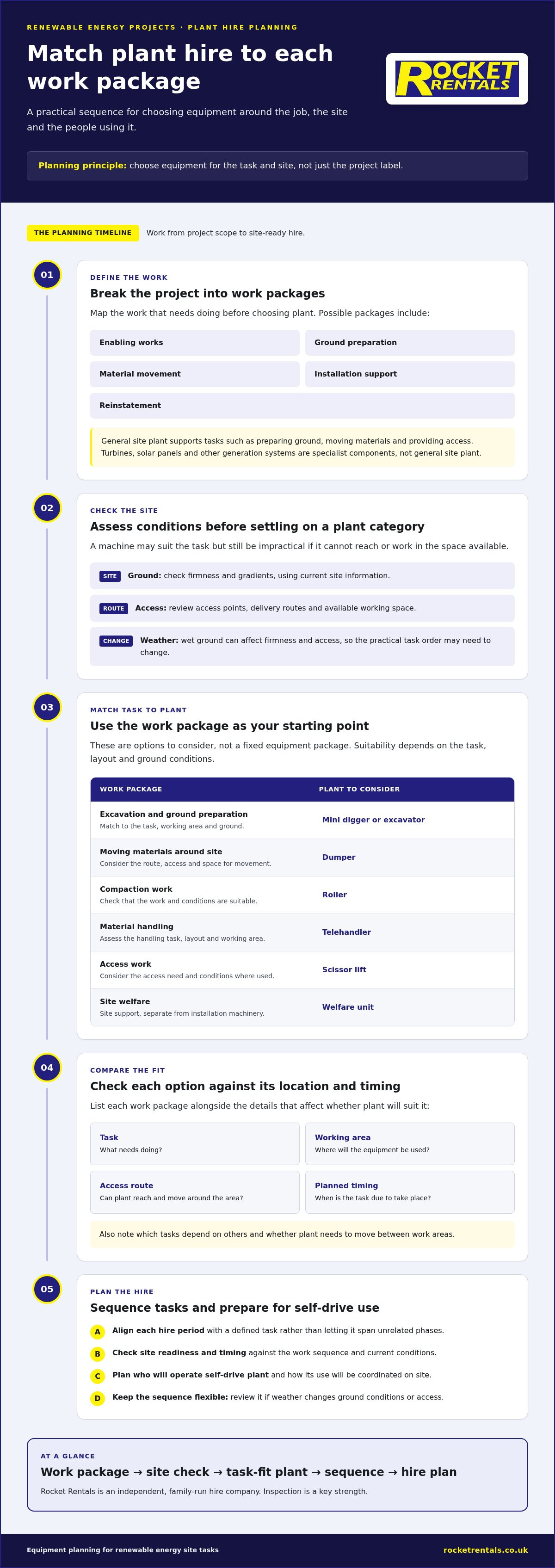
Requirements can change as a site moves through enabling works, ground preparation, material movement, installation support and reinstatement. Ground preparation, for example, may call for plant suited to the task and surface. Later work may involve moving materials or supporting access. Treat these as possible work packages, not a fixed equipment prescription.
Project type matters, too. A solar installation and an onshore wind development can have different layouts, work areas and sequences. Other renewable projects may bring different site requirements. Map the actual work packages first, then identify what general plant could support them. This avoids assuming every renewable project follows the same plan or confusing site equipment with specialist generation equipment.
What site conditions shape the hire requirement?
Assess the site before settling on a plant category. Ground firmness and gradients can affect where equipment can travel and work. Confined access, limited working space and the delivery route can determine what can reach the work area and how it can be positioned. A machine may suit the task in principle but not fit the space available.
Weather can change conditions as work progresses. Wet ground may affect firmness or access routes, which can alter the order in which tasks are practical. Build flexibility into the sequence instead of assuming site conditions will remain unchanged.
Use current site information to understand ground conditions and gradients.
Review access points, delivery routes and available working space.
Plan where equipment will be used and how the work area may change between stages.
Review the sequence if weather affects access or ground conditions.
These checks help you plan around the site as it is, rather than relying on assumptions based on the type of renewable project. They also give you a clear starting point for comparing plant against each task.
Match plant hire to renewable project tasks and work packages
Once you’ve divided the project into work packages, match plant to the job each one involves. This gives you a practical basis for comparing equipment rental for renewable energy projects without assuming one machine will suit every phase. The examples below are starting points. Suitability depends on the task, site layout and ground conditions.
Choose equipment for the task and site, not just the project label. A solar site and an onshore wind site may both need groundworks and material handling, but their layouts and work sequences can differ.
Groundworks, material movement and compaction
A mini digger or excavator may suit excavation or ground preparation, depending on the work area and site conditions. A dumper can support material movement where the route and layout allow. A roller may be appropriate for suitable compaction work. These are task-based options, not a fixed package for every renewable development.
Access, lifting and site support
A telehandler may suit an appropriate material-handling task, while a scissor lift may be considered for suitable access work. Assess the specific task and conditions rather than assuming either machine will fit every work area. A welfare unit serves a different purpose: it supports the site team rather than generation or installation work.
To make comparisons useful, list each work package alongside its location, access route and planned timing. Note which tasks depend on others and whether plant needs to move between work areas. This helps you avoid hiring equipment simply because it appears on a general project list. It also helps you align each hire period with a defined task instead of letting it span unrelated phases.
Rocket Rentals provides self-drive plant hire, including equipment for groundworks, material movement, compaction, access and site support. Explore plant hire for your project.
How to compare equipment rental options for a renewable project
Compare each plant option against the job it needs to do and the site where it will work. Headline size is only one consideration. Account for the working area, access limits, delivery route and intended hire period. An option that suits the task may still be a poor fit if it cannot reach or move around the planned work area.
Planning ahead helps prevent equipment mismatches. Before comparing options for equipment rental for renewable energy projects, record the practical requirements. This makes gaps easier to spot, such as a suitable machine category paired with an unsuitable access route, or a hire period that does not follow the work sequence.
A practical equipment comparison checklist
Make a short record for each work package. Include the task, its location, known ground conditions, access limits and sequence. Then note the equipment categories and any excavator attachments that may be relevant. Keep restrictions and delivery details with the task so you can compare options against the actual job, not just a general project description.
Task and location: What needs doing, and where on site will the equipment work?
Ground and access: What are the surface conditions, route constraints and available working space?
Sequence and duration: When is the task due, what must happen before it, and how long is the equipment intended to be needed?
Equipment and attachments: Which category appears suitable, and could an attachment better match the excavator task?
Site restrictions: Are there limits that affect delivery, movement or where plant can operate?
For attachments, start with the work required and the site conditions. Consider an attachment in relation to a suitable excavator task, rather than adding one without a clear purpose. Check that the attachment is appropriate for the machine and the work area.
Plan for reliability and avoidable downtime
Inspection is a useful consideration when comparing hire options because it relates to equipment condition and operational readiness. Rocket Rentals identifies inspection as a business strength. Your project team should also carry out appropriate pre-use checks and follow the information supplied with the equipment before work begins.
Routine maintenance is the regular care that helps keep equipment in working condition. Planning the task, access and timing in advance can help prevent mismatches that interrupt the sequence. Coordinate equipment arrival with site access and other contractors, so plant is positioned for the work it is intended to support.
Compare options in the same order each time: task fit, working area, access, attachment needs, timing and condition. This gives you a clear basis for your decision and keeps the hire plan aligned with work on site.
Plan self-drive plant hire around site access, safety and sequencing
With self-drive plant hire, your project team plans how equipment will be operated and coordinated on site. Before arranging equipment rental for renewable energy projects, work through the task, access arrangements, operator cover and timing. A clear plan helps plant arrive when the work area is ready and reduces disruption from avoidable site clashes.
Prepare the site and coordinate the hire period
Use this pre-hire sequence to turn the work plan into practical arrangements:
Define the tasks. Set out what the equipment needs to do and which work package it supports.
Map the site. Record delivery routes, access limits, working areas, ground conditions and site restrictions.
Set the sequence. Identify what must be ready before the equipment arrives, what other contractors will be doing nearby and when the plant can move between areas.
Plan the hire period. Match the intended period to the task and project programme, allowing for dependencies between activities.
Check site readiness. Confirm that the route and working area are prepared and that the team knows where the equipment should go.
Conditions and access can change, so share the site plan with the people coordinating deliveries and work areas. If wet weather affects the ground or a route becomes restricted, review the sequence before moving plant or continuing with the planned task.
Agree a process for recording equipment condition on arrival and return. Note visible damage or issues promptly and follow the agreed reporting arrangements. A shared record gives the project team a clear reference about when a concern was noticed.
Set clear responsibilities for self-drive equipment
Rocket Rentals provides self-drive plant hire. Your team needs to arrange suitable operators for the equipment and decide who is responsible for operating it during each shift or work package. Make sure operators understand the equipment information, relevant site rules, induction arrangements and how their task fits with nearby activities. This is practical planning guidance, not a statement of specific legal duties.
Build inspection and daily checks into the work routine. The team should know what checks are expected before use, where findings are recorded and who needs to be told if something appears wrong. An earlier check does not remove the need to assess the equipment at the start of work. Keep the process clear and consistent across the project team.
Good sequencing matters. Schedule plant movement around deliveries and other contractors’ work, rather than treating each hire as an isolated booking. Clear responsibilities and a ready site help your team put self-drive plant to work in a planned, controlled way.
Plan your equipment and site arrangements together. Arrange self-drive plant hire for the tasks in your project programme.
Arrange plant hire for your renewable energy project with Rocket Rentals
A clear equipment brief gives your hire enquiry a practical starting point. For equipment rental for renewable energy projects, describe the work and site conditions rather than relying on the project type alone. Rocket Rentals is an independent, family-run plant hire company offering self-drive equipment for professional projects. Inspection is a key strength, supporting a careful approach to equipment condition.
Build a clear equipment brief
Before discussing hire, gather the details that affect equipment choice and timing. A concise brief keeps the conversation focused on your work packages and site requirements. Include:
The tasks and work packages to complete, with their locations on site.
Plant categories you are considering, such as mini diggers, excavators, dumpers, rollers, telehandlers, scissor lifts or welfare units.
Any excavator attachments relevant to the planned work.
Access constraints, delivery routes, working space and known ground conditions.
The order of activities, coordination with other contractors and anticipated hire period.
Who will operate the self-drive equipment and how operation fits your site arrangements.
Share practical details rather than assumptions. For example, explain whether equipment must pass through a restricted access point, whether the working area changes between tasks, or whether one contractor’s work must finish before plant can move in. Include relevant site restrictions and planned changes to the work sequence. Focus on what the job involves and the conditions the equipment will face.
Choose equipment that fits the work
Each plant category has a different potential role. Excavators and mini diggers may suit appropriate excavation or ground preparation tasks. Dumpers can support material movement where the site layout allows, while rollers may suit compaction work. A telehandler may fit an appropriate material-handling task, and a scissor lift may be relevant for suitable access work. Welfare units support site welfare, rather than generation or installation activity.
These are possible applications, not a fixed package. The right choice depends on the task, access, ground conditions and working area. If you’re considering an attachment, explain the excavator task it needs to support so the requirement can be discussed in context. Share the intended hire period and project sequence to show when equipment is needed and where it will work.
Rocket Rentals’ plant hire is self-drive, so your team plans equipment operation and site coordination. A well-prepared brief helps keep those responsibilities clear and gives the hire discussion a practical basis. It also separates general site plant needs from specialist renewable generation equipment.
For plant and site equipment suited to your planned work, discuss your self-drive hire requirements with Rocket Rentals. Set out the tasks, site conditions and timing to start a clear conversation about equipment for your project.
Put your project plan into action
Turn your site plan into a clear hire brief. Set out what the work team needs to achieve, when each task is scheduled and what could affect access or progress. This gives you a practical starting point for discussing equipment rental for renewable energy projects and keeps decisions connected to the work as it develops.
Build in a review point before each phase begins. Site conditions, contractor schedules and access arrangements can change, so check that the planned equipment still fits the upcoming task. Reviewing the plan helps your team address a mismatch before it affects the next stage.
Rocket Rentals is an independent, family-run plant hire company, with inspection identified as a business strength. For a focused discussion about your project’s plant hire requirements, speak with Rocket Rentals about your hire needs. Bring your task list, site details and timing to plan the next stage.
Frequently Asked Questions
What equipment is commonly used to prepare a renewable energy project site?
Excavators or mini diggers may suit excavation and ground preparation, with dumpers supporting material movement and rollers considered for suitable compaction. The right mix depends on the work, site layout and ground conditions, rather than whether the development is solar or wind. Identify what needs digging, moving or compacting in each work area, then match plant to the task and available access.
Can I hire plant for a renewable energy project without an operator?
Yes. Rocket Rentals provides self-drive plant hire, so equipment is hired without an operator supplied by the company. Your project team arranges suitable operators and plans how the plant will be used within site rules and work sequencing. Before hire, decide who will operate each machine, ensure they understand its operating information, and brief them on the work area and nearby activities.
How do I plan equipment hire for a remote project site?
For equipment rental for renewable energy projects at a remote site, pay close attention to the full approach route, access points and space available to position equipment after arrival. Provide clear directions and a site contact for coordination, and identify route restrictions or changing ground conditions. Plan equipment use around the work sequence so plant is directed to the right area and isn’t left waiting for a work front to be ready.
What information should I provide when arranging plant hire for a project?
Explain the work you need to complete, where it will happen and which plant categories you’re considering. Include access restrictions, ground conditions, delivery arrangements and the planned order of tasks. If you need an attachment, describe the excavator task it must support. Give the anticipated hire period and clarify who will operate self-drive equipment. Specific details keep the discussion focused on your site rather than a generic equipment list.
Can excavator attachments be hired for renewable energy groundworks?
Rocket Rentals offers excavator attachments for hire. Whether an attachment is suitable depends on the excavator task, the attachment required and the conditions where the work will take place. Describe the work in practical terms, including the material or area involved and any access limits. This helps identify whether a particular attachment may suit the task. Don’t assume every attachment suits every excavator or site.
How can I reduce downtime when coordinating hired equipment?
Link each hire period to a defined task and set out when the work area will be ready for the equipment. Coordinate plant movements with deliveries and other contractors, and avoid scheduling overlapping activities in the same restricted space. Give the site team time to complete pre-use checks before work starts. If weather or site progress changes the sequence, review the plan promptly so equipment isn’t sent to an area that cannot yet support the task.
What should a site team consider before using hired plant?
Confirm that a suitable operator is assigned and understands the equipment information and site arrangements. Before use, check the plant’s condition and complete the checks expected by your team’s procedures. Make sure operators know the work area, access route and nearby activities, and agree how to report a concern or visible fault. These steps give the team clear responsibilities and help identify issues before they disrupt planned work.


Comments