
Excavator Size Guide: Choose the Right Machine for Projects
The biggest excavator on site isn’t always the best choice. A machine that’s too large may struggle to reach a confined work area, while one that’s too small may not dig deep enough. This excavator size guide will help you match the machine to the job, rather than choosing by weight alone.
Operating weight is only part of the decision. Consider the excavator’s dimensions, digging depth, reach, ground conditions, access route and the attachments your task requires. Each affects whether the machine can get to the work area and complete the job there.
In this guide, you’ll compare excavator size classes and see how their capabilities relate to different workloads and site conditions. You’ll also learn which specifications to review when shortlisting a machine and how to plan self-drive plant hire around access and working space.
Rocket Rentals is a family-run plant hire business supplying self-drive excavators and attachments. Use the steps below to prepare a practical shortlist, with machine inspection and the requirements of your site in mind.
Table of Contents
Excavator Size Guide: Machine Sizes for Your Project
Choosing an excavator by tonnage alone can leave you with a machine that doesn’t fit the site or meet the job’s requirements. A useful excavator size guide starts with three factors: operating weight, physical dimensions and working capability. Weight helps describe the machine, dimensions affect access and positioning, and working figures show what it can reach and dig.
Machine size describes an excavator’s weight and dimensions; digging capability describes what it can reach and do. These factors are related, but they aren’t interchangeable. Two machines in a similar size class may differ in reach, digging depth and attachment compatibility. Check the specifications for the particular machine rather than treating a broad category as a guarantee of performance.
What do excavator size classes tell you?
Compact, mid-size and larger excavators offer a useful starting point for organising your shortlist. Compact machines are often considered when access or working space is restricted. Larger classes may suit work that calls for greater reach or a higher volume of excavation. These are general comparisons, not fixed weight bands or substitutes for checking the machine’s specifications.
Every size involves trade-offs. A compact footprint can help with manoeuvring in a confined area, but may not provide the reach or capacity the task needs. A larger machine may suit more demanding work, but requires enough room to enter, turn and operate. The Excavator types and components overview explains common excavator configurations. Your shortlist still needs to reflect the specific site and task.
Which project details should shape your first shortlist?
Start with the work itself. Define what you’ll excavate, the material involved, the required depth and the approximate amount to remove. Then consider whether the machine must work from one position or move along the excavation. These details help you identify the working capabilities to compare before looking at machine dimensions.
Next, assess the whole working area, not just the entrance. Measure access restrictions and note obstacles, turning space, overhead limits and where excavated material will go. Spoil placement affects how much room remains for the excavator to manoeuvre. Ground conditions also matter when assessing access and positioning.
Task: What are you digging, and how much material must be removed?
Excavation: What depth and working reach does the job require?
Site: Where are the access limits, obstacles and working-area boundaries?
Spoil: Where will you place or move the excavated material?
If you’re working in a confined area, a mini excavator hire guide can help you assess compact-machine applications. Use your answers to form an initial shortlist, then compare the actual dimensions and working figures for each machine. This gives you a practical basis for matching excavator size to the project before arranging self-drive plant hire.
Compare excavator sizes by access, reach and working space
Once you have a shortlist, compare the actual machine dimensions and working figures rather than relying on class labels. The table below shows what to assess. It doesn’t give fixed measurements: dimensions, reach and digging depth vary by model and configuration, so check the specifications for the machine you’re considering.
How does site access narrow the size options?
Measure the narrowest access point, including gates, and consider what lies beyond it. A route that is wide enough in a straight line may still be difficult if the machine needs to turn around an obstacle or pass beneath an overhead restriction. Map the route from the delivery point to the working area, noting changes in width, headroom and surface.
Access width is only one part of the calculation. The machine also needs enough space to position and work at the excavation. Check for nearby structures, boundaries and stored materials that could restrict movement. A machine may pass through an entrance but leave too little room to work effectively once it reaches the task.
How should you compare reach and digging depth?
Use the manufacturer-stated reach and digging depth for the exact model, then compare them with the dimensions and layout of your excavation. Consider where the machine can stand and whether that position allows it to work across the required area. A reach figure isn’t automatically usable in every layout, and specifications from different models aren’t interchangeable.
Configuration matters, too. An attachment can affect the working setup, so assess the intended machine and attachment together. Don’t assume the size class alone tells you what an excavator can reach or dig. This excavator size guide is most useful when you treat the table as a comparison framework, then verify the specifications that apply to your job.
With your access measurements and required working figures to hand, you can prepare a practical shortlist for self-drive excavator hire.
Excavator size comparison: match machine capability to the job
With a shortlist in place, compare each machine against the work it must complete. Excavation volume, material and the working cycle all affect suitability. A narrow trench in manageable ground may call for a different setup from removing a larger volume of dense material, even if both jobs have similar depth requirements.
Use the figures for the exact machine and configuration. Reach and digging depth describe the excavator’s working range, but they don’t tell you how much it can lift. Lifting capacity is a separate figure and depends on the machine’s configuration and working position. If lifting forms part of the job, use the capacity data for the planned setup.
Which size suits trenching, foundations or bulk excavation?
Start with the shape and volume of the excavation, then consider the material and available working area. For trenching, assess the required depth and whether the excavator can work along the trench without frequent repositioning. For foundations, consider the footprint and how the machine will reach across it. These are decision prompts, not universal recommendations for a particular size.
Bulk excavation may involve repeated digging and spoil movement. Think through the working cycle: how often the machine must reposition, where spoil will be placed and whether other site activity limits its operating space. A larger class isn’t automatically the more practical choice if the site restricts movement.
How do attachments change the size decision?
Identify the task first, then decide whether an attachment is needed. An attachment can change the machine’s working setup, and its weight and compatibility can affect which excavator is suitable. Compare the attachment requirements with the data for the specific machine rather than assuming that an attachment will suit every excavator in a size class.
Rocket Rentals supplies excavator attachments alongside self-drive excavator hire. Include the intended attachment in your shortlist so you can consider machine capability and task requirements together.
Keep lifting separate from digging performance. A machine with enough reach or digging depth may not have the required lifting capacity in the planned configuration. Review the relevant lifting data for the machine’s position and setup, and don’t use digging specifications as a substitute.
Before settling on a class, compare your options against these job demands:
Volume and material: Estimate what must be removed and describe the ground or material involved.
Working cycle: Consider repeated digging, movement and spoil handling across the task.
Attachment: Include its weight and machine compatibility in the selection.
Lifting: Use the relevant capacity data for the exact machine and operating configuration.
This task-led approach makes an excavator size guide more useful: it helps you shortlist for the work and site together, rather than relying on machine class alone.
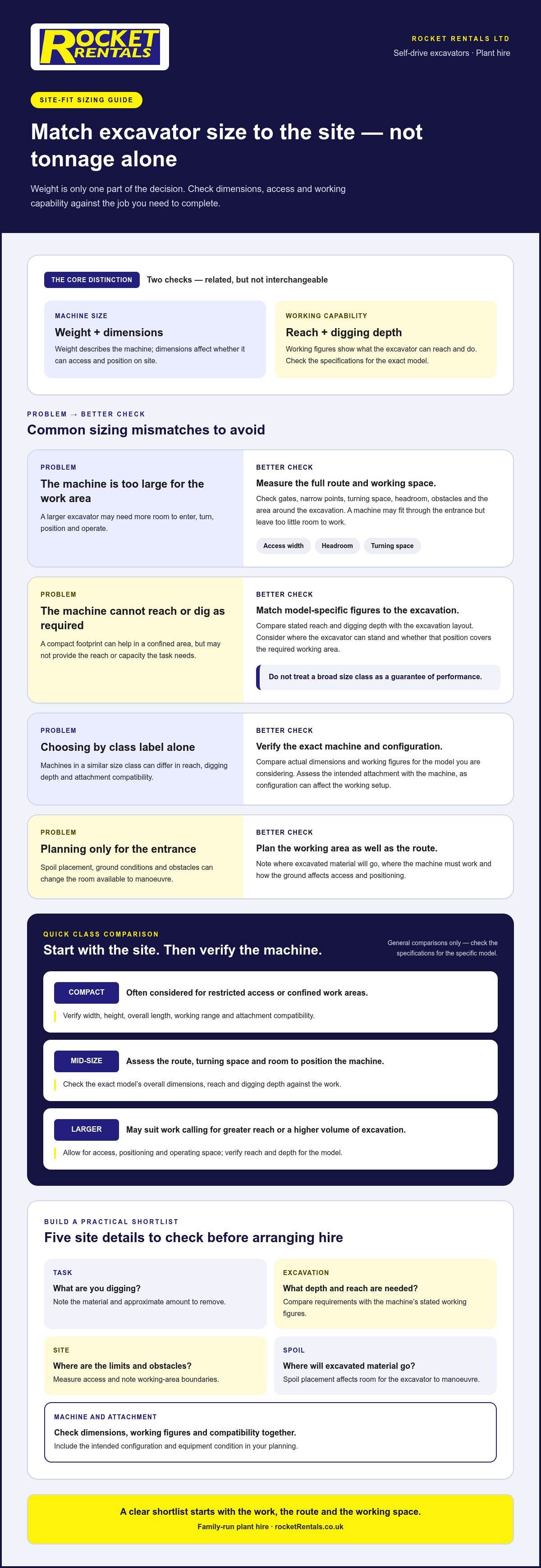
A practical excavator sizing checklist before arranging plant hire
Turn your project details into a clear machine shortlist before arranging plant hire. This checklist takes you from defining the work to comparing site conditions with the specifications for a particular excavator. Record measurements and requirements rather than relying on estimates, especially where access or working space is restricted.
What site information should you record?
Start with the task and work through the site in sequence. Record what you need to excavate, the material, the required dimensions and the order of work. Then map the machine’s route from delivery point to operating area, noting access restrictions, ground conditions and the space available to position and work.
Define the task. Describe the excavation and the amount of material to remove. Note whether the job involves trenching, foundations or another type of work.
Record excavation dimensions. Write down the required depth, width and length. Include any changes in level or shape that could affect how the excavator works.
Set out the working requirements. Record the reach needed from the planned working position and the expected sequence of work. Consider whether the machine will need to move as the task progresses.
Identify attachment needs. Note whether the task calls for an excavator attachment. Include it in your shortlist so you can compare compatibility with the machine.
Measure the access route. Check the narrowest point, gates, turns and overhead restrictions from delivery access to the working area. Include obstacles along the route.
Describe the ground and surface. Note the conditions on the route and at the work area. These details help you assess how the site may affect machine access and positioning.
Plan spoil handling. Mark where excavated material will be placed or moved, and account for the room this needs around the machine.
Confirm the working area. Record the space available to position and operate the excavator, including restrictions from boundaries, structures or other site activity.
How can you avoid choosing a machine that does not fit?
Compare your notes with the published specifications for the exact machine, including overall dimensions, reach and digging depth. Check that the route allows access and that the working area suits the planned position. These checks address two separate risks: adequate access doesn’t guarantee the machine can reach the excavation, and suitable reach doesn’t mean it can pass along the route.
If a requirement doesn’t align, revisit your shortlist before settling on a machine. Using the same site-first approach for your hire planning helps you set out your requirements clearly.
In short: define the task, measure the route, record the working requirements and compare them with the machine’s specifications. Keep those details together as you arrange self-drive excavator hire. Arrange self-drive excavator hire with a clear shortlist of your site and machine requirements.
Arrange self-drive excavator hire with a clear size shortlist
You’ve assessed the work, site and machine specifications. Bring those details together before arranging self-drive excavator hire so the discussion can focus on a suitable size and setup. With self-drive hire, you provide the operator, unlike operated plant hire.
What to have ready when arranging excavator hire
Summarise the job in practical terms. Include what you need to excavate, the material, the required digging depth and reach, and the expected amount of work. Add the access route, site restrictions and space available to position and operate the machine. These notes help relate the machine’s published dimensions and working figures to your site.
Include any attachment requirement and the intended machine configuration. If the work involves lifting, keep that requirement distinct from digging reach and depth, and refer to the relevant capacity data for the planned setup. An excavator size guide is most useful at this stage when it leads to a shortlist based on the task, not simply a broad size category.
Task details: excavation type, material and amount of work.
Working requirements: required reach, digging depth and any lifting needs.
Site information: access restrictions, ground conditions and operating space.
Machine setup: preferred size class and attachment requirements.
Why include inspection in your hire decision?
Inspection is a detailed examination of equipment to verify its safety and operational condition. It’s a relevant part of plant hire planning because the machine needs to be in suitable condition for the work. Rocket Rentals makes inspection a consideration when supplying self-drive plant equipment.
Rocket Rentals supplies self-drive excavators and excavator attachments for hire. Include your task details and size shortlist in the hire discussion, so the requirements of the job and machine can be considered together.
You now have a practical basis for your decision: a defined task, recorded site restrictions and a shortlist informed by the machine’s dimensions and working data. Discuss self-drive excavator hire with Rocket Rentals and take the next step towards selecting a machine for your project.
Put your excavator shortlist into action
A well-planned hire starts with clear information about the work and the machine setup it calls for. Use your excavator size guide to move from comparing options to preparing for hire. Keep your site measurements and task requirements together so you can explain what the excavator needs to do and how it must fit the working area.
Rocket Rentals is a family-run plant hire business supplying self-drive excavators and attachments. Bring your shortlist and project details together, including any attachment requirements, before arranging your hire. This gives the discussion a clear starting point and keeps the focus on matching equipment to the work ahead.
Discuss your self-drive excavator hire requirements with Rocket Rentals and take the next step with a clear plan. With your measurements and requirements ready, you can approach the project with a practical basis for choosing a machine.
Frequently Asked Questions
What size excavator do I need for my project?
You need a machine whose working capability matches the excavation and whose dimensions suit the site. For example, a job behind a building may put more emphasis on access and manoeuvring than a clear, open work area. Use this excavator size guide to shortlist options, then compare the exact machine specifications with the task. There isn’t one size that suits every project with the same excavation depth.
How do I choose between a mini excavator and a larger excavator?
Compare the site constraints with the amount and type of work. A mini excavator may be worth considering where the route or working area is restricted, while a larger machine may suit a task that needs different working capability. Think about the sequence of work as well: frequent repositioning in a tight area can affect which option is practical for your project.
Does excavator size mean its digging depth?
No. Size class and digging depth describe different things. Size generally refers to factors such as operating weight and dimensions, while digging depth is a model-specific working figure. A machine’s class alone won’t tell you whether it can reach the bottom of your planned excavation. Compare the manufacturer’s stated digging depth for the exact machine with your required depth and the position from which it will work.
Can an excavator fit through a narrow access point?
It may, but compare the access route with the dimensions of the particular machine. Measure the narrowest clear point, then consider gates, bends, overhead obstructions and space to turn beyond the entrance. A straight opening measurement won’t account for a tight corner or restricted headroom. Also assess whether there’s enough room to position the excavator once it reaches the work area.
How do attachments affect excavator size selection?
An attachment can change the machine setup needed for a task, so include it in your selection rather than treating it as a separate detail. Identify the job it must perform and check the attachment’s compatibility and weight against the excavator specifications. A machine shortlisted for access may still need reassessing if the required attachment changes the working arrangement.
What information should I have before arranging excavator hire?
Prepare a short description of the job, the excavation dimensions, the material and the required depth. Add your access measurements, working-area restrictions, ground conditions and where spoil will go. Note any attachment needs and whether the hire is self-drive, so the operator arrangement is clear. These details give the hire discussion a practical starting point and help relate the machine choice to your site.
Is excavator operating weight the only specification I need to compare?
No. Operating weight is only one part of the comparison. Check overall dimensions to assess access, then review reach and digging depth against the work. If the job involves lifting, use the relevant lifting data for the specific machine and its operating configuration. Include attachment compatibility too. Together, these details help you assess whether the excavator suits both the site and the planned work.


Comments