
How to Operate a Scissor Lift Safely: A Step-by-Step UK Guide
What if the safest part of learning how to operate a scissor lift happens before you touch the controls? Raising and lowering the platform is only one part of the job. You also need to inspect the machine, assess the ground and work area, and know when conditions make it unsafe to proceed.
If you’re unsure about pre-use checks, stability, overhead hazards or nearby people, follow a clear sequence before starting. You also need to understand the controls on the specific lift you’re using, follow its instructions and meet your site’s training requirements.
This guide covers preparation, inspection, positioning, operation and parking. It explains what to check, how to spot hazards and which instructions to follow before work begins. Rocket Rentals is a family-run, independent plant hire business offering scissor lift hire, with inspection as a key strength. Safe operation starts with the right checks, whoever supplies the equipment.
Table of Contents
How a scissor lift works, and what an operator must understand first
Pre-use inspection: check the scissor lift before you climb aboard
Assess the work area: ground, height and obstacles before lifting
How to operate a scissor lift: a controlled step-by-step sequence
After the task: lower, park and arrange suitable scissor lift hire
How a scissor lift works, and what an operator must understand first
A scissor lift is a mobile elevated work platform (MEWP) that raises a guarded platform vertically to give workers access to a task at height. The base supports the machine, while the platform provides a work area enclosed by guardrails. Controls direct the lift’s movements, but their layout and operation vary between machines.
Crossed supports beneath the platform open and close like the blades of a pair of scissors. As they extend, they raise the platform; as they fold, it lowers. This is separate from travelling the machine across the ground. Whether the lift can travel, and in which position, depends on the equipment and its instructions. Understanding the difference is central to how to operate a scissor lift safely: raising the platform doesn’t mean the lift is ready to move across the site.
What does a scissor lift do on site?
A scissor lift provides a work area for tasks such as installation, inspection and maintenance at height. It suits jobs where workers need to reach an elevated area from below. Because the platform rises vertically, plan the machine’s position around the task before raising it.
The platform, guardrails and controls work with the base to support access and operation. Don’t assume every lift has the same layout or movement options. Check the operating manual for the specific machine to understand its functions, limits and any restrictions that affect your planned work.
What should an operator know before starting?
You need training and familiarisation suited to the equipment and task. Recognising a control isn’t enough; you must understand what it does on that machine. Read the operating manual and site risk assessment before work starts. These explain the machine’s instructions and how the task should be managed on site.
Identify the relevant controls and understand the operating limits set out in the manual. If a control is unfamiliar, the instructions are unclear or the planned task doesn’t fit the guidance, pause. Don’t guess or test a function to see what happens. Follow the appropriate site process to get guidance before continuing.
This guide provides a practical overview, but it doesn’t replace suitable training, the machine’s instructions or site procedures. The lift and work area determine the steps you need to follow. Start with those references, then complete the required checks and planning.
Pre-use inspection: check the scissor lift before you climb aboard
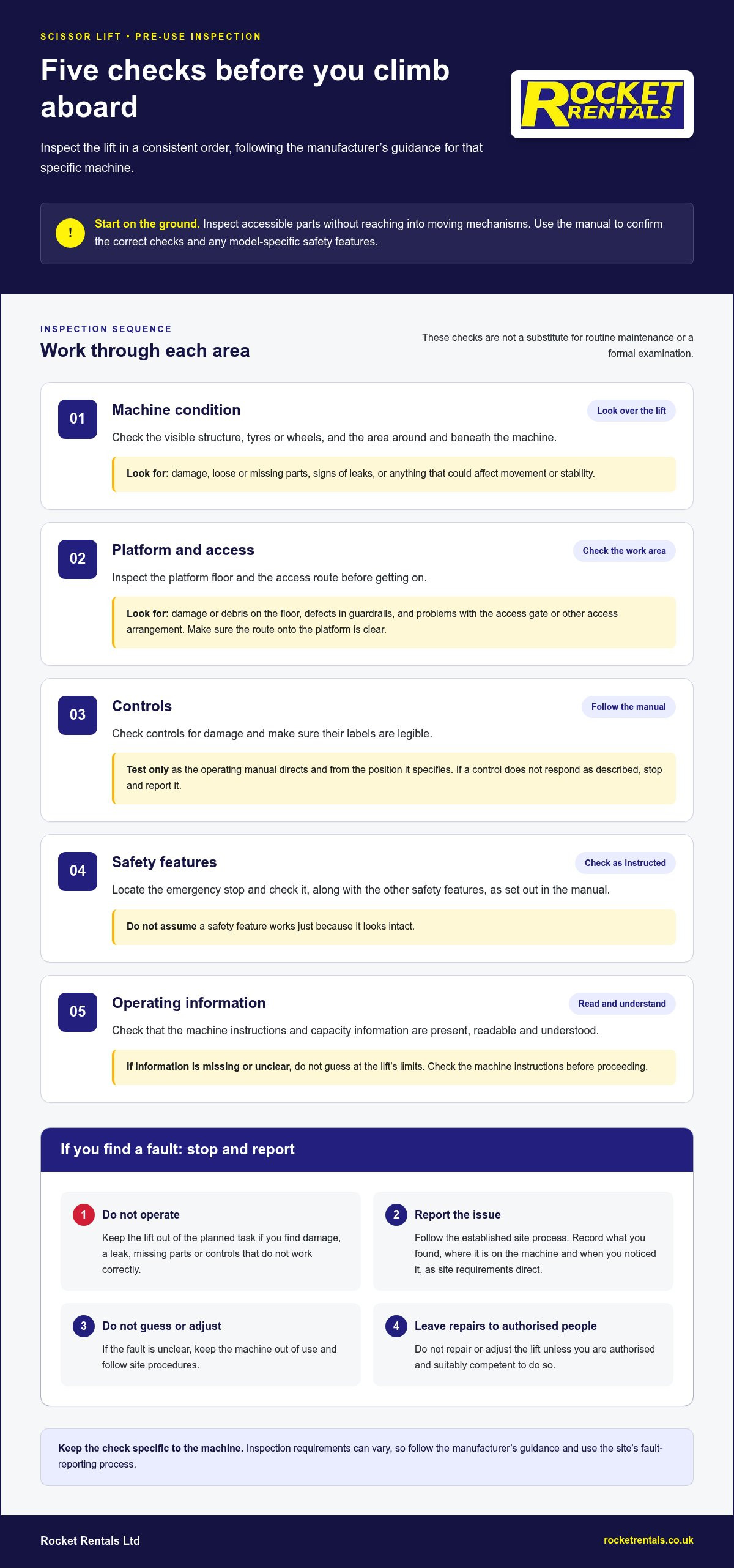
A pre-use inspection can help you identify visible damage or faults before they affect the task. Follow the manufacturer’s inspection guidance for the specific lift, as checks can vary. Inspect the machine before climbing aboard and report concerns through your site’s process. This is a practical part of how to operate a scissor lift safely, not a substitute for routine maintenance or a formal examination.
Which parts should you inspect before operation?
Work through the checks in a consistent order. Keep your feet on the ground while inspecting accessible parts, and don’t reach into moving mechanisms. Use the manual to identify the correct checks and any model-specific safety features.
Machine condition: Look over the visible structure, tyres or wheels, and the area around and beneath the lift. Check for damage, loose or missing parts, and signs of leaks. Note anything that could affect movement or stability.
Platform and access: Check the platform floor for damage or debris. Look for defects in the guardrails and access gate or other access arrangement. Make sure the route onto the platform is clear.
Controls: Check for damage and make sure labels are legible. Test controls only as the operating manual directs and from the position it specifies. If a control doesn’t respond as described, stop and report it.
Safety features: Locate the emergency stop and check it, along with other safety features, as set out in the manual. Don’t assume a feature works just because it looks intact.
Operating information: Make sure the machine instructions and capacity information are present, readable and understood. If information is missing or unclear, don’t guess at the lift’s limits.
Check the surrounding condition as part of the inspection. A leak or loose part may be easier to spot near the base, while damage to a guardrail may be clearer from the platform entrance. The UK Health and Safety Executive (HSE) guidelines provide official workplace health and safety information to support safe planning and equipment use.
What should you do if you find a fault?
If you find damage, a leak, missing parts or controls that don’t work correctly, don’t operate the lift. Keep it out of the planned task and report the issue through the established site process. Record what you found, where it is on the machine and when you noticed it, following site requirements. Clear details help those responsible assess the issue.
Don’t repair or adjust the lift unless you’re authorised and suitably competent to do so. If the fault is unclear, keep the machine out of use and follow site procedures. Rocket Rentals provides scissor lift hire for professional access work, with inspection as a key part of its approach.
Assess the work area: ground, height and obstacles before lifting
Before positioning the machine, assess more than the spot where you plan to work. The lift needs suitable ground, enough clearance to reach the task and a controlled area around it. A surface that looks level may still conceal a drain cover, weak patch or change in level. Use the machine’s instructions and site risk assessment to decide whether the setup is suitable.
Is the ground suitable for the lift?
Walk the intended route and check the working position before moving the lift. Look for slopes, holes, openings, edges, soft ground and transitions such as ramps or changes between surfaces. A level appearance alone doesn’t confirm that the ground can support the machine.
Assess the conditions against the lift’s operating manual and the site risk assessment. Follow the stated limits for gradients and ground conditions. Don’t estimate a safe slope by eye or assume the surface is suitable because other equipment has crossed it.
Look for covers, trenches or openings that could affect support beneath the wheels.
Check for uneven ground or changes in the surface along the route to the work position.
Consider whether site activity could alter the ground or obstruct the planned route.
If you can’t establish that the surface is suitable, don’t raise the platform. Stop and follow site procedures to get guidance. Reposition the lift only if you’ve identified a suitable alternative and can move it in line with its instructions.
Have you checked overhead and surrounding hazards?
Scan above and around the full work area, including the route the platform will take as it rises. Check for ceilings, beams, services, nearby structures, obstructions and other work at height. Allow for the platform and its occupants, not just the height of the machine’s base. Identify possible contact or trapping hazards before raising the platform.
Keep people and moving vehicles clear using the site’s agreed controls. Consider delivery routes, access points and places where workers may enter the area unexpectedly. OSHA’s guidelines for safe scissor lift operation discuss work-area hazards and safe positioning. This is US guidance, not a replacement for UK site procedures or the machine manual.
Indoor and outdoor use must stay within the lift’s stated operating limits. Check the manual for conditions that apply to the specific machine and planned task. Don’t assume a lift suitable for one setting can be used in another, or infer its limits from its appearance.
Conditions can change after your initial assessment. If weather, site traffic or nearby work creates a new hazard, pause and reassess. Stop if the area becomes unsafe or you’re unsure whether the setup remains suitable. You may need to secure the area, wait for activity to change or relocate the lift, but only when it’s safe and in line with the instructions.
How to operate a scissor lift: a controlled step-by-step sequence
Once the equipment and work area are ready, follow a deliberate sequence. The controls and permitted movements depend on the lift, so use its operating manual throughout. These steps don’t replace training or site procedures. If anything behaves differently from the instructions, stop and get guidance before continuing.
Mount correctly. Use the provided access point and enter the platform as instructed. Secure the access gate or arrangement as the manual directs. Don’t climb on guardrails or use them to gain extra height.
Set up at the work position. Position the lift as planned, following the manual’s instructions for movement and site conditions. Keep the intended route and work area clear of people and obstructions.
Check the load. Account for everyone on the platform, along with tools and materials. Keep the combined load within the capacity stated on the machine. Don’t add items or occupants if that would exceed the limit.
Identify the controls. Before moving the platform, confirm which controls operate the functions you need and where to use them. Test controls only as the manual directs. Don’t experiment with an unfamiliar switch or lever.
Raise the platform steadily. Use the designated control as instructed. Watch the platform, surrounding structures and overhead area as it rises. Stop if visibility is poor, an obstruction appears or the setup no longer looks safe.
Work from the platform. Stay within the guardrails and the machine’s stated limits. Avoid sudden movement, overreaching or actions that could affect stability. Keep checking the area for changes.
Lower and prepare to move. Check that the landing area is clear, then lower the platform as set out in the manual. Follow the machine’s instructions for travel, including the required platform position before moving.
How do you raise, position and lower the platform?
Use only the designated controls and operating sequence for that lift. Raise the platform only while the work area and task remain suitable. Stay alert to clearance as it moves. Before lowering, check beneath and around the machine so nobody or nothing is in the landing area. If you can’t see clearly, pause and follow the site’s agreed arrangements to restore a safe view.
When should you stop operating?
Stop if the lift behaves unexpectedly, an alarm activates or a safety feature fails. Pause if people, vehicles or obstructions enter the operating area, or if site conditions change. Don’t continue until the issue has been dealt with through site procedures. In an emergency, follow the machine-specific emergency instructions and the site plan. Never improvise a recovery method.
For professional projects that need access equipment, explore scissor lift hire with Rocket Rentals.
After the task: lower, park and arrange suitable scissor lift hire
Finishing the job safely means leaving the machine in a controlled condition, not simply stepping off the platform. Follow the manufacturer’s instructions and site process for lowering, parking and securing the lift. This stage also gives you a chance to pass on information that could affect the next operator.
What should happen when the work is finished?
Use a consistent close-down sequence, following the manual if its instructions differ from general guidance. Don’t leave the lift raised or unattended unless the machine’s instructions and site procedures specifically allow it.
Lower the platform fully using the designated controls and sequence.
Remove tools and materials safely, keeping the platform within its stated capacity until they’re taken off.
Park the lift in the required location and condition, as instructed.
Secure or isolate the machine as directed, then leave it ready for the next step in the site process.
Report faults, damage or unusual behaviour promptly through the agreed site and hire processes.
Be specific when reporting a concern. Describe what happened, where you noticed it and whether it affected the controls or movement. Don’t assume a fault is minor or that the next operator will spot it. Follow the site process for recording the issue and keeping the machine out of use until it has been addressed appropriately.
What information helps you plan scissor lift hire?
Start with the task, not a model name. Note the working height needed, the work to be carried out from the platform, the ground conditions and any access limits. Include route widths, doorways, turning space, surface changes and overhead restrictions. These details help match the equipment to the job and reduce the chance of discovering a mismatch once the lift is in position.
Describe the working environment too. Indoor and outdoor locations can call for different equipment categories, depending on site conditions and the machine’s stated operating limits. Don’t assume a lift suited to one setting is suitable for another. Include relevant site constraints in your planning and refer to the equipment instructions.
If you’re comparing equipment for a project, Rocket Rentals’ electric scissor lift hire guide is a starting point for considering this equipment category. Rocket Rentals’ focus on inspection supports a careful approach to scissor lift hire, alongside planning for the task, route and work area.
At every stage of how to operate a scissor lift, understand the machine, follow its instructions and report issues through the right process. For a professional project that needs access equipment, include scissor lift hire in your planning.
Make your next access task easier to plan
Plan how access will fit the wider job before equipment arrives. Agree who will operate the lift, who will keep the area controlled, how the team will communicate and what to do if conditions change. A short pre-start conversation helps everyone understand their role and makes it easier to pause if the plan no longer fits.
Knowing how to operate a scissor lift safely also means treating the plan as something to review, not a fixed instruction. If the task changes, access becomes restricted or nearby activity shifts, reassess rather than pressing on to stay on schedule. Keep the operating instructions available so the operator can refer to them. This shared understanding supports clear decisions throughout the shift, including when work resumes after a pause.
Before work begins, match the access equipment to the task and site, and allow time for familiarisation. Explore scissor lift hire with Rocket Rentals for your next professional access project. A clear plan helps you approach the work with confidence.
Frequently Asked Questions
Do you need training to operate a scissor lift?
Yes. Suitable training should help you understand the machine’s functions and respond appropriately during normal work. Familiarisation should then cover the particular lift you’ll use, including its control positions and emergency arrangements. If you’re new to the machine, don’t rely on watching someone else. Before operating a scissor lift on site, know who to approach if the task or equipment falls outside your training.
Can you move a scissor lift while the platform is raised?
Don’t decide from habit or from experience with another lift. Before planning a move, find out whether travel is permitted in the machine’s current configuration and whether the route has enough room for it to pass safely. For example, a narrow doorway or shared work area may need a different plan. If you can’t establish which movements are permitted, pause rather than testing the lift.
What should you check before using a scissor lift?
Alongside the machine checks, make sure the equipment suits the work you’ve planned. A change in task can affect what you need to carry, where the lift must stand and how the work area should be arranged. Confirm who is operating and who is keeping the area clear. This helps prevent last-minute changes once the lift is in position.
Is a scissor lift safe to use on uneven ground?
There’s no single answer for every lift or surface. Check whether the ground may have changed since the work area was first assessed, for example after site activity or a change in conditions. Don’t assume a previously acceptable setup is still suitable. If you can’t establish that the proposed position meets the machine’s instructions and site assessment, pause and follow the site’s process for guidance.
What happens if a scissor lift stops working while raised?
Follow the site’s planned emergency response rather than trying different controls to restore movement. If you can communicate, tell the site team where you are and clearly describe what has happened. Then follow their instructions and the machine’s emergency procedure. Keep other workers away from the affected area. Don’t attempt to climb down by an unplanned route or interfere with the machine unless the emergency plan directs you to do so.
Can you use a scissor lift indoors and outdoors?
Only if the particular lift is suitable for the setting and task. Consider practical constraints beyond the work position, including whether the machine can pass through access points and whether its route could obstruct people in the building. If a job involves moving between spaces, plan the sequence before starting so you don’t have to improvise a change of location.
How do you know the safe working capacity of a scissor lift?
Use the machine’s capacity information and manual, not a figure remembered from another lift. Include everything carried on the platform, even items added part-way through the job. If you don’t know the weight of a tool or material, find out before loading it rather than estimating. If the machine gives separate capacity conditions, follow the one that applies to your planned work.
Comments