
Landscaping Plant Hire: A Commercial Buying Guide for 2026
Updated: Sep 30
Hiring the largest machine available rarely speeds up a commercial contract. In reality, oversized equipment creates tight access bottlenecks and leaves chewed-up ground that swallows your schedule with remedial repairs. When tackling grounds maintenance or extensive site preparation, getting your landscaping plant hire right means balancing physical site dimensions against the exact breakout power required. You shouldn't have to battle avoidable equipment downtime, underpowered diggers, or the headache of juggling multiple suppliers just to keep a project moving.
Discover how to choose the right self-drive machinery to streamline grounds maintenance and earthmoving projects while keeping your timelines intact. We examine how to accurately specify machine tonnage, select productive attachments, and verify pre-hire inspection routines with a dependable hire partner so your groundworks run smoothly and safely throughout 2026.
Table of Contents
Selecting the Right Machinery for Commercial Landscaping Projects
Core Machinery Categories for Commercial Grounds Maintenance
Maximising Versatility with Specialised Excavator Attachments
Step-by-Step Checklist for Hiring Commercial Landscaping Equipment
Why Partnering with an Independent Plant Hire Specialist Protects Your Margins
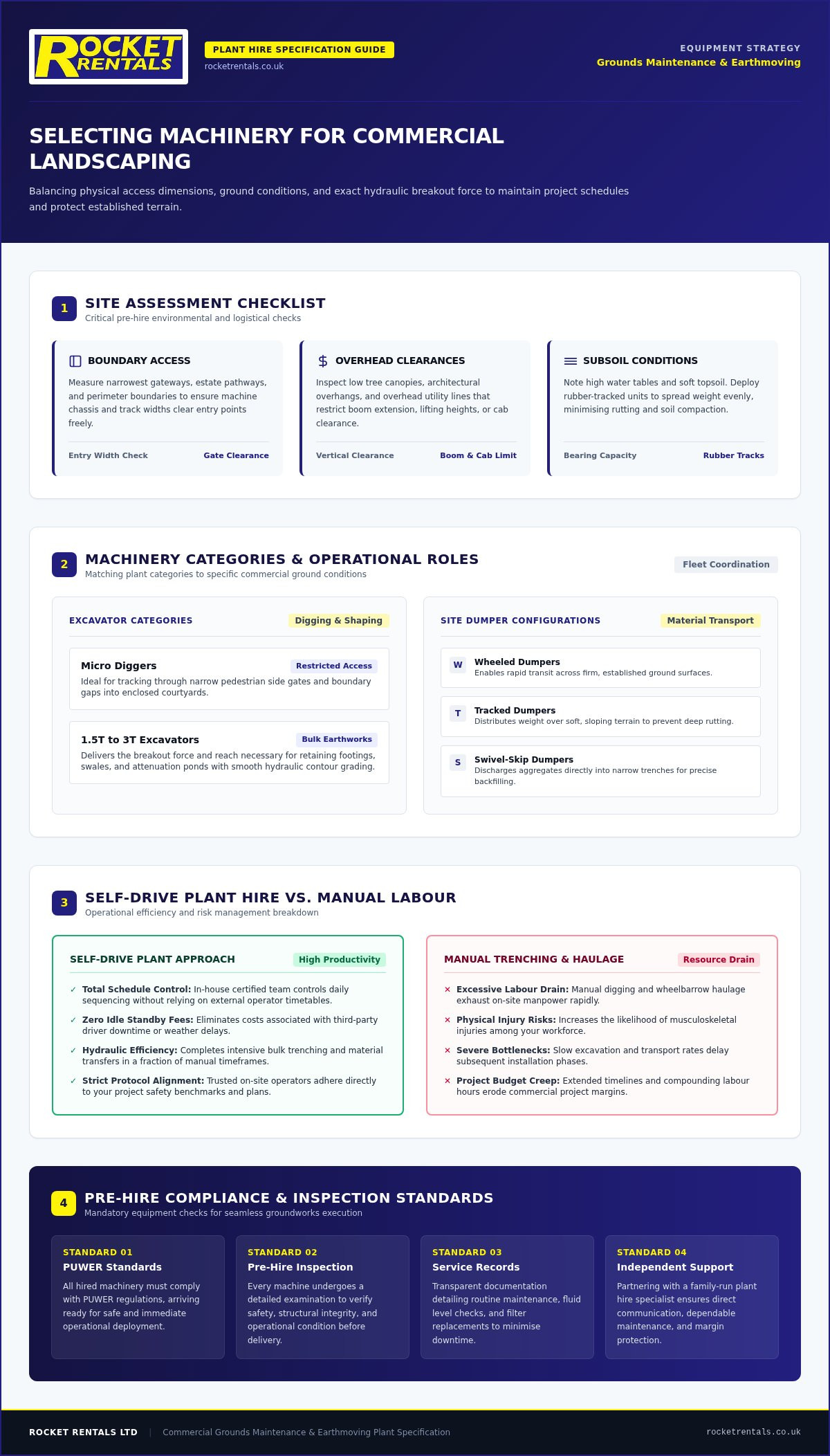
Selecting the Right Machinery for Commercial Landscaping Projects
Commercial landscape installations present a distinct operational challenge: you must shift substantial volumes of soil, aggregate, and sub-base without damaging established surroundings. Balancing rapid work rates with site-sensitive operation is essential. Relying on modern landscaping plant hire provides the mechanical advantage required to keep contracts on track while preventing the costly surface damage caused by inappropriate machinery.
While broad earthworks rely heavily on standard heavy construction equipment, commercial grounds maintenance and landscaping demand calibrated precision. Choosing self-drive plant gives your site supervisors absolute control over daily sequencing. Instead of working around third-party operator timetables or paying for idle standby time, your own certified workforce can tackle earthmoving, trenching, and grading exactly when the site schedule dictates.
Assessing Ground Conditions and Access Restrictions
Before booking any equipment, evaluate your working environment to avoid costly logistical bottlenecks. Heavy machinery can easily crush delicate subsoil, rupture shallow drainage runs, or damage finished paving. Run through these core checks before specifying machine dimensions:
Boundary access: Measure the narrowest gateways, estate pathways, and perimeter boundaries to ensure the chassis and track widths can pass freely.
Subsoil conditions: Note high water tables and soft topsoil. Deploying rubber-tracked excavators or tracked dumpers spreads vehicle weight evenly, drastically reducing rutting and ground compaction.
The Advantages of Self-Drive Plant Over Manual Labour
Relying on manual labour for bulk excavation, footing preparation, or site clearance is an expensive drain on resources. Manual trenching and wheelbarrow haulage are physically exhausting, slow down task completion, and heighten the risk of musculoskeletal injuries amongst your team. In contrast, modern hydraulic machinery completes intensive digging and material transfers in a fraction of the time.
Self-drive plant hire keeps your trusted operators at the controls. Your team already understands your specific safety protocols, quality benchmarks, and landscape plans. By keeping machine operation in-house, you eliminate external driver fees, accelerate daily productivity, and protect your commercial margins from unexpected budget creep.
Core Machinery Categories for Commercial Grounds Maintenance
Structuring your fleet with complementary machinery creates an unbroken material flow across your working footprint. A cohesive approach to landscaping plant hire ensures that excavators, transport vehicles, and compaction units work in sync, eliminating idle cycles and logistical bottlenecks. Professional contractors frequently look to benchmarks established by trade organisations like the National Association of Landscape Professionals to standardise site safety and equipment deployment. Carefully reviewing weight classes is critical on commercial grounds, as overly heavy plant can crush root zones or destabilise prepared surfaces. To assess machine ratings in detail, consult our professional mini excavator hire guide to match digger weight classes directly against required digging depths.
Compact Mini Diggers and Excavators for Precise Earthworks
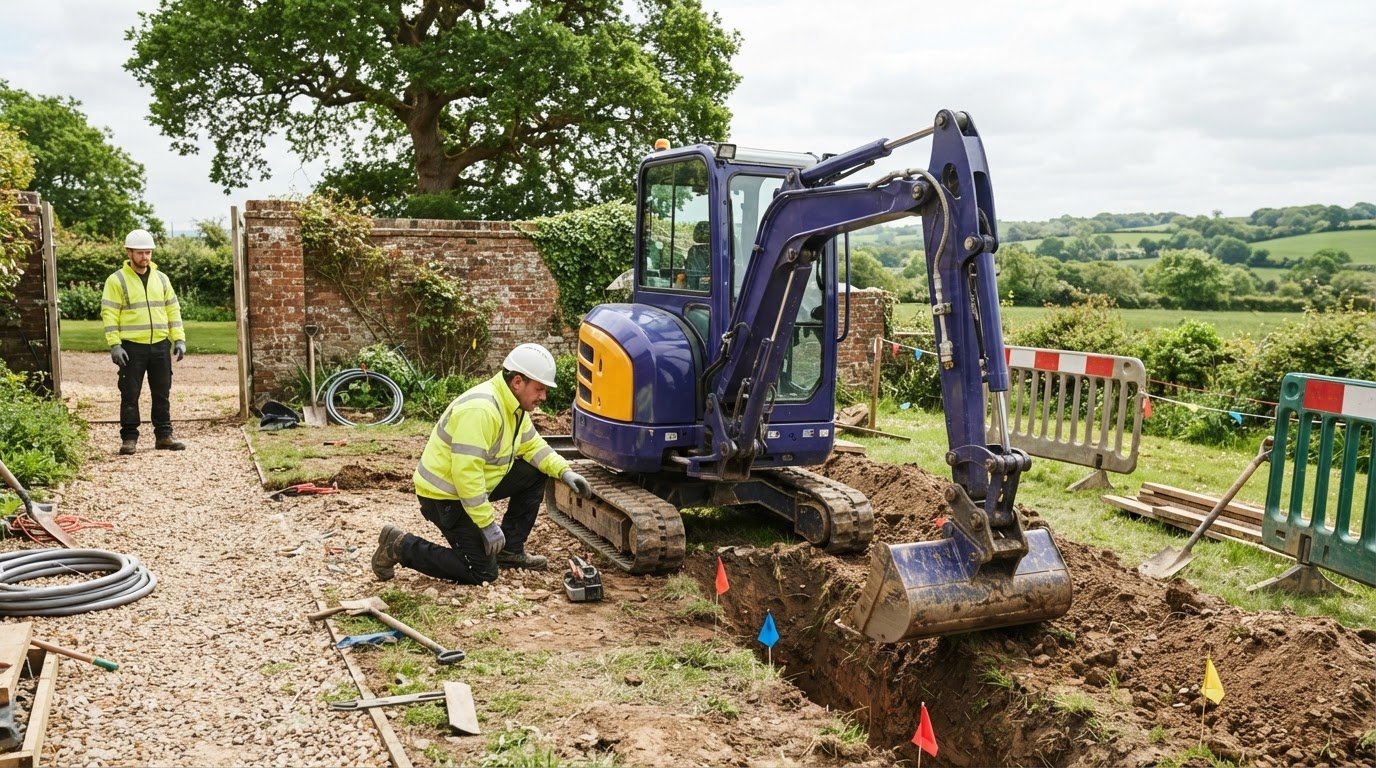
Micro diggers excel when tracking through narrow pedestrian side gates and restricted boundary gaps into enclosed courtyards. For larger commercial projects, 1.5-tonne to 3-tonne excavators provide the breakout force and reach necessary for retaining footings, swales, and attenuation ponds. Modern machines feature smooth hydraulic controls that allow operators to grade contours cleanly and place materials precisely without tearing up surrounding turf.
Site Dumpers for Rapid Material and Soil Transport
Digging efficiency stalls quickly if an excavator must pause for an empty skip. Pairing dumper capacities directly to excavator bucket volumes maintains a steady haul cycle. Wheeled dumpers provide rapid transit across firm terrain, whereas tracked dumpers distribute weight over soft, sloping ground to prevent ruts. Swivel-skip dumpers are especially effective for precision backfilling, discharging aggregates directly into narrow service trenches without requiring secondary manual shovelling.
Rollers and Compaction Equipment for Stable Ground Preparation
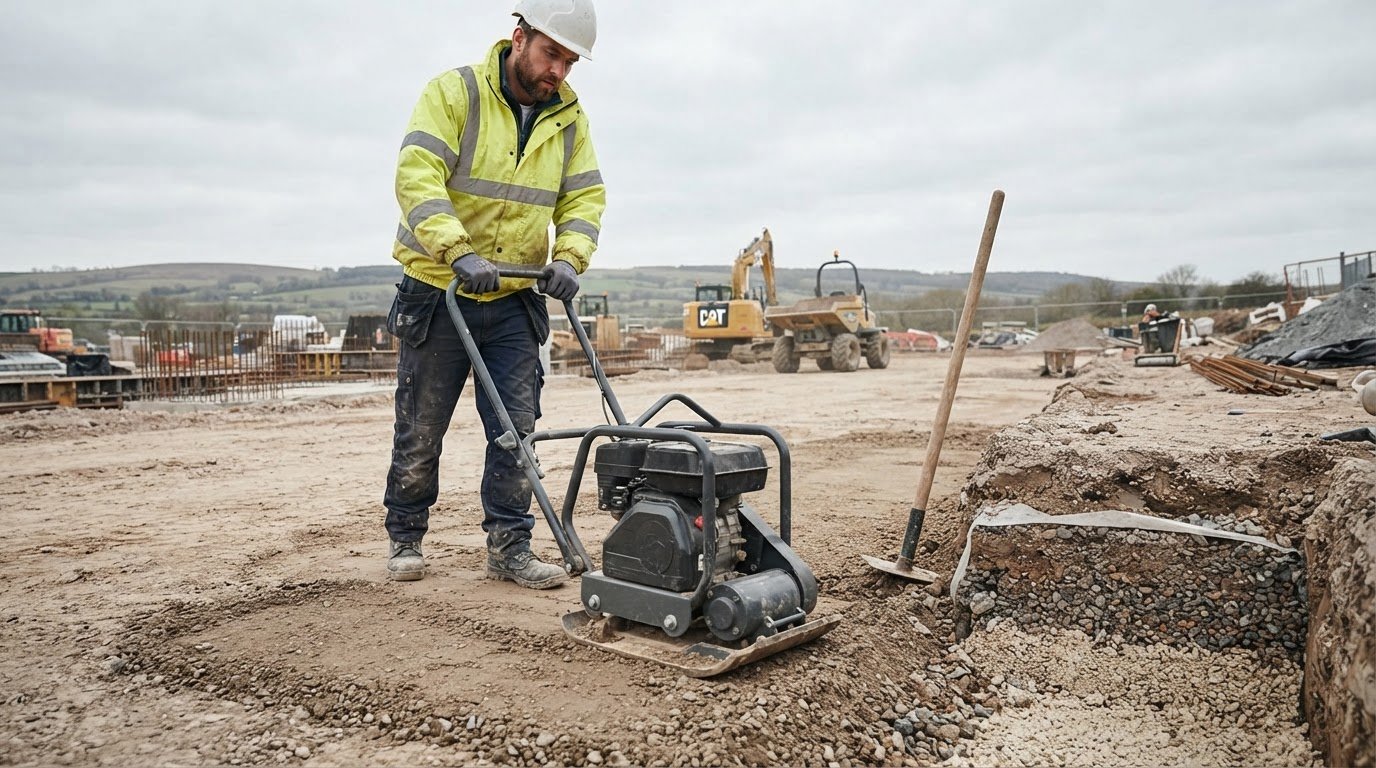
Tandem vibratory rollers deliver the uniform ground compaction essential before laying block paving, gravel paths, or tarmac access roads. Reaching specified soil density prevents future sub-base movement and extends the lifespan of your hard landscaping. Operators can adjust vibration frequencies to consolidate aggregate beds effectively without risking vibration transfer to nearby brickwork or shallow underground services. When planning your next groundwork phase, you can explore self-drive machinery to keep your site running safely on schedule.
Maximising Versatility with Specialised Excavator Attachments
A compact excavator should rarely sit idle on a commercial site. Adding task-specific attachments transforms standard machinery into a versatile multi-tool, eliminating the expense and congestion of bringing multiple machines onto congested plots. Modern mechanical and hydraulic quick-hitch couplers allow your operators to swap implements in minutes, keeping daily earthmoving continuous and reducing unwanted downtime. When configuring your fleet, check our hire guide for excavators to confirm pin dimensions and auxiliary hydraulic circuits before dispatch.
Specialist tooling expands the practical reach of your landscaping plant hire contract. Rather than treating an excavator merely as a digging bucket, commercial contractors use targeted work tools to tackle fine grading, demolition, and planting without bringing in extra machinery.
Grading and Ditching Buckets for Fast Surface Contouring
Wide grading buckets provide the clean, flat profile needed across large commercial lawns, sports pitches, and roadside verges. Their elongated cutting edge lets your operator distribute screened topsoil evenly without creating ridges. Tilt-grading variants take this precision further by angling hydraulically up to 45 degrees left or right. This mechanism lets operators shape drainage swales, profile balancing ponds, and dress batters cleanly from a stationary machine footprint, keeping track travel to a minimum. Once initial ground shaping is complete, grounds teams managing ongoing turf upkeep can turn to specialised platforms such as Mowing Route Density to rent high-quality lawn mowers and turf equipment.
Ground preparation often involves clearing stubborn obstructions and securing perimeters. Rather than relying on manual post-hole borers or handheld breakers, excavator-mounted hydraulic attachments deliver steady, repeatable power:
Earth augers: Drill plumb, accurate holes for boundary fences, security bollards, and root-ball tree planting in seconds, avoiding the ragged edges typical of manual excavation.
Hydraulic breakers: Break up old concrete slabs, strip footings, and break stone walls rapidly during the initial site clearance phase.
Always inspect hydraulic fluid levels and quick-release connections before operating high-flow hydraulic attachments. Ensuring that your host machine delivers the exact oil flow (litres per minute) and pressure specified for the tool prevents hydraulic overheating, protects seals, and ensures optimal hitting power throughout the shift.
Step-by-Step Checklist for Hiring Commercial Landscaping Equipment
A structured hiring process prevents costly delivery delays and ensures your machinery arrives ready to work. Without a clear plan, simple oversights like blocked access gates or missing paperwork can stall an entire groundworks team. Applying a systematic checklist to your landscaping plant hire protects your timeline and keeps daily operations running safely from start to finish.
Work through these key operational steps before signing off on your plant order:
Step 1: Check access and ground bearing: Confirm pathway widths, gate clearances, and ground conditions along the transit route before choosing your machine tonnage.
Step 2: Inspect maintenance records: Ask your plant supplier to confirm routine maintenance compliance and provide up-to-date documentation.
Step 3: Organise the delivery area: Establish a dedicated, level drop-off zone that accommodates delivery lorries without obstructing public traffic.
Step 4: Establish daily maintenance checks: Train site teams to monitor engine oil levels, tyre pressures, and track tension at the start of every shift.
Verifying Equipment Readiness and Routine Maintenance
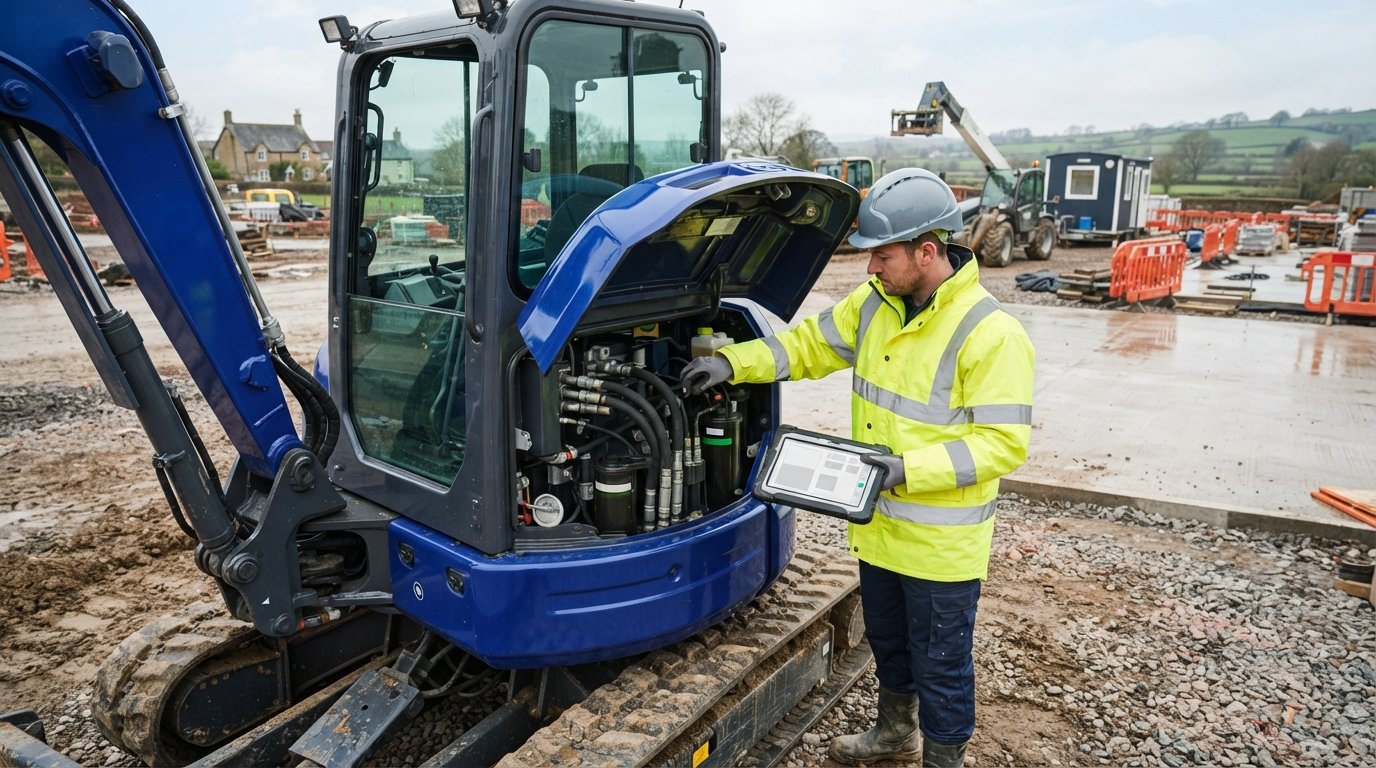
Equipment reliability depends on strict pre-hire checks. Always verify that your hire partner provides complete service records along with current inspection documentation to satisfy PUWER requirements. Look closely at hydraulic rams for seal leaks, check high-wear points for grease, and verify that all emergency stop mechanisms function cleanly before accepting handovers. Carrying out a short, five-minute walkaround each morning ensures minor issues are spotted early, helping you avoid preventable downtime on site.
Coordinating Site Delivery and Transport Logistics
Delivery logistics require forward planning to avoid hazards on site. Standard low loaders and beaver-tail delivery trucks require broad turning circles and clear road access. Ensure the approach route is free from low-hanging branches or tight vehicle chicanes. Unloading must always happen on firm, level ground well away from pedestrians, excavations, and overhead utility lines.
Before moving the machine into work, your operators should run through cab controls, mirrors, and safety cut-offs. Under UK safety standards, operators must engage isolation levers whenever an excavator is stationary. Taking these straightforward steps keeps your team compliant and your working footprint secure. If you want to review fleet options and secure reliable equipment, book your self-drive machinery with Rocket Rentals today.
Why Partnering with an Independent Plant Hire Specialist Protects Your Margins
Commercial landscaping schedules leave no margin for equipment failure. A machine that breaks down or struggles with sluggish hydraulics burns through labour hours while overheads keep ticking. Choosing an independent, family-run specialist for your landscaping plant hire gives you direct accountability that national call-centre hire chains cannot match. Instead of speaking with an anonymous switchboard, you deal directly with experienced equipment specialists who understand the physical demands of grounds maintenance and earthmoving.
Modern machinery maintained to high mechanical standards consumes fuel more efficiently, delivers crisp control response, and finishes tasks faster. Working alongside a dedicated provider founded on personal service ensures your business receives reliable, ready-to-work machines tailored to the realities of your site.
Dedicated Inspection Standards and Fleet Reliability
Fleet reliability begins long before a machine arrives on your low loader. Every excavator, dumper, and roller should pass an exhaustive multi-point inspection before dispatch. Technicians must check fluid levels, verify track tension, inspect hydraulic lines, and run safety system tests to confirm every component operates as intended.
Documented service records provide total transparency, giving project managers confidence that hired assets meet strict PUWER safety standards. When equipment is kept in pristine condition, your operators avoid the sudden mechanical failures that generate costly downtime, keeping your team productive from day one.
Personalised Trade Support for Landscaping Professionals
Large contracts rarely run in straight lines. Weather turns, ground conditions shift, and project scopes evolve, creating sudden demand for additional machines or different attachments. An independent partner provides the agility needed to react quickly, adjusting delivery slots or arranging alternative plant without bureaucratic red tape.
You also benefit from practical trade support rooted in genuine sector experience. Rather than guessing whether a micro digger or a 3-tonne machine is best for a walled perimeter, you can talk through site access constraints with plant professionals who know the equipment inside out. This direct collaboration simplifies logistics, keeps machine handovers punctual, and protects your project profitability on every phase of works.
Secure the Right Fleet for Your 2026 Landscaping Projects
Selecting the right machinery turns challenging terrain into predictable, profitable groundworks. By assessing site boundaries early, matching digger capacity with site dumpers, and insisting on thorough pre-hire checks, you keep projects moving without costly surface damage or mechanical delays. Dependable landscaping plant hire is about more than just placing machinery on site; it's about partnering with a team that values your project margins as much as you do.
Founded circa 1988, Rocket Rentals delivers an extensive fleet of modern self-drive excavators, dumpers, and rollers backed by a dedicated, family-run approach. Every machine leaves our depot with a rigorous multi-point inspection and complete service records, giving your operators total reliability from day one. When you're ready to take control of your site schedules, explore our modern self-drive plant hire fleet at Rocket Rentals and set up your next project for lasting success.
Frequently Asked Questions
Can commercial landscaping plant be operated on delicate turf without causing damage?
Yes, provided you select rubber-tracked machinery and use ground protection mats across high-traffic routes. Modern mini diggers and tracked dumpers distribute their operating weight over a wide surface area, drastically cutting ground pressure. Operators should avoid sharp spin-turns on wet turf, track smoothly at low travel speeds, and lay composite tracking boards over ornamental lawns to prevent soil compaction and surface tearing.
What is the difference between self-drive plant hire and operated plant hire?
Self-drive hire supplies the machinery for your own qualified personnel to drive, whereas operated hire includes a third-party driver. Commercial contractors generally choose self-drive landscaping plant hire because it offers direct control over site pacing and keeps project costs lower. Note that Rocket Rentals specialises strictly in self-drive plant rental, allowing your in-house operators to work to your exact project schedule without external disruption.
Which size of mini digger is best suited for commercial garden remodelling?
A 1.5-tonne to 3-tonne mini digger is usually the best choice for commercial garden remodelling. These weight classes deliver ample digging depth and breakout force for retaining walls, pond excavation, and sub-base preparation while remaining narrow enough to track through typical access ways. If entry routes are particularly restricted, a micro digger with retractable tracks can squeeze through narrow gaps down to 750mm.
Do I need a special licence to hire and operate a self-drive mini digger?
You do not need a UK driving licence to operate a mini digger on private land or enclosed commercial grounds. However, under PUWER safety regulations, employers must ensure every operator is properly trained and competent to handle the machinery safely. Site managers usually require plant operators to hold an industry certification, such as a CPCS or NPORS card, before permitting self-drive operation on commercial groundwork schemes.
What routine maintenance checks should my team perform on hired plant equipment?
Your operators should perform a quick visual walkaround before the start of each working day. Check engine oil, coolant, and hydraulic fluid levels, and examine track tension or tyre pressures. Clear away any impacted soil or debris from running gear, verify that all emergency stops and safety control levers function properly, and grease daily pivot points on high-wear joints to avoid preventable site downtime.
What happens if a piece of hired plant machinery suffers a technical fault on site?
You should cease operation immediately and notify your hire desk to report the issue. A dedicated plant provider will assess the fault over the telephone or dispatch a qualified mobile service engineer to inspect and repair the machine on site. Where an issue cannot be resolved swiftly, a reputable supplier will arrange a replacement machine to protect your schedule and keep project delays minimal.
Can multiple excavator attachments be supplied alongside a single digger hire?
Yes, you can hire multiple attachments alongside your excavator to handle different stages of your scheme. Pairing grading buckets, hydraulic breakers, and augers with a single machine expands your working capability while keeping total fleet requirements down. Most modern mini diggers feature mechanical or hydraulic quick-hitch brackets, enabling your operators to change between attachments quickly and safely as ground conditions dictate.
Comments