
Micro Digger vs Mini Digger: The Professional Plant Hire Comparison Guide
Updated: Aug 31
Choosing the wrong excavator isn't just a minor oversight; it's a mistake that can stall a professional site for days whilst labour costs continue to climb. When weighing up the micro digger vs mini digger, you likely already understand that timing is everything. Nothing disrupts a schedule faster than a machine that's too wide for the access point or too weak for the terrain. It's a frustrating scenario that often leads to unexpected delays and concerns regarding site safety and machine reliability.
This guide provides the technical clarity you need to choose the most efficient excavator for your specific project requirements. We'll explore the critical differences in power and performance, helping you select a machine that offers maximum breakout force without compromising on site restrictions. We'll preview the weight thresholds, specialised attachments, and the latest 2026 safety regulations to help you maintain a compliant, efficient site. By the end of this comparison, you'll have the information needed to secure a reliable, well-maintained machine that serves as a safe pair of hands for your next professional contract.
Table of Contents
Defining the Difference: Weight Classes and Performance Metrics
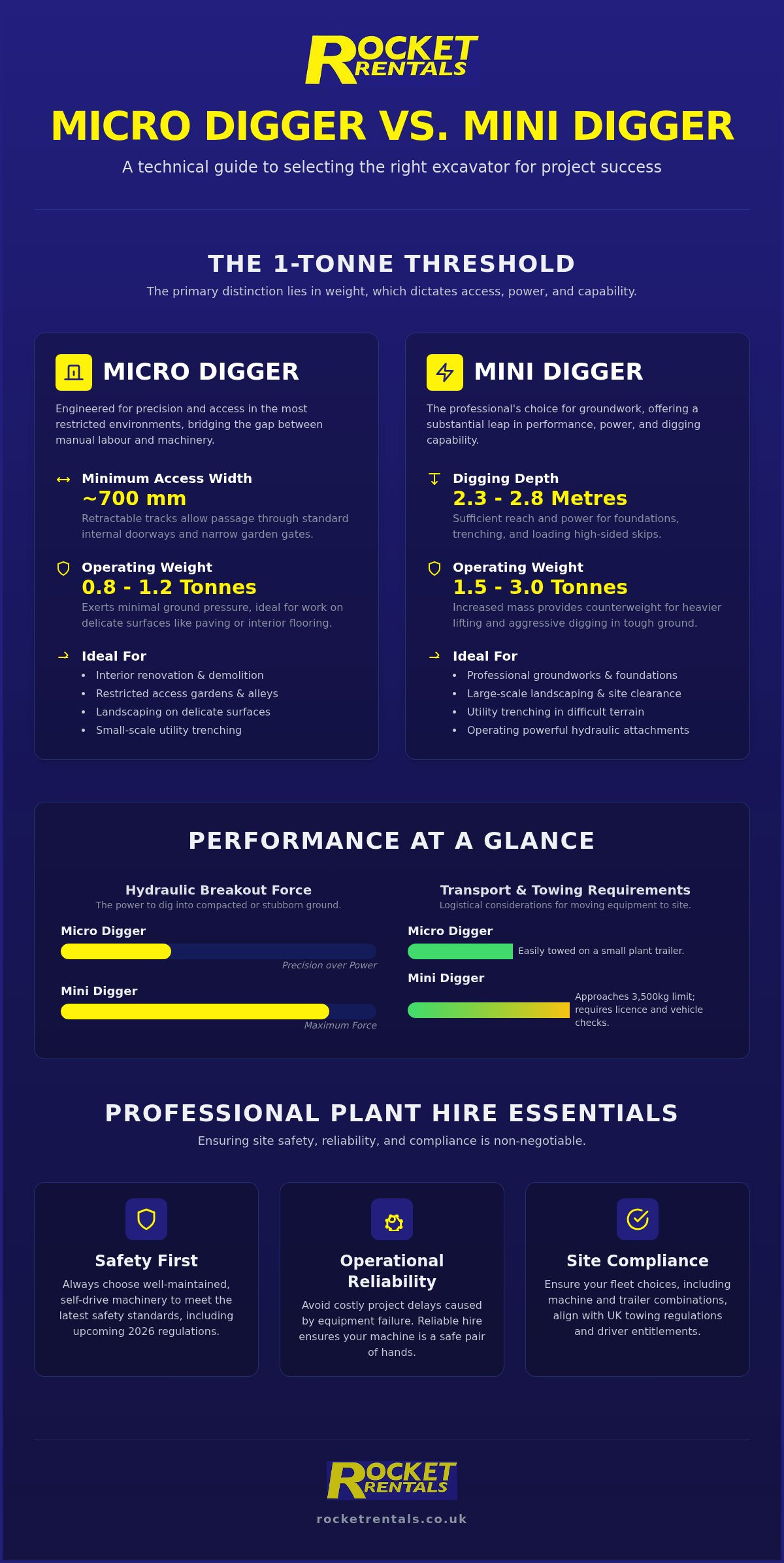
Understanding the technical distinction in the micro digger vs mini digger debate begins with a look at weight. While both machines belong to the compact excavator family, their operational roles are defined by their mass. In the UK hire market, the 1-tonne mark serves as the industry's primary pivot point. Machines falling below this threshold are engineered for extreme spatial constraints; those above it are designed for higher production output and deeper excavation.
The industry standard for Compact and micro excavator classifications typically places the dividing line at the 1,000kg mark. This weight isn't just a number on a spec sheet. It dictates everything from the machine's ground pressure to its transport logistics. For example, a micro digger exerts minimal pressure on site surfaces, making it the preferred choice for working over delicate paving or internal flooring. Conversely, the increased weight of a mini digger provides the necessary counterweight for heavier lifting and more aggressive digging in stubborn clay or compacted hardcore.
Transport requirements also shift significantly between these classes. A micro digger is easily transported on a small plant trailer. However, once you move into the 1.5t to 3t mini digger range, the combined weight of the machine, attachments, and trailer often approaches the 3,500kg towing limit. Professional contractors must ensure their fleet choices align with UK towing regulations and driver licence entitlements to maintain site compliance.
The Micro Digger Category (0.8t - 1.2t)
Micro diggers, often called "doorway diggers," are specialised tools for restricted environments. These machines typically feature engines producing between 7kW and 10kW, with hydraulic systems optimised for precision rather than raw speed. Their defining characteristic is a chassis width of approximately 700mm to 750mm. This allows them to pass through a standard internal doorway or a narrow side gate. Despite their small stature, they provide a vital bridge between manual labour and heavy machinery, significantly reducing project timelines on residential or interior renovation sites.
The Mini Digger Category (1.5t - 3t)
The 1.5t to 3t range represents the sweet spot for professional groundworks. These machines offer a substantial leap in performance, with digging depths often reaching between 2.3 and 2.8 metres. They provide the stability required for loading high-sided skips and the hydraulic flow necessary for demanding attachments like breakers or augers. While they require wider access than their micro counterparts, their ability to move larger volumes of material makes them the more cost-effective choice for foundation digging, trenching, and large-scale landscaping where space allows for a slightly larger footprint.
Micro Diggers: Maximising Efficiency in Restricted Access Sites
Modern micro plant design focuses on overcoming these physical barriers. Adhering to industry best practices regarding compact equipment operation is essential when working in these high-risk, confined areas. By using specialised features like retractable tracks and folding frames, these machines transform from narrow transit units into stable digging platforms in seconds. This flexibility allows for high-quality, maintained plant to be utilised in areas previously restricted to manual labour.
Navigating Narrow Access Points
The defining feature of a professional-grade micro digger is its adjustable undercarriage. This system allows the operator to hydraulically retract the tracks to a width as narrow as 700mm. This is narrow enough to pass through a standard internal doorway or a tight garden gate. Once the machine has reached the work area, the tracks are extended back to approximately 1000mm to restore lateral stability during excavation.
Retractable Track Systems: Enables transit through 700mm gaps whilst providing a 1000mm stable footprint for digging.
Folding ROPS: The Roll Over Protection System can be lowered to clear low ceilings or door headers during entry.
Zero-Tail Swing: Ensures the rear of the machine stays within the track width, preventing accidental damage to nearby walls or structures.
Professional Applications for Micro Plant
Micro diggers excel in internal renovation and basement conversion projects. They're frequently used for floor slab removal where exhaust fumes are managed through ventilation or the use of electric models. Their light weight makes them ideal for working on sites with sensitive underground services or where ground pressure must be kept to a minimum to protect existing landscaping.
Beyond indoor work, these machines are indispensable for utility trenching in narrow alleyways and precision digging amongst established foundations. For contractors managing tight residential sites, choosing the right excavator hire ensures that the project remains on schedule without the need for costly manual digging or structural alterations just to gain site access.
Mini Diggers: Balancing Power with Compact Versatility
While micro diggers solve the puzzle of restricted access, the mini digger remains the primary workhorse for small-to-medium professional sites across the UK. If your site allows for a machine width of approximately 1 metre or more, the performance gains offered by this category are substantial. Choosing between a micro digger vs mini digger often comes down to a trade-off between the ability to enter a site and the speed at which you can finish the job. Production rates are significantly higher here; a standard 1.5-tonne machine can typically shift up to three times more material per hour than a sub-1-tonne micro, making it the more cost-effective choice for bulk excavation.
Operator experience also sees a major upgrade in this class. As you move into the 1.5t to 3t range, the shift from open canopies to fully enclosed, heated cabs becomes the standard. This isn't just about comfort. A protected environment reduces operator fatigue and allows work to continue during the unpredictable British weather, ensuring your project timeline remains secure. These machines provide a stable, professional platform that bridges the gap between residential landscaping and heavy civil engineering.
Hydraulic Power and Attachment Versatility
The auxiliary hydraulic flow on a mini digger is engineered to handle more than just a digging bucket. These machines provide the consistent pressure required to operate demanding excavator attachments such as hydraulic breakers, augers, and grapples. This versatility transforms a single excavator into a multi-purpose tool capable of breaking concrete, drilling post holes, or clearing heavy scrub. Most modern fleets now include quick-hitch systems as standard, allowing operators to switch between buckets and attachments in seconds without leaving the cab. This efficiency is vital for maintaining momentum on fast-moving professional sites.
Stability and Lifting Capacity
A wider footprint and longer track frame provide the leverage needed for deeper excavation and safer lifting. Whilst a micro digger is limited by its narrow stance, a mini digger offers the stability required to reach the 2.5-metre dig depth mark comfortably. This capacity is essential for modern foundation requirements and deep utility trenching. Beyond digging, the increased lifting capacity allows for the safe handling of heavy site materials. Whether you're positioning concrete kerbs, moving large-diameter drainage pipes, or transporting bulk bags of aggregate, the mini digger provides the "safe pair of hands" needed for heavy-duty site logistics.
The Selection Framework: Matching Machinery to Project Requirements
A professional site manager views the micro digger vs mini digger choice as a strategic trade-off between accessibility and production volume. Selecting the right plant requires more than a glance at a site map; it involves a calculated assessment of the narrowest entry point, the density of the ground, and the total volume of material to be moved. Making the wrong choice leads to one of two expensive outcomes: a machine that sits idle because it cannot reach the work area, or an underpowered unit that turns a two-day task into a week-long struggle.
The "Doorway Test" serves as the first hurdle in this framework. If the narrowest passage on your site is between 700mm and 1000mm, a micro digger is your only mechanised option. However, if you have a clearance of 1200mm or more, the mini digger becomes the preferred choice for its superior breakout force. Soil density is equally critical. Heavy UK clay or compacted hardcore requires the hydraulic pressure of a 1.5t to 3t machine to maintain a steady work rate. If you're unsure which weight class suits your specific terrain, exploring our professional plant hire options can help you secure the most effective tool for the job.
The Access vs Output Dilemma
Production efficiency is often dictated by how the excavator interacts with other site machinery. Logistics must be seamless. For instance, matching your digger to your dumper capacity is vital for maintaining momentum. A micro digger paired with a 3-tonne dumper is often inefficient, as the bucket size is too small to load the dumper quickly. In some complex professional scenarios, contractors use a micro digger to "feed" material from a restricted area to a larger mini excavator or dumper stationed in a more accessible spot. This tandem approach avoids the high cost of manual labour whilst keeping the project on schedule.
Operational Environment Factors
The environment dictates the machine's configuration. Indoor projects or basement excavations require strict management of noise and emissions. Whilst micro diggers are often favoured for these tasks due to their size, you must also ensure the machine's boom reach is sufficient for your loading requirements. If you're loading high-sided skips or 1.5-tonne dumpers, a mini digger's superior hinge pin height is often necessary. Site safety is another factor; in tight urban spaces, a zero-tail swing model is essential to prevent accidental contact with existing structures. For outdoor work on finished surfaces, always consider the use of rubber tracks or bog mats to prevent ground damage.
Professional Plant Hire: Safety, Reliability, and Site Compliance
The technical decision of choosing a micro digger vs mini digger is only the first step in ensuring a successful project. For professional contractors, the reliability of the plant hire partner is just as critical as the machinery's breakout force. Hiring from a specialist like Rocket Rentals Ltd ensures that your site remains compliant with the latest UK safety standards. It also minimises the risk of mechanical failure, which can lead to costly downtime and disrupted schedules. By opting for self-drive plant hire, site managers maintain total project control, allowing their own qualified operators to manage the machinery's output according to the daily requirements of the programme.
Before any machine begins its first dig, a professional pre-hire inspection is essential. This isn't merely a formality; it's a vital safety check. Contractors should verify that all hydraulic hoses are in good condition, track tension is correct, and all safety decals are legible. Rocket Rentals Ltd positions itself as a safe pair of hands by providing equipment that has been rigorously tested and serviced before delivery.
Ensuring Site Compliance and Safety
Safety on a professional site is non-negotiable. Every excavator used for lifting operations must have a current LOLER (Lifting Operations and Lifting Equipment Regulations) certification. Modern machines in our fleet are equipped with advanced safety features, such as height and slew limiters, which are increasingly required on major infrastructure projects to prevent contact with overhead lines or unauthorised areas. It's also vital to ensure that your team is appropriately trained for the specific machine weight they'll be operating. A micro digger requires a different level of spatial awareness than a 3-tonne mini excavator, and operator competency is the foundation of a safe working environment.
The Rocket Rentals Ltd Standard
At Rocket Rentals Ltd, we understand that site managers need equipment they can trust implicitly. Our commitment to providing high-specification excavator hire means our clients receive machines that are not only powerful but also feature the latest technological integrations for efficiency and safety. We've built our reputation on decades of industry experience, positioning ourselves as a dependable partner for contractors who cannot afford the delays associated with unreliable plant.
Our experts are always available to provide tailored advice, helping you navigate the nuances of mini excavator hire to find the perfect fit for your site constraints. Whether you're navigating the tightest urban alleyways or preparing foundations for a new development, we ensure you have the right tool, the right attachments, and the right support to finish the job safely and on time.
Secure the Right Plant for Your Site Success
The decision in the micro digger vs mini digger debate ultimately rests on your site's unique physical constraints and excavation requirements. Whether you're navigating the 700mm transit width of a micro or utilising the superior breakout force of a 3-tonne mini, the goal remains the same: maximising efficiency whilst maintaining the highest safety standards. By applying the "Doorway Test" and matching machine weight to your dumper capacity, you ensure that every hour on site contributes to project momentum.
As an independent business with a focus on reliability, Rocket Rentals Ltd provides the specialist self-drive plant hire expertise needed to keep your operations moving. Our modern, high-specification fleet is maintained to exceed industry standards, offering you a safe pair of hands for even the most demanding contracts. We invite you to explore our full range of professional plant and book your digger hire today. We look forward to supporting your next project with the dependable machinery and expert advice your site deserves.
Frequently Asked Questions
Can a micro digger fit through a standard house doorway?
Yes, a micro digger is specifically designed to fit through a standard house doorway by utilising its retractable track system. Most models can narrow their width to approximately 700mm, which easily clears the standard UK internal door width of 762mm. Operators must also remember to fold down the Roll Over Protection System (ROPS) frame to ensure the machine clears the door header during transit into the building.
Do I need a special licence to operate a hired mini digger?
No specific driving licence is required to operate a hired mini digger on private land or a secured construction site. However, when choosing between a micro digger vs mini digger for a professional project, site managers often require operators to hold a valid CPCS or NPORS card. This certification proves the operator has the technical competency to handle the machine safely, which is essential for maintaining site insurance and project compliance.
What is the maximum digging depth of a 1.5-tonne mini digger?
A standard 1.5-tonne mini excavator usually offers a maximum digging depth of approximately 2.3 metres, though this can vary slightly by manufacturer. This depth is ideal for the vast majority of residential footings, utility trenches, and soakaway installations. If your specific project requires deeper excavation for basement works or large-scale drainage, moving up to a 3-tonne machine will typically provide a reach of 3 metres or more for greater efficiency.
Which is better for heavy clay soil: a micro or mini digger?
In the micro digger vs mini digger comparison, the mini digger is the superior choice for heavy clay soil. Clay requires significant breakout force to penetrate and lift effectively, which the heavier 1.5t to 3t machines provide through their robust hydraulic systems. Whilst a micro digger can eventually move clay, its lighter frame often results in the machine lifting itself off the ground rather than cutting through the stubborn, compacted UK soil.
Can I use hydraulic attachments like breakers on a micro digger?
Yes, most professional micro diggers are equipped with auxiliary hydraulic circuits to power attachments like breakers or augers. This versatility makes them ideal for internal demolition or fence post installation in restricted areas. Always ensure the attachment is specifically rated for the machine's weight class to avoid damaging the hydraulic system or compromising stability. Using the correct attachments ensures the machine remains a safe pair of hands on site.
What are the transport requirements for a 3-tonne mini excavator?
A 3-tonne mini excavator requires a dedicated plant trailer and a vehicle with a high towing capacity, such as a large 4x4 or a light commercial vehicle. The combined weight of the machine, trailer, and attachments often approaches the 3,500kg legal towing limit for standard UK categories. It's essential to verify your vehicle's Gross Train Weight before attempting transport to ensure you remain within the law whilst moving equipment.
How much space does a mini digger need to operate safely?
A mini digger generally requires a working radius of at least 3 to 4 metres to operate safely and efficiently. This provides enough room for the boom to swing and for the operator to deposit spoil without repositioning constantly. In tight urban environments, choosing a zero-tail swing model ensures the rear of the machine doesn't strike obstacles whilst rotating. Maintaining a clear safety zone is vital for protecting both personnel and structures.
Is there a significant price difference between micro and mini digger hire?
There is a price difference, but it's important to consider the total project cost rather than just the daily hire rate. A mini digger generally commands a higher daily fee than a micro digger due to its size and capability. However, because a mini digger can move material up to three times faster, the total hire duration is often shorter, which can lead to overall savings on labour and machine costs for larger projects.


Comments