
Professional Heavy Equipment Rental: The Contractor’s Guide to Plant Hire
- Rocket Rentals
- 2 days ago
- 11 min read
If your project timeline depends on the reliability of a machine you don't own, your most valuable asset isn't the equipment itself, but the maintenance record behind it. Most contractors have experienced the frustration of a site grinding to a halt because a telehandler or excavator failed at a critical moment. It's an expensive delay that often stems from inconsistent standards amongst national suppliers who overlook the finer details of machine readiness and safety documentation.
We understand that you need more than just iron on the ground; you need a dependable partner to ensure your project stays on track. This guide helps you master the complexities of heavy equipment rental, providing expert insights into fleet selection and site compliance. We'll show you how to achieve a zero-downtime operation whilst meeting the latest HSE welfare regulations. By the end of this article, you'll know how to organise seamless logistics and maximise project efficiency with a fleet that's as ready as your team.
Table of Contents
Understanding the Scope of Professional Heavy Equipment Rental
Professional plant hire is a distinct discipline that sits far above the standard tool rental market. Whilst a local DIY shop might provide a cement mixer, a professional partner provides the high-capacity machinery required for civil engineering and large-scale groundworks. This level of heavy equipment rental focuses on industrial-grade reliability and the strategic deployment of assets like 20-tonne excavators and high-reach telehandlers. It's about ensuring that every piece of machinery on a site contributes to a cohesive, efficient workflow.
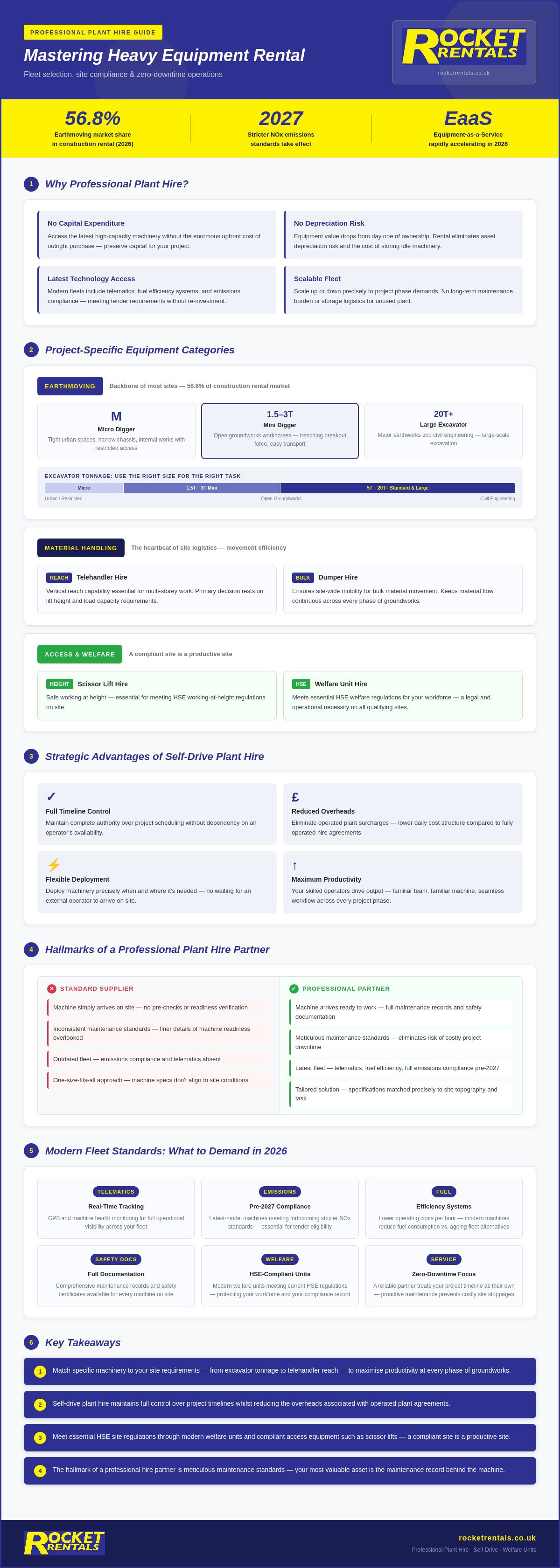
The equipment rental industry provides a foundation for modern infrastructure, allowing firms to scale their fleet without the massive capital expenditure of outright purchase. In 2026, the shift towards Equipment-as-a-Service (EaaS) is accelerating as contractors seek to preserve capital and reduce the burden of long-term maintenance. Market data shows that earthmoving machinery alone holds a 56.8% market share in the construction rental sector this year, highlighting just how critical these machines are to site success. By choosing to rent, you gain access to the latest technology without the risk of asset depreciation or the logistical headache of storing idle machinery.
The Evolution of Plant Hire Standards
Modern site requirements have transformed what we expect from a rental fleet. It's no longer enough for a machine to simply start; it must be fuel-efficient, compliant with the latest emissions standards, and equipped with telematics for real-time tracking. With more stringent NOx emission standards set to take effect in 2027, the demand for latest-model fleets has reached a new peak. Contractors now prioritise machines that offer lower operating costs and better environmental credentials to meet tender requirements. Heavy equipment rental is the professional provision of high-capacity machinery designed to meet rigorous site demands whilst ensuring full compliance with safety and environmental standards.
Project-Specific Equipment Categories
Identifying the right category of equipment is the first step in successful site planning. Each project phase requires a specific toolset to maintain momentum.
Earthmoving: This remains the backbone of most sites. It spans from Mini Digger Hire for tight urban spaces to large-scale Excavator hire for major earthworks. Using the correct tonnage ensures you aren't over-powering a small task or under-equipping a major excavation.
Material Handling: Efficiency depends on how quickly you can move materials. Telehandler Hire offers the vertical reach needed for multi-storey work, whilst Dumper Hire ensures site-wide mobility for bulk materials.
Access and Welfare: A compliant site is a productive site. This category includes Scissor Lift Hire for safe working at height and Welfare Unit Hire to meet essential HSE requirements for your workforce.
Choosing the right partner means finding a "safe pair of hands" that understands these categories intimately. It's the difference between a machine that just arrives and a machine that's ready to work.
Selecting the Right Fleet for Your Site Requirements
Selecting the right machinery requires a technical understanding of the site's topography and the specific tasks at hand. It's a strategic decision that impacts both the safety of your operators and the overall project timeline. Professional heavy equipment rental isn't a one-size-fits-all service; it's a tailored solution where machine specifications must align perfectly with ground conditions to prevent mechanical strain or site delays.
Excavators and Mini Diggers: Finding the Balance
Choosing the correct excavator tonnage is vital for maintaining productivity without compromising site safety. For urban projects or internal works with restricted access, a micro digger is often the only viable solution due to its narrow chassis. However, once you move into open groundworks, the 1.5-tonne and 3-tonne models become the workhorses of the site. These machines provide the necessary breakout force for trenching whilst remaining compact enough for easy transport between locations. You can find more detailed specs in The Professional Guide to Mini Excavator Hire, which explores how to match machine size to project scale effectively.
Material Handling and Site Logistics
The movement of materials is the heartbeat of any construction project. When considering Telehandler Hire, the primary decision often rests on the balance between lift height and forward reach. A high-reach model is essential for multi-storey masonry or roofing, but if you're loading skips or reaching over deep excavations, forward reach capacity becomes the priority. It's about more than just height; it's about the machine's stability at full extension.
Industry bodies like the American Rental Association highlight that equipment selection should always account for the specific terrain of the job site. For instance, wheeled dumpers offer speed and efficiency on established haul roads, but tracked models are indispensable when working on soft or uncompacted ground. Similarly, integrating Roller Hire into your site preparation phase is critical for achieving the correct soil compaction before foundations are laid. Ensuring your Dumper Hire includes modern safety features like ROPS (Roll-Over Protective Structures) and high-visibility mirrors is a standard requirement for professional contractors today.
To further maximise machine utility, consider the role of specialised Excavator Attachments. Swapping a standard bucket for a hydraulic breaker or a grapple can turn a single excavator into a multi-functional tool, significantly reducing the need for additional machinery on site. If you're looking to optimise your next project, reviewing a comprehensive range of high-specification plant hire options can provide the clarity needed for a successful site setup.
The Strategic Advantages of Self-Drive Plant Hire
Choosing a self-drive model for your project isn't merely a logistical preference; it's a strategic decision that places the reins of productivity firmly in your hands. Whilst operated plant hire has its place for one-off tasks, professional contractors increasingly favour self-drive options to maintain tighter control over their site environments. This approach allows for the seamless integration of high-specification machinery into your existing workforce, ensuring that your project's pace is determined by your own milestones rather than an external provider's schedule.
One of the primary benefits of this model is the clarity it brings to safety and compliance. Under current OSHA Equipment Regulations, responsibility for site safety is a shared endeavour. Whilst the rental partner must provide meticulously maintained machinery, the renter is responsible for ensuring operators are fully trained and that daily inspections are conducted. By utilising your own qualified team, you ensure that these critical safety protocols are embedded into your daily site culture, reducing the risk of struck-by incidents or falls which are under increased enforcement in 2026.
Control and Accountability on Site
Self-drive hire fosters a culture of accountability that's often missing when using third-party operators. Your team knows the site layout, the specific ground challenges, and the project's long-term goals. This familiarity translates into higher efficiency and a proactive approach to machine care. Because your operators are already on-site, they can respond to changing conditions without delay. Self-drive hire empowers site managers to reorganise tasks on the fly whilst maintaining momentum, allowing for a more fluid and responsive construction process.
Long-Term Cost Management
The financial argument for self-drive heavy equipment rental is compelling, particularly for industrial projects spanning several months. Operated hire carries a heavy premium to cover the driver’s labour and associated overheads. On a busy site, you often end up paying for an operator to sit idle during material delivery delays or weather-related stoppages. With self-drive, those "hidden" costs vanish.
Budget Predictability: Fixed rental rates allow for precise financial forecasting across the project lifecycle.
Elimination of Standby Fees: You don't pay for a driver’s time when the machine isn't in motion.
Optimised Labour: Your own staff can move from Excavator hire to other groundworks tasks during machine downtime, ensuring maximum utility of your payroll.
Partnering with a self-drive specialist ensures you receive a fleet that is ready for the rigours of continuous operation. It’s about finding a "safe pair of hands" that provides the reliability you need to manage your site with confidence.
Ensuring Site Compliance and Worker Welfare
Compliance isn't just about ticking boxes; it's about building a site culture where safety is the priority. When you engage in heavy equipment rental, you're not just hiring a machine, you're inheriting the responsibility for its safe operation and the welfare of your crew. High-quality site facilities directly impact productivity. A workforce that has access to clean, heated rest areas is a workforce that stays focused on the task at hand.
Welfare Units: More Than Just a Requirement
Under UK law, specifically the Construction (Design and Management) Regulations 2015, contractors must provide adequate facilities from day one. Welfare Unit Hire provides a turnkey solution for these requirements. Mobile units are ideal for projects that move along a linear path, such as roadworks, whilst static units offer more robust facilities for long-term construction hubs. These units ensure your site remains HSE-compliant by providing essential sanitation, drying rooms, and canteen spaces. It's a fundamental part of site logistics that shouldn't be overlooked during the initial planning phase.
Access Equipment and Safety Compliance
Working at height remains one of the highest-risk activities on any site. Selecting the right machinery, such as Scissor Lift Hire, is the first step in mitigating these risks. It's vital to choose equipment that matches the environment; diesel models for rough terrain and electric models for indoor or emission-sensitive areas. You can explore the technical nuances of these machines in our guide to Electric Scissor Lift Hire.
Every piece of plant delivered to your site must comply with LOLER (Lifting Operations and Lifting Equipment Regulations) and PUWER (Provision and Use of Work Equipment Regulations) standards. Upon delivery, your site manager should verify the following as part of a standard handover checklist:
A valid Report of Thorough Examination, which is required every six or twelve months depending on the equipment type.
Recent maintenance records and daily inspection logs for the specific machine.
Fully functional safety features, including emergency stops, tilt alarms, and secondary guarding where applicable.
Correct operator manuals stored securely within the machine for easy reference.
Maintaining these standards ensures you avoid the heavy penalties associated with non-compliance. In 2026, enforcement is tighter than ever, with a particular focus on struck-by incidents and falls. Ensuring your site is fully equipped with compliant welfare and access solutions is the best way to protect your team and your project timeline.
Partnering with Rocket Rentals Ltd for Fleet Reliability
Reliability is the bedrock of successful contracting. When you choose a partner for heavy equipment rental, you aren't merely sourcing a machine; you're looking for a guarantee that your project won't stall. At Rocket Rentals Ltd, we operate with a "safe pair of hands" philosophy. This means we take full ownership of the technical readiness and compliance of our fleet so you can focus on the complexities of your site management. We don't just provide plant; we provide the peace of mind that comes from knowing your equipment is as professional as your team.
The Rocket Rentals Ltd Fleet Standard
Why does fleet age and specification matter so much? In an industry where a single mechanical failure can cost thousands in lost labour and missed milestones, Rocket Rentals Ltd invests heavily in high-specification machinery from leading global brands. Our maintenance schedules are rigorous and frequently exceed standard industry norms. We don't wait for a service interval to address potential issues. Instead, we proactively inspect every piece of plant before it leaves our yard to ensure maximum uptime. For contractors seeking Excavator Hire in the South West, our fleet represents the pinnacle of modern earthmoving technology, designed for efficiency and ease of operation.
Seamless Logistics and Support
Site managers face immense pressure to keep projects on track. We understand that a delivery delay of even an hour can disrupt a carefully planned workflow. Our independent status allows Rocket Rentals Ltd to provide a dedicated, personal service that large, national corporations often struggle to maintain. We don't see you as a contract number; we see you as a professional partner. This personal touch ensures that when you need expert advice on matching machinery to a specific project challenge, you speak to someone who actually understands the equipment and the local terrain.
Our support extends from the initial enquiry to the final collection. We offer technical insights to ensure you don't over-specify and inflate your project costs unnecessarily. Whether you require Mini Digger Hire for a restricted urban site or a fleet of Telehandler Hire units for a complex build, we provide the readiness and reliability needed for a successful outcome. You can start your next hire programme with confidence, knowing that the commitment to excellence at Rocket Rentals Ltd is built into every machine we deliver.
Elevating Your Site Standards with Expert Plant Hire
Mastering the complexities of a construction site requires more than just high-capacity machinery; it demands a strategic approach to fleet management and a commitment to worker safety. By matching machine specifications to your specific groundworks and prioritising HSE-compliant facilities, you create an environment where productivity thrives. Choosing a dependable partner for your heavy equipment rental needs is the final piece of the puzzle, ensuring that every machine on your site is ready for the task at hand.
Rocket Rentals Ltd is an independent specialist with over 35 years of industry experience. We provide a high-specification fleet featuring excavators, telehandlers, and welfare units, all supported by meticulous maintenance standards designed for maximum site uptime. We understand the pressures of modern site management and are dedicated to providing the reliability your project deserves. Explore our full range of professional plant hire and discover how a dedicated partner can help you deliver your next project with total confidence.
Frequently Asked Questions
What is the difference between self-drive and operated plant hire?
Self-drive hire involves renting the machinery alone, requiring you to provide your own qualified operator. Operated plant hire includes a driver provided by the rental company. We specialise in self-drive options because they offer contractors greater control over site schedules and significantly reduce the high labour premiums associated with external operators.
Do I need a specific licence to hire heavy equipment for a construction site?
For work conducted within a closed site, operators don't usually need a standard driving licence but must hold a recognised competency card, such as CPCS or NPORS. However, if the machine needs to be driven on public highways, the operator must hold a valid UK driving licence with the correct categories for the vehicle's weight.
How is the delivery and collection of heavy machinery organised?
We manage the logistics using our dedicated transport fleet to ensure timely delivery and collection. Our team coordinates directly with your site manager to agree on specific time slots. This methodical approach helps to avoid congestion on site and ensures that your heavy equipment rental arrives ready for immediate use.
What happens if the hired equipment develops a fault whilst on site?
If you encounter a mechanical issue, you should contact our support team immediately. We'll work to resolve the problem as quickly as possible, either by providing technical guidance or arranging for a machine swap. Our focus is on maintaining your site's momentum and ensuring that any downtime is kept to an absolute minimum.
Are welfare units a legal requirement for all construction sites?
Yes, under the Construction (Design and Management) Regulations 2015, adequate welfare facilities are a mandatory requirement for every construction project. You're legally obligated to provide toilets, washing facilities, and rest areas for your workforce from the moment the project begins. Our welfare units are designed to meet these HSE standards efficiently.
Can I hire excavators with specific attachments like breakers or augers?
We offer a comprehensive range of excavator attachments, including hydraulic breakers and augers, to help you maximise the utility of your hired plant. Equipping a machine with the correct attachment for the task is a strategic way to manage your heavy equipment rental costs whilst ensuring that your groundworks are completed with precision.
How do you ensure the safety and compliance of your rental fleet?
Every machine undergoes a rigorous pre-hire inspection and regular LOLER and PUWER examinations to ensure total compliance. We invest in a high-specification, latest-model fleet that meets the most recent safety and emissions standards. This commitment to maintenance provides you with a reliable "safe pair of hands" for even the most demanding industrial projects.
What insurance do I need to hire heavy equipment for a professional project?
You'll typically need "Hired-in Plant" insurance to cover the machinery against loss, theft, or damage whilst it's on your site. It's vital to ensure that your policy's indemnity limit is sufficient to cover the full replacement value of the specific machines you're hiring. We recommend checking these details with your insurance provider before the equipment is delivered.


Comments