
Telehandler Safety Checklist: Guide for Site Managers
- Rocket Rentals
- Aug 5
- 11 min read
Did you know that being struck by a moving vehicle accounts for 37% of fatal accidents in the transportation and storage sector? According to the Health and Safety Executive 2025 report, these incidents remain a significant risk on modern sites. As a site manager, you likely feel the weight of responsibility for your team's wellbeing and the constant pressure to avoid HSE non-compliance. Implementing a rigorous telehandler safety checklist isn't just about ticking boxes; it's about building a culture of reliability that prevents accidents before they happen.
We understand that unplanned downtime is the enemy of any successful project. This guide provides a definitive daily inspection routine designed to ensure your machinery remains fully compliant with PUWER and LOLER standards. You'll learn how to establish a foolproof habit for your operators that reduces the risk of mechanical breakdown and keeps your site running efficiently. We'll explore the essential components of a thorough inspection, from hydraulic integrity to pedestrian segregation protocols, to help you maintain a safe and productive environment.
Table of Contents
Understanding the Legal Framework: PUWER and LOLER for Telehandlers
For any professional site manager, compliance isn't just a hurdle; it's the foundation of a safe and productive project. A Telescopic handler is a complex piece of machinery that falls under two distinct sets of UK regulations. First, the Provision and Use of Work Equipment Regulations 1998 (PUWER) ensures the equipment is fit for its specific purpose and maintained in a safe condition. Second, because these machines lift loads, the Lifting Operations and Lifting Equipment Regulations 1998 (LOLER) apply. These legal frameworks work in tandem to ensure that every lift is executed safely and every machine is mechanically sound.
Whilst LOLER demands a thorough examination by a qualified professional at least every six months, this doesn't cover the risks that emerge during daily use. This is where your telehandler safety checklist becomes vital. It serves as the formal "pre-use inspection" required to bridge the gap between statutory examinations. Without this daily routine, you risk a breach of PUWER standards, even if your six-monthly certificate is currently valid. It's a proactive measure that identifies minor wear before it develops into a dangerous mechanical failure.
The Role of the Competent Person
The law requires that inspections are carried out by a competent person. In the context of a daily telehandler safety checklist, this is usually the trained operator. They must have the practical and theoretical knowledge to recognise potential defects. However, a statutory LOLER examination is different; it must be performed by someone with enough independence and impartiality to make an objective assessment, often an external engineer. As a site manager, the legal responsibility for ensuring these checks happen rests with you whilst the equipment is on your site, regardless of whether it's owned or hired.
Record Keeping and Compliance
Maintaining an organised trail of safety documentation is essential for passing HSE audits and protecting your business. You must retain signed copies of every daily inspection sheet amongst your site records. Many modern sites are moving away from paper logs towards digital safety management systems, which offer real-time visibility of fleet health and easier retrieval during inspections. These records should typically be kept for at least two years to demonstrate a consistent history of maintenance and a commitment to safety standards. Clear records prove that you've taken all reasonable steps to ensure the safety of your workforce.
The External Walkaround: Structural and Mechanical Integrity
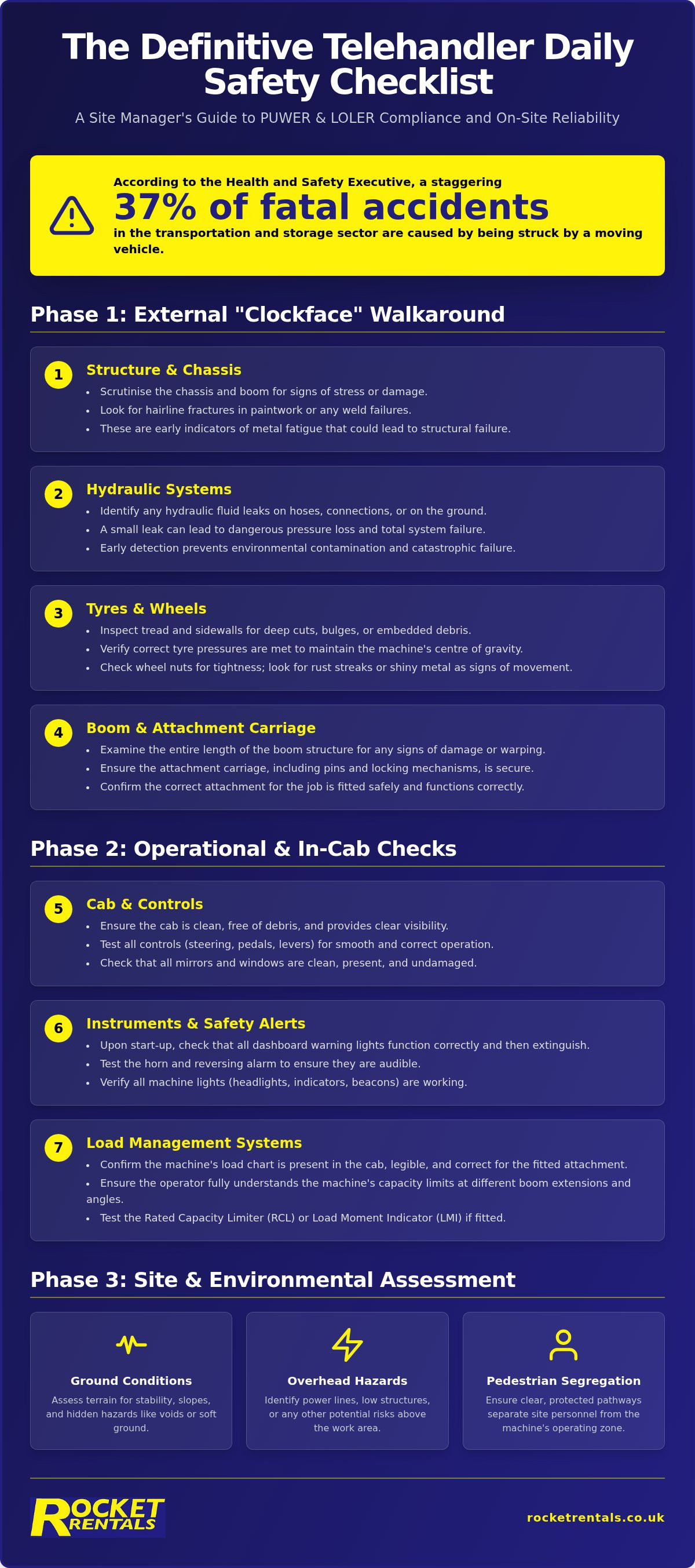
Before an operator enters the cab, a comprehensive physical assessment serves as the first line of defence against structural failure. We recommend that your team follows a consistent "clockface" path around the machine. By starting at the front right and moving methodically until they return to the starting point, they ensure that no component is overlooked. This structured approach is a core part of any professional telehandler safety checklist, turning a quick glance into a rigorous inspection routine. Whilst UK standards are specific, reviewing global best practices like OSHA's daily inspection checklist can provide a broader perspective on common mechanical failure points that occur during heavy use.
During this walkaround, the operator must scrutinise the chassis and boom for signs of stress. Look for hairline fractures in the paintwork or weld failures, as these are early indicators of metal fatigue. Hydraulic systems require equal attention. Identify leaks early to prevent environmental contamination and dangerous pressure loss. A small puddle under the machine today could lead to a total hydraulic failure tomorrow. Choosing a provider of telehandler hire that maintains a modern, pre-inspected fleet simplifies this process for your team, as newer machines are less prone to these wear-related issues.
Tyre Condition and Pressure
On rough terrain, tyres are vulnerable to significant damage. Operators should inspect the tread and sidewalls for deep cuts, bulges, or embedded debris that could cause a blowout under load. Stability is entirely dependent on correct tyre pressures; even a slight variance can compromise the machine's centre of gravity when the boom is extended. Don't forget to check the wheel nuts. Look for rust streaking or shiny metal around the nuts, as these are clear signs of movement that require immediate tightening.
The Boom and Attachment Carriage
The boom is the heart of the telehandler's versatility. Examine the boom sections for excessive wear on the wear pads; if these are worn down, the boom can become unstable or "chatter" during extension. Inspect the carriage and forks for bends or cracks, particularly at the "heel" of the forks where stress is highest. Ensure all locking pins are fully engaged and that grease points are adequately lubricated. A well-greased machine operates more smoothly and prevents components from seizing under the pressure of daily site work.
Operational Safety: Functional Checks and Cab Controls
Once the external walkaround is complete, the operator must step into the cab to verify that the machine's internal systems are functioning as intended. This phase of the telehandler safety checklist focuses on the interface between the human and the machine. A clean cab isn't just about aesthetics; it's a fundamental safety requirement. Loose tools, drink bottles, or muddy boots left on the floor can easily lodge behind a pedal, preventing the operator from braking or accelerating safely. Ensure that the floor is clear and that all controls are free from grease or debris that could cause a foot or hand to slip at a critical moment.
Visibility is another primary concern during this stage. Telehandlers have notoriously large blind spots, particularly on the offside where the boom is mounted. Operators must ensure all mirrors are adjusted for their height and that camera lenses are free from dust or mud. If a 360-degree camera system is fitted, verify the display is clear and functional before moving the machine. Additionally, check that seatbelts are in good condition and that door latches secure firmly. These are critical safety components designed to keep the operator within the protective structure in the event of a rollover.
Control Functionality and Emergency Stops
Before lifting any materials, the operator should cycle through all boom movements. This includes lifting, extending, and tilting the carriage to its full range of motion. Movements must be smooth and responsive, without any unusual vibrations or noises. Test the joystick's neutral return; it must snap back to the centre position the moment it's released. Finally, verify the emergency stop button. It's a vital safety component that should kill the engine or isolate the hydraulics immediately when depressed, ensuring the machine can be brought to a halt in an instant.
Safety Warning Systems
The Longitudinal Load Moment Indicator (LLMI) is perhaps the most vital piece of technology in the cab. It provides a real-time warning if the machine approaches its stability limit. Test this system according to the manufacturer's instructions to ensure the lights and audible warnings are active. Beyond internal indicators, the machine must communicate with those around it. Check that the reverse alarm is loud enough to be heard over site noise and that the amber flashing beacon is visible from all angles. A functioning horn is also essential for alerting pedestrians, who account for a significant portion of workplace transport accidents.
Site Environment: Load Charts and Ground Conditions
Even the most rigorous telehandler safety checklist cannot compensate for an unstable environment. A machine that passed every mechanical test in the morning can still tip in the afternoon if the ground gives way or the load exceeds the safe working envelope. Telehandler stability is not a static value; it changes drastically as the boom is raised or extended. As a site manager, you must ensure your operators are not just checking the machine, but also constantly re-evaluating the terrain and the specific weights they are moving. This vigilance is especially important when moving between different areas of a site where ground density may vary significantly.
Mastering the Load Chart
The load chart is the most critical document in the cab. It illustrates the safe working load at various boom angles and extension lengths. To use it correctly, the operator must find the intersection of the required height and the forward reach on the grid. It's vital to remember that attachments like buckets or winches alter these capacities; they add weight and can shift the machine's balance. The load centre is defined as the horizontal distance from the vertical face of the forks to the centre of gravity of the load, and its position is fundamental to maintaining machine stability. Without this understanding, an operator might inadvertently push the machine beyond its tipping point, even when the load seems relatively light.
Assessing Ground Stability
Ground conditions on UK construction sites can shift rapidly, particularly after heavy rain. What was solid, compacted soil on Monday can become a soft, treacherous hazard by Tuesday. Operators must be trained to identify risks such as uncompacted fill or proximity to excavations and trenches. If the machine is equipped with stabilisers, the use of spreader plates is non-negotiable on soft or uneven ground to distribute the weight effectively. Beyond the visible soil, "hidden" hazards like manhole covers or underground services must be identified and marked during the initial site survey. Striking a manhole cover with a heavily laden telehandler can cause a sudden shift in balance that leads to a catastrophic overturn. If you require modern machinery equipped with the latest stability technology, consider our options for telehandler hire to ensure your project remains both safe and efficient.
Managing Telehandler Hire for Maximum Safety
Selecting a hire partner is the first step in establishing a safe site. Whilst a telehandler safety checklist ensures daily vigilance, the inherent reliability of the machine depends on the standards of the provider. Modern fleets are far more than just newer engines; they often include advanced safety features like 360-degree cameras and enhanced load-sensing technology. These features significantly reduce the risk of accidents caused by visibility issues or operator error. By opting for a provider that prioritises fleet age and maintenance, you set a high standard for safety before the machine even arrives on site.
Clear communication regarding fault reporting is equally important. Your hire agreement should outline exactly how to report a defect found during a daily check and the expected timeframe for a technician to attend. This clarity prevents operators from "working around" a minor fault to avoid project delays, which is a common cause of more serious mechanical failures later. A transparent partnership with your hire company ensures that safety and productivity work in tandem rather than in opposition. It creates a "safe pair of hands" for your project, allowing you to focus on delivery instead of mechanical anxiety.
The Value of Pre-Delivery Inspections
Every machine delivered to your site should be accompanied by a Pre-Delivery Inspection (PDI) certificate. This document confirms that a qualified technician has checked the machine's fluid levels, tyre pressures, and hydraulic integrity immediately before dispatch. At Rocket Rentals Ltd, we ensure every telehandler is site-ready through a rigorous PDI process that standardises quality across our fleet. As a site manager, you should always cross-reference this PDI sheet with your own initial telehandler safety checklist. This double-verification provides peace of mind that the equipment has transitioned from the hire yard to the site in peak condition.
Training and Operator Competency
The most advanced machine is only as safe as the person behind the controls. You must verify that all operators hold a valid CPCS or NPORS card for the specific category of telehandler they are using. Beyond basic qualifications, machine-specific familiarisation is vital. Different manufacturers have varying control layouts and safety system interfaces. Providing even twenty minutes for an operator to familiarise themselves with a new model can prevent costly mistakes during the first few hours of operation. If you are looking for reliable machinery that meets these high standards, explore our range of telehandler hire options today.
Securing Your Site with Consistent Safety Standards
Maintaining a safe and efficient site requires a proactive commitment to every operational detail. By integrating a rigorous telehandler safety checklist into your daily routine, you effectively bridge the gap between statutory LOLER examinations and the daily wear of a high-pressure construction project. This guide has detailed how mechanical integrity, operator training, and environmental vigilance work in unison to prevent costly downtime and protect your workforce from harm.
The ultimate foundation of this safety culture is the calibre of the machinery you deploy. As a nationwide self-drive plant hire specialist, Rocket Rentals Ltd takes pride in being a dependable partner for complex construction and civil engineering projects. Our modern, expertly maintained fleet is prepared to meet the most stringent industry standards, providing you with the reliability needed for a successful build. We focus on the quality of our equipment so that you can focus on the delivery of your project.
Book your next telehandler hire with Rocket Rentals Ltd to experience the security of professional-grade equipment. We look forward to supporting your project with machinery that prioritises safety as much as you do.
Frequently Asked Questions
Do I need a specific licence to operate a telehandler on a UK site?
Operators don't require a "licence" in the traditional sense, but they must hold a valid certificate of training from a recognised body such as CPCS or NPORS. Under the HSE Approved Code of Practice L117, employers are legally required to ensure operators are competent. This involves a three-stage process including basic training, specific job training, and machine-specific familiarisation to ensure they can handle the exact model provided on-site safely.
How often does a telehandler need a LOLER inspection?
A telehandler requires a thorough examination by a competent person at least every six months. Since these machines are primarily used for lifting operations, they fall under the strict requirements of LOLER 1998. If the machine is also used to lift personnel with an approved attachment, this six-month interval is a mandatory legal minimum to ensure the integrity of the lifting mechanism and all associated safety components.
What should I do if a fault is found during the daily checklist?
If your telehandler safety checklist reveals a mechanical or structural defect, you must immediately stop using the machine and isolate it to prevent others from operating it. Report the fault to the site manager and your hire provider, then follow a formal "tag out" procedure to clearly mark the equipment as unsafe. Never attempt a temporary fix or continue working with a known fault, as this significantly increases the risk of a serious accident.
Can I use a telehandler to lift people?
You may only lift people if the telehandler is specifically designed for this purpose and used with a compatible, integrated work platform. Non-integrated platforms are generally discouraged by the HSE and should only be used in exceptional circumstances where it's the safest option. Both the machine and the platform must have a current six-monthly LOLER certificate, and the operator must be specifically trained in the safety protocols for lifting personnel.
Is a daily checklist a legal requirement in the UK?
Yes, performing a pre-use inspection is a legal requirement under the Provision and Use of Work Equipment Regulations 1998 (PUWER). Whilst the law doesn't dictate the exact format of a telehandler safety checklist, it mandates that equipment must be maintained in a safe condition and inspected before use. Keeping a written or digital record of these daily checks is the most effective way to prove compliance during an HSE inspection or site audit.
What is the most common cause of telehandler accidents on-site?
Being struck by a moving vehicle is the most common cause of fatal accidents in the transportation and storage sector, accounting for 37% of fatalities according to 2025 HSE data. Other frequent causes include the vehicle overturning due to overloaded booms or unstable ground conditions. Many of these incidents involve pedestrians who aren't directly involved in the machine's operation, highlighting the vital importance of pedestrian segregation and functioning warning systems.
How do I know if the ground is stable enough for a telehandler?
Stability depends on the ground's bearing capacity, which should be assessed during the initial site survey and re-evaluated daily. Operators must look for signs of uncompacted fill, soft patches, or proximity to excavations and underground services. If ground conditions are uncertain, always use spreader plates under stabilisers to distribute the machine's weight effectively. Remember that weather conditions, particularly heavy rain, can change ground stability in just a few hours.
Do I need to check the telehandler if it was only used for an hour yesterday?
You must check the machine at the start of every shift regardless of how little it was used the previous day. Faults such as hydraulic leaks, tyre pressure drops, or even site vandalism can occur whilst the machine is stationary overnight. A consistent pre-use inspection ensures that every operator starts their work with the confidence that the machine is safe, legal, and mechanically sound for the tasks ahead.


Comments