
The Professional Guide to Telehandler Forklifts: Maximising Site Productivity
- Rocket Rentals
- 13 hours ago
- 11 min read
Is your site's productivity being stifled by a machine that isn't quite right for the terrain? Many site managers rely on familiar equipment only to find that congestion and limited reach slow down their progress. We understand that choosing between a telehandler vs forklift isn't just about moving pallets. It's about ensuring safety and maintaining a steady workflow when every hour on the clock counts.
This guide provides the technical expertise you need to select, operate, and optimise telehandler forklifts for maximum material handling efficiency. You'll discover how to identify the precise machine size for your specific tasks while navigating the complexities of load charts and safety compliance. We will also examine how the right attachment choices and hire strategies can reduce site congestion and improve your project's return on investment. With the global telehandler market projected to reach approximately £5.6 billion in 2026, these versatile machines are increasingly central to modern construction. This article ensures you have a clear roadmap for choosing the most reliable equipment to keep your site running safely and effectively.
Table of Contents
Defining the Telehandler Forklift: More Than a Reach Machine
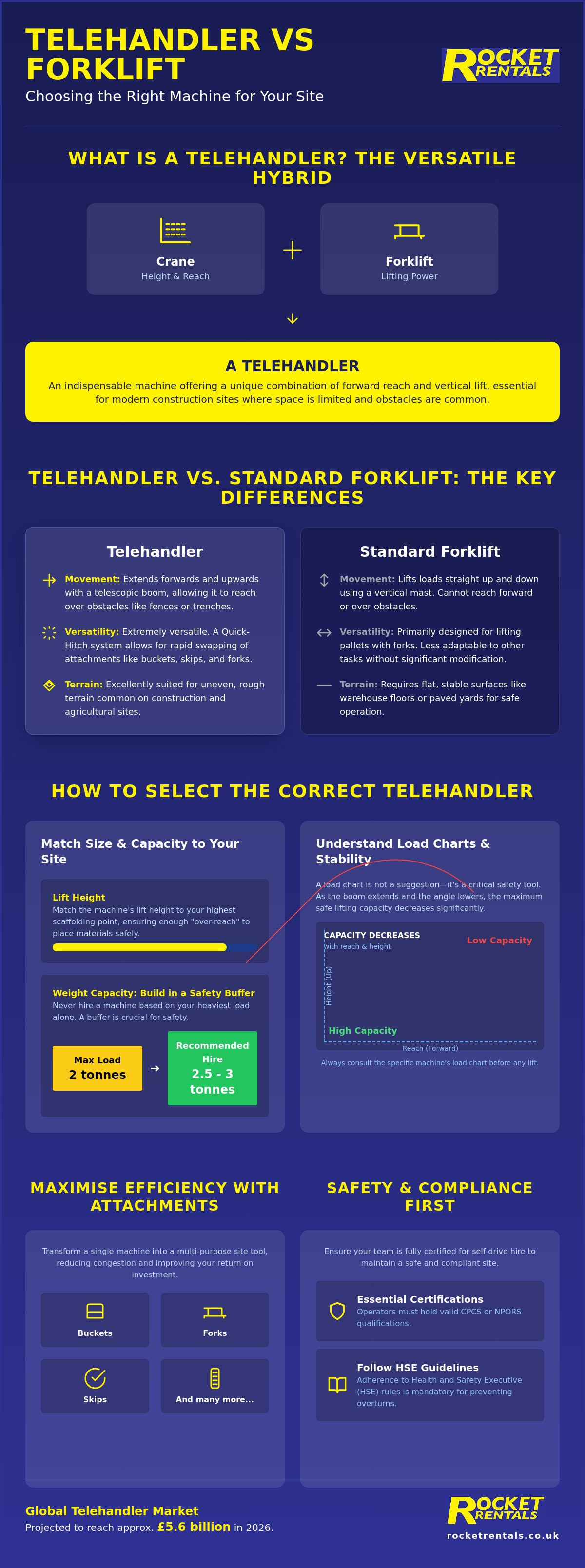
The telehandler is often the hardest working machine on a modern UK building site. Whilst it's frequently called a Loadall, teleporter, or simply a telescopic forklift, its true identity is more complex. It functions as a versatile hybrid of a crane and a forklift; providing the lifting power of the latter with the reach and height of the former. This unique combination makes it an indispensable asset for any project where space is limited and materials need to be moved beyond the reach of a vertical mast.
When evaluating a telehandler vs forklift, the primary distinction lies in the boom. A standard forklift uses a vertical mast to lift loads straight up and down. In contrast, the Telescopic handler utilises a single telescopic boom that can extend forwards and upwards simultaneously. This mechanical advantage allows operators to place palletised loads onto high scaffolding or reach over obstacles, such as trenches or fences, that would stop a traditional forklift in its tracks. Site versatility is the primary reason these machines have become ubiquitous across the UK's construction landscape.
The Anatomy of a Telescopic Handler
The machine's design is centred on the telescopic boom, the heavy-duty chassis, and the stabilisers. The boom provides the reach, but it also creates a dynamic challenge. As the boom extends, the machine's centre of gravity shifts forward; this requires the operator to monitor load charts closely to prevent tipping. Stabilisers are often deployed on larger models to widen the footprint and increase lifting capacity at height. The Quick-Hitch system serves as the gateway to machine versatility, allowing operators to swap between forks and buckets in minutes.
Key Industries and Applications
In the construction sector, these machines are essential for moving materials to upper storeys or navigating the uneven terrain common on new-build sites. Agricultural users rely on them for handling bulk materials and palletised feed; often favouring compact models for tight barn environments. On larger industrial projects, such as bridge or road works, they provide critical support where access is restricted and precision is required. By understanding the telehandler vs forklift dynamic, project managers can ensure they have the reach and flexibility needed for these diverse environments.
Selecting the Correct Telehandler Size and Capacity
Selecting the right machine requires more than a glance at a spec sheet. You must match the lift height to the highest point of your site scaffolding, whilst ensuring you have enough "over-reach" to place materials safely onto the deck. When considering a telehandler vs forklift, remember that a telehandler’s reach is its greatest asset, but that reach comes with strict physical limits that change depending on the boom's position.
Weight capacity is another critical factor. It's a common mistake to hire a machine based on your heaviest load alone. Instead, professional site managers hire for a capacity that provides a safety buffer. If your heaviest pallet is 2 tonnes, a 2.5-tonne or 3-tonne machine is a safer, more reliable choice. This proactive approach accounts for potential ground variations and the dynamic forces involved in moving loads at height, ensuring your project remains on schedule without compromising safety standards.
Understanding Load Charts and Stability
Every machine comes equipped with a load chart. This isn't a suggestion; it's a vital safety tool that dictates how much weight can be lifted at specific heights and distances. You must understand how the centre of gravity shifts as the boom moves. As the boom extends, the machine becomes less stable. Following Telehandler safety guidelines is essential for preventing overturns. Stabilisers, or outriggers, can be deployed on larger models to increase the footprint and safe lifting capacity. The maximum weight capacity decreases as the boom angle lowers and the extension increases.
Compact vs. Full-Sized Handlers
Urban sites often suffer from severe congestion. In these environments, a compact telehandler with a tight turning circle is often more productive than a larger unit. These smaller machines can navigate indoor warehouses or narrow alleyways where a standard unit would be trapped. A 4-metre compact handler has a significantly smaller footprint than a 17-metre heavy-duty unit, making it ideal for basement works or interior fit-outs.
However, for multi-storey residential projects, high-reach models are necessary. These machines often reach heights of 17 metres or more, allowing materials to be delivered directly to the top floors of a development. Ground conditions also dictate your choice. Whilst compact models are agile, full-sized units often feature superior 4WD and rough terrain capabilities to handle deep mud or steep gradients. If you are unsure which model fits your footprint, our team can help you select the right telehandler hire for your specific site conditions.
Telehandler vs. Standard Forklift: Which Does Your Site Require?
Choosing the right lifting equipment is a decision that impacts every stage of a project's timeline. Whilst a standard warehouse forklift is an excellent tool for level, finished surfaces, it often struggles with the realities of an active building site. The primary debate of telehandler vs forklift usually centres on the environment; a vertical mast forklift is designed for stability on concrete, whereas a telehandler is built to conquer the unpredictability of un-prepped ground. If your project involves moving materials across mud, gravel, or over existing structures, the telescopic boom provides a level of utility that a vertical mast simply cannot match.
Reach capability is the deciding factor for many site managers. A standard forklift requires the operator to drive right up to the drop-off point, which isn't always possible when trenches or scaffolding are in the way. By using a telehandler, you eliminate the need for double handling materials. Instead of dropping a pallet at the site entrance and moving it again with a different machine, you can lift it directly from the delivery lorry and place it exactly where it's needed, even if that's three storeys up. This efficiency justifies the higher hire rate by significantly increasing site speed and reducing labour costs.
Terrain and Surface Considerations
The success of your material handling often depends on what's under the tyres. Standard forklifts generally lack the high ground clearance and aggressive tread patterns required for rough terrain. Telehandlers, however, feature heavy-duty 4WD systems and large, puncture-resistant tyres that provide stability on steep gradients and soft soil. For those managing the transition from initial groundworks to active construction, reading The Professional Guide to Mini Excavator Hire provides essential context on preparing your site for heavier machinery. Once the ground is ready, the telehandler becomes the primary mover, navigating the bumps and dips that would beach a standard forklift.
Operational Reach and Flexibility
Flexibility is where the telehandler vs forklift comparison truly leans in favour of the telescopic boom. Operators can place loads over obstacles like walls, fences, or open excavations that a vertical mast forklift cannot cross. This is particularly useful when unloading lorries; a telehandler can reach across the entire bed of a trailer to pick up pallets from the far side. This allows for one-sided unloading, which is a massive advantage on congested sites where space for a lorry to turn or for a forklift to circle is non-existent. Even on smaller sites, the ability to act as a mini-crane for lifting beams or roof trusses makes the telehandler a more strategic investment than a machine limited to vertical movement.
Maximising Efficiency with Telehandler Attachments
The telehandler's true power lies in its ability to transform from a simple lifter into a specialised multi-tool. Whilst pallet forks remain the industry standard for daily site logistics, they are merely the beginning of what this machine can achieve. By swapping out attachments, a single operator can handle everything from bulk material movement to precision engineering tasks. This adaptability is a primary reason why the telehandler vs forklift debate often ends with the telehandler being chosen for complex, multi-stage projects where space and budget require a single machine to perform multiple roles.
Lifting hooks and jibs allow the telescopic boom to function like a mini-crane; this provides the precision needed to place steel beams or roof trusses with millimetre accuracy. For site clearance, heavy-duty buckets and skips turn the machine into a temporary loader, capable of shifting large volumes of soil or rubble. When safe access at height is required, man baskets and integrated work platforms offer a secure environment for tasks like cladding or high-level electrical installations. These options ensure that the machine remains a productive asset throughout every phase of the build.
The Quick-Hitch System: Minimising Downtime
Modern machinery relies on speed to maintain project momentum. Modern Quick-Hitch systems enable operators to switch between attachments in under two minutes, ensuring the machine spends more time working and less time idling. However, speed must never compromise safety. Strict protocols are required when transitioning from forks to a bucket, as the locking pins must be fully engaged and verified before operation. Whilst a man basket on a telehandler is useful for certain tasks, for dedicated interior or clean-environment work, Electric Scissor Lift Hire often provides a more specialised and compact alternative.
Specialised Attachments for Groundworks
Maintaining a clean site is essential for health and safety compliance and professional standards. Sweepers and hydraulic brushes can be fitted to clear mud from access roads, preventing hazards for both site traffic and the public. For foundation work, concrete skips allow for precise pouring in hard-to-reach areas where a traditional pump or mixer truck cannot gain access. It is vital to remember that every attachment changes the machine's load chart requirements by altering the centre of gravity and the weight of the boom assembly itself. To ensure your site has the right tools for the job, you can view our range of telehandler hire options and attachments today.
Navigating Self-Drive Telehandler Hire for Professional Projects
Choosing self-drive hire provides professional contractors with total control over their project schedule. You aren't restricted by the availability of an external operator, which allows you to integrate the machine seamlessly into your daily site programme. When weighing up the telehandler vs forklift for your hire needs, the flexibility of a self-drive arrangement often proves more cost-effective for long-term projects. This is particularly true when the machine must be on hand for varied tasks across a large site footprint rather than a single, static lifting job.
In the UK, operator compliance is a non-negotiable requirement for any professional site. Any personnel operating the equipment must hold the relevant CPCS or NPORS certification. This ensures that the operator understands the technical complexities of the machine, including the load charts and stability factors we have previously discussed. Planning your hire period effectively is about balancing daily rates against the duration of the project. Often, a weekly or monthly rate provides better value for money whilst ensuring the equipment is always ready when the delivery lorries arrive.
The Rocket Rentals Approach to Fleet Quality
We focus on providing high-quality, modern machinery designed to meet the rigorous demands of professional contractors. A well-maintained fleet is the best defence against on-site breakdowns, which can cause costly delays to your programme. We take pride in our maintenance standards, ensuring each unit is ready for immediate work upon delivery. For projects requiring a broader range of machinery, our guide to Excavator Hire in the South West offers further insights into building a comprehensive plant solution for your site.
Safety and Site Compliance
Site safety begins before the machine even arrives. Pre-hire inspections and daily operator checks are essential to maintain compliance and protect your workforce. A reliable plant hire partner doesn't just drop off equipment; they provide the technical support and guidance needed to ensure the machine is fit for your specific site conditions. This proactive relationship helps you maintain a safe, efficient, and productive environment from the first day of hire to the last. View our full range of telehandler hire options to find the perfect match for your next project.
Securing Efficiency for Your Next Build
Identifying the right machinery is the cornerstone of a productive and safe construction site. By carefully matching lift height to your scaffolding and understanding the nuances of load charts, you protect both your team and your project timeline. The telehandler vs forklift comparison clearly shows that whilst standard lifters have their place on level slabs, the telescopic boom offers the reach and rough terrain capability essential for modern UK developments.
Rocket Rentals has served as a trusted partner for professional contractors and site managers since 1988. As independent plant hire specialists, we maintain an extensive fleet of high-specification machinery backed by dedicated technical support. Whether you need a compact handler for an urban project or a high-reach model for a multi-storey build, we provide the reliability you require to avoid downtime. Explore Professional Telehandler Hire Solutions to secure the equipment your site deserves. We look forward to helping you maintain a steady workflow and a safe environment on your next successful project.
Frequently Asked Questions
Do I need a special licence to operate a telehandler forklift on-site?
Yes, you require a valid operator's card, such as CPCS or NPORS, to operate a telehandler on a professional UK construction site. These certifications prove you have the technical knowledge to manage load charts and machine stability safely. Whilst a standard driving licence is necessary if the machine is used on public roads, it does not qualify you for site-based material handling.
What is the maximum lift height available for telehandler hire?
Telehandler lift heights generally range from 4 metres on compact models to over 20 metres on high-reach units. When evaluating a telehandler vs forklift, the telehandler's superior height is often the deciding factor for multi-storey residential projects. Most professional hire fleets offer a range of sizes to match specific scaffolding requirements on your site.
Can a telehandler be used as a crane for suspended loads?
A telehandler can be used for suspended loads provided it's fitted with a certified lifting hook or jib attachment. It's essential to consult the specific load chart for suspended weights, as the machine's capacity changes when the load isn't resting on forks. You must also ensure the operator is specifically trained in slinging and signalling for crane-style operations.
What is the difference between a compact telehandler and a standard model?
The primary difference lies in the physical footprint and the turning circle. Compact models are designed for narrow access and height-restricted areas, typically featuring a lift height of 4 to 6 metres. Standard models are larger and provide the heavy-duty capacity and reach needed for major structural work. Choosing a compact unit helps reduce site congestion in tight urban environments.
How much space does a telehandler need to turn safely?
The space required depends on the machine's steering mode, as most modern units offer four-wheel, two-wheel, and crab steering. Four-wheel steering significantly reduces the turning circle, allowing the machine to navigate tight corners that a standard vehicle couldn't manage. Always check the manufacturer's turning radius specifications to ensure your site layout accommodates the machine's path without risk.
Is a telehandler suitable for use on soft or uneven ground?
Telehandlers are specifically designed for soft or uneven ground, featuring high ground clearance and 4WD as standard. Their large, deep-tread tyres provide the traction necessary to navigate mud and gravel safely. This rough-terrain capability is a major advantage in the telehandler vs forklift comparison, as standard forklifts are typically restricted to level, solid surfaces.
What safety features should I look for when hiring a telehandler?
Key safety features include Load Moment Indicators (LMI) that warn of potential tipping and ROPS/FOPS certified cabs for operator protection. You should also look for clear visibility aids, such as camera systems and mirrors, along with functional stabilisers on high-reach models. Ensuring these systems are fully operational during your pre-hire inspection is vital for maintaining a safe site.
Can I use a telehandler for indoor warehouse projects?
You can use telehandlers indoors, particularly compact models that fit through standard warehouse doors. If you're working in an enclosed space, you must consider exhaust emissions; electric models or those fitted with particulate filters are preferred. For clean environments or very tight racking, a specialised electric scissor lift might be a more suitable alternative for high-access tasks.


Comments