
The Ultimate Mini Digger Attachments Guide: Maximising Site Versatility in 2026
- Rocket Rentals
- 11 minutes ago
- 12 min read
Did you know that earth-moving machinery currently accounts for 34% of the total plant hire value across the UK? This mini digger attachments guide explores why these compact machines are no longer just for digging trenches; they're the most versatile assets on a modern construction site. It's a common frustration to see project timelines slip due to intensive manual labour or the logistical stress of hiring multiple specialised machines for a single job.
We believe that efficiency shouldn't be a complicated puzzle. You've likely felt the pressure of rising costs and the confusion that often comes with matching hydraulic flows to specific tools. This guide promises to clear that fog, showing you exactly how to transform your hired mini digger into a multi-purpose powerhouse. We'll preview the essential professional-grade attachments for 2026, including the latest high-performance breakers and augers, while providing the technical clarity you need to reduce manual handling and finish your projects faster.
Table of Contents
Why Mini Digger Attachments are Essential for Site Efficiency
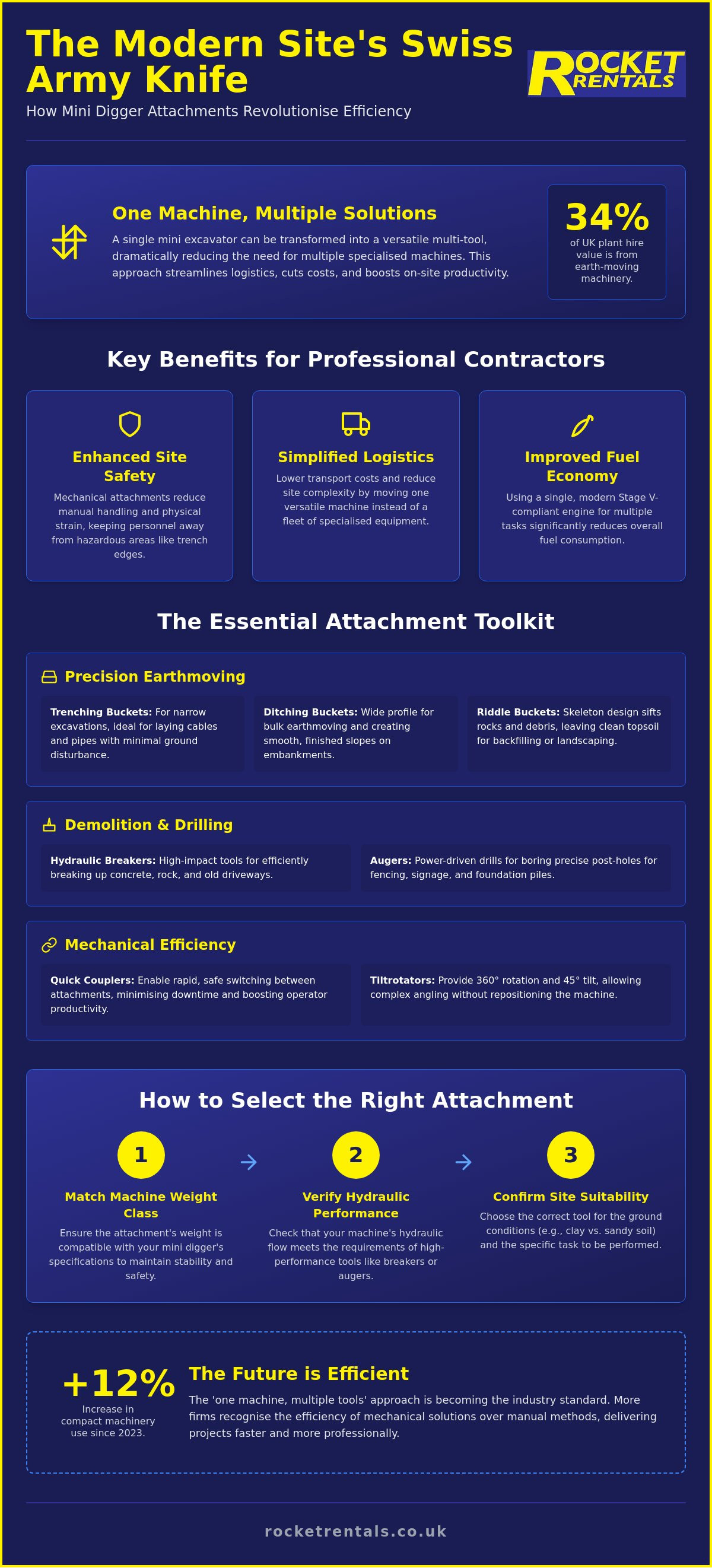
Mini digger attachments are interchangeable tools that mount directly to the excavator arm, allowing a single machine to perform a vast array of specialised tasks. In modern groundworks and civil engineering, the mini digger has become the industry’s equivalent of a Swiss Army Knife. Rather than relying on a fleet of niche machinery, this mini digger attachments guide highlights how a well-equipped 1.5t or 3t excavator can handle everything from breaking concrete to precision post-hole boring. This versatility is a primary reason why earth-moving machinery now accounts for 34% of the total plant hire value in the UK.
By moving away from manual labour and traditional hand tools, contractors can significantly improve site safety. Specialised attachments take the physical strain out of the job, keeping personnel away from trench edges and reducing the risk of manual handling injuries. The result is a more organised, professional site where the machinery does the heavy lifting. This shift is particularly evident in the 12% rise in compact machinery use since 2023, as more firms recognise the efficiency of mechanical solutions over manual methods.
The Evolution of Compact Equipment Versatility
The role of the mini digger has shifted dramatically from simple earth-shifting to complex demolition and landscaping. This evolution is driven by the development of high-flow hydraulics, which provide the consistent power required for demanding tools like breakers and mulchers. Modern 2026 models often feature Stage V-compliant engines that offer better fuel efficiency whilst powering these advanced systems. Site managers now favour a 'one machine, multiple tools' approach. It's often more logical to hire a single high-spec Yanmar or JCB with five attachments than to manage the logistics of five different machines. This transition is further supported by innovations in tiltrotator functionality, which allows for complex angling that was previously impossible with a standard bucket.
Key Benefits for Professional Contractors
Efficiency on a professional site is measured by the reduction of 'dead time'. With the right attachment, an operator can switch from digging a foundation to breaking up an old driveway within minutes. This speed doesn't just save time; it has a direct impact on the bottom line. Using a single machine reduces the complexity of site logistics and maintenance requirements.
Safety Standards: Keeping staff out of hazardous areas by using mechanical power for lifting and breaking.
Logistical Ease: Lowering transport costs by moving one machine instead of several.
Fuel Economy: Reducing overall consumption by using one efficient engine for multiple site requirements.
Choosing the right tool ensures you remain a 'safe pair of hands' for your clients, delivering projects with technical competence and modern efficiency. By matching high-quality attachments to your specific project needs, you ensure that every hour the machine is on-site is an hour spent productively.
Precision Earthmoving: Buckets, Rakes, and Grading Beams
Precision groundworks require more than just raw power. Whilst the standard digging bucket is a staple for any project, this mini digger attachments guide focuses on the specialised tools that transform a standard machine into a precision instrument. Choosing the correct profile for your bucket or beam doesn't just improve the aesthetic finish; it reduces the time spent on manual remedial work and ensures structural integrity from the ground up.
Selecting the Right Bucket for the Material
Narrow trenching buckets, often as slim as 150mm, are the professional choice for laying fibre optic cables or small-diameter pipework. They allow for minimal ground disturbance, which is critical when working in confined urban spaces where every centimetre of excavation counts. For broader tasks, wide ditching buckets are used for bulk earthmoving and creating smooth, finished slopes on embankments.
Soil composition should always dictate your choice of tool. For instance, heavy clay often sticks inside standard buckets, making a tapered design essential for efficient dumping. Conversely, sandy soils benefit from high-capacity buckets that maximise volume per cycle. For sites where material reuse is a priority, riddle buckets are indispensable. These skeleton-style buckets allow you to sift out large rocks and debris, leaving behind clean topsoil for backfilling or landscaping. If you're planning a complex project, our team can help you select the most effective excavator attachments for your specific ground conditions.
Landscaping and Finishing Tools
The rise of the grading beam has revolutionised how contractors achieve perfectly level surfaces. Unlike a standard bucket, a grading beam provides a flat, wide contact area that smooths out undulations in a single pass. This reduces the reliance on manual raking and constant laser levelling, allowing for faster completion of driveways and foundation pads. It's a significant upgrade for any site manager looking to reduce manual handling on-site.
When dealing with tougher terrain, a land clearance rake or a heavy-duty ripper tooth is often the first tool on the hitch. Ripper teeth concentrate the machine's entire breakout force into a single point, which is ideal for prying up old tarmac or breaking through compacted, stony ground. Once the ground is loosened, clearance rakes help organise debris and prepare the soil for seeding by removing roots and large stones without taking the soil with them.
When swapping between these precision tools, adhering to Quick coupler safety standards is paramount to prevent accidental detachment. For utility work, V-Ditchers and taper tile buckets offer the precision needed to create uniform trenches for drainage systems, ensuring the correct fall is maintained without excess excavation. This methodical approach to tool selection ensures your site remains efficient and your project stays on schedule.
Demolition and Drilling: Hydraulic Breakers and Augers
When your project moves beyond earthmoving and into the territory of heavy-duty demolition or structural drilling, the choice of tool becomes a matter of technical precision. This mini digger attachments guide emphasises that a machine's effectiveness is limited by its hydraulic compatibility. Before attaching a high-impact tool, you must ensure the flow rates and pressure settings of your excavator match the requirements of the attachment. For instance, breakers in the 1.5t class typically require a specific hydraulic flow to operate efficiently without overheating the system or causing premature wear on the machine's pumps.
Mastering Controlled Demolition
A hydraulic breaker, often referred to as a BRH, can transform a standard mini digger into a powerful demolition tool capable of tackling concrete pads, asphalt, and rock. However, power must be balanced with careful maintenance. To keep the equipment in peak condition, operators should grease the chisel every two hours of continuous use and strictly avoid 'blank firing'. Blank firing occurs when the hammer cycles without the chisel being pressed against a solid surface, which can cause internal damage to the breaker's piston and housing.
In urban environments, noise and vibration levels are critical considerations. Modern professional-grade breakers are designed with silenced housings to meet strict local authority regulations. Using well-maintained, high-spec attachments from our fleet ensures you remain a 'safe pair of hands' on-site, protecting both your operators from excessive vibration and the surrounding community from unnecessary noise pollution.
Precision Post-Hole Boring with Augers
For fencing, foundations, and tree planting, augers provide a level of accuracy that manual digging cannot replicate. In 2026, new lines of auger attachments have been developed with increased torque capacities specifically for tough British clay soils. When selecting an auger, the balance between torque and speed is vital; high torque is necessary to break through compacted ground, whilst speed helps clear the spoil from the hole. You should choose your flight diameter based on the specific post or pile requirement, typically ranging from 150mm to 450mm for mini excavators.
Safety remains the priority during any drilling operation. Protocols must include a thorough check for underground utilities before the auger touches the ground. Because augers can catch on buried cables or pipes with significant force, operators must stay alert to changes in resistance. To manage the resulting waste, sorting grapples and selector grabs are excellent additions to your site, allowing for the efficient handling and recycling of demolition debris and spoil. By integrating these tools, you ensure a cleaner, safer, and more productive workspace.
Maximising Mechanical Efficiency: Couplers and Tiltrotators
The point where the excavator arm meets the tool is the most critical link in your site’s mechanical chain. In this mini digger attachments guide, we prioritise the systems that facilitate these connections. Efficiency isn't just about the work performed; it's about the speed and safety with which you can transition between tasks. By utilising advanced couplers and rotation systems, you can significantly reduce machine movement. This directly lowers fuel consumption and prevents unnecessary track wear, which is particularly important when working on finished surfaces or sensitive ground.
Quick couplers come in two primary forms: mechanical and hydraulic. Whilst mechanical hitches are reliable and cost-effective, they require the operator to leave the cab and manually secure pins. Hydraulic hitch systems allow for tool changes from the comfort of the seat. For those needing more flexibility without the full complexity of a tiltrotator, Powertilt hitches are an excellent middle ground. These add 180-degree flexibility to every standard attachment, allowing you to angle buckets for precise grading or ditching without repositioning the entire machine.
The Safety Case for Hydraulic Hitch Systems
Safety is the cornerstone of professional plant operation. Hydraulic hitches eliminate the risk associated with operators climbing in and out of the cab on uneven ground. These systems use internal locking mechanisms and visual indicators to confirm a secure connection. Before every lift, you must check these safety pins and indicators. This simple routine drastically reduces the risk of dropped attachments on busy sites, ensuring a safer environment for everyone involved. It's a proactive approach that protects both your team and your equipment.
Tiltrotator ROI: Is the Extra Hire Cost Justified?
For complex landscaping or intricate groundworks, a tiltrotator is the gold standard. It offers 360-degree rotation and 45-degree tilt in both directions. Industry data suggests this can provide a 20-35% productivity boost in complex scenarios. By allowing the bucket to reach difficult angles without moving the machine, you protect the ground surface from excessive 'shunting' and track damage. You can read more about how this technology impacts mini excavator hire productivity in our dedicated guide.
Investing in these advanced mechanical interfaces ensures your project remains on schedule and within budget. If you're looking to upgrade your on-site capabilities, we offer a range of high-spec excavator attachments designed to maximise the potential of your fleet whilst maintaining the highest safety standards.
The Selection Framework: How to Hire the Right Attachments
Selecting the correct tool requires more than a cursory glance at a catalogue. To ensure your project remains efficient and safe, you must follow a structured approach. This mini digger attachments guide outlines a five-step framework designed to eliminate compatibility errors and maximise on-site productivity. By being methodical, you avoid the common pitfalls that lead to equipment downtime or site accidents.
Identify the primary task: Determine if you are primarily digging, breaking, or lifting. Each task requires a specific hydraulic configuration.
Match the weight class: Ensure the attachment is rated for your machine's size, typically ranging from 0.8t to 2.5t for compact projects.
Verify technical specifications: Double-check hydraulic flow requirements and pin dimensions to ensure a secure, functional fit with your hitch system.
Assess site access: Consider if the combined width of the machine and the attachment can navigate through narrow gates or confined urban workspaces.
Consult the experts: Speak with your plant hire partner to verify that your chosen tool is appropriate for the specific ground conditions you'll face.
Matching Attachments to Machine Size
It's a common mistake to assume a larger attachment will get the job done faster. In reality, using an oversized tool leads to instability and can cause significant hydraulic damage to the host machine. For example, a 1.5 tonne digger equipped with a grapple must operate strictly within its specified lift capacity to avoid tipping. Stability is paramount, especially whilst working on slopes or uneven terrain. If your project demands a higher breakout force or larger capacity, you might consider our excavator hire South West options for larger, more robust machinery.
Your Site Preparation Checklist
Preparation doesn't end once the equipment arrives. Upon delivery, conduct a thorough inspection of the kit. Check for hydraulic leaks and ensure the hose condition is pristine. It's equally vital to verify that your operators are competent with specialised hydraulic tools, as modern attachments require a nuanced touch to operate safely. Finally, plan for secure storage. Attachments are high-value targets for theft and should be stored in a secure, designated area when not in use. This proactive approach keeps your site running smoothly and protects your project timeline.
Ready to equip your site? Contact Rocket Rentals for expert plant hire advice and ensure you have the right tools for a successful project.
Future-Proofing Your Site with Advanced Attachments
Transforming your mini digger into a multi-purpose powerhouse is the most effective way to drive site efficiency. By following this mini digger attachments guide, you'll ensure your fleet is equipped for any challenge 2026 presents. Prioritising technical compatibility and modern safety standards helps you reduce manual handling whilst keeping your project on its critical path. The right tools don't just save time; they ensure a professional finish that meets the highest industry standards.
Rocket Rentals specialises in self-drive plant hire, providing high-quality, well-maintained machinery from leading brands like Yanmar and JCB. We provide reliable national support for professional contractors, ensuring you're never without the right tool for the job. Whether you're breaking concrete in a confined urban space or grading a large-scale landscape, we act as a safe pair of hands for technical advice and equipment readiness.
View our range of Excavator Attachments for Hire and discover how our fleet can support your next project. We look forward to helping you achieve a safer, more productive site.
Frequently Asked Questions
What are the most common mini digger attachments for landscaping?
Grading beams, land clearance rakes, and augers are essential tools for professional landscaping projects. Grading beams allow you to achieve perfectly level surfaces for driveways, whilst rakes are ideal for removing debris without taking topsoil. Augers provide the precision needed for fence post-holes and tree planting. Using a riddle bucket can also help you recycle on-site materials by separating stone from soil for backfilling.
Can I use any attachment on a hired mini digger?
No, you must ensure the attachment is compatible with the machine's weight class and hydraulic specifications. Using a tool designed for a larger excavator on a mini digger can cause instability or severe hydraulic pump damage. This mini digger attachments guide recommends verifying pin dimensions and flow rates with your hire partner before attempting to mount any third-party or specialised equipment to your hired machine.
How do I change a mini digger attachment safely?
The safest method involves using a quick coupler system and following a strict verification routine. For mechanical hitches, you must manually insert and lock the safety pin before operation. If using a hydraulic hitch, always check the visual or audible locking indicator from the cab. Never lift an attachment until you've performed a crowd test to ensure the tool is fully secured to the arm and cannot fall.
What is a tiltrotator and do I need one for my project?
A tiltrotator acts as a wrist for your excavator, offering 360-degree rotation and 45-degree tilt in both directions. It's highly beneficial for complex grading, narrow trenching, or working around obstacles without repositioning the tracks. Whilst it requires a higher level of operator skill, the reported 20-35% boost in productivity often justifies the additional hire cost for intricate civil engineering or landscaping tasks where precision is paramount.
Do mini digger attachments require a special hydraulic setup?
Most modern excavators feature auxiliary hydraulic lines, but high-demand tools like breakers or flails require specific flow and pressure settings. This mini digger attachments guide highlights the importance of matching the machine's output to the tool's requirements. If the hydraulic flow is too low, the tool won't perform; if it's too high, you risk overheating the system and causing premature component failure or burst hoses.
Are there weight limits for attachments on a 1.5 tonne digger?
Yes, every excavator has a strict Safe Working Load (SWL) that includes the weight of the attachment itself. A heavy tool, such as a sorting grapple, will significantly reduce the remaining capacity available for lifting materials. Overloading the arm can lead to tipping or structural damage. Always consult the machine's load chart to ensure the combined weight of the tool and the load remains within safe limits for stability.
What is the difference between a mechanical and hydraulic quick coupler?
The primary difference lies in the changeover process and operator safety. A mechanical coupler requires the operator to leave the cab and manually secure the attachment with a wrench or pin. A hydraulic coupler allows the operator to swap tools using cab controls, which is faster and safer on busy sites. Both systems are reliable, but hydraulic hitches are increasingly favoured for their efficiency and for keeping personnel away from potential hazards.
Can I hire specialised attachments like flails or mulchers?
Specialised attachments like flails and mulchers are available for hire but require a host machine with compatible high-flow hydraulics. These tools put a continuous load on the excavator's engine and cooling system, so it's vital to use a well-maintained, high-spec machine. We recommend discussing your specific site requirements with our technical team to ensure the equipment is perfectly matched for heavy-duty vegetation clearance or demolition tasks.


Comments