
Vibrating Roller Hire: A Practical Guide to Choosing the Right Machine
The biggest roller isn’t automatically the best choice for your site. With vibrating roller hire, match the machine to the material, the space available and the work you need to complete. A roller suited to an open area may be difficult to manoeuvre near boundaries or through a restricted entrance.
Machine size is only part of the decision. Drum layout, operating format and the route to the work area matter too. This guide explains the differences between single-drum and tandem rollers, and what to consider for soil, gravel and asphalt. You’ll also find practical checks for access, turning space and nearby edges before arranging hire.
Rocket Rentals provides self-drive roller hire for professional projects. As a family-run plant hire business, we place value on equipment inspection. Use the guidance below to plan your work and choose a roller that fits the site, rather than relying on the machine’s size or type alone.
Table of Contents
Vibrating roller hire: what the machine does and when it fits
A vibrating roller compacts a surface by pressing it with a heavy drum. Vibration adds repeated movement, helping particles settle closer together. The result depends on the material, machine and method. Put simply: a roller compacts by moving a drum over a surface; ramming compacts by delivering repeated blows to a small area.
That difference helps you decide whether vibrating roller hire fits the job. A roller can cover an accessible area in steady passes, but it isn’t right for every groundworks task. Consider the material, available space and required finish together. Hiring can also suit a project that needs a roller temporarily, without buying machinery or arranging long-term storage.
What work is a vibrating roller used for?
Vibrating rollers are used to compact suitable soil, gravel and asphalt. Common tasks include preparing ground, firming a gravel surface and working on an asphalt layer. The appropriate machine depends on the condition of the material and the area to be covered, not just the material name.
For example, an open stretch of prepared ground has different requirements from a narrow strip beside a wall. Before choosing equipment, assess the surface, the shape of the work area and the path the roller must follow. A road roller overview gives background on roller types and their construction uses, but your site conditions should guide the practical choice.
Be clear about the intended result. Are you preparing a broad surface, working close to a boundary or compacting a confined section? These details help narrow the options without making assumptions about depth or output. The machine needs to suit both the material and the route it must take.
When is a roller different from a compactor or rammer?
“Compactor” is a broad term for equipment that presses or agitates material to make it denser. A vibrating roller is one type. A rammer, including a trench rammer, uses repeated impacts and is generally suited to tighter working areas where a drum may not have room to pass.
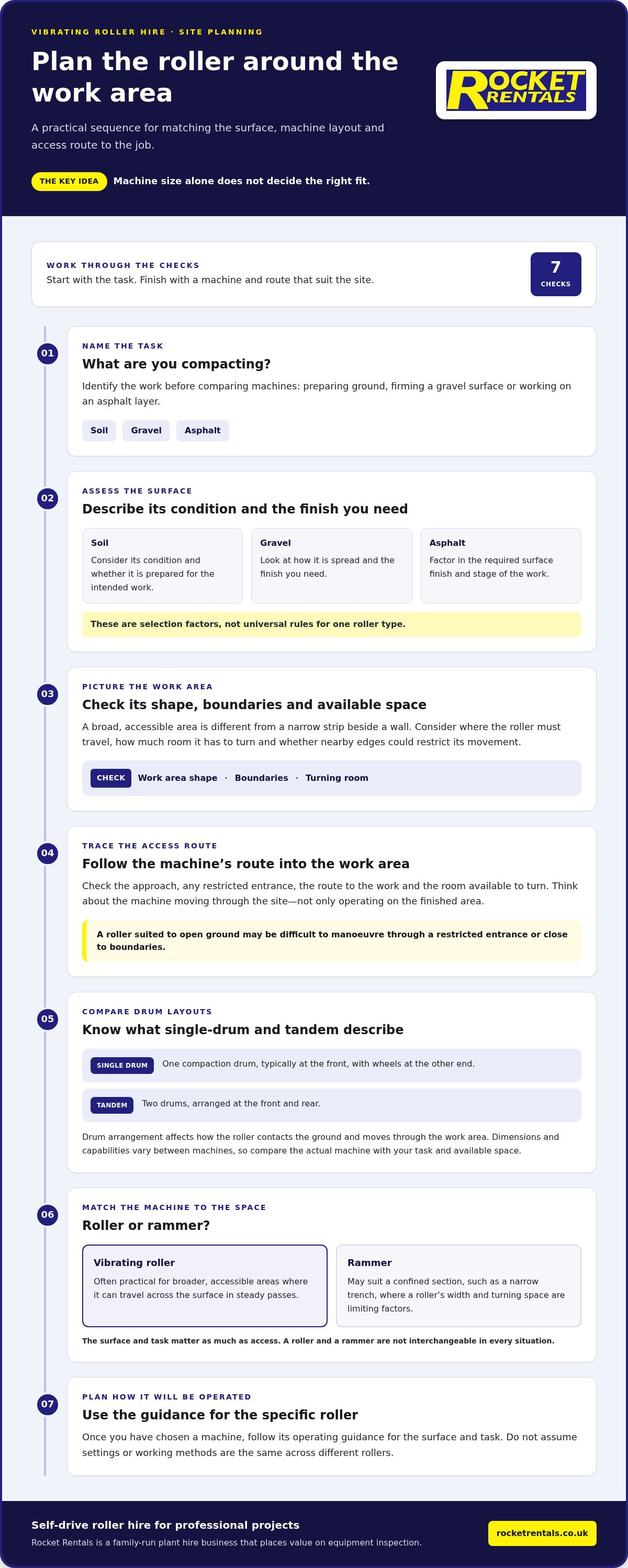
Use the working space as a first guide. A roller is often practical for broader, accessible areas where it can travel across the surface. A rammer may suit a confined section, such as a narrow trench, where the roller’s width and turning space are limiting factors. Neither machine is interchangeable in every situation: the surface and task matter as much as access.
Picture the machine moving through the site, not just operating on the finished area. Check the approach route, turning room and nearby edges before arranging hire. This helps you select equipment that fits the work and avoid discovering an access problem once the job is under way.
How vibration and drum design affect compaction
A roller’s effect comes from the contact between its drum and the ground. The machine’s weight presses down as the drum moves, while vibration adds repeated movement that helps material settle and pack together. The result depends on the surface and how the equipment is operated, so vibration alone does not establish whether a particular roller is suitable.
For vibrating roller hire, consider the finish you need and the room the machine will have to work. A broad, clear area presents different demands from a narrow strip beside a wall. Drum arrangement matters because it affects how the machine contacts the ground and moves around the work area.
Single-drum and tandem rollers: what changes?
A single-drum roller has one compaction drum, typically at the front, with wheels at the other end. A tandem roller has two drums, arranged at the front and rear. These terms describe the basic layout, not a guaranteed result. Machine dimensions and capabilities vary, so don’t assume every roller in one category will perform in exactly the same way.
Drum configuration affects how the roller contacts the surface and moves through the work area. Consider the site shape and the route the machine needs to take. It must have room to travel and turn without obstructing other work or coming too close to boundaries. Compare the task, ground conditions and available space, rather than choosing by drum count alone.
How does the surface affect roller selection?
Soil, gravel and asphalt each need to be assessed in their own right. For soil, consider its condition and whether it is prepared for the intended work. On gravel, look at how the material is spread and the finish you need. With asphalt, the required surface finish and the stage of the work influence the choice. These are selection factors, not universal rules for a particular roller type.
Define the result you’re working towards before deciding. Are you preparing a ground surface, compacting a gravel area or working on asphalt? Then consider the area’s boundaries, shape and access. These details help you describe the job clearly and avoid choosing equipment based on a broad label that may not reflect your site.
Once you’ve chosen a machine, follow its operating guidance for the surface and task. Don’t assume settings or working methods are the same across different rollers. If your assessment points towards a roller, you can view Rocket Rentals’ roller hire as part of planning your equipment choice.
Compare vibrating roller types for your site and task
A roller that worked well on one project may be a poor fit for another. Compare the task, operating format and available space, rather than relying only on labels such as “single-drum” or “tandem”. Use the table as a starting point for vibrating roller hire, then consider the actual machine’s dimensions and capabilities before making your selection.
These are broad comparisons, not a guarantee that every machine in a category will suit the same work. Dimensions, controls and capabilities depend on the specific equipment. A tight entrance, uneven approach or narrow turning area can affect suitability, even when the working surface itself looks spacious.
Ride-on or walk-behind vibrating roller?
With a ride-on roller, the operator works from a seat or platform on the machine. A walk-behind roller is guided by an operator on foot. The right format depends on the site layout, the scale of the area and the route in and out. A larger open work area may make a ride-on format worth considering, while a smaller section may call for equipment guided from behind. Neither format is automatically the better choice.
Which roller suits edges, restricted access and open areas?
In an open area, check whether there is room to travel and turn without interrupting other site activity. Near kerbs or walls, visibility matters: consider what the operator can see along the drum and machine sides, and allow for safe clearance. In a restricted space, compare the access route and working width with the machine’s actual dimensions. A rammer may be more suitable for a confined section if a roller cannot manoeuvre or work there effectively.
Map the entrance, turning points, obstacles and edges the machine will pass. Then compare those details with the selected roller’s dimensions and operating guidance. This helps you choose for the actual site rather than assuming a familiar roller type will suit every surface or layout.
Prepare your site before arranging vibrating roller hire
A few checks before you book can help you choose a roller that suits the job and reach the work area without avoidable disruption. Describe the task, then assess the material, site layout and access route. This gives you a practical basis for selecting equipment and planning its use.
What site details should you establish first?
Start with the surface and intended result. Note whether you’re working on soil, gravel or asphalt, and identify the area that needs compacting. Then look beyond the working surface: the route in, turning space, nearby boundaries and other site activity can all affect which machine is suitable.
Define the task: describe the material and the result you need from compaction.
Mark the work area: record its shape, approximate working width and any sections that need separate attention.
Trace the access route: consider entrances, narrow points, turns and the surface the machine must cross to reach the work.
Identify boundaries: note kerbs, walls, edges, services or other features close to the route or working area.
Flag site conditions: highlight uneven ground, obstacles or activity that could affect machine movement or operation.
These details help you explain the job before selecting a roller configuration. An open work area with a clear approach has different access considerations from a narrow section beside a boundary. Don’t choose on the basis of the surface alone: the machine also needs to reach and manoeuvre within the work area.
What should you check when equipment arrives?
Before starting, carry out an inspection of the machine and note any visible condition concerns. Check that the equipment appears suitable for the planned work. If something doesn’t look right, raise it before use rather than making assumptions.
Look over the machine and note any visible damage or concerns.
Review the controls and operating guidance for the specific equipment.
Keep the route and work area clear of obstacles that could interfere with movement.
Plan how the machine will pass boundaries and avoid clashes with other site activity.
Check that the working area and access remain suitable as the task progresses.
Keep the selected machine’s instructions to hand and follow them throughout the work. Equipment inspection and operating guidance are practical parts of a well-planned hire, alongside your assessment of material, boundaries and access.
Once you’ve set out the job and site conditions, explore Rocket Rentals roller hire as you plan your equipment choice.
Arrange self-drive vibrating roller hire with Rocket Rentals
You’ve assessed the surface, work area and access route. Use those details to describe the job and arrange self-drive roller hire for your project. Rocket Rentals provides vibrating roller hire for professional projects as part of its plant hire service. With self-drive hire, your team operates the machine, so planning the task and understanding the operating guidance are part of getting ready.
What to have ready when arranging self-drive hire
A clear description helps connect the equipment choice with conditions on your site. Be ready to explain what you’re compacting, where the work will take place and how the machine will reach it. Focus on the details you can see and the result the work needs, rather than making technical assumptions about the roller.
Surface and task: describe the material and the compaction work planned.
Working area: explain its shape and where the roller needs to travel.
Access: outline the route to the work area, including narrow entrances and turning points.
Boundaries: mention nearby kerbs, walls, edges or other features that may affect movement.
Site activity: flag obstacles, uneven areas or other work that could affect how the machine is used.
For example, “compact a gravel surface in an open area” gives a useful starting point. Add detail if the approach is narrow or the work runs close to a wall. That makes the practical constraints clear and keeps the discussion focused on how the machine will be used, rather than relying on a general description of the job.
A dependable hire partner for your project
Equipment choice is one part of the plan. You also need to consider the hire process and the condition of the machinery you’ll operate. Rocket Rentals is a family-run plant hire business, and equipment inspection is one of its strengths. Inspection provides a practical point of reassurance when arranging machinery, alongside your own checks and review of the operating guidance before use.
Keep the task details to hand as you arrange hire. If the surface, access route or boundaries change, revisit the equipment choice before work begins. A roller suited to the original plan may no longer fit if the working area or route has changed. Clear preparation helps you make a considered choice and plan self-drive use around the conditions on site.
Ready to plan your project? Arrange your roller hire with Rocket Rentals and have your site and task details ready.
Make your next groundworks decision with confidence
Before work begins, confirm that the equipment choice still matches the task. Site conditions and sequencing can change between planning and starting, particularly when several tasks share the same work area. If the material, access route or available space has changed, pause and review the plan rather than continuing with an unsuitable set-up.
A clear handover helps everyone involved understand where the roller will work, how it will move through the site and which areas need to remain clear. This supports an organised start and helps avoid preventable disruption once the machine is in use.
With your task and site details ready, take the next step towards vibrating roller hire for your project. Arrange your vibrating roller hire with Rocket Rentals and plan around the work in front of you.
Frequently Asked Questions
Can a vibrating roller compact both soil and asphalt?
Yes, vibrating rollers are used on suitable soil and asphalt, but one machine won’t necessarily suit both. The material, its condition and the task all affect the choice. Preparing a soil base differs from compacting an asphalt surface to a particular finish. Match the equipment to the intended result and follow the selected roller’s operating guidance before starting work.
Is a vibrating roller the same as a vibrating plate compactor?
No. Both machines compact surfaces, but their formats and suitable working conditions differ. A roller is generally used across broader areas, while a plate compactor may suit other types of work. Consider the surface, available space and route to the work area before choosing. For a small patch with limited turning room, assess how each machine can reach and work on the area.
Can you use a vibrating roller close to a building or boundary?
Nearby structures, edges and limited working space affect machine selection and operation. Consider whether the roller can reach the area, manoeuvre and be guided with a clear view of its path. Don’t rely on a universal clearance distance. Follow the machine’s operating guidance, and use a more suitable compaction method if the roller cannot work safely in the available space.
Do you need an operator when hiring a vibrating roller from Rocket Rentals?
Rocket Rentals provides self-drive equipment hire, so you arrange for your own person to operate the roller. Before work starts, that person should be familiar with the machine’s controls and operating guidance. Decide who will operate it as part of your site planning, and allow time for them to review the instructions before compaction begins.
What should you check before using a hired vibrating roller?
Inspect the roller before use, read its operating guidance and check the work area for access limits, nearby boundaries and other activity. If you see a condition that could affect operation, pause and raise it before starting rather than assuming the machine is ready for your task. Also consider whether the site has changed since you planned the hire, such as new obstacles or activity along the route.
Is a ride-on roller suitable for a small or restricted site?
Not always. Suitability depends on the access route, working space, nearby boundaries and the specific machine’s dimensions and capabilities. A ride-on roller may be difficult to position or turn in a compact area. Another roller format or compaction machine could be more appropriate, depending on the task. Assess the site alongside the selected machine’s operating guidance instead of relying on the ride-on label alone.


Comments