
Welfare Unit Hire Cost: The Site Manager’s 2026 Budgeting Guide
Updated: Sep 1
If you believe the weekly rental rate is the most critical figure in your welfare unit hire cost, you might be overlooking the hidden expenses that actually jeopardise a project budget. Most site managers recognise that providing high-quality facilities isn't just about crew comfort; it's a non-negotiable legal obligation under the CDM 2015 regulations. However, balancing these essential requirements whilst avoiding the sting of unexpected delivery charges or high fuel consumption is a challenge that requires more than just a surface-level estimate.
This guide will help you master the complexities of welfare unit budgeting, ensuring you remain fully compliant with HSE standards whilst protecting your bottom line. We'll explore the true components of a modern hire quote, from the efficiency of solar-powered units to the logistical realities of site servicing. By the end, you'll have a clear framework for securing reliable, cost-effective equipment that keeps your site running smoothly and your budget intact for the duration of your 2026 projects.
Table of Contents
HSE Compliance and the Baseline Cost of Site Welfare
Providing suitable facilities on a construction site is far more than a matter of convenience; it's a fundamental legal obligation. Under the Construction (Design and Management) Regulations 2015 (CDM 2015), site managers are responsible for ensuring that welfare facilities are available from the very first day of a project. When calculating your welfare unit hire cost, it's helpful to view this expenditure as a baseline for site safety rather than an optional extra that can be trimmed to save money. Failing to provide adequate facilities doesn't just impact morale; it creates a significant legal vulnerability that can lead to project delays or complete site shutdowns.
The modern construction environment relies on portable and modular buildings to meet these standards efficiently. These units offer a self-contained solution for sites where mains connections are unavailable. High-quality welfare provision is also directly linked to site productivity. A crew that has access to clean, warm, and well-maintained rest areas is likely to be more focused and efficient throughout the working day. By prioritising the quality of your site equipment, you're investing in the health and performance of your most valuable asset: your workforce.
The Legal Minimum: What Your Hire Must Include
What exactly defines "adequate" in the eyes of the Health and Safety Executive? The requirements are specific and leave little room for interpretation. To remain compliant, your welfare unit must provide a comprehensive set of features designed to support basic human needs whilst on site.
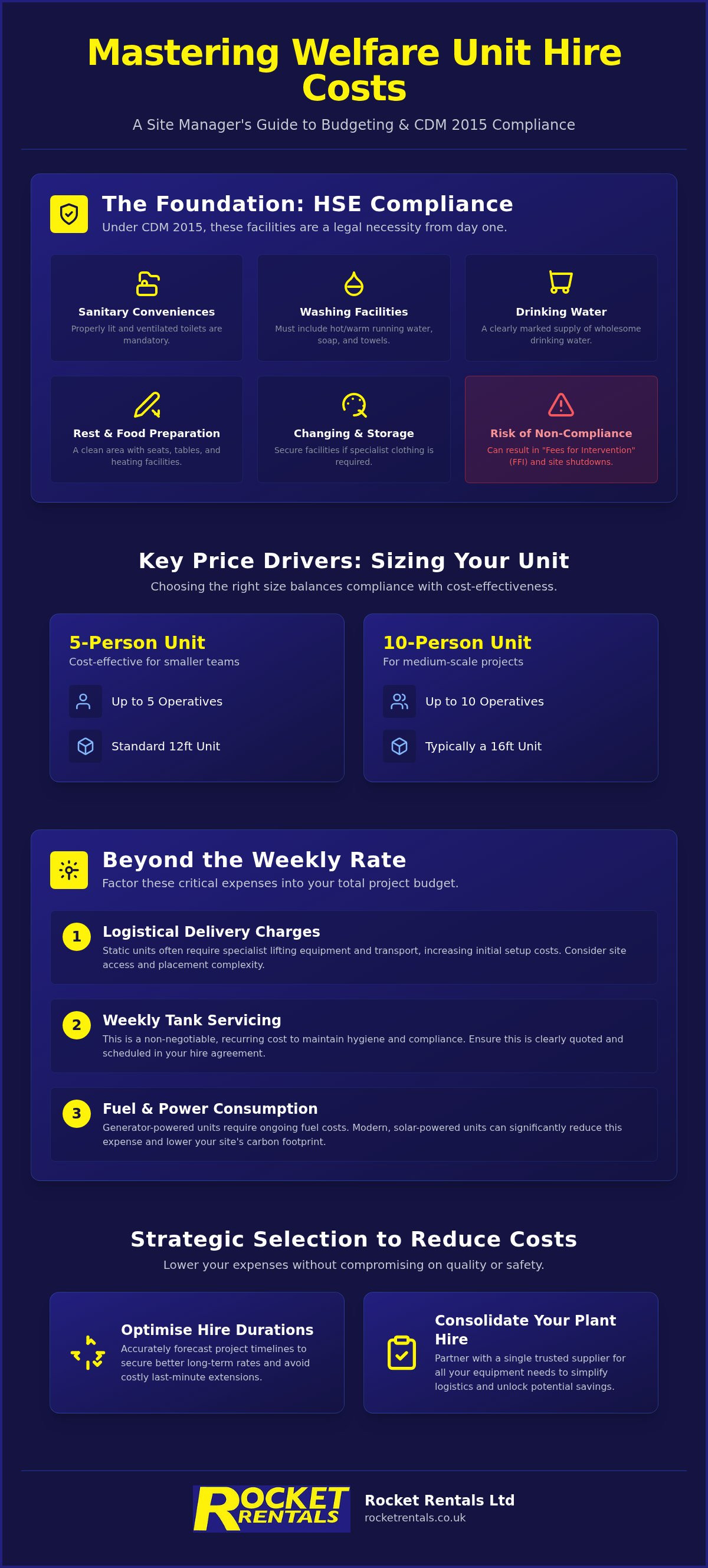
Sanitary conveniences: Toilets must be suitable, sufficient, and provided with adequate ventilation and lighting.
Washing facilities: These must include basins with hot and cold (or warm) running water, soap, and towels. Cold water alone does not meet the standard.
Drinking water: A supply of wholesome drinking water must be clearly marked and easily accessible.
Rest and food preparation: You must provide a clean area with seats, tables, and the means to boil water and heat food.
Changing and storage: If workers need to wear specialist clothing, you must provide facilities for changing and secure storage for personal items.
The Financial Risk of Non-Compliance
The cost of cutting corners often far outweighs the initial welfare unit hire cost. If the HSE identifies a material breach of regulations, they may apply "Fees for Intervention" (FFI), which are charged for the time taken to identify and rectify the issue. Beyond these direct fines, poor facilities contribute to high staff turnover and difficulty in recruiting skilled labour. In an industry where reputation is everything, being known for substandard site conditions can make it harder to win future contracts. CDM 2015 compliance for site managers means ensuring that every worker has immediate access to safe, clean, and fully functional welfare facilities from the start to the finish of a project.
Key Price Drivers: Size, Capacity, and Power Specifications
The base welfare unit hire cost is primarily determined by the physical footprint and power requirements of the equipment. Choosing the correct specification is a balancing act between meeting legal capacity requirements and avoiding unnecessary expenditure on oversized units. Static units often provide a more robust solution for long-term projects, yet they typically involve higher transport costs due to the need for specialist lifting equipment. Mobile units, by contrast, offer greater flexibility for sites with shifting work fronts, such as highway maintenance or pipeline installation.
Internal configuration also plays a significant role in the final quote. A standard mess area might suffice for a small groundwork crew, but projects requiring on-site administration may benefit from integrated office space. Whilst these combined units carry a higher weekly rate, they often prove more economical than hiring separate canteen and office blocks. Modern site managers in 2026 are also increasingly opting for units with integrated Wi-Fi and GPS tracking. These features enhance site productivity and security, providing a level of oversight that traditional units lack.
Sizing Your Unit: 5-Person vs 10-Person Facilities
Capacity is the most straightforward driver of cost. A standard 12ft unit is typically designed to accommodate up to 5 people, making it the most cost-effective choice for small teams. For medium-scale groundworks with up to 10 operatives, a 16ft unit becomes the necessary standard to ensure HSE compliance regarding rest space. It's vital to match the unit to your actual headcount. Hiring a 20ft unit for a small crew leads to avoidable costs, whilst cramming a large team into a 12ft space risks non-compliance. Selecting the right welfare unit hire specification ensures you only pay for the capacity you truly need.
Eco and Solar Units: Higher Initial Hire vs Lower Running Costs
The shift towards sustainability in 2026 has made solar-hybrid units a staple on professional sites. These units command a higher initial hire rate compared to traditional diesel-only models, but the long-term savings are substantial. By utilising solar panels to charge battery banks, these units significantly reduce generator run-time. On a typical 12-week hire, the reduction in diesel consumption often offsets the higher weekly rental fee. Beyond the financial benefit, eco units offer a quieter site environment and help contractors meet increasingly strict carbon reduction targets.
Beyond the Weekly Rate: Factoring in Total Budgetary Requirements
Site managers often focus on the headline rental figure, but the true welfare unit hire cost includes several variable operational expenses that can fluctuate based on project specifics. These logistical and maintenance factors are just as essential as the unit itself for accurate financial planning. To avoid budget creep, you must look at the "total cost of ownership" for the duration of the hire period. This includes everything from the initial transport to the ongoing hygiene cycles required by health and safety standards.
Fuel management is a primary consideration for generator-powered equipment. Whilst modern units are highly efficient, the cost of diesel and the logistics of refuelling must be accounted for. If your site lacks a dedicated fuel bowser, you may rely on the hire provider for refuelling, which often carries a service surcharge. Additionally, insurance is a non-negotiable requirement. Most standard hire agreements operate under CPA or similar terms, necessitating "Hired-in Plant" insurance. You should verify that your policy covers the full replacement value of the unit, as these are sophisticated, high-value assets that represent a significant liability if damaged or stolen.
Logistics and Site Access Challenges
The method of delivery significantly impacts your initial setup budget. Mobile, towable units are generally more flexible and can be positioned using a standard 4x4 vehicle. However, larger static units require a heavy goods vehicle (HGV) equipped with a Hiab crane for lifting. If your site has restricted access, narrow entrances, or weight-limited bridges, the hire company may need to deploy smaller, specialist transport which can increase the delivery fee. It is also vital to prepare the ground beforehand. Ensuring a level, hard-standing area is ready prevents aborted delivery charges and ensures the unit remains stable and safe for use.
Maintenance and Consumables
Hygiene standards are not a one-time setup; they require a consistent schedule of professional attention. To remain compliant with CDM 2015 regulations, units need a weekly service that includes emptying the chemical toilet effluent tank and replenishing the fresh water supply for washing facilities. Accounting for these weekly servicing fees within your total hire budget is vital for maintaining a safe and compliant working environment. You should also factor in the cost of basic consumables, such as soap, paper towels, and toilet rolls, which need regular restocking to keep the facilities functional for your crew.
Strategic Selection: Reducing Hire Costs Without Compromising Quality
Managing your welfare unit hire cost requires a strategic approach to both time and logistics. Whilst short-term hires offer flexibility for sudden project shifts, long-term agreements typically provide a more stable weekly rate. It's often more economical to commit to a longer duration if the project timeline is clear. Consolidating your equipment needs with a single provider also yields significant financial benefits. By sourcing your welfare units alongside excavators or telehandlers, you can reduce transport fees and simplify your administrative processes through a single point of contact.
Avoiding "dead time" is another critical factor in budget control. Precise scheduling ensures the unit arrives exactly when the ground is ready and is collected immediately once the project concludes. Every day a unit sits idle on site adds to the total expenditure without providing value. You might also consider "Dry Hire" options, where you manage your own consumables such as soap, sanitiser, and paper towels. This allows for tighter control over daily running costs, provided your team is diligent in their inventory management.
Sourcing Reliable Plant Hire
Finding a dependable partner is essential for maintaining site momentum and safety. A provider that prioritises high maintenance standards will help you avoid the hidden costs of equipment breakdown and site downtime. Reliable machinery ensures that your welfare facilities remain operational and compliant throughout the project duration. For a deeper look at selecting the right equipment for your site requirements, consult The Professional’s Guide to plant machinery.
Managing On-Site Behaviour to Control Costs
The way your crew interacts with the facilities directly impacts your final invoice. Encouraging staff to keep the mess area and toilets clean can prevent additional cleaning surcharges upon the unit's return; for those seeking professional standards for interior maintenance, The Rutland Cleaning Company provides expert care for floors and upholstery. Similarly, monitoring generator use is a simple way to lower fuel costs. If a generator is left running when the unit is unoccupied, it wastes fuel and increases engine wear. Before the hire ends, implement a "site-ready" checklist to ensure the unit is accessible, clean, and empty of personal belongings. This prevents aborted collection fees and ensures a smooth handover. If you are ready to secure high-quality equipment for your next project, you can explore our reliable welfare unit hire services.
Choosing a hire partner is about finding a "safe pair of hands" that understands the high-stakes environment of a modern construction site. At Rocket Rentals, we approach every project with quiet confidence and a commitment to professional reliability. Founded circa 1988, our team brings decades of plant hire expertise to your project, ensuring that your welfare facilities are delivered on time and maintained to the highest standards. We recognise that a site manager's primary goal is to maintain momentum whilst ensuring full compliance with safety regulations.
Our fleet is built on the foundation of quality and readiness. We understand that site managers need equipment that works from the moment it arrives on site. By providing modern, well-maintained equipment, we help you avoid the hidden expenses associated with site downtime and equipment failure. When you evaluate your total welfare unit hire cost, the reliability of the provider becomes a significant factor in your overall budget. A dependable unit ensures your crew remains productive and your site stays compliant without the risk of sudden, costly interruptions.
A Comprehensive Fleet for Every Site Requirement
Beyond welfare, we offer a comprehensive range of high-quality, self-drive equipment tailored for professional contractors. You can streamline your logistics by pairing your welfare units with our mini excavator hire for groundworks or ensuring safe work at height with our electric scissor lift hire. Sourcing your plant from a single, veteran provider allows for better coordination and more efficient site management. This integrated approach reduces the administrative burden on your team, allowing you to focus on the project's successful delivery.
Get a Professional Quote for Your Next Project
Our team is here to help you manage the practicalities of site setup. We assist in determining the ideal unit size based on your specific headcount and project duration, ensuring you don't pay for capacity you don't need. Transparency is at the heart of our service; our hire agreements are straightforward, with no hidden surprises in the small print. We take pride in our heritage as a service-oriented business that values long-term relationships with our clients. If you are planning your 2026 project budget and require a partner you can trust, contact Rocket Rentals for a reliable welfare hire quote today.
Securing a Compliant and Cost-Effective Site Setup
Managing a project budget in 2026 requires a deep understanding of how various factors influence your total welfare unit hire cost. By looking beyond the basic weekly rate and accounting for logistical challenges, servicing schedules, and fuel efficiency, you can prevent unexpected expenses from eroding your margins. It is helpful to remember that high-quality welfare facilities are not just a line item; they are a legal necessity under CDM 2015 that directly supports your team's productivity and well-being.
Since 1988, Rocket Rentals has served as a safe pair of hands for contractors across the UK. We maintain a modern, high-quality fleet that meets the rigorous standards of professional construction projects. Whether you need a single unit or a comprehensive plant package, our team provides the reliability you need to keep your site running smoothly and safely. Our heritage as expert plant hire specialists ensures that your equipment arrives site-ready and stays that way.
Request a Professional Welfare Hire Quote from our expert team today to ensure your next project is built on a foundation of safety and trust. We look forward to supporting your site's success with reliable equipment and straightforward service standards.
Frequently Asked Questions
What is the minimum hire period for a welfare unit?
Most hire agreements for site equipment require a minimum period of four weeks. This standard allows providers to cover the logistical costs of delivery and setup whilst ensuring the unit remains on site for a meaningful project phase. If your project is shorter, you may still be charged for the full four week block. Longer agreements often provide a more stable weekly rate, which helps in managing your total welfare unit hire cost more effectively.
Do welfare units need a mains water or electricity connection?
No, modern welfare units are designed to be entirely self contained, making them ideal for sites without existing infrastructure. They feature internal fresh water and effluent tanks, alongside a diesel generator or solar hybrid system to provide power. This independence ensures you can meet HSE requirements from the first day on site. However, you must ensure the unit remains accessible for weekly servicing to replenish water and empty waste tanks throughout the project duration.
Are there hidden costs when hiring a mobile welfare unit?
Beyond the weekly rental, you should account for delivery and collection fees, fuel consumption, and weekly servicing charges. These variable expenses are sometimes overlooked but are essential for an accurate budget. You may also face surcharges for aborted deliveries if the site is not ready or if the unit requires an intensive deep clean upon return. Clarifying these components in your initial quote prevents unexpected spikes in your overall welfare unit hire cost.
How often do welfare units need to be serviced?
Welfare units typically require a professional service once a week to maintain hygiene and compliance. This service involves emptying the chemical toilet effluent tank, refilling the fresh water supply for washing facilities, and performing a general inspection of the generator and internal components. Regular servicing is a requirement under CDM 2015 regulations to ensure that facilities remain adequate for use. Neglecting this schedule can lead to poor site conditions and potential HSE enforcement action.
Can I tow a mobile welfare unit myself?
Yes, mobile units are designed for easy transport, but you must ensure your vehicle has the correct towing capacity and the driver holds the appropriate licence. Many professional contractors prefer to use their own vehicles to move units between work fronts on larger sites. It is vital to check the manufacturer weight specifications before attempting to tow. If you are unsure, we can arrange professional delivery and collection to ensure the unit is positioned safely.
What happens if a welfare unit breaks down on site?
If you experience a technical issue, such as a generator failure or water pump malfunction, you should contact the hire provider immediately. A dependable partner will offer a prompt repair or replacement service to minimise site downtime. Maintaining facilities is a legal requirement, so resolving breakdowns quickly is essential for continued HSE compliance. Our fleet is maintained to the highest standards to prevent these issues, but we remain ready to assist should a problem arise.
Is insurance included in the welfare unit hire cost?
Insurance is generally not included in the standard weekly rental rate and remains the responsibility of the hirer. You will typically need Hired in Plant insurance to cover the full replacement value of the unit against theft, fire, or accidental damage. It is essential to verify that your existing policy is sufficient before the equipment arrives on site. This coverage protects your business from significant financial liability, as these units represent a substantial investment in site technology.
What is the difference between a static and a mobile welfare unit in terms of price?
Static units often have a lower weekly rental rate than mobile models, but they involve higher transport costs due to the need for HGV Hiab delivery. Mobile units carry a premium for their flexibility and ease of movement but can be more cost effective for projects with multiple phases or shifting work fronts. When comparing prices, you must factor in the total logistical expenditure rather than just the rental fee to determine which configuration suits your project needs.


Comments