
20 Tonne Excavator Hire Cost: 2026 UK Professional Guide
The most expensive part of your 20-tonne excavator rental isn't the headline weekly rate; it's the logistical oversights that catch you off guard mid-project. Most site managers understand that securing a competitive 20 ton excavator hire cost UK is vital for maintaining a healthy project margin. However, it's frustrating when hidden transport surcharges or fluctuating fuel consumption figures start to erode your carefully planned budget.
This guide provides a comprehensive breakdown of the 2026 rental landscape, helping you forecast accurately and avoid the common pitfalls of heavy plant procurement. We'll explore the nuances of self-drive machinery, examine national logistics challenges, and share strategies to optimise your site productivity whilst keeping overheads under control. By the end of this professional guide, you'll have a clear framework for budgeting and the confidence to manage your next large-scale civil engineering project with precision.
Table of Contents
Understanding the 20-Tonne Excavator Market in 2026
Professional contractors often view the 20-tonne class as the backbone of any serious infrastructure project. It represents a specific tier of heavy plant that balances raw digging power with relatively straightforward transport logistics. Understanding what is a 20-tonne excavator requires a look at its fundamental design: a heavy-duty crawler chassis equipped with a high-torque hydraulic system capable of managing massive earthmoving tasks without the extreme footprint of 30-tonne plus machines.
In the current market, this size is considered the "sweet spot" for civil engineering. It provides the breakout force needed for hard ground conditions whilst remaining versatile enough to work on larger housing developments. Determining the total 20 ton excavator hire cost UK involves more than just looking at the base rental figure. It requires an assessment of the machine's specification. Standard models are ideal for general earthworks, but 2026 has seen an increased demand for zero-tail-swing variants. These models allow for safer operation in confined spaces, such as motorway central reservations or adjacent to existing structures, without sacrificing the lifting capacity of the 20-tonne class.
The industry has also seen a distinct shift towards self-drive hire. Professional firms are increasingly moving away from operated plant to maintain tighter control over their project timelines and safety protocols. This trend is driven by the need for high-specification machinery that can be integrated into a contractor's own digital site management systems.
Primary Applications for 20-Tonne Machinery
These machines are rarely idle on a professional site. Their primary roles include:
Large-scale site clearance: Efficiently removing topsoil and managing bulk excavation for commercial foundations.
Deep drainage: Providing the reach and stability required for utility trenching on new-build developments, often reaching depths exceeding 6 metres.
Demolition: Handling heavy-duty hydraulic breakers and shears to dismantle reinforced concrete structures.
Self-Drive vs. Operated Plant: The Professional Choice
For many contractors, the decision to opt for self-drive hire is about operational autonomy. By providing your own qualified CPCS or NPORS operators, you eliminate the risk of third-party scheduling conflicts that can stall a project. It's often a more cost-effective route for long-term projects where the 20 ton excavator hire cost UK is offset by the consistency of having a dedicated internal team. This approach ensures the machine is utilised to its full potential during every hour of the hire period, rather than being tied to the specific working hours of an external operator. It also allows for a more seamless integration of specialist attachments, as your own team will be familiar with the specific requirements of the site.
Key Factors Influencing 20-Tonne Excavator Hire Rates
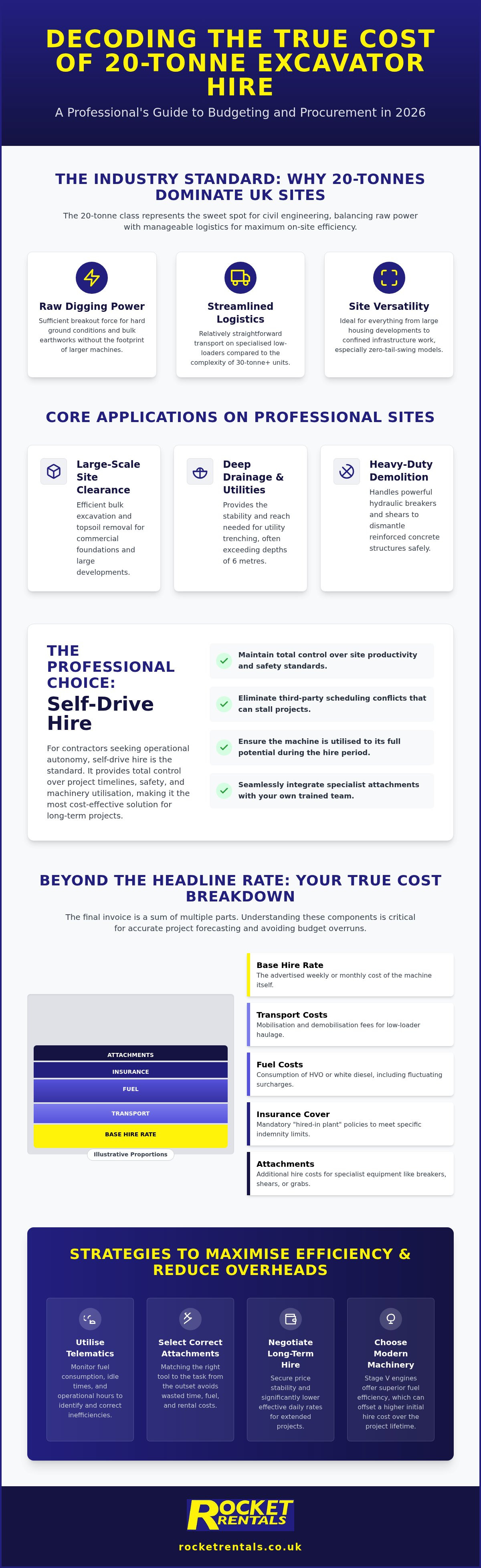
Calculating a precise 20 ton excavator hire cost UK requires looking beyond the headline figure. Several variables dictate the final invoice, with machine specification being a primary driver. Modern fleets featuring Stage V engines command a premium due to their superior fuel efficiency and reduced emissions. Whilst older models might seem cheaper initially, the increased fuel burn and potential for downtime often negate those savings on a professional site. Site managers must also account for comprehensive insurance coverage, often requiring "hired-in plant" policies that meet specific indemnity limits. Additionally, fuel management has become more complex in 2026. With fluctuating surcharges and the requirement for HVO or white diesel, your fuel strategy can swing the total cost by hundreds of pounds over a monthly hire period.
The Impact of Hire Duration on Pricing
Heavy plant machinery typically operates on a "minimum hire" basis, often set at one full week. Short-term daily rentals are rare for 20-tonne units because the mobilisation effort is so high. Conversely, long-term contract hire significantly reduces the effective daily rate. The UK construction plant-hire market fluctuates with seasonal demand; securing equipment during peak summer months often requires advanced booking to ensure availability and price stability. For those managing extended infrastructure projects, negotiating a fixed monthly rate provides the most predictable budget forecast.
Logistics: Transporting 20-Tonne Equipment Nationally
Moving a 20-tonne excavator is a major logistical undertaking. Unlike smaller machines, these units require specialised low-loader trailers. Mobilisation and demobilisation costs cover the haulage to and from the depot, which varies based on distance and site access. You'll need to ensure your site has adequate turning circles and ground stability for a heavy transport vehicle. In some instances, moving wide or heavy loads on UK roads requires specific permits or escort vehicles, which adds to the logistical complexity. If you're planning a project with specific access constraints, choosing a partner with a modern fleet of excavators and experienced logistics support is vital. This ensures the machinery arrives on schedule without the risk of transport delays or safety incidents during unloading.
Finally, don't overlook attachment surcharges. Whilst a standard digging bucket is usually included, specialist hydraulic breakers, shears, or 3D grading systems often carry an additional weekly fee. Matching the right attachment to your task is essential; using an undersized bucket for bulk excavation will increase your fuel consumption and extend your project timeline, ultimately driving up the total cost of hire.
Estimated Cost Breakdown: 20-Tonne Excavator Hire in 2026
The UK boasts the UK's leading plant-rental sector, a mature market that serves complex infrastructure needs with high efficiency. When calculating the 20 ton excavator hire cost UK, businesses usually encounter B2B pricing structures where VAT is excluded from the initial quote. Professional contractors must also demonstrate they hold adequate hired-in plant insurance before the machine is mobilised. For a 20-tonne machine, indemnity limits often need to cover the full replacement value of the asset, which is a significant financial consideration. High-specification models equipped with integrated GPS or 3D grading systems naturally command higher rates than standard crawler units. However, these modern machines often reduce the total project spend by increasing digging accuracy and reducing the need for manual grade checking on site.
Weekly vs. Monthly Hire Rate Comparison
Most plant hire providers operate on a weekly minimum because the logistical effort of delivering a 20-tonne machine makes daily hire impractical for both parties. Whilst a standard weekly rate serves as the baseline, significant savings are often realised during extended hire programmes. Committing to a 12-week or longer duration typically unlocks lower rates compared to ad-hoc weekly rentals. This structure allows the hire partner to plan fleet availability more effectively, passing those efficiencies back to the contractor in the form of more competitive long-term pricing. It's a strategic approach that rewards foresight and clear project scheduling.
Hidden Costs and Site Surcharges
Beyond the base rental, fuel management is the most significant variable in your operational budget. Modern 20-tonne engines are designed for maximum efficiency, yet their consumption in litres per hour (l/h) varies based on the intensity of the work being performed. For example, heavy digging in compacted clay will burn more fuel than light grading or loading tasks. Site managers should also account for potential cleaning surcharges if the machine is returned with excessive mud or debris. Damage waivers are an essential consideration; they provide peace of mind by capping your financial exposure to a set excess in the event of accidental damage. Without these, you remain liable for the full cost of repairs, which can quickly exceed the initial 20 ton excavator hire cost UK.
Maximising Efficiency and Reducing Operational Costs
Site productivity is the most effective lever for controlling your total project spend. Whilst the headline 20 ton excavator hire cost UK is a fixed weekly figure, your operational efficiency is entirely variable. If a machine sits idle due to poor site planning, that rental investment quickly becomes a financial drain. Professional contractors prioritise site preparation before the low-loader arrives. This involves establishing clear haul roads and designated stockpile areas to ensure the excavator spends its time digging rather than waiting for dumpers or navigating poorly organised terrain.
Integrating specialised excavator attachments allows a single 20-tonne unit to perform the work of multiple smaller machines. This reduces the total number of assets on site and simplifies your logistics. By matching the correct bucket size to the material being moved, you reduce the number of cycles required to fill a dumper. It's a simple calculation: a well-matched bucket can improve loading times by up to 15% compared to using standard-issue equipment for specialist tasks like heavy clay extraction or fine grading.
Attachment Selection for Multi-Tasking
Selecting the right tool for the job is essential for maintaining a high work rate. For demolition tasks, hydraulic breakers provide the force needed for primary breaking, whilst munchers are superior for secondary processing and rebar separation. Using tilting hitches is another professional strategy; they allow the operator to tilt the bucket without repositioning the tracks. This reduces wear on the undercarriage and saves significant time during complex battering or trenching work. Selecting a bucket width that precisely matches your trenching requirements prevents over-digging, which saves on both fuel and backfill materials.
Fuel Management and Idle Reduction
Modern fleets in 2026 almost exclusively feature Stage V engines, which are designed to minimise both emissions and fuel burn. However, technology only goes so far without proper operator behaviour. Training your team to utilise "eco-modes" during light-duty tasks, such as pipe handling or fine levelling, can significantly lower your daily fuel costs. Telematics systems now provide real-time data on idle time. If an engine is left running whilst the operator is waiting for instructions, it's essentially burning your profit. Planning site traffic to minimise unnecessary machine travel is another vital step. Every metre of travel adds to the fuel bill and increases the long-term maintenance requirements of the tracks. View our full range of self-drive excavators to find the right specification for your next project.
Organising National 20-Tonne Hire with Rocket Rentals Ltd
Securing heavy plant for a major infrastructure project requires a partner that understands the high stakes of civil engineering. Rocket Rentals Ltd has established itself as a reliable provider of high-quality, self-drive machinery, specifically catering to contractors who demand total control over their site operations. By focusing on a modern, well-maintained fleet, we ensure that the 20 ton excavator hire cost UK remains a transparent and manageable part of your project budget. Our commitment to professional standards means every machine arrives on site ready for heavy-duty use, backed by technical expertise that helps you navigate the complexities of large-scale groundworks.
National logistics for 20-tonne machinery can often be a bottleneck for project managers. Rocket Rentals Ltd streamlines this process by managing the specialised transport requirements internally, ensuring that your excavator is delivered and collected according to your strict schedule. This logistical precision, combined with our independent advice on machinery selection, allows you to focus on site productivity rather than plant coordination. Whether you're managing a single deep-drainage task or a multi-phase earthworks programme, our team provides the support needed to keep your project moving forward.
The Self-Drive Advantage for Contractors
In the professional plant sector, self-drive hire offers a level of flexibility that operated plant simply cannot match. When you hire from Rocket Rentals Ltd, you maintain absolute authority over your site schedule and the standards of your operators. This approach eliminates the risk of "operator standby" fees, which often inflate the total 20 ton excavator hire cost UK when work is paused due to weather or material delays. You're paying for the machine's availability, giving you the freedom to utilise your own qualified CPCS or NPORS operators who are already familiar with your specific site safety protocols and performance expectations. It's a cleaner, more professional way to manage heavy plant that aligns with the needs of modern construction firms.
Getting a Tailored Quote for Your Project
To provide an accurate, fixed-price quote for your 20-tonne hire, our team requires specific details about your project. Providing precise site access information and ground conditions allows us to calculate mobilisation costs with total transparency. For major infrastructure works, Rocket Rentals Ltd often discusses long-term hire requirements to ensure fleet availability and price stability over several months. We also encourage contractors to consult our experts regarding specialised attachment recommendations. Matching the right hydraulic breaker or grading bucket to your specific material can significantly reduce your operational timeline. Contact our expert team today to discuss your requirements and receive a comprehensive breakdown tailored to your project's unique demands.
Securing Project Success with Precision Plant Hire
Managing a large-scale construction project requires more than just finding a competitive headline rate. It involves a thorough understanding of the total 20 ton excavator hire cost UK, including the logistical precision of transport and the long-term savings offered by fuel-efficient Stage V engines. By prioritising self-drive machinery, you maintain total control over your site standards and project timelines whilst ensuring your budget remains transparent and predictable.
Rocket Rentals Ltd provides the reliable partnership your project needs, offering a high-specification 2026 fleet maintained to the most rigorous professional standards. Our expertise in national logistics and specialised attachments ensures that your machinery arrives on site ready to deliver maximum productivity from day one. If you're ready to optimise your next groundworks project with reliable, heavy-duty plant, request a professional quote for 20-tonne excavator hire today. We look forward to supporting your site's success with the quality and care your work deserves.
Frequently Asked Questions
What is the average weekly cost of 20-tonne excavator hire in the UK for 2026?
Industry reports for 2026 suggest that weekly rates for this class of machinery reflect the high capital value and professional maintenance standards required. Whilst specific figures vary depending on the hire duration and machine age, contractors should budget for a baseline weekly rate that covers a standard five-day working week. Long-term hire agreements often provide better value than ad-hoc rentals. The total 20 ton excavator hire cost UK is also influenced by the machine's specific technology suite.
Do 20-tonne excavator hire rates include fuel and insurance?
Standard hire rates generally exclude fuel and insurance, as these are variable costs managed by the hirer. You'll typically receive the machine with a full tank and are expected to return it refilled or pay a refuelling surcharge. Insurance is a critical requirement; contractors must provide evidence of hired-in plant insurance that covers the full replacement value of the excavator. Some providers offer damage waivers to cap your liability, but these are separate from the base rate.
Can I hire a 20-tonne excavator on a self-drive basis for a national project?
Yes, professional self-drive hire is the standard choice for national infrastructure and civil engineering projects. This arrangement gives your site manager total control over the machine's utilisation and the standard of the operator. National delivery is organised via specialised low-loaders to ensure the equipment arrives on schedule at your site. Opting for self-drive allows you to integrate the machinery into your own safety protocols and project timelines without relying on external operator availability or schedules.
What are the transport requirements for moving a 20-tonne excavator?
Transporting a 20-tonne machine requires a specialised low-loader trailer due to its weight and physical dimensions. Site managers must ensure that the delivery location has sufficient access for a heavy goods vehicle, including adequate turning circles and ground stability. Mobilisation and demobilisation charges are usually calculated based on the distance from the depot to the site. In some cases, moving such heavy plant on public roads may require specific permits or escorted transport to comply with UK regulations.
How much extra do hydraulic attachments cost for a 20-tonne machine?
Specialist hydraulic attachments such as breakers, munchers, or shears carry an additional weekly hire charge. Whilst a standard digging bucket is often included in the base 20 ton excavator hire cost UK, these high-performance tools are priced separately due to their high maintenance requirements and wear rates. Selecting the right attachment is vital for site efficiency; using a dedicated breaker for demolition work is far more cost-effective than attempting the task with standard equipment, despite the fee.
Is a specific licence required to operate a 20-tonne excavator on-site?
Operators must hold a valid and relevant qualification, such as a CPCS (Construction Plant Competence Scheme) or NPORS (National Plant Operators Registration Scheme) card. These certifications ensure the individual has been professionally trained to handle 20-tonne machinery safely and efficiently. Whilst a standard UK driving licence isn't sufficient for on-site operation, it may be required if the machine needs to be moved on public highways, though 20-tonne tracked excavators are almost exclusively moved via low-loader for safety.
What happens if the hired excavator breaks down during a project?
If a machine experiences a technical fault, the hire partner typically provides professional support to minimise downtime. Professional fleets are maintained to high standards to prevent such issues, but mechanical failures can occur under heavy use. Most agreements include a commitment to attend the site and perform repairs or, if necessary, provide a replacement machine. It's essential to report any issues immediately to the hire company's service department to ensure a swift resolution and maintain your project's momentum.
Does the hire cost change for long-reach or specialised excavator models?
Specialised models such as long-reach excavators or zero-tail-swing units typically command a higher rental rate than standard crawler models. These machines offer specific technical advantages, such as extended digging depths for marine work or the ability to operate in confined motorway lanes. The increased cost reflects the specialised nature of the equipment and its suitability for complex engineering tasks. When budgeting for your project, always specify if you require these enhanced capabilities to ensure an accurate and realistic cost forecast.


Comments