
9m Telehandler Lifting Capacity: A Professional Guide to Load Charts and Site Safety
- Rocket Rentals
- Jul 18
- 12 min read
A 3,500kg rating on a specification sheet does not mean your machine can safely handle that weight in every position; in fact, relying on that single figure is one of the most frequent causes of stability incidents on site. Understanding 9m telehandler lifting capacity requires looking well beyond the "maximum" sticker and mastering the precise relationship between height, boom extension, and weight. It is a dynamic calculation that every operator and site manager must respect to keep the workspace secure and efficient.
You likely recognise the daily pressure of keeping a construction programme on schedule whilst managing the inherent risks of high-reach lifting. It is easy to feel frustrated by dense technical manuals or the nuanced performance differences between various fleet models. This professional guide promises to demystify these load limits, giving you the clarity needed to select the right plant and maintain strict LOLER compliance. We will examine how to interpret complex load charts accurately, avoid the dangers of overloading at full reach, and prepare for the 2026 regulatory updates affecting lifting operations.
Table of Contents
9m Telehandler Lifting Capacity: Understanding the Core Specifications
The 9m telehandler is often considered the middle-weight champion of the construction site. It offers a unique balance of reach and manoeuvrability that makes it a favourite for housebuilding and site groundworks. Whilst smaller units might struggle with the height of a three-storey build, and larger machines can be too cumbersome for tight residential plots, the 9m class provides the necessary versatility. Central to its utility is the 9m telehandler lifting capacity, which typically ranges from a maximum of 3,000kg to 3,500kg depending on the specific model in the fleet.
On UK sites, this capacity is formally governed by the Safe Working Load (SWL). This is the maximum weight the machine is certified to lift under specific conditions. Understanding this figure is essential for maintaining site safety and ensuring compliance with LOLER regulations. A Telescopic handler is a complex piece of engineering; its ability to lift is not a fixed number but a variable based on the boom's position. Correctly calculating the 9m telehandler lifting capacity for your specific task is the first step towards a productive and safe shift.
Maximum Lift Capacity vs. Operational Capacity
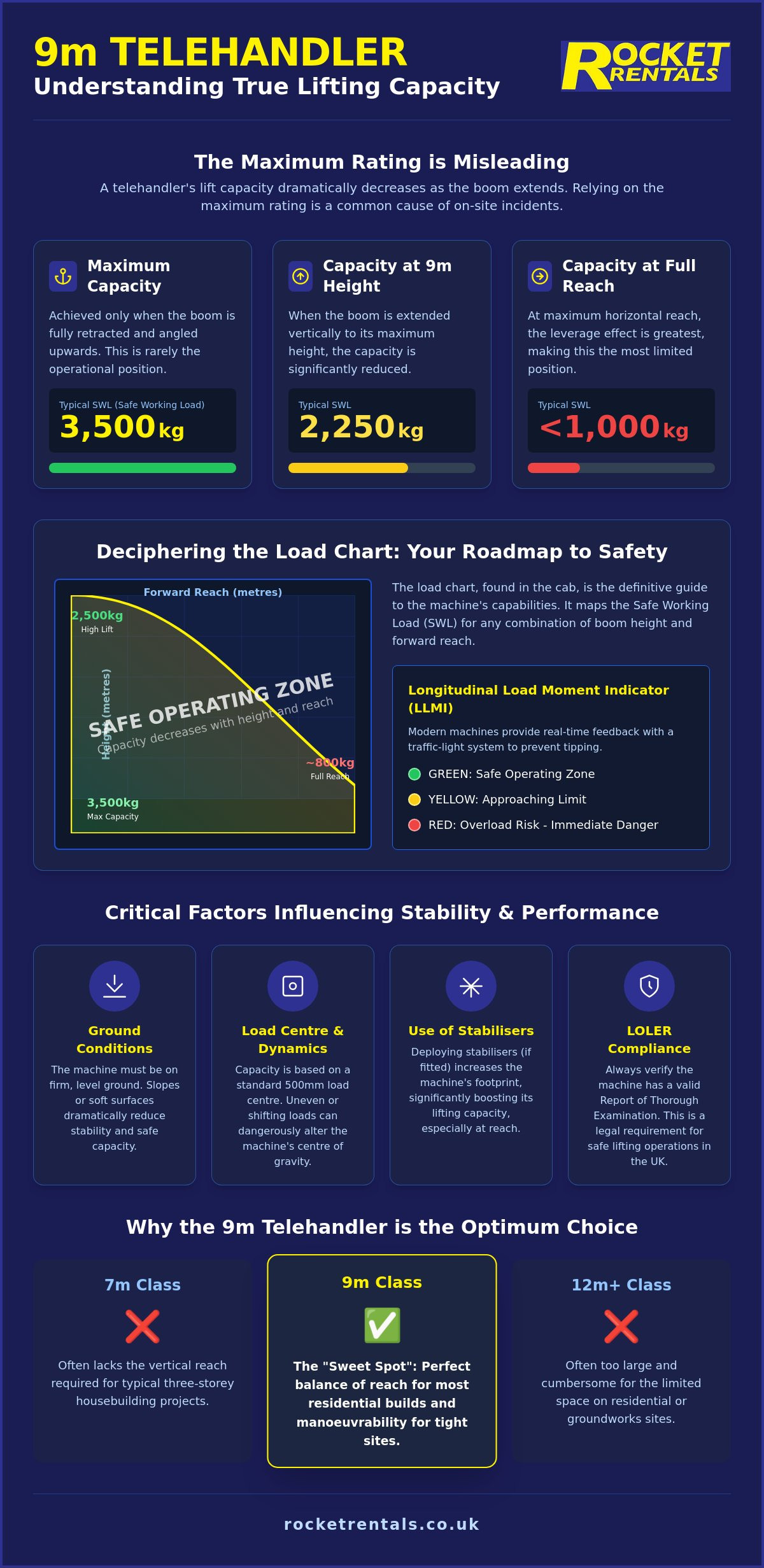
Maximum lift capacity is the headline figure you see on a spec sheet. It's usually achieved when the boom is fully retracted and raised to a high angle. However, this is rarely the position the machine is in during a typical task. As soon as you extend the boom forward or upwards, the operational capacity drops significantly. This occurs because the machine's centre of gravity shifts, reducing stability. The load centre refers to the distance from the heel of the forks to the centre of gravity of the load, which is standardised at 500mm for most UK pallets.
Typical Specs for the 9m Class
Whilst models vary, most machines in this category, such as a JCB 533-105 or similar, provide a maximum lift of roughly 3,300kg. It's vital to note that when the boom is fully extended to its 9-metre height, this capacity often reduces to between 2,000kg and 2,500kg. Relying on general industry averages can lead to dangerous overloading.
Maximum Capacity: 3,000kg to 3,500kg (boom retracted).
Capacity at 9m Height: 2,000kg to 2,500kg (boom vertical).
Capacity at Full Forward Reach: Significantly lower, often under 1,000kg.
You should always check the specific manufacturer's plate located inside the cab of the hired machine before commencing any lift. Every machine is different, and the plate provides the only definitive data for that specific unit's safe operation.
Deciphering the Load Chart: Reach vs. Weight Distribution
The load chart is the single most critical document found inside the cab of any machine. It's the operator's roadmap to safety. When reviewing your 9m telehandler lifting capacity, the chart reveals a stark truth: distance is the enemy of stability. Every chart is structured using two primary axes. The Y-axis represents the boom height or vertical lift, whilst the X-axis indicates the horizontal forward reach. By finding the intersection of these two points, an operator can determine the Safe Working Load (SWL) for a specific boom position.
Modern machines often supplement these physical charts with digital Longitudinal Load Moment Indicators (LLMI). These monitors use a traffic-light colour system to provide real-time feedback. Green indicates a safe operating zone; yellow warns that the machine is approaching its limit; red signifies an immediate risk of tipping. These systems work in tandem with boom angle indicators, which are either mechanical scales on the side of the boom or digital readouts on the dashboard. Maintaining a steep boom angle keeps the load closer to the machine's centre of gravity, which maximises lifting potential.
Capacity at Maximum Forward Reach
Forward reach is typically the most limiting factor for any 9m machine. As the boom extends horizontally, the leverage exerted by the load increases exponentially. For instance, whilst a machine might be rated for 3,500kg, its capacity at full forward reach could drop as low as 500kg to 1,000kg. This is a vital consideration when you need to reach across a deep foundation trench or place materials onto a distant scaffold platform. Always calculate the horizontal distance from the front tyres to the landing point before attempting the lift.
The Impact of Stabilisers on Lifting Performance
There is a significant difference between a machine's capacity when lifting "on tyres" versus "on stabilisers". Using outriggers increases the machine's footprint and shifts the tipping point further forward, which allows for much higher capacities at height. For many 9m models, reaching the full vertical extension with a heavy load is only permissible when the stabilisers are fully deployed. Safety protocols demand that these are always set on firm, level ground. If you are operating on soft soil, the use of spreader plates is essential to prevent the jacks from sinking. If you are unsure which machine suits your specific site requirements, our team provides expert guidance alongside our professional telehandler hire options.
Factors Influencing Lifting Performance and Site Stability
Ground conditions are a primary factor in maintaining the integrity of any lift. Whilst a level concrete pad offers the most predictable environment, construction sites are rarely so accommodating. Soft or uncompacted soil can cause the machine's centre of gravity to shift unexpectedly as the boom extends. If one tyre sinks even slightly, the resulting tilt is amplified at the tip of a 9-metre boom, potentially leading to a lateral tip-over. It is essential to assess the ground bearing capacity before positioning the machine, particularly when working near excavations or backfilled areas.
The nature of the load itself is equally important. We often speak of static capacity, but site work is inherently dynamic. Moving a load across a site introduces forces that do not exist when the machine is stationary. Sudden braking or turning with an elevated load creates a pendulum effect, which can quickly exceed the 9m telehandler lifting capacity. Modern Load Moment Indicators (LMI) are designed to prevent such over-tipping by monitoring the weight on the rear axle. When the system detects the rear wheels are becoming light, it will lock out boom extension and lowering, allowing only the safer retraction of the boom to restore stability.
Environmental factors, particularly wind speed, are often overlooked. Bulky materials like insulation packs or large timber sheets act as sails in high winds. When these are lifted to the full 9m height, the lateral pressure can compromise stability. Most manufacturers specify a maximum wind speed for safe operation, though this should be reduced significantly for high-surface-area loads that are harder to control.
Tyre Pressure and Machine Level
A machine is only as stable as its foundation. Pneumatic tyres act as the machine's primary suspension; if pressures are uneven, the machine will not sit level. A slight slope of just a few degrees can reduce your safe lifting capacity by a significant margin. Operators must perform daily pre-start checks including:
Verifying all tyre pressures match the manufacturer's specification.
Inspecting sidewalls for cuts or bulges that could lead to a blowout under load.
Ensuring the chassis is level using the bubble indicator or digital display.
If the machine is equipped with a chassis levelling feature, it should be used to square the machine before the boom is raised.
Attachment Weight and Load Centres
The Safe Working Load (SWL) assumes you are using standard forks. If you swap to a bucket, grapple, or crane jib, you must subtract the weight of that attachment from the machine's rated capacity. In many material handling scenarios, mini excavator hire is used alongside telehandlers to manage smaller, more precise ground-level tasks, allowing the telehandler to focus on high-reach placement. Non-standard loads, such as long timber or oversized crates, shift the load centre further forward. This reduces the 9m telehandler lifting capacity because the weight is no longer balanced at the standard 500mm centre, effectively making the load feel heavier to the machine's stability sensors.
Operational Safety and LOLER Compliance for Telehandler Hire
Compliance with the Lifting Operations and Lifting Equipment Regulations 1998 (LOLER) is a legal necessity on every UK construction site. These regulations ensure that all lifting activities are planned, supervised, and carried out safely. Central to this is the Report of Thorough Examination. This document acts as a "MOT" for the machine, proving it has been inspected by a qualified engineer within the required timeframe. You should never accept a delivery of hired plant without verifying this report is current and valid for the duration of your project.
A designated "Competent Person" must oversee the planning of any lift. This individual is responsible for assessing the risks and ensuring that the chosen 9m telehandler lifting capacity is sufficient for the specific weights and reaches involved in the task. They must account for the factors discussed previously, such as ground stability and environmental conditions. Alongside this planning, the operator must hold a valid CPCS or NPORS card. Professional certification is the only way to guarantee that the person behind the controls understands the nuances of load charts and machine behaviour under load.
Daily Checks and Maintenance Records
Safety doesn't end with the initial paperwork. Operators have a daily duty to perform visual and functional inspections before starting the engine. This includes checking the boom for cracks, inspecting hydraulic hoses for leaks, and ensuring the wear pads and lifting chains are in good condition. At Rocket Rentals, we take this responsibility seriously. Every machine in our fleet undergoes a rigorous multi-point safety check and service before it leaves our depot. This ensures you receive a machine that is not just functional, but reliable. For complex or repetitive high-reach tasks, we recommend maintaining a site-specific lift plan that details every manoeuvre and weight calculation.
Safe Working Zones and Exclusion Areas
Establishing clear exclusion zones is vital for protecting ground workers. No one should ever stand beneath the arc of a moving boom or under a suspended load. Clear signage and physical barriers help define these "no-go" zones. Effective communication is the next line of defence. A trained banksman or signaller should always be present when visibility is restricted, using standardised hand signals or two-way radios to guide the operator. It's also worth remembering that telehandlers are designed for moving materials; using them to lift personnel on forks is strictly prohibited. If your project requires safe access for workers at height, our electric scissor lift hire provides a purpose-built, compliant solution.
To ensure your site meets the highest safety standards, you can view our full range of certified telehandlers and speak with our expert team about meeting your specific LOLER requirements.
Why a 9m Telehandler is the Optimum Choice for Your Project
Choosing the right machinery often involves a trade-off between power and agility. Whilst a 7m unit is compact, it often falls short when reaching the higher scaffolding levels of a three-storey residential build. Conversely, a 12m or 17m machine provides impressive height but can be difficult to position on a busy, restricted site. The 9m model sits in the "Goldilocks" zone, providing enough height to clear standard rooflines whilst retaining the compact dimensions required for modern housing developments. Understanding the 9m telehandler lifting capacity in this context allows site managers to maximise their equipment's utility without the expense or logistical footprint of larger plant.
Transport logistics are another significant factor in project planning. Because 9m machines are lighter and more compact than their high-reach counterparts, they often fit on smaller transport trailers. This can lead to lower delivery costs and easier access to sites with narrow entrance gates or weight-restricted access roads. It's an efficient choice that balances operational performance with project economy, making it the definitive all-rounder for the UK construction industry.
Manoeuvrability in Tight Spaces
How does a machine this capable navigate a cluttered site? The answer lies in its sophisticated steering modes. Most 9m models feature 4-wheel steering for an incredibly tight turning circle and crab steer for diagonal movement near walls or trenches. This level of control is essential when you're balancing the 9m telehandler lifting capacity against the physical space available to manoeuvre. A 9m machine can often operate comfortably in areas where a 17m unit would simply be too large to turn, allowing you to place materials closer to the point of use and reduce manual handling.
Securing Reliable Plant Hire Nationally
Partnering with a specialist like Rocket Rentals ensures you're backed by a "safe pair of hands" for your project. Our focus on self-drive hire means you maintain complete control over your project timelines and operator standards. Every machine in our fleet is high-specification and rigorously maintained, ensuring that when you need to rely on your plant, it's ready to perform. Choosing a modern, reliable machine reduces the risk of downtime and keeps your site running at peak efficiency. We pride ourselves on providing the technical expertise needed to help you select the perfect machine for your specific task.
If you're ready to secure the right equipment for your next build, explore our full range of telehandlers and book your hire today.
Securing Safety and Efficiency for Your Next Lift
Mastering 9m telehandler lifting capacity is about more than reading a spec sheet; it is about the practical application of load charts to ensure every lift is executed with precision. By respecting the relationship between boom extension and stability, you protect both your team and your project timeline. We have explored how the 9m class offers the perfect balance of reach and manoeuvrability, making it a dependable choice for diverse UK construction tasks.
Choosing a reliable partner is just as critical as the technical calculations. Rocket Rentals provides a modern, low-hour fleet that is fully LOLER certified, offering you peace of mind from delivery to project completion. With our national support and commitment to professional standards, we act as a safe pair of hands for your plant requirements.
Ready to equip your site with the industry's most versatile all-rounder? View 9m Telehandler Specifications and Hire Rates to find the ideal machine for your requirements. We look forward to supporting your next successful build with the professional care your project deserves.
Frequently Asked Questions
What is the maximum weight a 9m telehandler can lift?
A 9m telehandler can typically lift a maximum weight of 3,000kg to 3,500kg when the boom is fully retracted and at a steep angle. This headline figure represents the machine's absolute limit under ideal conditions. However, the 9m telehandler lifting capacity reduces as the boom is extended or raised. You should always consult the specific load chart in the cab, as different models have unique performance profiles based on their engineering.
Can a 9m telehandler lift a full pack of bricks to the second floor?
Yes, a 9m machine is well-equipped to lift a standard pack of bricks, which usually weighs around 1,500kg, to a second-floor height. Since these machines often retain a capacity of over 2,000kg at their full vertical extension, they are ideal for this task. It's essential to ensure the machine is level and the load is centred on the forks before beginning the lift to maintain stability and safety.
Do I need a special licence to operate a 9m telehandler on a UK site?
On most professional UK construction sites, you'll need a CPCS or NPORS card to operate a telehandler. These certifications prove you've undergone rigorous training to handle high-reach machinery safely. Whilst a standard UK driving licence is required if you're driving the machine on public roads, site managers will require specific plant certification to comply with insurance requirements and health and safety regulations like PUWER.
What happens if the Load Moment Indicator (LMI) starts beeping?
If the LMI begins to beep or flash, you must stop all boom movements immediately. This audible warning indicates that the machine is approaching its stability limit and is at risk of tipping. To restore safety, you should slowly retract the boom to bring the load closer to the machine's centre of gravity. Don't attempt to lower or extend the boom further until the warning signal has stopped.
Is a 9m telehandler better than a 7m machine for housebuilding?
For modern housebuilding, the 9m machine is often the superior choice because it can comfortably reach the roofline of three-storey properties. Whilst a 7m machine is excellent for ground-level tasks and standard two-storey builds, it lacks the versatility for higher scaffolding. The 9m model provides that extra reach whilst remaining compact enough to navigate tight residential plots, making it a more flexible all-rounder for most developers.
How much does the lifting capacity drop at full forward reach?
The lifting capacity drops dramatically at full forward reach, often falling below 1,000kg. As the boom extends horizontally, the leverage exerted by the load increases, which shifts the machine's tipping point. For example, a machine with a 3,500kg maximum rating might only handle 500kg at its furthest extension. Always verify the 9m telehandler lifting capacity on the manufacturer's chart before attempting to reach across deep foundations or trenches.
Are stabilisers always required when lifting to 9 metres?
Stabilisers aren't always mandatory for every lift, but they are essential for achieving the machine's full rated capacity at height. Lifting on tyres is possible for lighter loads, but it offers a much smaller margin for error. For any lift approaching the 9-metre limit or involving heavy materials, deploying outriggers on firm ground is the safest practice. It significantly increases the machine's footprint and prevents the suspension from compressing.
Does Rocket Rentals provide CPCS operators with the telehandler hire?
No, Rocket Rentals is a specialist in self-drive plant hire. We provide high-specification, well-maintained machinery, but we don't provide the operators. This model gives you full control over your project's schedule and allows you to use your own trusted, CPCS-certified staff. We focus on ensuring the equipment is delivered in peak condition and fully compliant with all LOLER regulations, acting as a reliable partner for your project.


Comments