
Access Platform Hire Regulations UK: The Professional Compliance Guide 2026
- Rocket Rentals
- 3 hours ago
- 12 min read
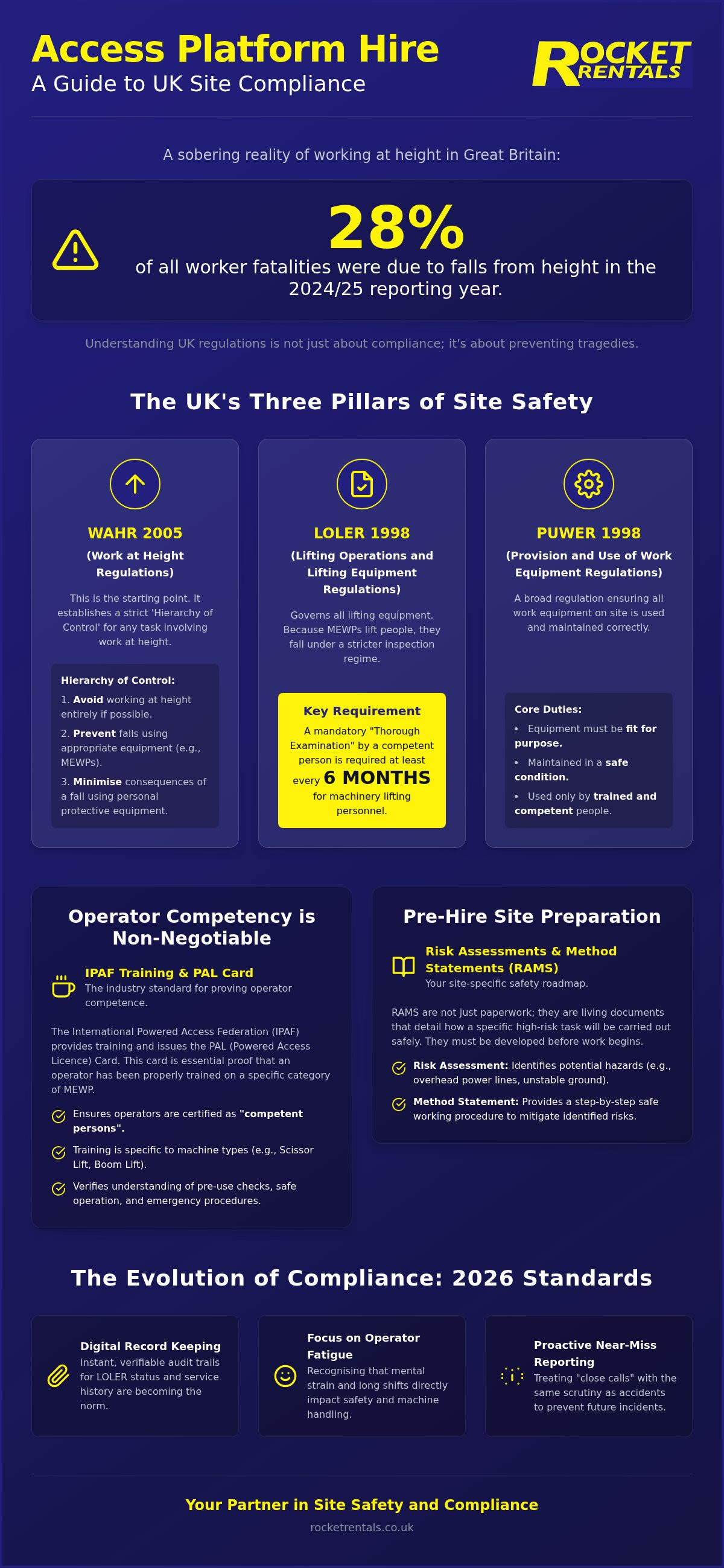
Did you know that falls from height accounted for 28% of all worker fatalities in Great Britain during the 2024/25 reporting year? It's a sobering figure that highlights why staying current with access platform hire regulations UK is more than just a box-ticking exercise. It's a fundamental part of keeping your team safe and your projects on track. We understand that the division of responsibility between the site operator and the hire company can often feel blurred, especially when you are focused on meeting tight deadlines.
You want the peace of mind that comes from knowing every piece of equipment is fully compliant before it even arrives on site. This guide provides a definitive roadmap to mastering your legal obligations, ensuring you can operate with total confidence and avoid the risk of HSE fines or costly site shutdowns. We recognise the importance of being a dependable partner in your safety journey.
We'll clarify the latest 2026 updates to IPAF categories, break down your specific duties under PUWER and LOLER; we also provide a streamlined approach to site safety audits. By the end of this article, you'll have the clarity needed to select the right machinery and trained operators for any task.
Table of Contents
The UK Regulatory Landscape for Access Platform Hire
The Health and Safety at Work Act 1974 remains the bedrock of site safety in Britain. It places a clear, non-negotiable duty on both employers and hire companies to ensure that all work equipment is fit for purpose and safe for use. For those managing projects, understanding the nuances of access platform hire regulations UK is essential to maintain a safe working environment. These regulations aren't merely administrative hurdles; they're designed to protect lives by preventing the two most common causes of site accidents: falls from height and mechanical failure.
In technical documentation and safety audits, these machines are officially classified as Mobile Elevating Work Platforms (MEWPs). However, the industry often uses the broader term Aerial work platform (AWP) to describe the various scissor lifts and boom lifts found on UK sites. The core objective of the current regulatory framework is to ensure that every lift is planned, supervised, and carried out in a safe manner. Failing to meet these standards carries heavy penalties. The Health and Safety Executive (HSE) has the power to issue Prohibition Notices that stop work immediately, and courts now regularly impose unlimited fines for serious safety breaches.
The Role of the Health and Safety Executive (HSE)
The HSE acts as the national regulator, possessing the authority to inspect sites and enforce safety standards without prior notice. They categorise access platform incidents into specific risk profiles, such as entrapment, overturning, or falls from the platform. To stay compliant, businesses should adhere to Approved Codes of Practice (ACoPs). These documents provide a "safe harbour" for operators; if you can prove you've followed the ACoP, you're generally considered to have met your legal obligations. The HSE uses these standards to determine whether a site has taken "reasonably practicable" steps to ensure safety.
Why 2026 Standards Demand Greater Transparency
Compliance in 2026 has moved firmly into the digital age. The days of relying on faded paper certificates tucked into a machine's manual box are ending. Modern standards now favour digital compliance records that provide an instant, verifiable audit trail of a machine's service history and its LOLER status. There's also a significant shift in how the industry views operator safety. Current regulations place a higher premium on "soft" safety factors, including:
Operator Fatigue: Recognising that long shifts and mental strain directly impact machine handling.
Digital Near-Miss Reporting: Treating a "close call" with the same level of scrutiny as an actual accident to prevent future fatalities.
Real-Time Documentation: The expectation that Risk Assessments and Method Statements (RAMS) are accessible to everyone on the ground, not just stored in a site office.
Adopting these transparent practices doesn't just keep you on the right side of the law. It builds a culture of reliability that protects your workforce and your reputation.
Key Legislation: Understanding WAHR, LOLER, and PUWER
What makes UK site safety so robust? It's the layered approach provided by three core pieces of legislation. These regulations work in tandem to ensure that every lift is planned, every machine is maintained, and every operator is protected. When you manage a site, staying on top of access platform hire regulations UK means understanding how the Work at Height Regulations 2005 (WAHR), LOLER, and PUWER overlap to form a comprehensive safety net.
WAHR 2005 is the starting point for any vertical task. It establishes a strict hierarchy of control. First, you must avoid working at height if the job can be done from the ground. If height is unavoidable, you're legally required to use equipment that prevents falls, such as a scissor lift with integrated guardrails, before resorting to personal fall protection. This legislation ensures that the method of access is always the safest possible choice for the specific task at hand.
LOLER: The Six-Month Inspection Rule
The Lifting Operations and Lifting Equipment Regulations 1998 (LOLER) apply specifically because MEWPs are designed to lift people. Because the risks are higher when personnel are involved, these machines require a "thorough examination" every six months, rather than the standard twelve months used for general lifting gear. It's vital to distinguish between a pre-use check and a thorough examination. A pre-use check is a daily visual inspection performed by the operator, whilst a thorough examination is a rigorous, independent audit of the machine's structural integrity. In 2026, LOLER compliance for hired access platforms remains a strict legal mandate requiring a valid Report of Thorough Examination issued within the last six months by an independent competent person. You should always check for this documentation before a machine is put into service on your site.
PUWER: Maintenance and Suitability
Whilst LOLER focuses on the lifting mechanism, the Provision and Use of Work Equipment Regulations 1998 (PUWER) covers the machine as a whole. PUWER requires that all work equipment is suitable for its intended use and maintained in an efficient state. This means ensuring a scissor lift designed for flat concrete isn't used on soft, uneven ground. Compliance involves keeping detailed maintenance logs and ensuring that all safety features, from emergency stops to tilt alarms, are fully functional. When you hire a scissor lift from a professional fleet, you're partnering with experts who handle these complex maintenance schedules for you. For further guidance on maintaining high standards, the IPAF training and licensing resources provide excellent frameworks for ensuring your team and equipment meet current UK expectations.
Training and Licensing: IPAF Categories and the PAL Card
The law requires that anyone operating a Mobile Elevating Work Platform (MEWP) must be a "competent person." This is a cornerstone of access platform hire regulations UK, ensuring that operators possess the necessary skills and technical knowledge to use machinery without risking themselves or others. Competence isn't just a vague term; it's a measurable standard that involves understanding machine stability, weight limits, and emergency lowering procedures. The International Powered Access Federation (IPAF) is the global authority that defines these standards, providing the industry-recognised training framework used across British construction sites.
For site managers, verifying these credentials is a critical part of the safety audit. When you choose self-drive hire, the legal responsibility for ensuring the operator is trained rests with the employer or site operator. You can find more detail on these specific duties in the UK Health & Safety Regulations for Powered Access resources. It's not enough to assume an operator is capable because they've used similar gear before; you must verify they hold the specific category of training for the machine they intend to use.
Common IPAF Categories for Site Work
IPAF divides machinery into distinct categories to ensure training is specific to the equipment's behaviour. The most common categories you'll encounter include:
Category 3a (Mobile Vertical): This covers machines that move vertically, such as standard scissor lifts. These are often driven whilst the platform is elevated.
Category 3b (Mobile Boom): This applies to self-propelled booms, commonly known as cherry pickers, which can reach out and over obstacles.
Category 1b (Static Boom): These are booms that remain static, such as spider lifts or van-mounted platforms that require outriggers for stability.
The PAL Card and Digital Verification
The Powered Access Licence, or PAL Card, serves as the primary proof of an operator's training. As of July 1, 2026, a new design for all IPAF certificates and Competent Assessed Person (CAP) cards has been phased in to enhance security and prevent fraud. Verification has also become significantly more efficient through the ePAL app. This digital tool allows site managers to perform real-time checks on an operator's credentials, ensuring the training is both genuine and current.
It's important to remember that IPAF training is valid for five years. Once this period expires, operators must complete a renewal course to maintain their PAL Card status. This cycle ensures that operators stay updated on the latest safety innovations and regulatory shifts. For projects in sensitive or enclosed spaces, such as electric scissor lift hire for clean indoor environments, checking that your operator holds a valid 3a category is a vital step in your compliance checklist.
Pre-Hire Site Assessments and RAMS
Compliance isn't just about the machine; it's about the environment in which it operates. Adhering to access platform hire regulations UK requires a proactive approach to site preparation. Site-specific Risk Assessments (RA) and Method Statements (MS) are fundamental to this process. These documents shouldn't be generic templates. They must reflect the actual conditions on your site to be legally valid and practically useful. A robust Method Statement provides a step-by-step guide on how the work will be performed, detailing the sequence of operations and the specific safety measures identified in the Risk Assessment.
Evaluating ground conditions is a critical step in meeting access platform hire regulations UK for safe operation. A common oversight is failing to assess ground bearing capacity. Whether you're hiring a scissor lift or a telehandler, you must ensure the surface can support the weight of the machine plus its maximum load. Using outrigger pads and spreader plates is often a mandatory requirement to distribute the load safely and prevent the machine from tipping on soft or uneven ground.
Conducting a Thorough Risk Assessment
Start by identifying overhead hazards. Power lines, low-hanging structures, and even nearby trees can become lethal obstacles if they aren't mapped out before work begins. You also need to manage the space around the platform. If you're working in a public area, traffic management and physical barriers are essential to keep pedestrians at a safe distance. According to 2026 safety data, falls from height remain the single most significant hazard for those operating access platforms on UK construction sites. Identifying these risks early allows you to implement the hierarchy of control effectively.
Emergency Rescue Planning
A rescue plan is a legal necessity, not an optional extra. If an operator becomes incapacitated or the machine fails, you need a clear, written procedure for getting them down safely. This requires at least one ground-based person who is fully trained in the machine's emergency lowering procedures. Modern machines often include secondary guarding systems to prevent operator entrapment; however, these are only effective if the ground crew knows how to override them in an emergency. You should test these emergency controls at the start of every shift to ensure they're operational. Ensuring your site is ready for a delivery is easier when you have the right support. You can view our range of self-drive plant to find the exact equipment specified in your safety plans.
Rocket Rentals: Supporting Your Site Compliance
Compliance isn't a task you should face alone. At Rocket Rentals, we position ourselves as a dependable partner, ensuring that your equipment meets every requirement of the access platform hire regulations UK before it even leaves our depot. Since 1988, we've built a reputation for providing high-quality, self-drive machinery to contractors who value reliability and safety as much as we do. We combine the scale of a national provider with the personal touch of an independent specialist, ensuring you're never just a number in a system.
Every machine in our fleet undergoes a rigorous Pre-Delivery Inspection (PDI). This isn't just a cursory glance; it's a methodical check to ensure the machine is in peak condition. Crucially, we guarantee that every scissor lift or telehandler is delivered with a valid LOLER certificate. This removes the administrative burden from your site team and provides the peace of mind that your equipment is fully compliant from day one. We don't just provide the machine; we provide the technical data sheets necessary for your Method Statements and Risk Assessments.
Our Fleet and Safety Standards
Our modern fleet is comprised of industry-leading scissor lifts and telehandlers designed for professional projects. This transparency allows you to integrate our equipment seamlessly into your site safety plans. By choosing our self-drive fleet, you maintain full control over your site operations whilst benefiting from our extensive maintenance standards. Our commitment to quality means we only supply machinery that we'd be happy to use ourselves.
Are you looking for a more comprehensive site solution? Beyond access, we offer a range of plant, including excavators and rollers. For instance, you can explore The Professional Guide to Mini Excavator Hire to see how we support efficiency across your entire project. Every piece of equipment we hire follows the same strict safety protocols, ensuring a uniform standard of care across your entire site.
Expert Advice for Complex Projects
Matching the right machine to specific site regulations can be challenging. Our team acts as a knowledgeable guide, helping you navigate the technical specifications required for your environment. Whether you're dealing with restricted floor loadings or need specific access platform hire regulations UK advice for indoor work, we're here to help. We also ensure you have the correct excavator attachments or telehandler tools for safe material handling, preventing the use of makeshift solutions that could compromise site safety.
If you're ready to secure equipment that meets the highest safety standards, Contact Rocket Rentals today for compliant access platform hire. We're ready to help you keep your site safe, efficient, and fully regulated.
Securing Your Site with Professional Compliance
Staying ahead of access platform hire regulations UK is about more than avoiding penalties; it's about fostering a culture of safety that protects your workforce every day. By mastering the overlap between WAHR, LOLER, and PUWER, you ensure that every lift is planned with precision and executed with the right equipment. Competence is a continuous process, from verifying IPAF categories to maintaining site-specific RAMS as living documents that adapt to changing conditions.
We're here to act as your safe pair of hands. Our modern fleet of scissor lifts and telehandlers is maintained to the highest standards, ensuring you receive full LOLER certification with every hire. Whether you need expert technical support for site assessments or reliable, self-drive machinery, our team provides the professional backing your project deserves. We're proud of our heritage and remain focused on helping you achieve modern efficiency without compromising on safety.
Explore our range of compliant access platforms for your next project and move forward with the confidence that your operations are fully regulated and secure.
Frequently Asked Questions
Who is legally responsible for the LOLER inspection on a hired access platform?
The hire company is responsible for ensuring the machine has a valid LOLER certificate before delivery. However, the site operator is responsible for ensuring the certificate remains valid whilst the machine is on hire. If the hire period exceeds the six-month inspection interval, the operator must coordinate with the hire company to facilitate a new examination. It's a shared duty to ensure compliance on site.
Do I need a special licence to operate a scissor lift on a private construction site?
Yes, you require proof of competence, which is typically demonstrated by holding a valid IPAF PAL Card. Whilst "licence" is the common term, the legal requirement under PUWER is for operators to be adequately trained. Most UK contractors won't allow operation without a PAL Card in the correct category. This ensures the operator understands the specific safety protocols for access platform hire regulations UK.
How often should pre-use checks be carried out on hired MEWPs?
Pre-use checks must be carried out at the start of every single shift or when a new operator takes control of the machine. These daily inspections involve checking hydraulic levels, tyre condition, and the functionality of emergency controls. Recording these checks in a logbook is essential for your safety audit trail. It's the operator's duty to ensure the machine is safe before any work at height begins.
What is the difference between IPAF 3a and 3b training categories?
The 3a category covers Mobile Vertical platforms, such as scissor lifts, which move straight up and down. The 3b category covers Mobile Boom platforms, commonly known as cherry pickers, which have an articulated or telescopic arm. Training is specific to the machine's behaviour and stability characteristics. Holding a 3a card doesn't legally qualify you to operate a 3b machine; you must be trained for the specific equipment type.
Is a harness mandatory when operating a scissor lift in the UK?
A harness isn't usually mandatory in a scissor lift unless the site's specific risk assessment or the manufacturer's instructions dictate otherwise. Scissor lifts provide collective fall protection through their guardrails. However, in boom-type platforms, a full-body harness with a short restrained lanyard is a strict requirement to prevent the operator from being catapulted out of the basket during a sudden movement or jolt. This remains a critical safety standard.
Can I use an access platform in high winds according to UK regulations?
You must never exceed the maximum wind speed limit specified by the machine's manufacturer, which is usually 12.5 m/s or approximately 28 mph. Every MEWP has a rating plate that details its safe operating limits. Operators should use an anemometer to check wind speeds at the platform's working height, as ground-level conditions can be deceptive. Operating in excessive winds poses a significant risk of the platform overturning.
What documentation should I receive from the hire company upon delivery?
You should receive a valid Report of Thorough Examination and the manufacturer's operator manual. The hire company should also provide a Pre-Delivery Inspection record to prove the machine was checked before arrival. It's best practice to check these documents against the machine's serial number immediately. These records are vital for demonstrating your adherence to access platform hire regulations UK during any HSE site inspection or safety audit.
What are the requirements for a MEWP rescue plan?
A rescue plan must be a written document that details how an operator will be safely lowered if they become incapacitated or if the machine fails. It's a legal requirement under the Work at Height Regulations 2005. The plan must identify a ground-based person who is trained in the machine's emergency controls. Simply relying on the emergency services isn't an acceptable rescue strategy for professional UK construction sites.


Comments