
Affordable Plant Hire Solutions: A Professional Guide to Cost-Effective Site Management
Updated: Aug 25
Is the cheapest weekly rate actually costing your project more in the long run? True efficiency on site requires more than just a low price tag. Finding affordable plant hire solutions isn't just about chasing the lowest headline figure; it's about the total value brought to your operations. You've likely felt the frustration of a budget-friendly machine arriving late, or worse, breaking down and stalling your entire crew. It's exhausting to manage multiple contracts while worrying about hidden delivery fees or being overcharged for an excavator that's far too large for the task.
We understand that reliability is the foundation of any successful build. This guide will show you how to secure a high-specification, modern fleet whilst actually reducing your total project expenditure through strategic machinery choices. We'll explore how selecting the right self-drive equipment and leveraging specialised attachments can streamline your site management and eliminate unnecessary administrative overheads. By focusing on precision and fleet quality, you can ensure your project remains productive, safe, and strictly on budget.
Table of Contents
Defining Affordability in Modern Plant Hire
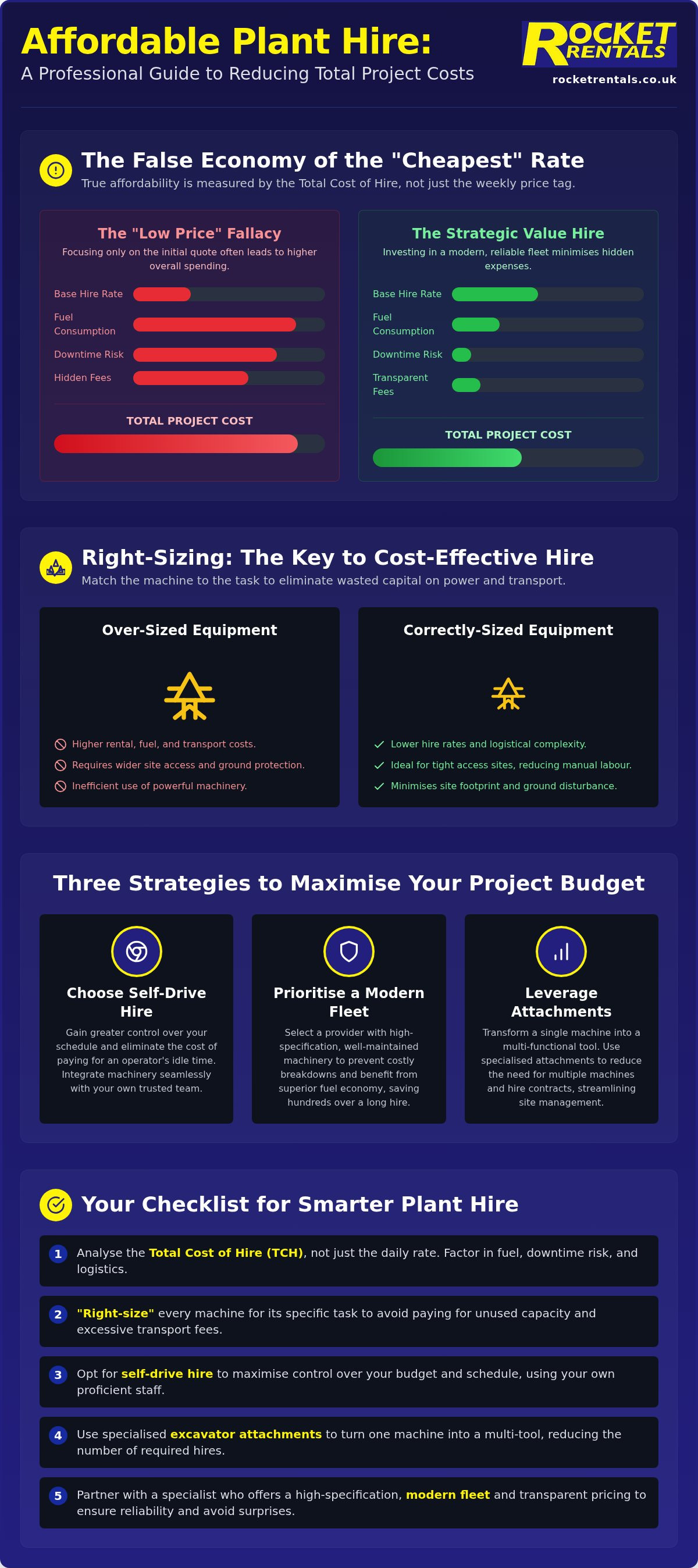
For many site managers, the initial quote is the only figure that seems to matter during the procurement phase. However, focusing solely on the lowest daily rate is a common trap that frequently leads to the most expensive project outcomes. True affordability is found by looking at the bigger picture. The equipment rental industry has shifted toward a model where efficiency and reliability dictate the final balance sheet more than the headline rental price. To find genuine affordable plant hire solutions, one must adopt the Total Cost of Hire (TCH) framework.
This approach requires an analysis of every expense associated with a machine's presence on site. A professional TCH evaluation includes:
Base rental fees: The standard daily or weekly cost.
Fuel and fluid consumption: Older machines often burn significantly more diesel.
Logistical costs: Delivery and collection fees that aren't always transparent.
Productivity rates: How quickly the machine completes the task.
The risk of downtime: The cost of a crew standing idle during a breakdown.
By using this framework, it becomes clear that a slightly higher rate for a premium, modern machine is often the more economical choice. Self-drive hire further enhances this budget control. Unlike operated plant, where you pay for a driver's time regardless of machine usage, self-drive options allow you to integrate the machinery into your own workflow, using your trusted staff to maintain peak productivity.
The Hidden Costs of Unreliable Machinery
Downtime is the silent killer of construction budgets. When a machine fails, the financial impact ripples through the entire site. You aren't just losing the hire fee for that afternoon; you're paying for operators who cannot work and potentially facing liquidated damages for missing project milestones. Modern, high-specification fleets, like those provided by Rocket Rentals, are maintained to exacting standards to prevent these interruptions. Newer engines also offer better fuel economy, which can save a project hundreds of pounds over a long-term hire period. Reliability isn't a luxury; it's a fundamental requirement for cost-effective site management.
Value vs. Price: A Professional Perspective
Choosing a partner based on their quote alone ignores the value of expert support. Independent specialists often provide a level of care that large national aggregators cannot match. They offer transparent hire agreements that eliminate end-of-contract surprises, such as unexpected cleaning fees or damage disputes. When you hire an excavator or telehandler, you're investing in the success of your project. Partnering with a provider that prioritises fleet readiness and clear communication ensures that your "affordable" solution stays that way until the final invoice is settled.
Right-Sizing: The Key to Cost-Effective Machinery Hire
Precision is the hallmark of professional site management. Hiring a 20-tonne excavator for a task that a 6-tonne machine could handle isn't just inefficient; it's a direct drain on your project's profitability. You pay more for the rental, more for fuel, and significantly more for transport. True affordable plant hire solutions rely on matching the machine's capabilities exactly to the site's requirements. This process, known as right-sizing, ensures you don't waste capital on unused power or reach.
Selecting the wrong machine size often causes a cascade of secondary costs. A machine that is too large might require extra ground protection or wider access routes. Conversely, a machine that is too small takes longer to complete the work, extending the hire duration and increasing labour costs. Finding the sweet spot is essential for maintaining a lean budget. It's about balance. Every piece of equipment on your site should be working at its optimum capacity.
Mini Diggers and Small Excavators for Targeted Efficiency
Often, the most cost-effective choice is the smallest one that can safely perform the job. Selecting a 1.5-tonne mini digger instead of a larger model can drastically reduce hire rates and logistical complexity. These compact machines excel in tight access environments where larger plant simply cannot operate. By using them, you eliminate the need for expensive manual labour in confined spaces. For a deeper look at how these machines impact your bottom line, see The Professional Guide to Mini Excavator Hire. Their small footprint also means they are easier to transport, further lowering your overheads.
Maximising Telehandler Utility
Telehandlers are the workhorses of the modern site. Their versatility is a key component of a lean budget. Why hire a separate forklift and a small crane when a single telehandler with the correct reach can perform both roles? It's vital to select the right lift capacity from the outset. Over-specifying leads to higher costs, whilst under-specifying creates safety risks and delays. Matching the machine to your specific material handling needs ensures you aren't paying for unused potential. A well-chosen telehandler keeps materials moving without the need for multiple, redundant machines.
Similar logic applies to dumper hire. A dumper that is too small for your excavator will lead to slow cycle times and fuel waste. If the dumper can't keep up with the digging pace, your excavator sits idle. Conversely, a dumper that is too large for the task will burn more fuel than necessary. Balancing your fleet ensures every piece of equipment is working at its optimum level. If you're unsure about the exact specifications needed for your next phase, you can browse our modern fleet options to find the most efficient match for your site.
Self-Drive vs. Operated Plant: Maximising Your Project Budget
Deciding between self-drive and operated plant is one of the most impactful choices a site manager makes. Whilst operated plant offers a turnkey solution, it comes with a significant financial premium that often outweighs the convenience for professional contractors. Seeking truly affordable plant hire solutions usually leads established firms toward the self-drive model. This approach places the control back into your hands, allowing you to manage your own personnel and schedule without being tethered to an external operator's availability or agency markups.
For firms with their own qualified staff, self-drive hire is almost always the more economical path. It provides the flexibility to adjust your workflow on the fly. If a task is completed ahead of schedule, your operator can immediately move the machine to the next phase of the project. This level of agility is difficult to achieve when coordinating with third-party operators who may have strict start and finish times.
Financial Breakdown of Self-Drive Efficiency
The financial benefits of self-drive hire become particularly evident during longer projects. When you hire an operator, you aren't just paying for the machine; you're paying for their expertise, insurance, and the hire company's profit margin on that labour. Over a month-long project, these costs accumulate rapidly. Perhaps more importantly, self-drive hire eliminates the "dead money" associated with operator downtime. If a site is stalled due to a late material delivery or a sudden downpour, you aren't paying a premium for a hired operator to sit idle. Your own staff can be redeployed to other tasks, ensuring your budget remains productive. This flexibility also extends to working hours, as you don't face overtime premiums from a hire company if a task runs slightly over the standard day.
Training and Compliance for Site Teams
Transitioning to a self-drive model requires a commitment to operator competence. Professional sites require operators to hold recognised qualifications, such as CPCS (Construction Plant Competence Scheme) or NPORS (National Plant Operators Registration Scheme). Investing in your team's training isn't just a compliance exercise; it's a strategic move that enhances your site's long-term efficiency. When your staff are familiar with a modern fleet of telehandlers and excavators, they work faster and more safely. A reputable hire partner will always provide a thorough handover and safety instructions, ensuring your team is fully prepared to operate the equipment within PUWER and LOLER regulations. This focus on internal skill sets, combined with the right "Hired-in Plant" insurance, creates a robust framework for cost-effective site management.
Site Efficiency Strategies to Reduce Hire Overheads
Maximising site output requires a shift in perspective. Instead of viewing each machine as a single-purpose tool, smart contractors look for ways to consolidate their fleet. This strategy is a core pillar of affordable plant hire solutions. Why pay for multiple transport fees and daily rates when a single well-equipped excavator can handle several phases of a project? Effective planning also extends to the logistical side of hire. By synchronising delivery and collection times, you can often reduce transport expenses and ensure machinery doesn't sit idle on its first or last day.
Attachments are often the most underutilised assets on a modern construction site. By adding a hydraulic breaker, an auger, or a specialised grading bucket to your excavator hire, you transform a standard digging machine into a multi-purpose powerhouse. This versatility often eliminates the need to hire additional plant, such as dedicated breakers or piling rigs. The right attachment can easily double the speed of groundworks, especially when matched to specific soil conditions. We recommend consulting with your hire partner early in the planning phase to ensure your excavator attachments are perfectly suited for the task at hand.
Integrating Welfare and Access Solutions
Site productivity depends heavily on the well-being of your operators. Providing high-quality welfare units isn't just a legal requirement; it's a strategic choice to keep your team on-site and focused. Mobile welfare units offer a particularly cost-effective solution for fast-moving projects where static cabins would be impractical to move. Similarly, choosing a scissor lift for short-term maintenance or installation tasks can be far more economical than erecting complex scaffolding. For projects requiring internal or clean-environment work, our Electric Scissor Lift Hire Guide explains how to maintain access efficiency without compromising on site standards.
A well-organised site is a profitable site. By integrating welfare, access, and versatile machinery into a single, cohesive plan, you reduce the administrative burden of managing multiple contracts. If you're ready to optimise your next project phase, you can view our full range of plant and attachments to find the most efficient combination for your specific needs.
Sourcing Professional Plant Hire with Rocket Rentals
For developers who have recently secured a site through Auction Property Ltd, the next critical decision is selecting the right equipment to bring the project to life.
Choosing a machinery partner shouldn't feel like a gamble. When you search for affordable plant hire solutions, the human element is just as critical as the machinery itself. Rocket Rentals positions itself as a dependable partner for contractors who value control, safety, and transparency. By focusing strictly on self-drive equipment, we provide the high-specification fleet you need without the unnecessary administrative layers or hidden costs often found with larger, less specialised providers. This focus ensures you get the best machinery for your project without the "fluff" of managed services you don't require.
Working with an independent specialist allows for a more agile response to your site's needs. We don't just supply iron; we offer decades of technical knowledge to ensure you have the right tool for the task. This collaborative approach helps you avoid the common pitfalls of over-specification or equipment mismatch that we discussed earlier. It's about building a relationship based on trust and professional reliability.
Our Commitment to Quality and Safety
Maintenance is the cornerstone of our operation. Every excavator, dumper, and telehandler in our fleet undergoes rigorous inspections to ensure it arrives site-ready and compliant with PUWER and LOLER standards. Our "Safe Pair of Hands" approach combines the scale of a national provider with the dedicated, personal service of a specialist. We believe that a well-maintained machine is the most cost-effective machine. For a deeper technical overview of how we select and maintain our fleet, you can read our Professional Guide to Plant Machinery. This commitment to quality reduces the risk of on-site failures and keeps your project moving forward.
National Reach with a Specialist Touch
With a heritage stretching back to 1988, we've spent over 30 years refining our service to meet the demands of the professional construction industry. We support projects across the UK, providing reliable delivery and support wherever your site is located. This national reach doesn't come at the expense of our specialist touch. You still get direct access to experts who understand the nuances of groundworks, access, and material handling.
Streamlining your procurement is the final step in reducing site overheads. Setting up a trade account with Rocket Rentals is straightforward and helps to simplify your administrative burden through clear invoicing and prioritised support. This allows you to focus on site productivity whilst we handle the equipment logistics. If you're ready to secure a bespoke quote tailored to your specific project timeline and budget, contact our team today to discuss your requirements and find the most efficient path for your next build.
Optimising Your Project for Long-Term Success
Achieving real site efficiency is a matter of precision. By moving beyond the initial quote and focusing on the Total Cost of Hire, you ensure your budget remains productive from day one. Whether it's right-sizing your excavator or leveraging the versatility of self-drive telehandlers, the choices you make during procurement define your project's success. True affordable plant hire solutions aren't just about the lowest rate; they're about minimising downtime and maximising output through high-specification, reliable machinery.
At Rocket Rentals, we've spent over 35 years refining our service to meet the exact needs of professional contractors. Our comprehensive fleet of modern excavators, telehandlers, and site welfare units is maintained to the highest standards, ensuring you have a safe pair of hands for every phase of your build. We're dedicated to providing a professional, self-drive service that empowers you to maintain total control over your site schedules and costs. It's about providing the reliability you need to focus on the work that matters.
Ready to optimise your next project? View our full range of professional plant hire solutions and discover how a partnership built on expertise and reliability can transform your site management. We look forward to supporting your next successful project.
Frequently Asked Questions
What is the most affordable way to hire a mini digger for a long-term project?
Long-term affordability is best achieved through negotiated weekly rates and selecting a modern, self-drive mini digger. Self-drive options remove the continuous cost of an operator's salary, whilst newer machines offer superior fuel efficiency. For projects lasting several months, many contractors find that partnering with a specialist for affordable plant hire solutions provides the necessary transparency to avoid hidden fees. Ensuring you have a secure site also reduces the risk of insurance claims that can inflate project costs.
Do I need my own insurance for self-drive plant hire?
Yes, contractors are typically required to have "Hired-in Plant" insurance to cover equipment against theft, damage, or loss whilst in their care. This insurance is a standard requirement for professional self-drive hire agreements and protects both the hirer and the supplier. You should check that your policy cover limit matches the replacement value of the machinery. Most specialist commercial insurers provide this cover as a standalone policy or as an extension to your existing public liability insurance.
How can I reduce the fuel costs of hired plant machinery?
Reducing fuel costs starts with hiring modern, high-specification machinery equipped with the latest engine technology. Older plant often consumes significantly more diesel for the same output. You can further lower expenses by training operators to avoid unnecessary idling and by ensuring all daily maintenance checks are performed to keep the engine running at peak efficiency. Selecting the correct machine size for the task also ensures you aren't burning fuel on a machine that is over-powered for the job.
Is it cheaper to hire a telehandler or a forklift for site work?
A telehandler is often the more cost-effective choice for site work due to its superior versatility and reach. Whilst a basic rough-terrain forklift may have a lower initial hire rate, it lacks the forward reach and lift height required for most multi-storey construction or material distribution tasks. Hiring one telehandler that can perform the duties of both a forklift and a small crane reduces your total transport costs and simplifies your site logistics, ultimately saving money.
What site welfare units are legally required for small construction sites?
Under HSE regulations, all construction sites must provide adequate welfare facilities, including clean toilets, washing facilities with hot and cold water, and a sheltered area for rest and eating. For smaller or fast-moving projects, mobile welfare units are a highly efficient way to meet these legal requirements. These units combine mess rooms, toilets, and drying areas into a single towable cabin, ensuring your team remains productive and compliant without the need for permanent utility connections.
Can I hire excavator attachments separately or as part of a package?
Excavator attachments can be hired both as part of a machine package or as individual units, depending on your specific project needs. Integrating attachments like hydraulic breakers or augers into your initial hire agreement is often the most efficient way to secure affordable plant hire solutions. This allows you to transform a single excavator into a multi-functional tool, reducing the need for multiple machines on site. We recommend discussing your ground conditions early to ensure the correct attachment is provided.
How does right-sizing machinery help in staying under project budget?
Right-sizing prevents the financial waste associated with hiring machinery that is either too large or too small for the task. A machine that is too large incurs higher rental rates, increased fuel consumption, and higher transport fees. Conversely, a machine that is too small takes longer to complete the work, extending the hire duration and increasing labour costs. By matching the equipment's capacity to the specific site requirements, you optimise every pound spent on plant hire.
What certifications do my operators need for self-drive excavator hire?
Professional construction sites require operators to hold recognised qualifications such as the Construction Plant Competence Scheme (CPCS) or the National Plant Operators Registration Scheme (NPORS). These certifications demonstrate that the operator has undergone formal training and assessment for the specific category of machinery they are using. Whilst a standard driving licence might be sufficient for private land, professional site managers must ensure all operators are fully qualified to maintain safety standards and comply with PUWER regulations.


Comments