
Do You Need a Licence to Hire a Telehandler? UK Guide for 2026
What paperwork do you need to hire a telehandler, and what qualification does the operator need? If you’re asking, “do you need a licence to hire a telehandler?”, the key point is that arranging self-drive hire and proving operator competence are separate matters. On a private site, there isn’t a government-issued telehandler licence, but operators need suitable training and competence for the work.
It’s easy to confuse site qualifications with the driving entitlement needed for public roads. The requirements depend on where the machine will be used: operating on site is different from driving on a public roads. Preparing the operator’s training evidence and the site paperwork before the hire starts can help avoid delays.
This guide explains what to prepare before arranging hire, how schemes such as CPCS and NPORS may fit site requirements, and what changes if the telehandler will travel on a public road. Rocket Rentals Ltd is a family-run plant hire business offering self-drive telehandler hire, with a focus on equipment inspection. Have the operator and project details ready to help organise your hire.
Table of Contents
Do you need a licence to hire or operate a telehandler?
Arranging telehandler hire and being competent to operate the machine are separate matters. You can arrange a self-drive hire, but hiring the machine does not prove that you are qualified or authorised to use it. A telehandler, also called a telescopic handler, has an extending boom used to lift and place materials. The Telescopic handler overview describes common uses and types of machine.
So, do you need a licence to hire a telehandler? There isn’t a government-issued telehandler licence for operating one on a private site in the same way there is a driving licence for a car. The key site requirement is suitable training and the ability to demonstrate competence for the work. The employer or person in control of the site must ensure the operator is competent, and site rules may specify which evidence they accept.
A driving licence serves a different purpose. It relates to driving on public roads, while operator training or certification provides evidence of competence to use plant at work. If the telehandler will only be used on site, don’t treat a car driving licence as a substitute for operator competence evidence. Likewise, a site operator card does not by itself show that you can drive the machine on a public road.
What does a telehandler licence actually mean?
People often use “telehandler licence”, “ticket” or “certificate” informally to mean proof of operator training and assessment. It isn’t necessarily a driving licence or a single universal permit. Evidence may come from an operator training scheme, but whether it is accepted can depend on the site rules and the work involved. Find out the site’s requirements early, rather than relying on the name of a card alone.
Does hiring a telehandler automatically authorise you to operate it?
No. Self-drive hire supplies the machine, not an operator qualification or authorisation for a particular site. The person operating it must meet the relevant site requirements and be prepared for the task and machine. Before use, establish who will operate it, what work the telehandler will do, and what familiarisation or evidence the site expects. That preparation supports safe operation and helps keep the hire organised.
For example, a site may ask an operator to present competence evidence at induction or expect them to be familiar with the machine and planned lifting task. Requirements vary, so include operator preparation in the hire plan instead of leaving it until after the machine arrives. Make sure the intended operator and the person responsible for the site have the relevant details in advance. Rocket Rentals Ltd provides self-drive telehandler hire for professional projects.
Identify the task and the materials to be handled.
Find out what competence evidence and site arrangements apply.
Prepare the intended operator for the machine and the work.
Once these points are clear, you can choose a suitable training route and organise the hire around the job.
How to get telehandler operator training and prove your competence
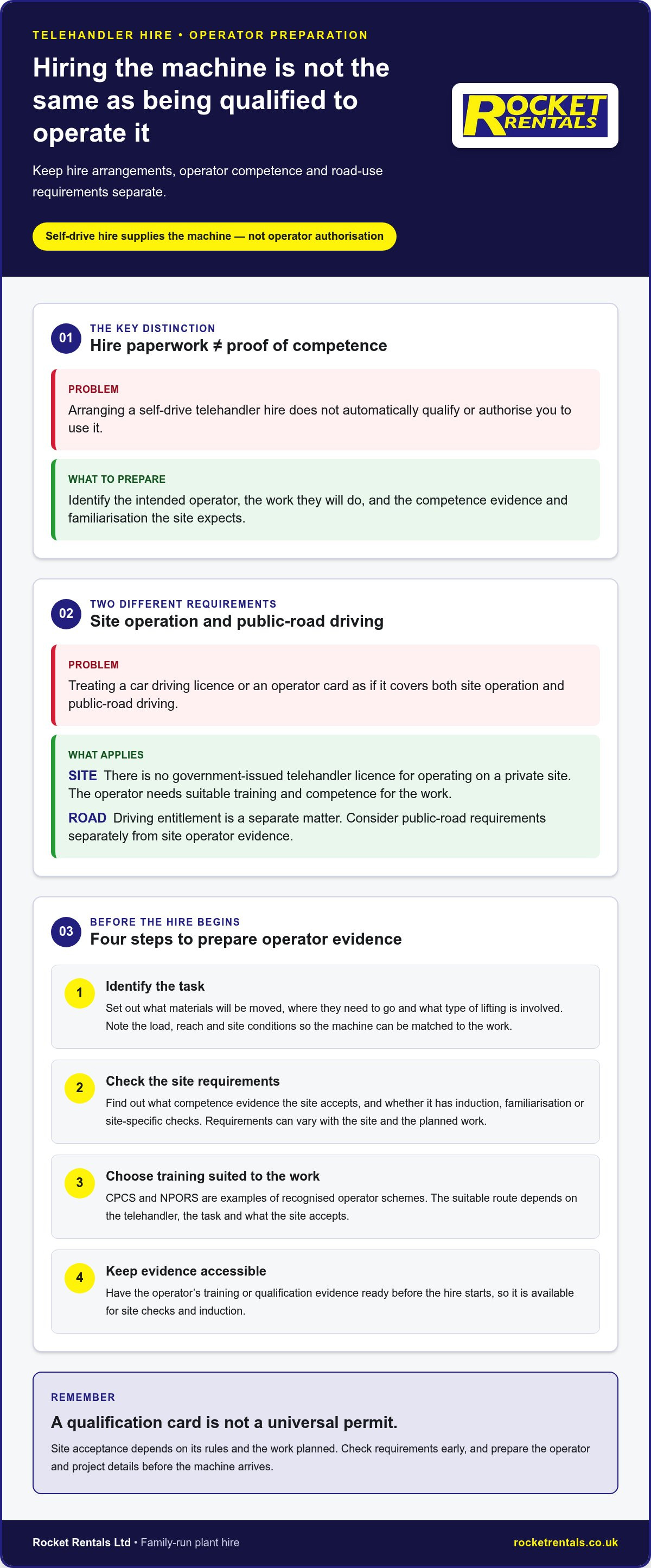
The distinction behind do you need a licence to hire a telehandler is that hire paperwork and operator competence are separate. Prepare the person who will use the machine by working through these steps before the hire begins:
Identify the task. Set out what materials will be moved, where they need to go and what type of lifting is involved. The work helps determine the skills and practical experience the operator needs.
Find out the site requirements. Establish what evidence the site expects and whether it has its own induction or familiarisation process. Site managers may apply their own checks, so don’t assume a qualification card will automatically meet every site’s requirements.
Select suitable training. Choose a training route that matches the telehandler and the planned work. CPCS and NPORS are examples of recognised operator schemes, but the right route depends on the task and the site’s acceptance requirements.
Keep evidence ready. Have the operator’s training or qualification evidence accessible before the hire starts. This makes it easier to provide for site checks and meet induction requirements in good time.
Choosing a suitable telehandler training route
Learning the controls is only part of preparing to operate a telehandler. The operator also needs to demonstrate practical competence by applying their knowledge to the machine and the work. Training should reflect the intended use, rather than being treated as a general qualification for every task. CPCS and NPORS are examples of recognised schemes. Consider current scheme guidance and the site’s requirements when choosing a route.
The job matters, too. Moving materials across a site and placing a load at a particular point can call for different practical skills. When identifying training needs, describe the planned work, the type of machine and the operator’s experience. This helps keep the training relevant, rather than relying on a certificate title alone.
Keeping operator evidence ready for site checks
Keep the operator’s current training or qualification evidence somewhere it can be accessed before the hire begins. A site manager may review it and require familiarisation or site-specific checks. Don’t assume one card guarantees access everywhere. Acceptance depends on the site’s rules and the work planned.
Training and practical assessment help operators build the knowledge and handling skills needed to use lifting equipment safely. Lifting work also needs appropriate planning: the Lifting Operations and Lifting Equipment Regulations 1998 (LOLER) set out requirements for lifting operations and equipment. Keep operator evidence with relevant job information so the site team can review the arrangements before work starts.
For self-drive work, preparation matters as much as the machine itself. Rocket Rentals Ltd is a family-run plant hire business with a focus on equipment inspection. You can view self-drive telehandler hire while planning the equipment for your project.
Telehandler use on site versus public roads: what changes?
Requirements depend on where the telehandler will be used. Operating within a controlled site is different from driving or moving the machine on a public road. If you’re asking do you need a licence to hire a telehandler, keep the two situations separate: site competence checks and road-driving rules apply to different activities.
Operating a telehandler within a worksite
For site work, the employer, site manager or principal contractor may set access and competence checks. A standard driving licence alone does not show that you can operate a telehandler. Before work starts, establish what evidence and familiarisation the site expects, and consult current Health and Safety Executive (HSE) guidance for workplace information. Site rules can differ, so prepare for the specific project.
For example, an operator working on a construction site may need to present competence evidence as part of site access, then complete any required machine familiarisation. That is separate from road-driving entitlement. Include the site’s requirements in the project plan so operator checks don’t become a last-minute issue.
Taking a telehandler onto a public road
Public-road use raises separate questions, even if the telehandler is only moving between nearby parts of a job. Before planning a road journey, identify the vehicle’s classification and check current DVLA guidance on the licence category that applies. Also verify registration, tax and insurance requirements using official sources. Don’t rely on general assumptions: the rules depend on the vehicle and its classification.
Use this practical check before any road journey:
Establish whether the planned route includes a public road.
Identify the telehandler’s vehicle class from its documentation.
Check the operator’s licence entitlement against current DVLA guidance.
Verify the relevant registration, tax and insurance arrangements.
Check age thresholds and licence categories against current official rules, rather than relying on general advice that may not fit the vehicle. If the telehandler will stay on site, focus on site competence, access requirements and task-specific familiarisation. If it will go onto a public road, treat that as a separate planning step and confirm the road-use requirements before the journey.
How to prepare before arranging a self-drive telehandler hire
A clear plan helps you arrange a machine suited to the work and prepare the operator before it arrives. “Do you need a licence to hire a telehandler?” is only one part of that preparation. For self-drive hire, think through the task, site access, operator evidence and hire period as well.
Describe the task. Note what you need to lift and where the materials must be placed. Include the working area and ground conditions, as these can affect the choice of machine.
Set out the lift requirements. Consider the load, required height and reach, and the route the telehandler will take. These details help guide machine selection, rather than relying on a guess based on the job name alone.
Review access and site conditions. Consider how the machine will reach the work area and whether the route and working space are suitable. Include site rules that could affect where or how it operates.
Prepare operator evidence. Have the operator’s training or competence evidence ready, along with the site requirements and any familiarisation arrangements.
Set the hire period and handover plan. Work out when the machine is needed and plan delivery, site access and collection around the project schedule.
Match the machine and attachments to the task
Machine selection depends on the load, required reach and site conditions. Placing materials at height may call for different capabilities from moving loads across a working area. Share the details of the lift and the available space so the machine selection reflects the actual job, not simply the broad category of work.
If you plan to use an attachment, include it in the task description. Attachments can change how the telehandler is used, so the operator needs to understand the equipment and work method. Make sure the operator’s preparation covers the machine and attachment combination. Don’t assume familiarity with one set-up covers every configuration. Capacity matters, but so do the site layout and planned movements.
Prepare operator, site and handover details
Before delivery, keep the operator’s competence evidence accessible and make sure the site requirements are understood. Allow time at handover to inspect the machine and review its controls and features with the operator. Familiarisation helps them understand the specific telehandler they’ll use. If anything appears damaged or doesn’t seem right during inspection, pause and have it addressed before work starts.
Make the hire period and delivery or collection arrangements clear in your project plan. This helps coordinate the machine with the work sequence and site access, rather than having it arrive before the area is ready. Rocket Rentals Ltd is a family-run plant hire business with a focus on equipment inspection. Arrange self-drive telehandler hire with the task and site details prepared.
Arrange telehandler hire with a clear plan for safe operation
Before arranging a self-drive hire, bring the operator, task and site arrangements together. Hiring the machine and being prepared to operate it are separate parts of the plan. If you’re still asking, “do you need a licence to hire a telehandler?”, have the operator’s competence evidence and site requirements ready, along with clear details about the work.
What to have ready when planning your hire
Clear project information helps match the hire to the job and supports an organised handover. Before setting the hire period, bring together the practical details, including the loads involved and how the machine will access the work area.
The task: describe what the telehandler will do and where materials need to be placed.
Site access: note the route to the work area, available space and relevant ground conditions.
Anticipated loads: explain what will be lifted and the reach or height the task calls for.
Operator preparation: keep competence evidence and site requirements accessible, including familiarisation arrangements.
Hire period: identify when the machine is needed and plan delivery and collection around the project schedule.
These details help prevent avoidable problems, such as planning a machine movement before the access route is ready or finding that operator evidence isn’t available when the site requests it. They also give a clearer basis for matching equipment to the work, rather than relying on a broad description of the project.
Choose a dependable self-drive hire partner
With self-drive hire, your team is responsible for having a suitably prepared operator and following site arrangements. Choose a hire plan that makes those responsibilities clear and takes account of the machine’s readiness. Inspection is a practical part of preparing hired equipment for use. Allow time to review the machine and familiarise the operator before work begins.
Rocket Rentals Ltd is a family-run plant hire business offering self-drive telehandler hire. Equipment inspection is a key consideration when organising machinery for a professional project. Keep the job details and operator preparation in view as you make the arrangements.
Confirm the task, load and working conditions.
Have operator evidence and site requirements ready.
Plan access, delivery, collection and the hire period.
Allow time for equipment inspection and operator familiarisation before work starts.
With your project details prepared, explore telehandler hire for your self-drive requirements.
Put your telehandler hire plan into action
Before the project starts, arrange a clear handover between the person arranging the hire, the operator and the site team. Keep the job details together so decisions about equipment and site arrangements reflect the work you need to complete.
If you’re still wondering, do you need a licence to hire a telehandler, remember that arranging a hire and being prepared to operate the machine are separate considerations. Plan for both, and allow time to resolve operator or site questions before the equipment is needed.
Rocket Rentals Ltd is a family-run plant hire business offering self-drive telehandler hire for professional projects, with a focus on equipment inspection. Explore the hire option and take the next step towards organising your project’s equipment.
Explore telehandler hire and get your project plan moving.
Frequently Asked Questions
Can I hire a telehandler if I do not hold an operator qualification?
Yes. Arranging a self-drive hire and holding an operator qualification are separate matters. If you’re asking, “do you need a licence to hire a telehandler?”, the key point is that the person operating the machine must meet the relevant site requirements. For example, you could arrange the hire for a trained colleague to operate, but you shouldn’t operate the machine yourself unless you’re competent and permitted under the site’s rules.
Does a telehandler operator certificate expire?
There isn’t one expiry date that applies to every telehandler certificate or card. Validity and renewal arrangements depend on the training scheme and the evidence issued, so check the card details and current guidance from its issuing body. Keep track of any renewal date, and don’t assume an old certificate is still accepted simply because you’ve operated a telehandler before.
Are CPCS and NPORS telehandler qualifications interchangeable?
No. Don’t assume a CPCS card and an NPORS card are automatically interchangeable. They are separate schemes, and the site decides what evidence it accepts for the work. A card accepted on one project may not satisfy another site’s access process. Follow the project’s stated requirements and current guidance from the relevant scheme before relying on a particular qualification.
Do I need separate telehandler training for different attachments?
Not necessarily, but the operator needs to understand the attachment and how it affects the planned task. An attachment changes the machine’s set-up and use, so don’t assume experience with one configuration covers another. Include the attachment in training and familiarisation, then follow the site’s requirements before using it. The preparation needed depends on the equipment and work involved.
Can a forklift qualification be used to operate a telehandler?
Don’t assume a forklift qualification alone covers telehandler operation. The machines have different designs and operating characteristics, and the site may require evidence specific to the telehandler and task. Treat forklift training as relevant experience to consider when assessing the operator’s preparation, not as automatic proof that they’re ready to use a telehandler. Follow the site’s competence requirements before work begins.
Can I drive a telehandler on a public road with a car licence?
Not automatically. The licence entitlement needed for a public-road journey depends on the telehandler’s vehicle classification and the current rules. Check the vehicle documents and use official DVLA guidance to establish which category applies. Don’t assume a car licence is enough. Road-use requirements are separate from site operator competence, so account for both if the machine will leave the worksite.
What should I do if a site will not accept my telehandler qualification?
Don’t operate the telehandler until the issue is resolved. Find out which evidence or training route the site accepts, then compare that requirement with your card and its scope. You may need to provide further information or complete additional preparation before starting. Keep a record of the site’s instructions and arrange the operator plan early, so a qualification query doesn’t disrupt the work.


Comments