
Electric Scissor Lift Hire: The Professional Guide to Clean Access Solutions
Updated: Jul 5
Could a single equipment choice be the difference between meeting strict indoor emission standards and facing a costly site shutdown? Many site managers recognise that manual handling at height presents significant safety risks, yet the pressure to maintain high productivity levels remains constant. Securing the right electric scissor lift hire is no longer just about reaching a ceiling; it's about ensuring a clean, quiet, and compliant workspace that protects both your team and your reputation.
For projects that require reaching over fixed installations or navigating tight spots where a vertical-only platform is unsuitable, North Wales Cherry Picker Hire provides operated access equipment that can assist in more complex industrial environments.
We understand that navigating the complexities of LOLER safety compliance and strict urban noise regulations can feel overwhelming. This guide is designed to help you master your vertical access requirements with quiet confidence. We will provide a clear breakdown of technical specifications, site efficiency strategies, and the logistics of securing the right machinery for your specific project needs. You will gain a thorough understanding of how to achieve zero-emission access whilst maintaining the highest standards of safety and productivity on every floor.
Table of Contents
Understanding Electric Scissor Lift Hire: The Modern Site Essential
An electric scissor lift is a specialised type of mobile elevating work platform (MEWP) designed primarily for vertical access. Unlike diesel models, these machines use rechargeable battery packs to power a hydraulic scissor stack. This mechanism provides a broad, stable platform that moves strictly on a vertical plane, offering a much safer alternative to ladders or traditional scaffolding towers. For professional contractors, electric scissor lift hire has become the preferred choice for indoor maintenance and fit-out projects due to its compact footprint and precision. When considering electric scissor lift hire, partnering with a reputable provider like Rocket Rentals Ltd ensures access to modern, well-maintained equipment.
Why has this equipment become a site essential? The mechanical advantage lies in the platform’s stability and capacity. A standard lift can support multiple operators along with their tools and materials, reducing the need for frequent trips up and down. To operate these machines effectively, it's helpful to recognise three core components: the battery pack, the hydraulic scissor stack, and the control console. The console allows the operator to drive the unit and adjust height with millimetre precision, ensuring a safe approach to the work area.
The Shift Towards Zero-Emission Access
Modern UK building regulations are increasingly restrictive regarding exhaust fumes and noise pollution. In urban centres and projects involving schools, hospitals, or active retail spaces, electric plant is often the only permissible option. In many highly regulated urban environments, for instance, strict Non-Road Mobile Machinery (NRMM) standards drive the demand for cleaner alternatives. Choosing electric scissor lift hire helps contractors meet these environmental requirements whilst supporting broader corporate sustainability goals. The silent operation also permits work during unsociable hours or in occupied offices without causing disruption.
Key Features of Professional-Grade Lifts
A professional-grade electric lift is equipped with features tailored for delicate indoor environments. These include:
Proportional Controls: These ensure smooth, graduated movements, which are vital when navigating amongst sensitive HVAC ductwork or electrical cable trays.
Non-marking Tyres: These are essential for protecting finished flooring, such as polished concrete or resin, in warehouses and showrooms.
Safety Systems: Standard equipment includes tilt sensors that alert the operator to uneven ground and emergency descent systems for added security.
Selecting the Right Lift: Height, Capacity, and Dimensions
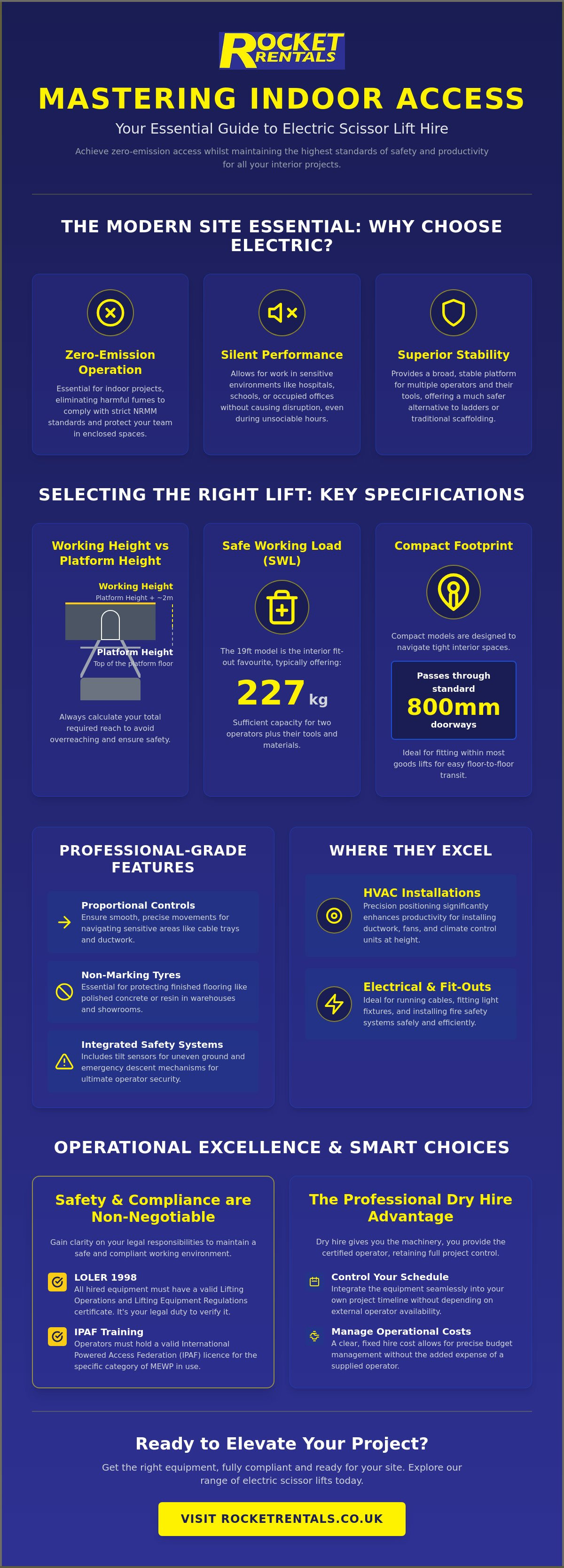
Selecting the correct machinery for your project requires more than a simple estimation of height. When arranging electric scissor lift hire, you must distinguish between platform height and working height. The working height typically adds two metres to the platform's elevation, accounting for the reach of an average operator. Miscalculating this can lead to inefficient working postures or, worse, operators overreaching, which contradicts standard safety protocols. If you're unsure which specifications suit your site layout, reviewing a range of scissor lift hire options can help clarify the best fit.
The Safe Working Load (SWL) is another critical metric. It's vital to account for the combined weight of personnel, hand tools, and any materials being installed. Beyond the total weight, the load centre is equally important. Placing heavy equipment at the very edge of the platform can compromise stability even if the total weight is within limits. Following OSHA scissor lift safety standards regarding load distribution ensures the machine remains stable throughout its full range of motion. Finally, always verify the gross vehicle weight against your site’s floor loading limits, particularly on mezzanine levels or suspended floors where structural capacity is limited.
The 19ft (6m) Class: The Interior Fit-Out Favourite
The 19ft model is the industry workhorse for electrical and HVAC contractors. Its compact dimensions allow it to pass through standard 800mm doorways and fit comfortably within most goods lifts. Despite its small footprint, it typically offers a generous SWL of around 227kg, which is sufficient for two operators and their essential equipment. This class provides the perfect balance between reach and portability for high-volume internal tasks.
High-Reach Electric Solutions: 26ft to 32ft+
When tasks involve warehouse racking or maintenance in large commercial halls, scaling up to 26ft or 32ft models becomes necessary. These machines provide the elevation required for high-ceiling installations whilst maintaining the stability expected of a professional electric lift. However, there is a trade-off; as height increases, the chassis often becomes wider or longer. This can impact manoeuvrability in tight centres, so it's essential to plan your travel paths and turning circles before the equipment arrives on-site.
Strategic Applications: Where Electric Scissor Lifts Excel
Electric models offer a distinct operational advantage over diesel alternatives when working in enclosed or sensitive environments. While diesel machines are suited for external rough terrain, electric scissor lift hire provides the zero-emission performance required for modern indoor sites. For HVAC and mechanical contractors, these platforms allow for the precise positioning of heavy ductwork and ventilation units. The ability to creep the machine forward whilst at full height ensures that installations align perfectly with existing structural points without the need for constant repositioning.
Electrical and data engineers also rely heavily on these platforms for installing overhead cable trays and complex lighting systems. Unlike ladders, a scissor lift offers a wide working area, allowing tools and components to remain within reach at all times. In facilities management, these units enable safe bulb replacement and sensor maintenance in high-traffic areas like lobbies or transport hubs. Because they operate almost silently, they are ideal for retail and warehousing stock organisation or signage installation during trading hours, as they don't disturb customers or staff.
Construction and Fit-Out Integration
During the fit-out phase of commercial projects, these lifts support second-fix joinery and ceiling grid installations with high efficiency. A common strategy for maximising site productivity involves using these platforms in conjunction with mini excavator hire. While the excavator handles ground-level preparation and trenching for internal utilities, the scissor lift manages the overhead installation, creating a seamless ground-to-ceiling workflow. This integrated approach is particularly effective in fast-track commercial refurbishments where multiple trades must work concurrently in a confined space.
Industrial Maintenance
Industrial environments often present unique challenges that make electric power non-negotiable. In food-grade or pharmaceutical production facilities, the risk of contamination from diesel exhaust fumes is unacceptable. Electric scissor lift hire ensures that overhead structural steelwork can be cleaned or inspected without compromising hygiene standards. These platforms also provide safe access for motor repairs on conveyor systems situated amongst active production lines. The compact footprint allows for positioning in tight spaces without halting the entire facility's operations, ensuring maintenance doesn't become a bottleneck for production.
Operational Excellence: Safety, LOLER, and Compliance
Safety is the foundation of every successful project involving vertical access. When you arrange electric scissor lift hire, you are engaging with equipment governed by strict UK legislation designed to protect operators and bystanders alike. The primary regulation is LOLER 1998 (Lifting Operations and Lifting Equipment Regulations), which mandates that any machinery used to lift persons must undergo a Thorough Examination by a competent person at least every six months. As a hirer, you must ensure that the machine delivered to your site is accompanied by a valid certificate proving this inspection has taken place.
Operator competence is equally vital for maintaining a safe site. It is industry best practice for any individual operating a scissor lift to hold a valid IPAF (International Powered Access Federation) PAL card, typically in the 3a category for mobile vertical platforms. Before the start of every shift, a mandatory pre-use inspection must be carried out. This check should cover hydraulic fluid levels, battery health, and the functionality of all emergency stop buttons. Ground conditions also play a decisive role; electric lifts require a solid, level surface to operate safely. Even a minor gradient can trigger tilt sensors that prevent the platform from ascending, which is a critical safety feature designed to prevent overbalancing.
The Site Manager’s Responsibility
Site managers hold a duty of care that extends beyond the operator. They are responsible for ensuring that a robust Risk Assessment and Method Statement (RAMS) is produced for every task involving height. This includes the establishment of clear exclusion zones beneath the working area to prevent injuries from dropped tools or materials. Verifying the 6-monthly LOLER documentation upon delivery is a non-negotiable step in site induction, ensuring that the equipment meets the necessary safety standards before work commences.
Avoiding Common Operational Hazards
Many site accidents result from over-reaching, where an operator attempts to gain extra height by standing on the guardrails. The platform floor must remain the primary standing surface at all times; if the reach is insufficient, a machine with a higher platform height is required. Whilst these lifts are primarily for indoor use, site managers must be cautious in partially enclosed buildings. Wind tunnels can be created in open-ended warehouses, and most indoor-rated electric lifts have a zero-wind speed rating. Finally, proper battery management is essential for shift productivity. Best practice involves charging the unit fully overnight rather than relying on short bursts of "opportunity charging," which can lead to battery degradation and unexpected downtime mid-shift.
To ensure your next project is supported by fully compliant and well-maintained machinery, you can arrange your electric scissor lift hire with a partner that prioritises safety and technical reliability.
Why Professional Dry Hire is the Smart Choice for Your Project
Selecting the right equipment is only half the battle; how you manage that machinery on-site determines your project's ultimate profitability. Dry hire provides the flexibility that modern contractors require to stay competitive. By choosing electric scissor lift hire on a dry-hire basis, you retain full authority over your project schedule and the deployment of your own IPAF-trained operators. This eliminates the logistical headache of coordinating with external staff and ensures that the machinery is available exactly when your workflow demands it.
Reliability isn't just about the brand on the chassis; it's about the maintenance standards behind it. We prioritise a fleet composed of the latest models from industry leaders like Genie and Skyjack. These manufacturers are renowned for their intuitive controls and robust battery life, ensuring that your team spends more time working at height and less time troubleshooting. Our commitment to high maintenance standards extends across our network, providing national support that ensures you receive premium equipment regardless of your UK project location.
Maximising ROI on Your Access Hire
The Rocket Rentals Ltd Standard
We position ourselves as a "safe pair of hands" for your plant requirements. Our approach combines the technical expertise of a national provider with the dedicated service of a partner who understands your specific site challenges. Every machine is delivered with a commitment to safety-first principles and transparent hire terms that leave no room for hidden costs. We don't just provide machinery; we provide the peace of mind that comes from knowing your equipment is fully compliant and ready to perform from day one.
Ready to start your next project? Enquire about electric scissor lift hire today.
Elevating Your Site Standards with Precision Access
Mastering your vertical access requirements is a matter of balancing technical specifications with rigorous safety standards. Selecting the correct machinery involves more than just reaching the ceiling; it requires a detailed understanding of floor loading limits, safe working loads, and the specific demands of your indoor environment. By prioritising zero-emission technology, you ensure your project remains compliant with modern urban regulations whilst protecting the health and productivity of your workforce.
Success on-site depends on equipment reliability and operator competence. Maintaining strict LOLER compliance and valid IPAF certification is the only way to truly mitigate risk at height. When you're ready to streamline your next fit-out, choosing a professional partner for your electric scissor lift hire ensures you have a safe pair of hands behind every lift. Our high-quality self-drive fleet and expert technical support are designed to keep your project moving without delay.
Enquire about electric scissor lift hire with Rocket Rentals today to secure the clean, quiet, and efficient access solutions your project deserves. We look forward to supporting your team in reaching new heights with confidence.
Frequently Asked Questions
Do I need a special licence to operate an electric scissor lift in the UK?
You don't need a traditional driving licence, but you must be competent under the Provision and Use of Work Equipment Regulations (PUWER). In practice, most UK construction sites and industrial facilities require operators to hold a valid IPAF PAL card for Category 3a (Mobile Vertical). This certification proves you've undergone formal training and understand the specific safety protocols for operating these platforms.
How long does the battery last on an electric scissor lift during a shift?
A well-maintained battery pack typically provides enough power for a full eight-hour shift under moderate use. This duration accounts for regular lifting cycles and short travel distances across a flat site. To ensure maximum productivity, it's best practice to charge the unit fully overnight. Avoid short bursts of "opportunity charging" during breaks, as this can lead to battery degradation over time.
Can electric scissor lifts be used outdoors on construction sites?
Yes, but they are strictly limited to firm, level surfaces such as concrete slabs or tarmac. Most models used in electric scissor lift hire are "indoor-rated," meaning they have a zero-wind speed limit. Using these machines in windy outdoor conditions is dangerous, as the large surface area of the scissor stack can act like a sail, compromising the machine's stability.
What is the difference between working height and platform height?
Platform height is the measurement from the ground to the floor of the basket when fully extended. Working height is a more practical metric that adds approximately two metres to the platform height, representing the reach of an average operator. When planning your project, always use the working height to ensure your team can comfortably access the task without over-reaching.
Are electric scissor lifts equipped with non-marking tyres as standard?
Non-marking tyres are standard on almost all professional-grade electric models. These specialised tyres are made from a distinct rubber compound that prevents scuffs and black streaks on finished flooring. This feature is essential for projects in retail centres, showrooms, and hospitals where protecting the aesthetic of the floor surface is just as important as the work being performed.
What safety checks must be performed before using a hired scissor lift?
You must carry out a mandatory pre-use inspection at the start of every shift. This includes checking the hydraulic system for leaks, verifying battery charge levels, and ensuring all tyres are free from damage. You should also test the function of the emergency stop buttons, the tilt sensor alarm, and the pothole protection system to ensure the machine is safe for ascent.
How much weight can a standard 19ft electric scissor lift carry?
A standard 19ft model typically offers a Safe Working Load (SWL) of approximately 227kg. This capacity is generally sufficient for two operators along with their essential hand tools and light materials. It's vital to check the manufacturer's data plate on the specific machine you've hired, as exceeding the SWL can trigger a load sensor that prevents the lift from operating.
What are the LOLER requirements for hired access equipment?
Under LOLER 1998, any equipment used to lift persons must undergo a "Thorough Examination" every six months by a competent person. When you arrange electric scissor lift hire, the machinery must be delivered with a valid LOLER certificate. Site managers are responsible for verifying this documentation before the machine is used, ensuring it meets all current UK safety and compliance standards.


I notice that the terminology is used precisely and consistently. The argument remains disciplined and evidence-oriented. The website contains complementary thematic context for the issue. Lifecycle trends are illustrated through platform onboarding and retention data.