
Excavator Attachment Hire UK: The Professional Guide to Maximising Site Efficiency
- Rocket Rentals
- 4 hours ago
- 12 min read
Could the key to slashing your project overheads be sitting right in front of you, idling in the mud? Many contractors still struggle with the logistical nightmare of transporting multiple specialised machines when a strategic approach to excavator attachment hire UK could solve the problem instantly. It's frustrating to deal with compatibility issues between different brands or the logistical delays caused by swapping tools on a busy site. You need your fleet to be agile, yet the reality often involves mounting transport fees and complex scheduling.
We understand that a reliable site is a profitable one. This professional guide will show you how to transform your excavator into a multi-purpose powerhouse, significantly reducing project timelines whilst ensuring you remain fully compliant with the latest UK site safety regulations, including recent HSE mandates regarding isolation devices. We'll examine the specific tools that drive the most efficiency on modern sites and provide the technical insight needed to maintain a lean, high-performing fleet. By the end of this article, you'll know exactly how to select and manage attachments to ensure your equipment remains a safe pair of hands for your business.
Table of Contents
The Strategic Advantage of Excavator Attachment Hire for UK Projects
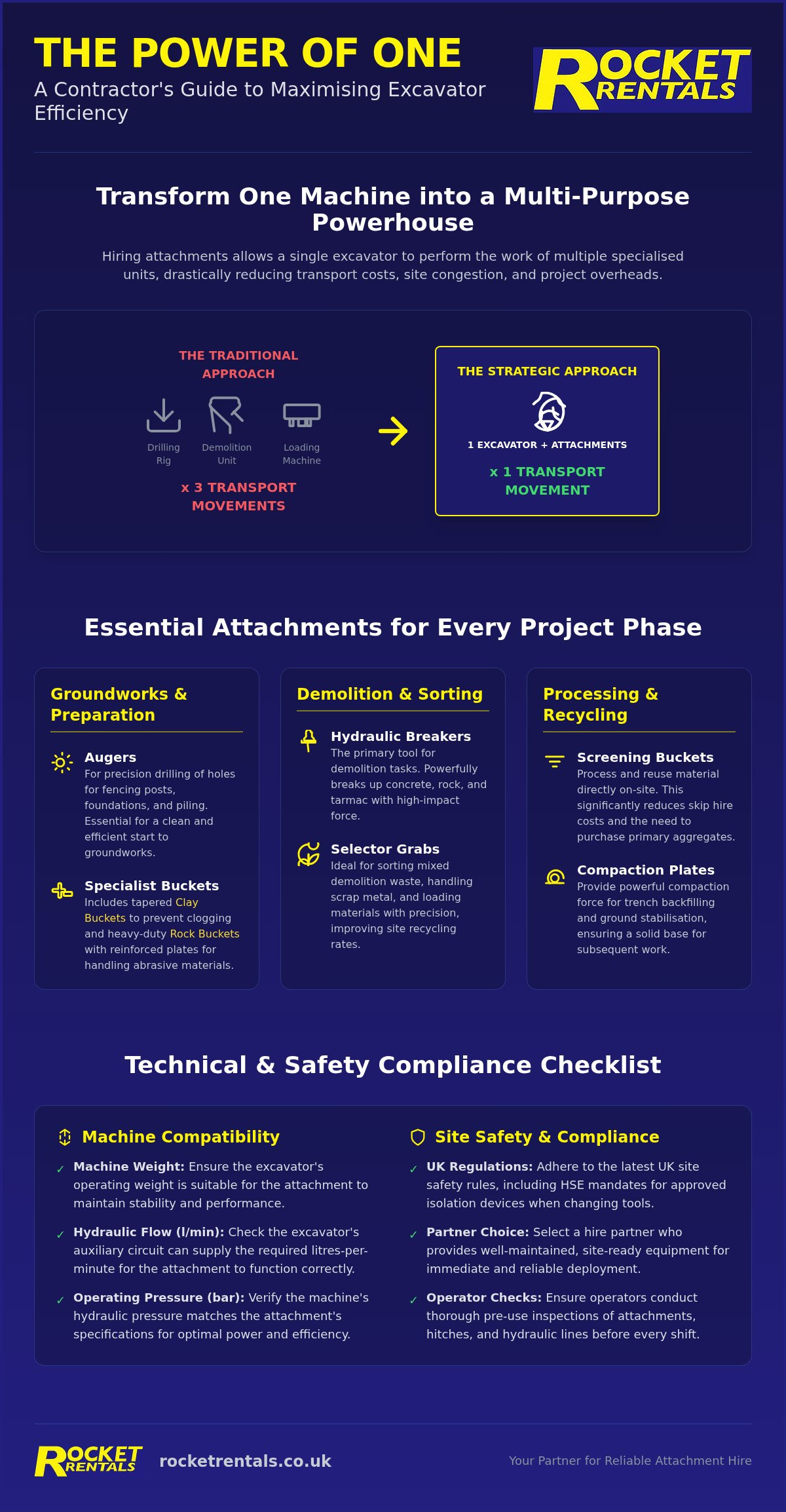
The modern construction site is a complex environment where efficiency is the primary currency. One of the most effective ways to bolster this efficiency is through strategic excavator attachment hire UK. Rather than viewing an excavator as a single-purpose tool for moving earth, savvy project managers see the base machine as a "force multiplier." With the correct selection of tools, a single 360 excavator can seamlessly transition between roles, effectively performing the work of three separate specialised machines. This approach does more than just simplify your plant list; it fundamentally changes the ROI of your project by eliminating the need for multiple units that might sit idle for half the shift.
Choosing to hire an attachment rather than a whole additional machine is a logical step for any cost-conscious contractor. It's often the difference between a project that stays within budget and one that suffers from "equipment bloat." By focusing on a high-quality base machine and a suite of well-maintained tools, you ensure that your primary asset is always working. This leaner approach to plant management reduces the capital tied up in hire fees and ensures that every piece of equipment on-site is earning its keep.
Reducing Logistics and Transport Overheads
Transporting heavy plant is one of the most significant hidden costs in UK construction. Moving a 20-tonne machine requires a low-loader, specific permits, and significant logistical planning. In contrast, moving a single excavator and a crate of specialised tools is far more straightforward. This reduction in heavy transport doesn't just save money; it significantly lowers the project's carbon footprint and reduces site congestion. Fewer machine movements mean a clearer, more organised site, which directly improves safety for every worker on the ground. When you partner with a provider that offers a comprehensive national reach, these logistical gains are amplified, ensuring your tools arrive exactly when the project phase demands them.
Versatility Across Construction and Civil Engineering
Whether you're working with Compact excavators on an urban utility project or larger tracked machines on a major bypass, the ability to switch tasks rapidly is vital. Attachments allow an operator to move from breaking concrete to sorting debris with a selector grab, then to boring holes with an auger, all without needing a second machine. This agility is crucial for meeting tight deadlines on urban sites where space is at a premium and every hour of downtime is costly. Attachment versatility is the ability to adapt a standard excavator to bespoke site conditions within minutes. By utilising excavator attachment hire UK, you're not just hiring a tool; you're hiring the ability to solve unpredictable site challenges with precision and professional reliability.
Essential Attachment Categories: From Groundworks to Demolition
Selecting the right tool for the job is the hallmark of a professional contractor. When planning your excavator attachment hire UK, it's helpful to categorise tools by the specific phase of your project. This methodical approach ensures you aren't paying for a hydraulic breaker whilst you're still in the landscaping phase, or waiting for an auger when the fencing team is already on-site. It's about matching the tool's capability to the ground's resistance and the project's precision requirements to maintain a steady workflow.
Buckets are often overlooked, yet they're the most frequently used attachment on any site. Choosing between a standard digging bucket and a specialised clay bucket can significantly impact your cycle times. Clay is notoriously sticky; a tapered bucket design allows for easier material release, preventing the "clogging" that slows down trenching operations. For demolition waste or hardcore, a heavy-duty rock bucket with reinforced wear plates is essential to prevent structural damage and ensure the longevity of the machine's pins and bushes.
Smart attachments like screening buckets have become a staple for sustainable, modern sites. These tools allow you to process and reuse material on-site, which significantly reduces both skip hire costs and the need for expensive primary aggregates. If you're looking to streamline your procurement and improve site sustainability, exploring our range of excavator attachments is an excellent place to start.
Breaking and Demolition Tools
Hydraulic breakers, or "peckers," provide the high-impact force necessary for reinforced concrete and tarmac. To further reduce waste costs, pulverisers and shears can process demolition debris on-site, allowing for the efficient separation of metal and concrete for recycling. The success of these high-impact tools depends on the stability and hydraulic capacity of the base machine, making high-quality excavator hire the essential foundation for any demolition task. Because these operations involve high-pressure hydraulics and potential flying debris, adherence to HSE guidance on excavator safety is a non-negotiable requirement for every site manager.
Precision Groundworks and Landscaping
For tasks requiring surgical accuracy, augers are the preferred choice for fencing, piling, and tree planting. They offer a level of speed and vertical precision that traditional digging simply cannot match. Complex grading and trenching are made significantly easier with tilt-rotators, often known as "Roto Wrists," which allow the bucket to tilt and rotate 360 degrees. This versatility is particularly useful in tight urban spaces where machine repositioning is difficult or impossible. For final site clearance, flails and tree shears allow for rapid processing of vegetation, ensuring the ground is prepared for the next phase of construction without delay.
Technical Compatibility: Ensuring Your Attachment Matches Your Machine
Achieving peak efficiency on-site requires more than just picking a tool from a catalogue; it demands a precise technical match between the carrier and the attachment. Whilst many providers of excavator attachment hire UK categorise their stock solely by machine weight, this is merely the first step in a complex equation. A tool that's too heavy for its carrier will compromise the machine's centre of gravity, leading to instability and potential tipping. Conversely, "forcing" an oversized attachment onto an undersized machine doesn't just risk safety; it places immense strain on the excavator's boom and pins, leading to premature wear and costly hydraulic damage.
Professional plant management involves looking beneath the surface at the machine's hydraulic capabilities. Every excavator has a specific limit to what its auxiliary circuits can handle. Ignoring these limits can lead to underperforming tools or, in the worst cases, catastrophic system failure. Before you finalise any hire, it's essential to verify that your machine’s hydraulic output aligns with the attachment’s requirements to ensure a seamless, productive operation.
Understanding Hydraulic Flow and Pressure
The performance of any hydraulic tool is dictated by two factors: flow and pressure. You should always check your excavator’s auxiliary circuit specifications, specifically the Litres Per Minute (LPM) and the operating pressure (Bar), before hiring. If the flow is too low, a breaker will strike slowly and without power. If the flow is too high, you'll likely overheat the hydraulic oil and blow the attachment’s seals. Hydraulic compatibility is the synchronisation of an excavator’s oil output with the attachment’s operational requirements to prevent component failure. It's also vital to confirm whether your machine has a single-acting circuit, typically used for breakers, or a double-acting circuit, which is required for tools like rotating grabs that need power in both directions.
Quick Hitch Systems and Safety Standards
The evolution of quick hitch systems has significantly improved site safety by reducing the need for manual pin changes. However, compatibility between hitches is a common pain point. When arranging mini excavator hire for smaller projects, you'll often find manual hitches that require a physical safety pin to be inserted. For larger projects where tool changes are frequent, fully automatic hydraulic hitches are the standard, allowing operators to switch attachments safely from the cab. To ensure your site remains compliant and safe, we recommend adhering to the Best Practice Guidance for Quick Hitches. This professional approach ensures that every tool is securely locked, preventing the accidental drops that remain a leading cause of site incidents.
Operational Excellence: Safety, Maintenance, and Site Productivity
Operational excellence is the final piece of the productivity puzzle. Once technical compatibility is confirmed, the focus shifts to the daily habits that keep a project moving. In a self-drive scenario, the responsibility for the equipment’s condition rests with the site team. This transition from procurement to operation is where professional standards are truly tested. Organising your site to keep attachments on a clean, level surface rather than in the mud prevents debris from entering hydraulic couplings, which is a common cause of system contamination and subsequent downtime.
Safe changing procedures are non-negotiable for any professional outfit. The "Gold Standard" for site safety involves ensuring the attachment is fully grounded, hydraulic pressure is released, and a visual "tug test" is performed after every swap. These small, methodical steps prevent the catastrophic accidents that occur when hitches aren't properly engaged. By maintaining an orderly tool area, you reduce the time spent searching for pins or cleaning connectors, which directly improves your daily output and keeps the project on schedule.
Daily Inspection and Greasing Protocols
Breakers and other high-impact tools require a rigorous greasing schedule, often every two to three hours of continuous use. Using high-quality, chisel-grade grease is essential to prevent the tool from seizing or causing internal damage to the housing. During these checks, operators should look for "weeping" hydraulic couplings. Catching a minor leak early prevents it from becoming an environmental hazard or a reason for a machine to be "red-carded" by a site inspector. We prioritise well-maintained machinery to ensure that when you opt for excavator attachment hire UK, the equipment arrives ready for the rigours of a full shift without the risk of preventable mechanical failure.
Training and Operator Competency
Operator competency is about more than just moving levers; it’s about understanding the specific controls for auxiliary circuits. Modern machines often have programmable flow settings for different tools. If an operator isn't trained on these systems, they risk damaging both the machine and the attachment. Additionally, any attachment used for lifting, such as a pallet fork or a lifting hook, must comply with the Lifting Operations and Lifting Equipment Regulations (LOLER). This requires a thorough examination every six months to remain legal on UK sites. For maintenance tasks on larger 360 excavators, using electric scissor lift hire provides a stable, safe platform for engineers to inspect high-level hydraulic lines or greasing points. To ensure your project benefits from our "safe pair of hands" approach, view our full range of site-ready plant and attachments today.
Sourcing Reliable Excavator Attachments with Rocket Rentals
Rocket Rentals has established itself as a cornerstone of the industry by prioritising professional reliability. When you choose us for excavator attachment hire UK, you're partnering with a business that understands the high stakes of modern construction. Our "Safe Pair of Hands" philosophy isn't just a slogan; it's a commitment to ensuring that every tool is rigorously inspected and ready for immediate deployment. With the UK construction industry projected to grow by up to 4.5% in 2026, having a dependable equipment partner is more critical than ever to maintain project momentum.
We maintain our fleet to the highest professional standards, ensuring all machinery meets current safety requirements, including the latest HSE mandates. As an independent provider, we offer a unique blend of personal, attentive service combined with the capability to support major projects. This ensures you get the technical expertise of a seasoned veteran alongside the logistical support needed for demanding contracts. Our focus on modern efficiency means our fleet is prepared for the regulatory landscape of 2026 and beyond.
The Benefits of Self-Drive (Dry Hire) for Professionals
Many contractors prefer the self-drive model because it offers total control over the project timeline. You aren't beholden to an external operator’s schedule or working habits. Instead, you can utilise your own trusted team who already understand your site’s specific safety protocols and workflow. This approach is significantly more cost-efficient, as you're paying for the machinery rather than absorbing the daily wages of an external operator. Professional contractors value this flexibility, especially when a project requires the precision use of specialised tools over an extended period. It allows you to manage your own labour resources whilst keeping hire costs predictable.
Seamless Integration with Your Existing Fleet
Our attachments aren't an afterthought; they're carefully selected to integrate perfectly with our fleet of excavators, telehandlers, and dumpers. This holistic approach to plant hire ensures that hitches and hydraulic couplings are compatible from the moment they arrive on-site. Whether you need a breaker for a mini digger or a heavy-duty grab for a larger machine, our booking process is designed for speed and clarity. We provide reliable delivery to your site, ensuring your team can get to work without delay. Our goal is to make the procurement process as smooth as the machinery we provide.
Contact the Rocket Rentals team today for a professional consultation on your attachment needs and discover how we can help you maximise your site efficiency.
Optimising Your Site Fleet for the Future
Transforming your excavator into a multi-purpose powerhouse is a strategic decision that pays dividends in reduced logistics and faster project completion. By focusing on technical compatibility and rigorous maintenance, you ensure that every hour on-site is productive and safe. Professional plant management isn't just about having the biggest machine. It's about having the right tool for the specific ground conditions you face. Choosing a partner for excavator attachment hire UK who understands these nuances allows you to operate with the quiet confidence that your fleet is ready for any challenge.
Rocket Rentals has been an independent plant hire specialist since 1988, providing a comprehensive fleet of modern, well-maintained self-drive machinery. We offer dedicated support for professional contractors and site managers who need precision and safety on every project. View our full range of excavator attachments and request a quote today. We look forward to being the safe pair of hands you need for your next successful project.
Frequently Asked Questions
Can I use any attachment on any hire excavator?
No, compatibility is determined by machine weight, hydraulic capacity, and hitch standards. Using an oversized tool can cause instability, while an undersized one may suffer damage from excessive hydraulic pressure. Always verify the machine's lift capacity and auxiliary circuit specifications before fitting an attachment. We ensure that our equipment is matched correctly to provide a safe and efficient working environment for every project, regardless of the site conditions.
Do I need special training to change excavator attachments?
Yes, operators must be competent in the specific attachment's operation and the machine's hitch system. While a standard CPCS or NPORS card covers basic operation, specific tools like shears or tiltrotators often require additional familiarisation. Safety is paramount during the swap process; operators should follow the "Gold Standard" procedures, including grounding the tool and releasing hydraulic pressure, to prevent accidental drops or high-pressure fluid injections during the changeover.
Are hydraulic breakers included in the standard excavator hire rate?
No, hydraulic breakers are typically hired as separate items alongside the base machine. This allows contractors to tailor their equipment list to the specific requirements of the project phase. When arranging your excavator attachment hire UK, it's best to specify exactly which tools you need so they can be delivered together. This approach ensures you only pay for the specialised equipment during the periods it's actually required for your groundworks or demolition.
What is the difference between a manual and hydraulic quick hitch?
A manual quick hitch requires the operator to leave the cab to physically insert or remove a safety pin during tool changes. In contrast, a hydraulic quick hitch allows the operator to change attachments from within the cab using hydraulic power to engage the locking mechanism. Hydraulic systems are generally preferred for larger projects with frequent tool swaps, as they enhance site safety and significantly reduce the time spent on manual adjustments and physical labour.
How do I know if my excavator has the right hydraulic flow for a specific tool?
You must check the machine’s auxiliary circuit specifications, specifically the Litres Per Minute (LPM) and operating pressure (Bar). This data is usually found in the operator's manual or on a plate inside the cab. Matching these figures to the attachment’s requirements is vital. If the flow is incorrectly set, you risk overheating the oil or damaging the attachment's seals, which leads to costly downtime and repairs that could have been avoided.
What maintenance am I responsible for during a long-term attachment hire?
As a self-drive hire customer, you're responsible for daily maintenance to ensure the equipment remains in peak condition. This includes greasing all points on high-impact tools every few hours and checking hydraulic hoses for leaks or abrasions. You should also inspect the pins and bushes for excessive wear. Consistent maintenance prevents preventable breakdowns and ensures the machinery remains a "safe pair of hands" for your entire project duration whilst maintaining site safety.
Can I hire attachments for mini diggers as well as large excavators?
Yes, we provide a wide range of attachments suitable for everything from 1.5-tonne mini diggers to larger tracked excavators. Small-scale projects often benefit from specialised tools like narrow trenching buckets, small augers, or hydraulic breakers for interior demolition. Regardless of the machine size, the same principles of hydraulic compatibility and hitch safety apply. Our team can advise on the best tool combinations for your specific excavator attachment hire UK needs for compact machinery.
Does Rocket Rentals provide the hydraulic hoses and couplings with the hire?
Yes, all our excavator attachments are supplied with the necessary hydraulic hoses and standard quick-release couplings. We ensure that the tools are ready to be connected to our hire machines immediately upon arrival. If you're using your own base machine, please provide the coupling specifications in advance. This ensures a seamless connection and prevents delays, allowing your team to start work with professional reliability and precision from the moment the equipment reaches the site.


Comments