
Mobile Welfare Unit Hire Cost: A Professional Guide to Site Budgeting 2026
- Rocket Rentals
- Jul 29
- 12 min read
Updated: Aug 7
If you believe the lowest initial quote for your site's facilities represents the best value, you may be overlooking the true mobile welfare unit hire cost that reveals itself once your project is underway. We know that site managers often feel the pressure of balancing strict HSE compliance with a tightening bottom line, whilst simultaneously navigating the complexities of delivery logistics and unpredictable servicing fees. It is a common frustration to find that what seemed like a straightforward rental quickly becomes a source of administrative stress and financial surprises.
This professional guide provides the clarity you need to budget accurately for 2026, ensuring your workforce remains productive and your site stays fully compliant with CDM regulations. You will discover the transparent factors behind hire rates and learn how to avoid the hidden charges often associated with toilet maintenance and generator fuel. We will examine how a strategic approach to welfare procurement, particularly when coordinated alongside your existing plant requirements, can lead to more predictable weekly costs and a much smoother site operation.
Table of Contents
Understanding the Basics of Mobile Welfare Unit Hire Costs
Mobile welfare units are essentially the operational heart of any modern project. These self-contained hubs provide essential construction site facilities, including sanitary conveniences, washing stations, and canteen areas, all housed within a single towable unit. Unlike static cabins that require heavy lifting equipment for placement, mobile units are designed for rapid deployment. This flexibility is particularly valuable for roadworks or multi-phase groundworks where the site boundary shifts frequently. Because they can be towed by a standard 4x4, they offer a level of agility that static alternatives simply cannot match.
The primary driver behind the mobile welfare unit hire cost is legal necessity. Under the HSE Schedule 2 regulations, providing adequate welfare is a non-negotiable requirement for every project. These regulations dictate that workers must have access to clean toilets, hot and cold running water, and a heated area for rest and meals. Failing to meet these standards doesn't just risk staff discomfort; it invites heavy fines and potential site closures from the Health and Safety Executive. To ensure your site meets all its legal obligations, including fire safety, UK Fire Risk Assessments can provide professional evaluations for your site buildings. Most hire agreements are structured around a weekly rate, though long-term project agreements can offer more predictable budgeting for extended programmes of work.
The ROI of Workforce Welfare
Investing in high-quality welfare facilities offers a tangible return on investment. When facilities are located directly on-site, you significantly reduce the downtime caused by staff travelling to off-site locations for breaks. Beyond the clock, the impact on operative morale is substantial. A clean, warm "mess" area provides a vital space for recovery during harsh weather, which directly correlates with sustained productivity. For projects in the Stoke-on-Trent area, providing hot food from Rupeyal Express is a great way to reward a hard-working crew. Most importantly, robust welfare provision acts as an insurance policy against the financial and reputational damage of regulatory non-compliance.
Beyond on-site facilities, supporting your workforce's recovery during off-hours is a key component of overall welfare. For projects based near the Lincolnshire coast, you can learn more about Happy Place Caravans to find high-quality accommodation that ensures your staff remain refreshed and productive.
Self-Drive vs. Managed Service Costs
Choosing a self-drive mobile welfare unit hire cost model often appeals to experienced site managers who prioritise maximum control. By opting for self-drive, you take responsibility for the unit whilst it is on your site, which typically reduces the management overheads associated with third-party service providers. This approach allows you to integrate the welfare unit into your existing plant management routine. It's a straightforward way to ensure your site remains a "safe pair of hands" for your workforce without the complexities of managed service contracts. When you manage the unit yourself, you gain the freedom to position and move the facility exactly when and where your project demands.
Key Factors That Influence Your Weekly Rental Rate
When calculating your mobile welfare unit hire cost, the weekly rate is rarely a fixed figure across different models. Several technical specifications and capacity requirements dictate the final price. Choosing the right unit involves balancing your peak head-count with the physical constraints of your site. It is not just about the footprint; it is about the efficiency of the space provided for your team. A well-specified unit ensures that your site remains operational and compliant without unnecessary expenditure on underutilised space.
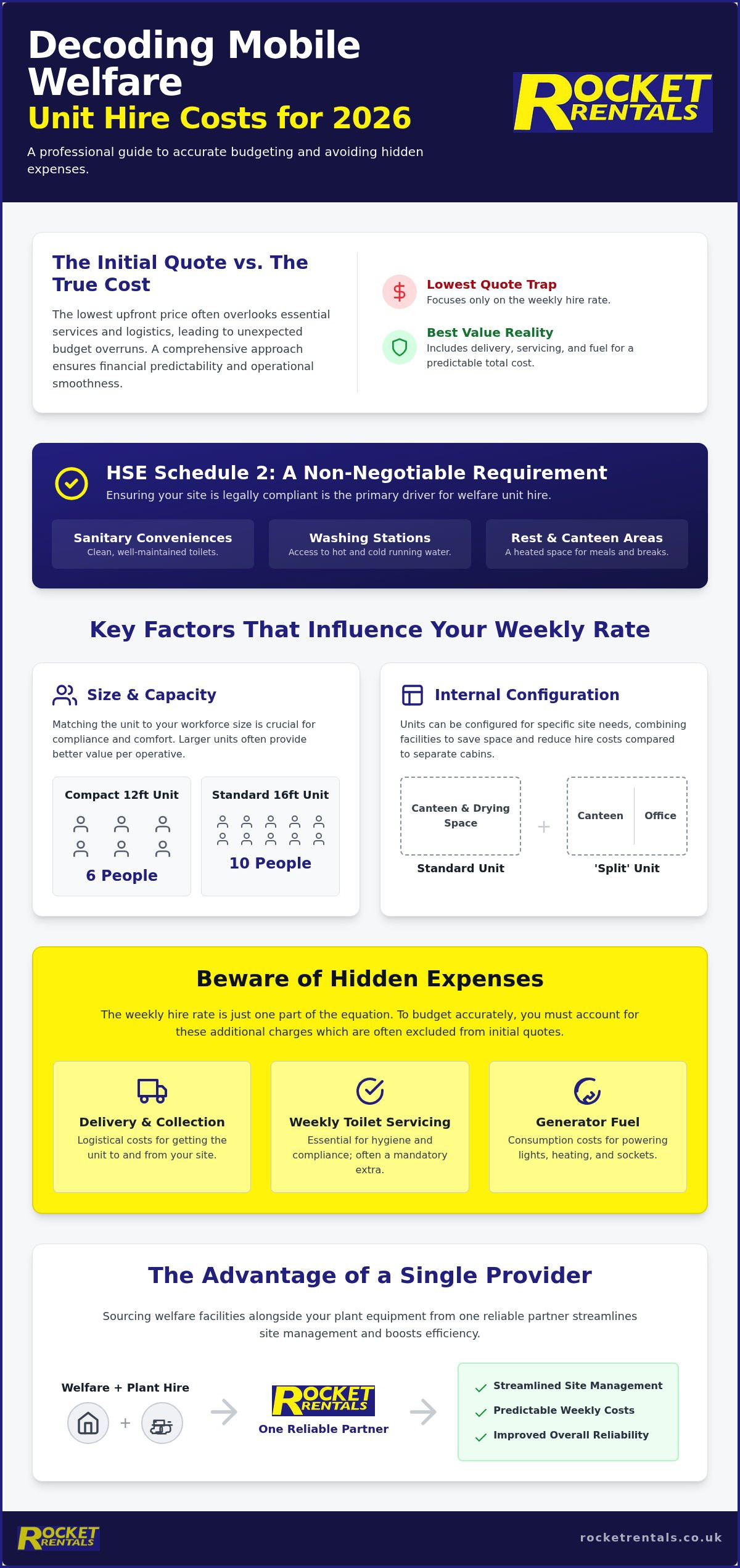
Size and capacity are the most immediate influences on the budget. A compact 12ft unit typically accommodates six people, whilst a 16ft model can support up to ten. Whilst the larger unit carries a higher weekly rental, the cost per operative often decreases as capacity grows. This is a vital consideration for meeting HSE welfare requirements during peak project phases. If you have a rotating crew, ensuring everyone has a seat and adequate facilities is both a legal and a moral necessity for any professional contractor.
Internal configuration also plays a significant role in the quote. Standard units focus on canteen and drying space. However, many projects in 2026 require integrated office space for site administration. These 'split' units combine a mess room with a secure office, which can be more cost-effective than hiring two separate cabins. Secure steel construction with anti-vandal features also protects your investment. High-quality locking systems and window shutters reduce the risk of theft and damage, which helps keep your insurance risks manageable and your site secure.
Size vs. Capacity Requirements
Matching your unit to your workforce prevents overcrowding and maintains hygiene standards. For restricted urban sites, a 12ft unit is often the only viable option due to its smaller footprint. On larger industrial projects, the 16ft 10-person unit provides the extra space needed for changing and drying heavy PPE without the area feeling cramped. Calculating the cost per operative helps justify the investment in larger units for bigger crews, ensuring comfort is never compromised.
Eco vs. Standard Power Solutions
The choice between power sources is a major component of the mobile welfare unit hire cost. Solar-hybrid systems serve as a premium alternative to traditional diesel generators. Whilst these 'Eco' units often carry a higher initial hire cost, they can significantly reduce your total expenditure by slashing fuel consumption. They also operate with much lower noise levels, which is essential for night works or projects in residential areas. Standard diesel units remain a reliable choice for sites where fuel management is already established. If you need a reliable welfare unit from Rocket Rentals Ltd that balances performance with efficiency, selecting the right power source is key.
Comparing Mobile vs. Static Welfare Solutions for Site Efficiency
Choosing between mobile and static welfare facilities often depends on the specific logistical demands of your project. Static cabins are typically semi-permanent structures that require a heavy HIAB lorry for delivery and a crane for precise placement. In contrast, mobile units are designed for agility. They can be towed into position by a standard 4x4 and lowered into a secure, ground-level position within minutes. This rapid deployment capability is a significant factor in the overall mobile welfare unit hire cost, as it eliminates the need for expensive specialised lifting equipment during the initial setup.
Site access often dictates the choice. Mobile units are the preferred option for locations with height or weight restrictions that would prevent a large delivery lorry from entering. Because they are towable, they can navigate narrow tracks or residential streets where a static cabin simply couldn't reach. Furthermore, ground requirements are generally more flexible for mobile types. Whilst static units often require prepared hardstanding or a perfectly level base to prevent structural stress, mobile units are engineered to be stable on a wider variety of surfaces, provided the ground is firm enough to support their weight.
When to Choose Mobile Units
Mobile units are ideal for short-term projects, typically those lasting under three months, where the cost of HIAB delivery would be disproportionate to the hire duration. They are particularly effective for linear projects such as pipeline installations or utility works where the site boundary moves every few days. Combining mini excavator hire with mobile welfare allows your team to move across a site with maximum agility. This setup ensures that your crew always has immediate access to canteen and toilet facilities, no matter how far the work progresses from the initial site entrance.
Logistical Cost Comparison
When you evaluate the mobile welfare unit hire cost, it is essential to look at the total logistics package. Towable units usually carry lower delivery and collection charges because they don't require heavy haulage. This also applies to relocation fees; if you need to move a static unit mid-project, you'll face another round of crane and lorry costs. Mobile units can be repositioned by your own site team if they have a suitable vehicle. Insurance considerations also differ; mobile units are often viewed as plant equipment, whereas static cabins are treated as temporary buildings, which can influence your site's premium structure and security requirements.
Avoiding Hidden Costs: Delivery, Servicing, and Consumables
Experienced site managers recognise that the headline mobile welfare unit hire cost is only one component of a project's welfare budget. To avoid financial surprises, you must account for the logistical and operational expenses that occur throughout the hire period. Distance is the primary factor in delivery and collection charges. If your site is located in a remote area or has restricted access, transport fees will reflect the extra time and specialised equipment needed for a safe handover. It is always prudent to confirm these one-off costs at the point of enquiry to ensure your initial budget remains accurate.
Operational maintenance is equally vital. Standard hire agreements typically assume a baseline level of usage, but high-intensity sites may require more frequent attention. Damage waivers and insurance also play a crucial role in protecting your investment. Whilst modern units are built from robust steel, accidental damage on a busy site can be costly. Ensuring you have comprehensive cover in place provides peace of mind and prevents unexpected repair bills from inflating your final invoice. If you want a transparent quote for welfare hire, always ask for a full breakdown of these secondary costs.
The Essential Servicing Schedule
Maintaining hygiene standards is not just a comfort issue; it's a fundamental health and safety requirement. A standard weekly service typically includes professional cleaning of the canteen and toilet areas, the safe removal of effluent waste, and the replenishment of fresh water for washing. It also involves restocking essential consumables like soap and paper towels. If your workforce exceeds the unit's standard capacity or works multiple shifts, you may need to schedule additional servicing visits. These extra visits will impact your monthly budget, so it's best to plan for them during the initial site setup phase.
Consumables and Fuel Budgeting
Fuel management is often the most variable part of the mobile welfare unit hire cost. If you aren't using a solar-hybrid unit, your diesel consumption will depend entirely on how long the generator runs each day. Estimating this usage helps you set a realistic fuel budget and ensures you don't run out at a critical moment. As of 2026, red diesel remains restricted for construction site generators, meaning most units must operate on white diesel or HVO fuel to comply with current UK tax regulations. Effective water management is also essential. Ensuring your tanks are regularly topped up prevents downtime and guarantees that your washing facilities remain fully operational for every member of the crew.
Securing Reliable Welfare Facilities with Rocket Rentals Ltd
Managing a complex project requires a partner who understands that equipment reliability is just as important as the initial quote. Rocket Rentals Ltd positions itself as a "safe pair of hands" for your site requirements, providing high-quality, self-drive welfare units that meet the rigorous standards of the modern construction industry. We know that a poorly maintained unit does more than just frustrate your workforce; it risks your project's compliance and reputation. Our commitment to maintaining an extensive, modern fleet ensures that the facilities we deliver reflect the same professional standards you apply to your own work. As independent plant hire specialists, we focus on the details that larger providers might overlook, ensuring every unit is ready for immediate deployment.
One of the most effective ways to manage your total mobile welfare unit hire cost is to streamline your procurement process. By sourcing your excavator hire South West and welfare units from Rocket Rentals Ltd, you significantly reduce the administrative burden of managing multiple suppliers. This integrated approach allows for better coordination of deliveries and collections, often leading to more efficient site logistics and clearer financial oversight. Our team supports you throughout the entire hire period, from the first transparent quote to the final collection, ensuring your site remains operational and compliant. This focus on self-drive units allows you to maintain maximum control over your site layout and operational schedule.
A Comprehensive Site Solution
Coordinating the arrival of plant and welfare facilities can be a logistical challenge. Rocket Rentals Ltd simplifies this by synchronising deliveries, which helps you hit the ground running without waiting for disparate suppliers to arrive. Our experience as seasoned industry veterans means we can offer expert advice on the ideal equipment mix for your specific project, whether you are managing a small groundworks task or a large-scale industrial development. This proactive service model provides the peace of mind that comes from knowing your site infrastructure is handled by professionals who understand the nuances of site requirements. By consolidating your plant and welfare needs, you ensure a consistent standard of maintenance across all your site machinery.
Next Steps for Your Project
Securing the right facilities starts with a clear understanding of your needs and a transparent, itemised quote. Rocket Rentals Ltd avoids the hidden fees that often plague the industry, providing you with a predictable mobile welfare unit hire cost that fits your budget. Before your unit arrives, our team can advise on site preparation to ensure a smooth handover and immediate setup. If you are ready to prioritise workforce comfort and legal compliance, the next step is straightforward. Contact Rocket Rentals Ltd for a professional welfare hire quote and let us help you build a safer, more productive site for 2026. We remain dedicated to supporting your project with the reliability and expertise your site deserves.
Optimising Your Site Budget for 2026
Achieving a lean site budget for the coming year requires moving beyond the basic rental rate and adopting the comprehensive logistics strategy we have explored. By integrating high-specification units with your broader plant requirements, you avoid the administrative friction of multiple service visits and hidden delivery premiums. Understanding how the mobile welfare unit hire cost interacts with fuel management and weekly servicing schedules ensures that your 2026 project forecasting remains resilient against unexpected site overheads and regulatory changes.
Rocket Rentals Ltd has been an independent plant hire specialist since 1988, offering a safe pair of hands for contractors who prioritise reliability. Our HSE-compliant welfare fleet is maintained to the highest standards, supported by reliable national delivery that keeps your project on track. We understand the unique pressures of the industrial sector and provide the technical expertise needed to support your workforce effectively. Choosing a partner with nearly four decades of experience ensures your site infrastructure is managed with professional precision and care.
We look forward to helping you establish a compliant, comfortable, and cost-effective site environment for your next project.
Frequently Asked Questions
What is the typical minimum hire period for a mobile welfare unit?
Most hire agreements for these units require a minimum commitment of four weeks. This standard period ensures that the logistical costs of delivery, collection, and initial setup remain viable for the duration of your project. For very short-term requirements, it's best to discuss your specific timeline with our team to find the most cost-effective solution.
Does the hire cost include weekly toilet servicing?
A standard weekly service visit is typically included in your agreement to maintain essential hygiene standards. This visit covers the professional cleaning of the toilet and canteen areas, the safe removal of effluent waste, and the replenishment of fresh water and consumables. It is a vital part of your mobile welfare unit hire cost that ensures your site remains fully compliant with health and safety regulations.
How much fuel does a standard mobile welfare unit consume per week?
Fuel consumption depends heavily on whether you choose a traditional diesel generator or a modern solar-hybrid model. A standard unit running for typical site hours may consume between 20 and 30 litres of fuel weekly. Choosing an eco-friendly solar unit can significantly reduce this figure, as the generator only triggers when the battery levels drop, leading to lower overall mobile welfare unit hire cost over the project's life.
Are mobile welfare units secure against theft and vandalism?
These units are specifically engineered for site security, featuring heavy-duty steel construction and integrated anti-vandal shutters. Once the unit is towed into position, it is lowered to the ground, which hides the wheels and makes it extremely difficult to move. High-security locking systems on all doors and hatches provide additional protection for your equipment and the personal belongings of your workforce.
Can I tow the mobile welfare unit myself once it is on site?
You can reposition the unit on your site if you have a suitable vehicle with the correct towing capacity, such as a professional 4x4. This is a primary advantage of the self-drive model, as it gives your site manager total control over the facility's location. This flexibility is particularly useful for linear projects where the work area moves frequently throughout the week.
Do I need a mains water connection for a mobile welfare unit?
No, these units are entirely self-contained and require no external mains water or sewage connections. They are equipped with internal fresh water tanks for washing and separate waste tanks for the toilet facilities. These systems are replenished and emptied during your scheduled weekly service, making them ideal for remote sites or projects where utilities aren't yet established.
How many people can legally use one welfare unit on site?
The legal capacity is determined by the size of the unit and the seating provided. A standard 12ft unit is typically designed for a crew of six, whilst a larger 16ft unit can accommodate up to ten people. To remain compliant with HSE regulations, you must ensure that your welfare facilities can comfortably support your peak headcount during any shift.
What happens if the generator breaks down during the hire period?
Reliable support is a core part of our service, and a technical team is available to resolve any equipment issues promptly. Our focus on high-specification, well-maintained units significantly reduces the risk of mechanical failure. If a problem does occur, we prioritise getting your power and facilities back online to ensure your site remains productive and your workforce stays comfortable.


Comments