
Professional Ride-On Roller Hire: The Contractor’s Guide to Compaction (2026)
A single pocket of trapped air in your sub-base can be the difference between a structural masterpiece and a costly failure that requires total rework. For contractors, the pressure to deliver perfect density isn't just about meeting a specification; it's about protecting your reputation and your timeline. We understand that inconsistent results often stem from using the wrong equipment for the material depth, leading to the very delays you're working hard to avoid. Securing a reliable ride on roller hire is the first step toward reclaiming control over your site's structural integrity.
In this guide, we'll help you master the technicalities of compaction science and machine selection to ensure you achieve perfect density the first time. You'll learn how to match centrifugal force to your specific ground conditions whilst maintaining 100% compliance with PUWER 1998 regulations and CPCS certification standards. From understanding the benefits of modern tandem vibratory rollers to implementing rigorous site safety protocols, we'll provide the expert insights you need to maximise daily productivity and keep your project moving forward with confidence.
Table of Contents
Understanding the Essentials of Ride-On Roller Hire
The tandem vibratory roller is the definitive industry standard for asphalt and soil compaction. These machines utilise two smooth steel drums that both drive and vibrate, providing a level of consistency that static rollers simply can't match. For any contractor focused on road building, car park construction, or large-scale foundations, selecting a high-specification ride on roller hire is a critical decision. It's the most reliable way to ensure your sub-base meets the structural requirements of the project without the risk of future subsidence.
Opting for hire over purchase allows you to maintain a fresh fleet. Modern machinery is subject to rigorous maintenance schedules, ensuring maximum uptime and access to the latest safety features. This approach removes the burden of depreciation and long-term storage, allowing you to focus on the groundworks at hand. You'll always have the right tool for the specific material depth you're working with, whether that's granular sub-base or a delicate tarmac finish.
The Science of Vibratory Compaction
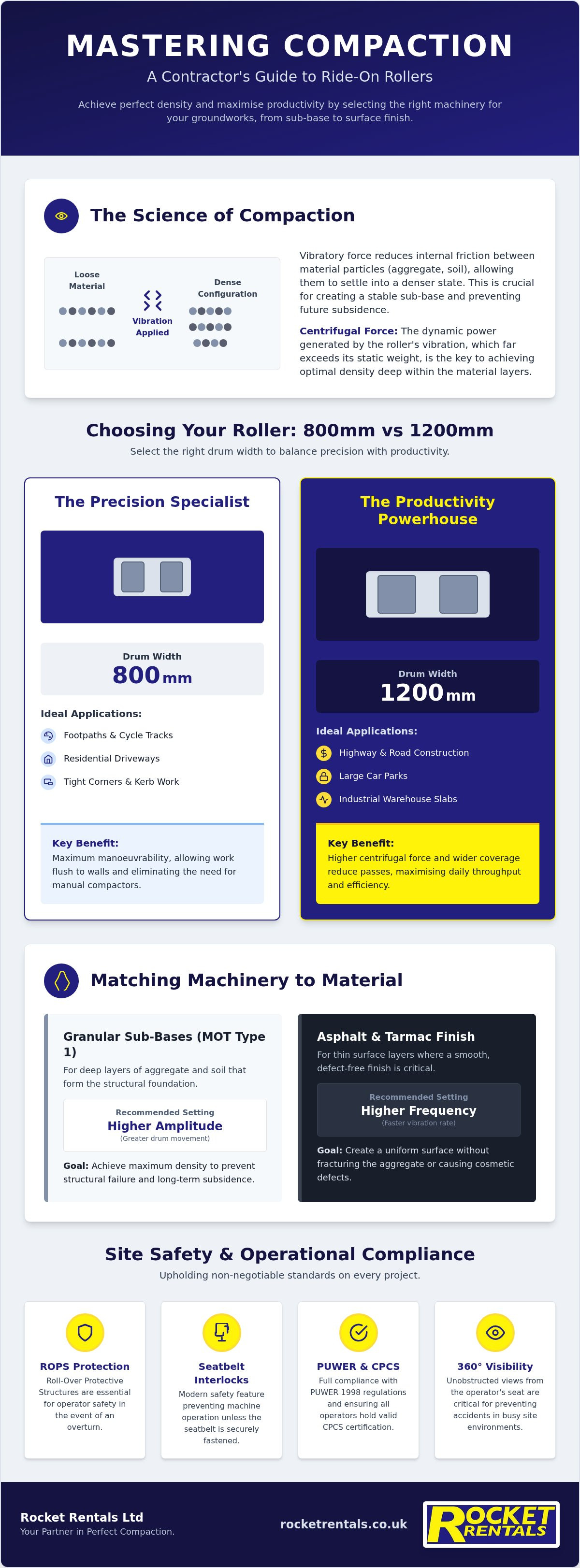
To understand why these machines are so effective, you need to look at how vibration interacts with the ground. Understanding Road roller basics reveals that compaction isn't just about weight. Vibratory force reduces the internal friction amongst material particles. As the drum vibrates, it temporarily breaks the "lock" between aggregate or soil grains, allowing them to rearrange into a much denser configuration.
Centrifugal force is the key metric here. It's the dynamic power generated by internal eccentric weights, which often far exceeds the machine's static weight. High-frequency vibration is typically best for thin asphalt layers to prevent damage, whilst higher amplitude—the actual distance the drum moves—is necessary for deeper soil or MOT Type 1 layers. Matching these settings to your material is what prevents structural failure.
When to Choose Ride-On over Pedestrian Rollers
Project scale usually dictates when a ride-on machine becomes a necessity. Whilst pedestrian rollers are useful for small repairs or narrow paths, they can't compete with the productivity of a tandem unit. A standard ride on roller hire can process hundreds of square metres per hour, keeping pace with constant deliveries of tarmac or aggregate.
Consistency is another major factor. Operator fatigue on a pedestrian roller often leads to uneven compaction or missed patches. Ride-on rollers provide a stable platform and 360-degree visibility, allowing the operator to maintain a steady speed and overlap passes accurately. This leads to a more uniform surface finish and ensures the entire site reaches the specified density simultaneously.
Comparing Tandem Drum Specifications: 800mm vs 1200mm Models
Selecting the right drum width is a fundamental part of effective site management. Whilst the 1200mm roller is often seen as the workhorse of larger developments, the 800mm variant provides precision that larger machines can't replicate. Understanding soil compaction principles is vital here; larger machines exert higher loads, but those loads must be balanced against the physical layout of your site. Choosing the wrong machine often leads to inefficient passes or, worse, damage to existing kerbs and structures.
The 800mm Tandem: Versatility and Precision
The 800mm 'compact' tandem roller is designed for environments where space is at a premium. Its primary advantage is its ability to work flush to walls and kerbs, eliminating the need for manual plate compactors in tight corners. With a narrow transport width, these rollers are easily moved between urban sites on a standard plant trailer. They're the preferred choice for footpaths, cycle tracks, and residential driveways where manoeuvrability is the primary factor for successful groundworks.
The 1200mm Tandem: Maximising Site Throughput
When your project involves highway construction or expansive industrial warehouse slabs, the 1200mm roller becomes a logistical necessity. These models offer significantly higher centrifugal force, allowing for deeper material lifts and more efficient sub-base preparation. By covering a wider area in a single pass, you reduce the total number of passes required to reach the target density. This directly impacts your daily productivity and reduces the time needed for each layer of the compaction programme.
Modern ride on roller hire models often feature drum offset capabilities. This allows the operator to shift the rear drum slightly to the side, making it easier to navigate around manhole covers or site obstructions without losing compaction consistency. In high-traffic zones, 360-degree visibility is a non-negotiable standard. Clear lines of sight to the drum edges ensure the operator can work safely amongst other plant and personnel. If you're unsure which specification fits your current groundworks, you can browse our range of roller hire options to find the ideal match for your site's footprint.
Matching Machinery to Material: From Sub-base to Tarmac
Achieving a structurally sound finish requires a nuanced understanding of material behaviour under vibration. It isn't a one-size-fits-all process. Whether you're laying an MOT Type 1 sub-base or finishing a final wearing course, your technique must adapt to the physical properties of the material. Securing a high-quality ride on roller hire ensures you have the technical features, such as pressurised water systems and adjustable frequency, to handle these transitions seamlessly. Getting the moisture content right is equally vital; too little leads to poor bonding, whilst too much causes the material to shift under the weight of the drum.
Compacting Hardcore and Granular Fills
Optimal lift thickness is the first hurdle. For an 800mm tandem roller, material lifts should generally be restricted to 100 to 150mm to ensure full-depth compaction. A 1200mm model can often manage deeper lifts up to 250mm depending on the aggregate type. During the process, keep a keen eye out for "heaving" or sponginess. If the material moves in a wave-like motion under the drum, it's a sign of excessive moisture or a soft subgrade that needs addressing. This stage is vital for creating a stable platform for subsequent excavator hire operations, such as digging foundations or service trenches, where ground stability is paramount.
Asphalt Finishing and Surface Sealing
Asphalt work demands even greater precision. Scuffing or tearing of the surface usually occurs if the drum is too dry or if the operator makes sharp turns on hot material. This is where the integrated water sprinkler system becomes critical. It creates a thin lubricating film that prevents the bitumen from sticking to the steel drums. Tandem rollers are naturally superior for this task because they provide two points of contact, effectively sealing the surface and eliminating voids in a way that single-drum units cannot. Always ensure the roller is moving before engaging the vibration to avoid creating permanent indentations in the fresh tarmac.
Avoid the temptation to keep rolling once the material has reached its target density. Over-compaction can actually degrade the aggregate, crushing the stones and reducing the interlocking strength of the sub-base. It's a fine balance that requires experience and the right machinery. By monitoring the number of passes and the material's response, you can ensure a durable, flat finish that meets every structural standard without the risk of material degradation.
Site Safety and Operational Compliance
Safety on a busy construction site isn't an afterthought; it's the foundation of every professional groundworks operation. When you arrange a ride on roller hire, you're taking responsibility for a powerful piece of machinery that must meet stringent legal standards. Our fleet is maintained to exceed the requirements of the Provision and Use of Work Equipment Regulations 1998 (PUWER). This commitment ensures that every machine arrives on your site equipped with essential safety features, including Roll-Over Protective Structures (ROPS) and seatbelt interlocks. These systems are designed to protect the operator in the event of an incident, providing peace of mind for both the contractor and the site manager.
Modern rollers also feature 360-degree visibility and 'dead-man' switches. The switch ensures that if an operator leaves the seat or loses control, the machine's drive and vibratory systems immediately cut out. These layers of protection are vital for managing the risks associated with heavy plant. Ensuring your team is compliant with site-specific Risk Assessments and Method Statements (RAMS) is a non-negotiable part of modern project management.
The Daily Inspection Checklist
A methodical approach to maintenance logging is the best way to prevent equipment failure and ensure continuous site safety. Every morning, before work commences, the operator should perform a series of essential checks. This includes verifying fluid levels, checking tyre or drum integrity, and testing the braking system. It's equally important to test the vibratory system and water sprayers to ensure they're fully functional before laying any material. Cleaning the drums at the end of each shift prevents material build-up, which can lead to surface defects or even affect the machine's balance during operation.
Safe Manoeuvring in Confined Spaces
Manoeuvring a multi-ton roller in tight urban environments or busy sites requires precision and clear communication. Establishing strict exclusion zones is the first step in protecting ground personnel. For any reversing manoeuvres, the use of a trained banksman is essential to navigate blind spots safely. Operators must also stay mindful of the machine's centre of gravity, particularly when working on slopes or gradients where the risk of a rollover increases. Coordinating these movements with other plant, such as during mini excavator hire tasks, allows for a more organised and secure site environment.
By prioritising these safety protocols and choosing reliable machinery, you ensure your project meets every health and safety standard whilst maintaining maximum productivity. If you're planning your next phase of groundworks, you can view our full range of plant hire to find the right equipment for a safe and efficient site.
Why Professionals Choose Rocket Rentals for Self-Drive Hire
Professional contractors need more than just a piece of equipment; they require a partnership built on trust and technical competence. Our 'safe pair of hands' philosophy is at the centre of everything we do, ensuring that your groundworks project proceeds without the friction of unreliable machinery. By focusing exclusively on self-drive models, we provide you with the autonomy to manage your own site schedules and operator assignments. This flexibility is essential for maintaining project momentum, especially when coordinating multiple phases of construction across a national footprint.
Modern Fleet, Minimal Downtime
A high-quality ride on roller hire should be synonymous with reliability. Our team maintains a rigorous fleet turnover programme to ensure you always have access to the latest compaction technology. This proactive approach doesn't just improve performance; it integrates modern safety features that protect your workforce and keep your site compliant with current legislation. Newer machines are also inherently more fuel-efficient, helping you manage site costs whilst reducing the environmental impact of your operations. Every unit undergoes a comprehensive pre-hire inspection before delivery, ensuring it's ready to perform from the moment it arrives on site.
A Dependable Partner for National Projects
Reliability extends beyond the machinery to the logistics and support that keep your project moving. Site timelines are sensitive, which is why our professional logistics team focuses on precision delivery. Whether you're managing a civil engineering project or a commercial development, having equipment arrive exactly when needed is critical for avoiding costly downtime. Our experts bring decades of industry experience to every hire, offering technical guidance that helps you match the right drum width to your specific material requirements.
We've built our reputation on being a dependable partner for contractors who value quality and readiness. By combining the scale of a national provider with the personal touch of a dedicated service specialist, we ensure your groundworks meet every structural standard. You can explore our full range of ride-on rollers and plant hire to see how our modern fleet can support your next project with maximum uptime and professional reliability.
Delivering Structural Integrity in Every Pass
Achieving perfect compaction density is a technical discipline that requires the right blend of machinery and expertise. By matching your drum width to the specific material lifts on site and understanding the vibratory science behind the process, you protect your project from future structural failure. We've explored how a modern ride on roller hire provides the necessary centrifugal force and safety features, such as ROPS and seatbelt interlocks, to keep your groundworks both efficient and compliant.
As an independent specialist founded in 1988, Rocket Rentals remains a "safe pair of hands" for contractors across the UK. Our commitment to a high-specification, self-drive fleet ensures that you have access to reliable technology with maximum uptime. Whether you're preparing a granular sub-base or finishing a final asphalt course, our expert technical support is here to guide your selection. You can secure your ride-on roller hire from Rocket Rentals today and move forward with the confidence that your site meets every professional standard. Let's get your next project off to a solid start.
Frequently Asked Questions
What is the difference between a tandem roller and a single drum roller?
Tandem rollers feature two smooth steel drums that both drive and vibrate, making them the standard for asphalt and soil finishing. Single drum rollers utilise one vibrating drum at the front and heavy rubber tyres at the rear. Whilst single drum models are often used for massive earthworks and deep soil lifts, a tandem ride on roller hire is the preferred choice for achieving the precise, uniform surface required for roads and car parks.
Do I need a specific licence to hire a ride-on roller for self-drive?
Operators must hold a valid CPCS card to operate these machines on professional sites. This certification confirms you've passed the CITB Health, Safety and Environment Test within the last two years. If you intend to use the machine on a public highway, it must be road-legal with proper lighting and insurance, and the driver must hold the correct UK driving licence category. Always verify site-specific requirements before starting your hire.
How many passes are typically required for MOT Type 1 compaction?
Achieving the required density for MOT Type 1 aggregate typically requires 6 to 8 passes when using a standard vibratory roller. The exact number depends on the lift thickness, which shouldn't exceed 150mm for smaller rollers. It's vital to monitor the surface; if the material stops compacting and starts crushing, you've reached the limit. Consistent speed and a 10% drum overlap ensure uniform stability across the entire sub-base.
Can a ride-on roller be used on steep gradients or embankments?
Ride-on rollers can handle gradients, but you must stay within the manufacturer's specified gradeability limits, which often range between 30% and 40%. Operators should avoid turning on slopes and never drive across a side-slope, as this shifts the centre of gravity and increases the risk of a rollover. Always check the machine's technical manual for the specific limit of the model you've chosen for your project.
What is the 'vibration frequency' and why does it matter for my project?
Vibration frequency refers to the number of times the internal eccentric weights impact the drum per minute. It's a critical setting because different materials respond to different speeds. High-frequency vibration is best for thin tarmac layers to prevent aggregate breakage, whilst lower frequencies with higher amplitude are better for deep granular fills. Matching this setting to your material depth is what ensures you reach the specified density without damaging the sub-base.
Is water always necessary when compacting tarmac with a ride-on roller?
Water is essential when compacting tarmac to prevent the hot bitumen from adhering to the steel drums. The integrated water sprinkler system creates a thin lubricating film that allows the drum to roll smoothly over the surface. Without constant water flow, the tarmac will "pick up" and tear, leading to surface defects and costly rework. Modern rollers allow you to adjust this flow to match the ambient temperature.
How do I choose between an 800mm and a 1200mm roller for my site?
Your choice depends on site access and total surface area. The 800mm model is the best ride on roller hire for residential driveways, footpaths, and working flush against walls. If you're preparing large-scale industrial slabs or highway sub-bases, the 1200mm model is necessary to maximise daily throughput. The wider drum reduces the number of passes required, which significantly improves your site's overall productivity and reduces fuel consumption.
What safety equipment (PPE) is required for operating a ride-on roller?
Standard site PPE is mandatory and typically includes a hard hat, high-visibility clothing, and safety boots with steel mid-soles. Because the vibratory system produces high decibel levels, hearing protection is also a critical requirement for the operator. You should also consider safety gloves when performing daily checks or refilling the water tank. Always ensure your PPE is in good condition and meets the latest British safety standards before beginning work.


Comments