
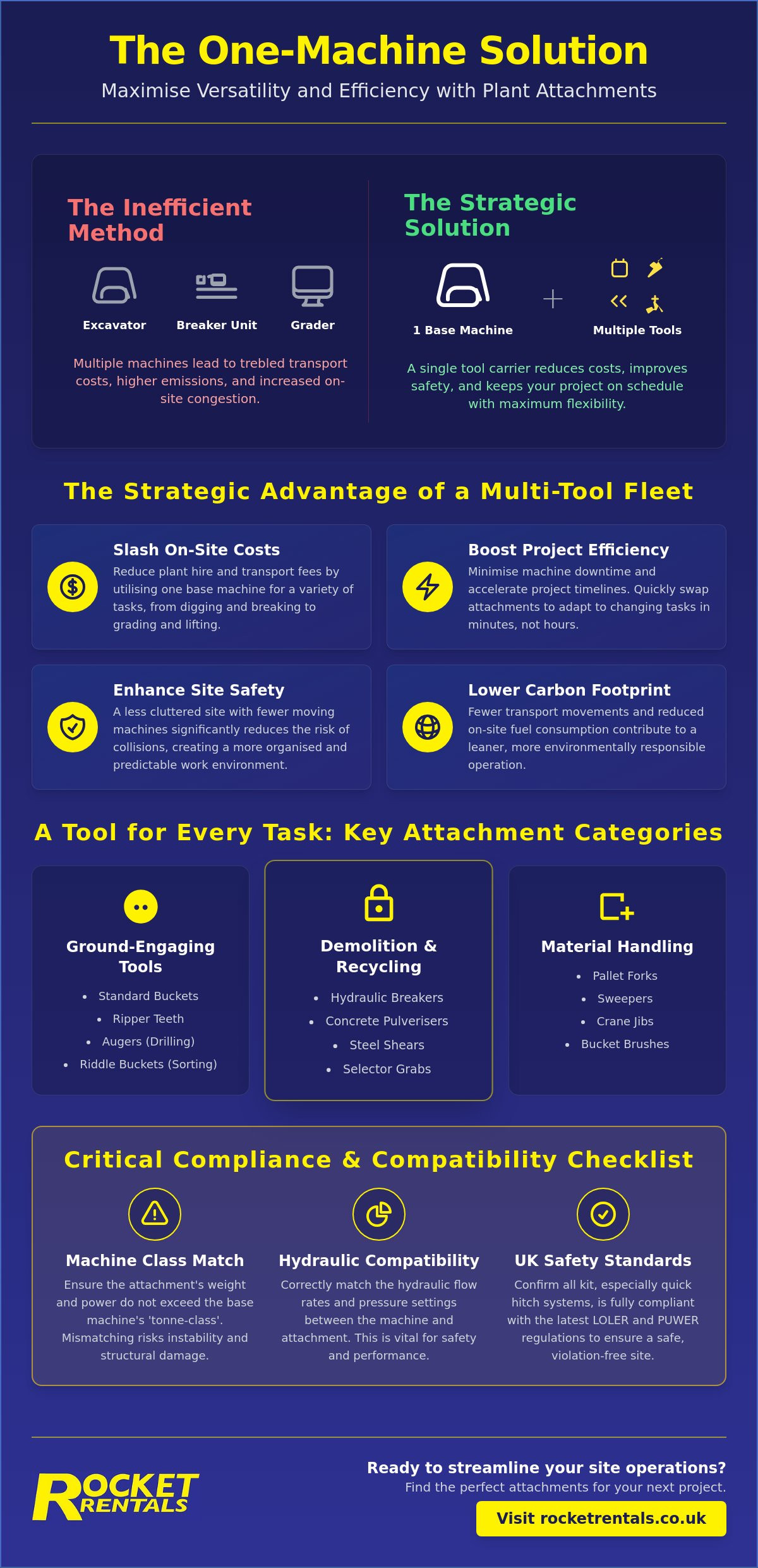
The Essential Guide to Plant Attachments: Maximising Site Efficiency in 2026
Why pay for a fleet of specialised machinery when a single excavator and the right kit can do the work of four? It's a question more contractors are asking as they look to streamline operations and protect their margins on increasingly tight schedules. We understand the pressure of avoiding project delays caused by using the wrong tool for the job. You might also worry about hydraulic compatibility or the risk of machine damage when swapping out kit. This guide explores how to transform your hired machinery into high-performance specialist tools using the right plant attachments.
We'll show you how to find a 'one-machine' solution that reduces manual labour whilst ensuring you remain fully compliant with the latest LOLER and PUWER safety regulations. You'll learn how to navigate the complexities of quick hitch standards and hydraulic flow requirements for 2026. By the end of this guide, you'll have the technical clarity needed to select the perfect tools for your site, ensuring every hire is as productive and safe as possible.
Key Takeaways
Learn how to convert standard machines into multi-purpose tool carriers to reduce the total number of heavy vehicles required on-site.
Discover specific plant attachments for excavators and telehandlers, ranging from high-tech tiltrotators to specialised sweepers.
Understand the critical importance of hydraulic flow rates and pressure matching to prevent machine damage and ensure operational safety.
Gain insights into the latest UK safety standards for quick hitch systems, ensuring your site remains fully compliant with LOLER and PUWER.
Identify the most efficient attachment for specific tasks like demolition or landscaping to minimise manual labour and speed up project timelines.
Table of Contents
Maximising Machinery Versatility with Plant Attachments
Modern construction sites are no longer defined by the number of machines they house, but by the versatility of the fleet they deploy. We define plant attachments as specialist tools designed to be mounted on primary machinery, such as excavators or telehandlers, to perform specific functions. In recent years, the industry has moved away from 'single-purpose' machines. Instead, we see a focus on 'tool carriers'-base machines that remain on-site whilst their functionality changes as quickly as the task requires.
This concept has evolved significantly over the decades. For instance, the Skid-steer loader has long been celebrated for its ability to swap buckets for forks or augers in minutes. Today, this level of flexibility is standard across larger excavators and telehandlers, allowing contractors to maintain a high pace of work without the clutter of excessive machinery.
The Strategic Advantage of a Multi-Tool Fleet
Why pay for three machines when one can do the job? Consider the logistical benefit of an 8-tonne excavator. In a single day, this machine can dig a trench, break up old concrete, and then grade the surface for a new road. If you hired three separate machines for these tasks, your transport costs would treble. By utilising various plant attachments, you keep the base machine active for longer. This approach also improves site safety. Fewer active machines in tight spaces mean a lower risk of collisions and a more organised, predictable working environment.
Key Categories of Plant Attachments
To help you choose the right kit, it's useful to categorise these tools by their primary function. Ground-engaging tools include standard buckets, ripper teeth for hard clay, and augers for precise drilling. For demolition and recycling, we provide hydraulic breakers, pulverisers to separate rebar from concrete, and shears for steelwork. Finally, material handling attachments like pallet forks and selector grabs turn a standard lifter into a precise tool for moving site supplies. This variety ensures that your hired plant is never sitting idle.
Hiring attachments is often far more cost-effective than hiring additional heavy plant. It reduces the capital tied up in specialised machinery and significantly lowers your site's carbon footprint. Fewer machine movements and reduced transport requirements mean less fuel consumption and lower emissions. It's a lean, efficient way to manage a modern project whilst maintaining the highest standards of professional delivery.
Specialist Attachments for Excavators and Telehandlers
Selecting the right tool starts with understanding your machine's capacity. A common mistake on busy sites is attempting to fit an attachment that exceeds the base machine's 'tonne-class'. If you mount a breaker designed for a 13-tonne machine onto an 8-tonne excavator, you risk hydraulic overheating and structural damage. We ensure that all plant attachments are perfectly matched to the host machine's lifting capacity and hydraulic flow. This precision prevents unnecessary wear and maintains the stability required for safe operation.
Essential Excavator Tools for Groundworks
Hydraulic breakers are the workhorse of demolition. When choosing one, consider the impact energy required for the material; breaking reinforced concrete requires significantly more force than tarmac. Modern breakers also feature noise suppression technology, which is vital for projects in residential areas. For drilling, augers are indispensable. The key is matching the drive unit and flighting to the soil type. A standard flighting might struggle in dense, compacted clay, whereas a heavy-duty unit will maintain its pace. To reduce waste disposal costs, many contractors now use riddle buckets. These allow you to sort stone and hardcore from topsoil directly on-site, repurposing materials and reducing the number of dumper trips required.
Safety is paramount when swapping these tools. Maintaining strict excavator attachment safety protocols, particularly regarding quick couplers and locking pins, is essential to prevent accidental releases. If you are unsure which tool fits your specific machine, our team can help you select the ideal excavator attachments for your next project.
Versatile Telehandler and Dumper Attachments
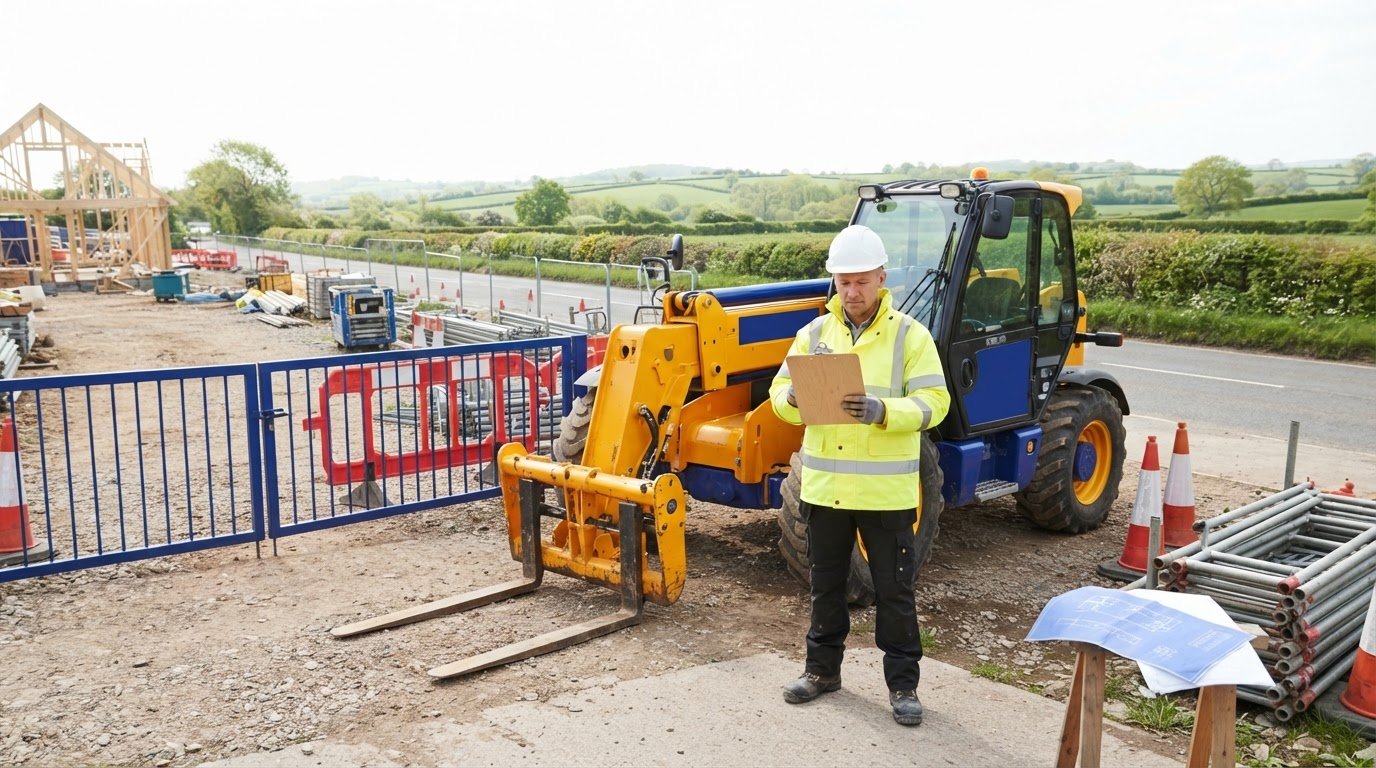
Telehandlers are often viewed simply as lifters, but they can be transformed into sweepers or even light cranes with the right kit. Pallet forks are the most common addition, but they must be checked for correct load ratings and the presence of safety pins before every shift. For site maintenance, road sweepers are a practical choice to keep access roads clear of mud, ensuring you remain compliant with local highways regulations. We also see an increase in the use of tipping skips. By integrating these directly into your material handling flow, you can move waste across a site far more efficiently than using manual wheelbarrows. For niche tasks, specialised plant attachments like hedge cutters or post drivers can be fitted to smaller excavators, providing a mechanised solution to traditionally labour-intensive jobs.
Compatibility and Safety: Matching Attachments to Your Fleet
Achieving a perfect match between machine and tool is about more than just pin diameters or bucket widths. It requires a deep understanding of the host machine’s internal systems. When selecting plant attachments, the hydraulic specifications are your most critical data points. Mismatched hydraulics lead to failure. If these aren't aligned, you risk catastrophic damage to the attachment or the machine’s main pump, resulting in expensive downtime that is easily avoided with the right technical knowledge.
Hydraulic System Requirements
Most modern excavators come equipped with auxiliary hydraulic circuits, but these aren't all created equal. One-way circuits are typically used for hammers and breakers, where the oil flows in one direction and returns via a low-pressure line. Two-way circuits are necessary for tools that require movement in both directions, such as selector grabs or tiltrotators. If you attempt to run a two-way tool on a one-way circuit, the attachment won't function. Conversely, over-pressuring a tool by exceeding its maximum BAR rating can blow seals and cause internal leaks. For high-performance breakers, hydraulic flow compatibility is the precise alignment of the machine's litres-per-minute output with the breaker's internal strike-rate requirements.
Safety Regulations and Quick Hitches
Site safety has been transformed by the evolution of quick hitch systems. The industry has moved decisively away from manual hitches that require the operator to leave the cab to hammer in a pin. Leading organisations like the Association of Equipment Manufacturers (AEM) emphasise that maintaining high standards in attachment connection is a cornerstone of modern site safety. Whilst fully automatic hydraulic hitches are now common, many sites still use semi-automatic versions. These require a physical 'safety pin' check. If an operator forgets this step, the attachment can fall during operation, posing a severe risk to ground workers. Professional training is vital to ensure every team member knows how to verify a secure connection before any lifting begins.
Weight and balance are equally important for operational stability. A heavy attachment changes the machine's centre of gravity. This reduces its safe lifting capacity, especially when working over the side of the tracks. You must consult the machine's load chart to account for the additional weight of the tool. Finally, never overlook daily maintenance. Hydraulic couplings should be cleaned before every connection to prevent grit from entering the system. Using protective dust caps when plant attachments are disconnected is a simple but effective way to prevent hydraulic contamination and ensure the long-term reliability of your hired fleet.
Project-Specific Solutions: Which Attachment for Which Task?
Selecting the right tool for a specific task is the difference between a project that runs on time and one that stalls due to inefficiency. In demolition, the choice between a hydraulic breaker and a pulveriser is a matter of primary versus secondary processing. While a breaker is essential for the initial shattering of heavy structures, a pulveriser is the superior choice for on-site material separation. It allows operators to crush concrete and strip away rebar in one movement, significantly improving recycling rates and reducing the need for secondary processing off-site.
Attachments for Demolition and Site Clearance
Efficient site clearance relies on the ability to sort waste at the source. Using selector grabs or grapples, you can move timber, metal, and masonry into separate skips with surgical precision. This reduces the volume of mixed waste sent to landfill, directly lowering your disposal costs. For structural removal, lifting beams provide a stable, balanced solution for lowering sections of a building safely. These plant attachments turn a standard excavator into a precise dismantling tool, ensuring you meet the highest safety standards during high-risk phases of work.
Civil Engineering and Infrastructure Tools
In civil engineering, mechanisation is the key to reducing manual labour and increasing safety. Compactor plates, for instance, allow you to achieve the required soil density in deep trenches without sending a worker down with a manual rammer. This removes the risk of trench collapse and vibration-related injuries. For deep excavations or loading material in restricted urban areas, clamshell buckets offer vertical reach and precise placement that standard digging buckets cannot match. The tiltrotator is perhaps the most versatile addition for infrastructure work. It acts as the 'Swiss Army Knife' of the site, allowing a bucket to rotate 360 degrees and tilt up to 45 degrees for complex grading, shaping, and finishing with minimal machine movement.
For landscaping projects, selecting the right bucket width is vital for efficient trenching, whilst a ripper tooth is the most effective tool for breaking through sun-baked or frozen hard ground before you begin digging. Utility contractors often rely on augers for fencing or selector grabs for the delicate placement of heavy concrete pipes. In forestry and site maintenance, tree shears and hedge cutters allow for rapid clearance of vegetation whilst keeping the operator safely inside the protected cab. If you're planning a complex project, you can view our full range of plant attachments to find the exact match for your machinery and task requirements.
Efficient Site Operations with Rocket Rentals Ltd Attachments
Maximising site efficiency isn't just about having the right machinery; it's about having a dependable partner who understands the technical demands of your project. At Rocket Rentals Ltd, we focus on providing high-quality, modern plant attachments that are maintained to the highest industry standards. Our self-drive hire model is designed specifically for experienced contractors who require the freedom to manage their own site operations whilst knowing their equipment is backed by professional expertise. By providing the tools that transform standard machines into specialist assets, we help you maintain a lean and productive site without the need for a bloated fleet.
Reliable Support and Technical Expertise
Reliability is the cornerstone of our service. Every piece of kit in our inventory undergoes rigorous safety and performance checks before it arrives on your site. We don't just deliver equipment; we provide the peace of mind that your plant attachments are site-ready and fully compliant with UK safety regulations. If you're unsure about the specific hydraulic requirements for a complex task, the technical team at Rocket Rentals Ltd offers expert advice on matching our excavator fleet with the right specialist tools. Whether you're managing a local groundworks project or a long-term industrial contract, our national delivery and support network ensure your operations stay on track. This proactive approach to maintenance reduces the likelihood of mechanical failure, keeping your project on its critical path.
Booking Your Plant and Attachments Together
How much time do you spend coordinating multiple suppliers for one machine? Streamlining your site setup becomes far simpler when you hire the base machine and its attachments from a single, trusted source. This integrated approach ensures full compatibility between the machine's hydraulic system and the tool's requirements, reducing the risk of on-site technical issues. Our hire process is straightforward and transparent, allowing professional contractors to secure the kit they need without unnecessary delays. We understand that on a busy site, every hour of uptime counts.
Choosing the right partner means more than just access to a catalogue of equipment. It's about finding a team that values your project's success as much as you do. Rocket Rentals Ltd prides itself on being a "safe pair of hands" in the industry, combining modern efficiency with a traditional commitment to service. Since our establishment in 1988, we've built a reputation for delivering high-specification machinery that meets the rigorous demands of the UK construction sector. To get started on your next project, you can Explore our full range of plant attachments and request a quote today.
Future-Proofing Your Site Operations
Modern construction demands a shift from owning a vast fleet to managing a versatile one. By embracing the concept of the 'tool carrier', you can significantly reduce transport costs and site congestion whilst maintaining the ability to tackle specialised tasks. Success hinges on precise technical matching. Ensuring your plant attachments align perfectly with your machine’s hydraulic flow and safety systems isn't just a regulatory requirement; it's a strategic advantage that prevents downtime.
Rocket Rentals Ltd has positioned itself as a specialist self-drive hire expert since 1988, providing a modern, high-specification fleet that contractors can rely on. We understand that your project's success depends on the readiness and quality of your kit. By sourcing both your base machinery and specialised tools from a single partner, you streamline your logistics and ensure full compliance with UK site standards.
Maximise your site productivity with Rocket Rentals Ltd - View our attachments here. We look forward to helping you transform your next project into a model of efficiency and safety.
Frequently Asked Questions
Are all excavator attachments universal?
No, they aren't universal. Every attachment must be matched to the host machine's pin diameter, ear spacing, and pin centres. Even if a tool physically fits the hitch, it must also align with the machine's hydraulic flow and pressure ratings to operate safely and effectively without causing internal damage.
Do I need a special licence to operate plant attachments?
You don't usually require a separate licence, but you must be competent and trained on the specific tool. While a standard CPCS or NPORS card covers the base machine, specialised plant attachments like tiltrotators or tree shears often require additional familiarisation. This ensures you meet PUWER regulations regarding the safe use of work equipment.
What is the difference between a manual and a hydraulic quick hitch?
A manual quick hitch requires the operator to leave the cab and physically hammer in a safety pin to secure the tool. In contrast, a hydraulic quick hitch is operated entirely from the cab. Modern UK sites favour hydraulic systems because they significantly reduce the risk of manual handling injuries and accidental bucket drops.
Can I use a larger attachment on a smaller excavator?
You shouldn't attempt to use an oversized tool on a smaller machine. Doing so risks making the excavator unstable and liable to tip, especially when the arm is fully extended. It also places immense strain on the hydraulic pump and can lead to structural cracks in the machine's boom or dipper arm.
What maintenance is required for a hired hydraulic breaker?
Greasing is the most critical maintenance task. You should apply high-pressure grease to the tool bit and bush every two to three hours of constant use. This prevents metal-on-metal wear and ensures the breaker maintains its impact energy throughout the duration of your project.
How do I know if my excavator has the right hydraulic circuits for an attachment?
You can check the auxiliary pipework on the dipper arm for clues. One-way circuits, used for breakers, typically have a large return pipe. Two-way circuits, required for rotating grabs, feature two pipes of equal diameter. If you're in any doubt, we can verify compatibility using your machine's specific model and year.
What happens if an attachment gets damaged whilst on hire?
Standard hire terms generally mean the hirer is responsible for damage that occurs during the hire period. It's vital to ensure your 'Hired-in Plant' insurance policy is up to date and covers specialised plant attachments. We always recommend a thorough inspection upon delivery to confirm the equipment's condition before work begins.
Do you provide the hydraulic hoses with the attachment hire?
Yes, we supply all necessary hydraulic hoses and quick-release couplings with every hire. These components are pressure-tested and checked for leaks before they leave our depot. This ensures the attachment is ready for immediate connection to your excavator’s auxiliary points so you can start work without delay.
Comments