
Tight Access Mini Digger Hire: The Professional Guide to Restricted Site Excavation
What if the only thing standing between your project's completion and a costly delay is a single centimetre of clearance? For many contractors, the search for tight access mini digger hire often begins only after a standard machine has failed to pass through a garden gate or a narrow side passage. It's a frustrating bottleneck that risks property damage and often forces teams back into inefficient manual digging.
We understand that restricted sites shouldn't mean restricted productivity. You need a dependable partner who provides modern, narrow-width machinery that doesn't sacrifice breakout force for a smaller footprint. This professional guide will help you master the complexities of confined excavations by offering expert insights on selecting, operating, and maximising the efficiency of compact plant. From understanding the capabilities of sub-800mm micro diggers to ensuring site safety compliance, we'll examine how to keep your project moving forward with the precision and power it deserves.
Table of Contents
Defining Tight Access: When Standard Plant Isn't Enough
Professional site management requires more than just selecting a machine with enough power to dig a trench. It demands a logistical assessment of how that machine will reach the work area. We define "tight access" as any site where physical constraints, such as width, height, or weight, prevent the use of standard plant machinery over 3 tonnes. In urban environments, these restrictions are common. Whether you're managing internal demolition in a commercial unit or excavating a rear garden for a terraced house, tight access mini digger hire becomes the only viable path to maintaining your project timeline. Without the right machinery, you risk property damage or relying on manual labour, both of which inflate costs.
Choosing the right equipment involves a delicate trade-off. You must balance the machine's footprint with the necessary breakout force and dig depth required for the task. A Compact excavator is engineered to provide surprising power within a reduced frame, but categorising your specific access points before the hire fleet arrives is essential to avoid site delays. This proactive approach ensures that your tight access mini digger hire choice is fit for purpose from the moment it arrives on site.
The 'Standard Doorway' Benchmark
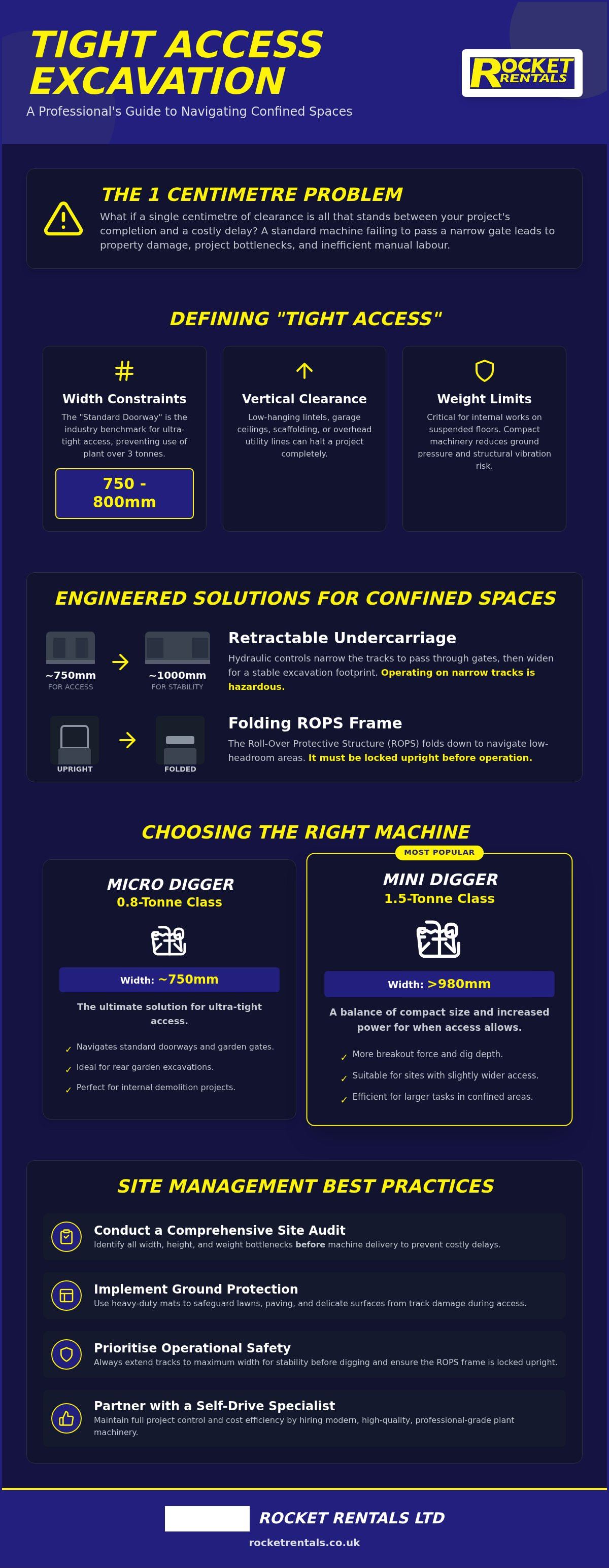
A standard UK doorway typically measures between 750mm and 800mm. This measurement is the industry benchmark for ultra-tight access. Micro diggers are specifically designed to navigate these internal thresholds, often featuring retractable tracks that narrow the machine's stance to as little as 700mm. Getting through the gap is only half the battle. Site managers must also account for "slew" clearance. Once inside, the machine needs enough space for the upper body to rotate without impacting walls or structural supports.
Vertical and Weight Constraints
Access isn't always about width. Vertical obstacles like low-hanging lintels, scaffolding, and overhead utility lines can halt a project just as effectively as a narrow gate. Weight is another critical factor. For internal works on suspended slabs or floors, the machine's ground pressure must be carefully matched to the building's floor loading limits. Using compact machinery also serves a protective purpose. It reduces the risk of structural vibration damage, which is a significant concern when working in close proximity to existing foundations or neighbouring properties. A smaller machine exerts less pressure, making it a safer pair of hands for sensitive environments.
Engineering Solutions for Restricted Spaces
Modern machinery designed for tight access mini digger hire relies on sophisticated engineering to overcome physical site constraints. It isn't simply a matter of shrinking a standard excavator. Instead, manufacturers focus on adjustable geometry. This ensures the machine remains stable whilst working, even if it had to squeeze through a 750mm gap to reach the dig site. These technical features allow professional contractors to maintain high productivity levels in areas where manual digging was once the only option.
Retractable Undercarriages: The 700mm to 1000mm Transition
The retractable undercarriage is perhaps the most vital feature for restricted sites. Using hydraulic controls, the operator can pull the tracks inward to a width of roughly 700mm to 750mm. This allows the unit to pass through standard garden gates or internal doorways. Once the machine is positioned, the tracks must be extended back to their full width, typically around 1000mm, to provide a stable footprint for excavation. Operating on narrow settings during digging is hazardous and increases the risk of tipping. Following established safety protocols, such as those found in Virginia Tech's Excavation Safety Guidelines, ensures that stability is never compromised for the sake of convenience.
Folding Frames and Low-Headroom Operations
Vertical clearance is often overlooked until a machine meets a low lintel or garage ceiling. Most modern micro diggers feature a folding Roll-Over Protective Structure (ROPS). This frame can be lowered to reduce the machine's overall height during entry. It's vital to lock the frame back into its upright, protective position before starting any work. If you're working in basements or semi-enclosed areas, you must also manage exhaust emissions. Proper ventilation is necessary to maintain a safe environment for the operator. For those managing complex indoor projects, choosing the right mini digger hire partner ensures you receive equipment with these specific safety features as standard.
Precision Control with Zero Tail Swing
Zero Tail Swing (ZTS) is a design where the machine's counterweight stays within the width of its tracks during rotation. This allows the operator to slew the upper body 360 degrees without the risk of the rear end "scuffing" against a nearby wall or fence. When combined with a boom offset, which allows the digging arm to swing independently of the cab, operators can excavate flush against a structure. This precision significantly reduces the risk of property damage, particularly when working near quality installations from Romford Fencing Ltd, and allows for faster cycle times, as the operator doesn't need to constantly check for rear-end clearance in narrow corridors.
Selecting the right machine for tight access mini digger hire depends on the specific geometry of your site and the physical properties of the ground. While a smaller machine can reach more places, it may take longer to complete the work if the ground is compacted or the dig depth is significant. Professional site management is about finding the equilibrium between the narrowest access point and the breakout force required to meet your deadline.
The 0.8-Tonne Micro: When Every Millimetre Counts
The 0.8-tonne micro digger is the primary solution for sites where access is restricted to standard internal doorways or narrow garden gates. With tracks retracted, these machines typically measure between 700mm and 750mm in width. When the ROPS is folded down, they can pass under low lintels or through garages without difficulty. They are ideal for narrow trenching for utilities or internal floor slab removal. However, their max dig depth is usually capped at around 1.7 metres, and their lifting capacity is lower than larger models. This makes them best suited for loose materials or shallow excavations where space is the absolute priority.
The 1.5-Tonne Mini: Power vs. Access
If your site allows for a gap of at least 1000mm, the 1.5-tonne mini digger is often the more efficient choice. It serves as the industry workhorse for general groundworks because it offers a significant increase in breakout force. This is particularly important when dealing with heavy clay or compacted stony ground where a smaller micro might struggle. The increased weight provides better stability for lifting larger buckets, which speeds up the removal of spoil and improves overall site productivity. Choosing a 1.5-tonne mini digger hire ensures you have the power needed for deeper foundation work without needing the space of a 3-tonne machine.
Managing site logistics for small-batch plant hire involves more than just the machine's size. You must consider the delivery vehicle's access to the kerbside and the method of refuelling in confined spaces. Since these machines are often used in residential or semi-enclosed areas, choosing a modern fleet with high fuel efficiency is a priority. This reduces the frequency of refilling and minimises the impact of exhaust fumes on the immediate work environment.
Comparison Table: Micro vs. Mini Specifications
For urban landscaping projects where site access is generous enough for a one-metre width, the 1.5-tonne model typically delivers the best return on investment. Its ability to handle larger buckets and deeper trenches outweighs the compact benefits of a micro digger unless the entry point is strictly limited to a standard doorway.
Best Practices for Narrow Access Site Management
Success on a restricted site depends on more than just the machine's technical specs. It requires a logistical strategy that accounts for the entire workflow, from the first entry to the final spoil removal. When you arrange tight access mini digger hire, you must adopt a "system thinking" approach. This means ensuring that your excavation speed doesn't outpace your ability to move material or protect the existing environment. Managing the "slew zone" is equally critical; even a zero tail swing machine requires an operator to be mindful of nearby structures to prevent accidental impacts in extremely confined corridors.
The Restricted Access Site Audit
Before the plant arrives, a comprehensive audit is essential. You must measure every pinch point along the path to the dig site, as a single protruding downpipe or an uneven path can render a 750mm machine useless. In residential areas, underground services like water and gas are often buried at shallower depths than on commercial sites. You should also look up. Telephone lines, low-hanging branches, and scaffolding can all obstruct the movement of the boom. Identifying these hazards early prevents costly downtime and ensures site safety compliance—a level of preparation mirrored by AMS Removals when planning the logistics of moving items through restricted access points.
A micro digger is only as efficient as your waste removal plan. There's little point in excavating at high speed if the spoil accumulates and blocks your already limited workspace. We recommend pairing your excavator with tracked skip-loaders or narrow-width dumpers that share the same footprint. This creates a seamless flow of material out of the site. For more detailed insights on coordinating your fleet, see our article on The Professional Guide to Mini Excavator Hire, which covers broader strategies for maximising site efficiency.
Ground Protection and Property Integrity
Confined spaces often mean driving over finished surfaces like decorative paving or manicured lawns. Using professional ground mats or heavy-duty plywood is necessary to distribute the machine's weight and prevent rutting. You should also consider the "entry points" themselves. Protecting door frames and external corners with temporary padding can prevent scuffs during the initial transit. Finally, be mindful of your neighbours. Compact machinery naturally produces less noise and vibration, but operating within reasonable hours and maintaining a tidy site helps preserve local relationships. If you're ready to start your next project, explore our range of professional mini digger hire options to find the perfect fit for your site.
Secure Your Site Success with Rocket Rentals
Choosing a partner for tight access mini digger hire requires more than just browsing a catalogue of machine widths. It demands a relationship with a provider that understands the technical nuances of restricted site work. We position ourselves as a "safe pair of hands" for site managers and contractors across the UK. By focusing exclusively on self-drive hire, we ensure that you retain absolute control over your project's pace, safety, and precision. This approach is particularly valuable in confined spaces where the operator needs an intimate understanding of the site's unique challenges and immediate environment.
A Fleet Built for Professionals
Our fleet is comprised of modern, high-spec machinery from the world's leading manufacturers. We invest heavily in the latest compact technology, ensuring that features like retractable tracks and zero tail swing come as standard rather than as optional extras. We purposefully exclude operated plant from our service offering. This allows professional contractors to utilise their own trusted operators who are already familiar with the specific safety protocols of the site. For those managing larger developments that require a broader range of equipment, you can explore our resources on Excavator Hire in the South West to understand how we support diverse project scales with professional-grade plant.
Reliability You Can Build On
Mechanical failure on a restricted site is more than an inconvenience; it can bring an entire project to a standstill if the machine is blocked in a narrow corridor. To prevent this, our independent heritage drives us to maintain meticulous standards of readiness and maintenance. Every machine undergoes rigorous safety and compliance checks before it leaves our yard, ensuring maximum uptime from the moment it arrives at your location. We provide national UK coverage, delivering high-performance plant wherever your project is situated. Our team offers expert advice to help you navigate the complexities of machine selection, ensuring the equipment you hire is the exact match for your physical access constraints.
We believe that professional groundworks deserve professional equipment. Whether you're navigating the narrowest garden gate or excavating within a commercial interior, our commitment to quality provides the peace of mind you need to focus on the task at hand. Our fleet is ready when you are, maintained to the highest industry standards, and backed by decades of experience in the plant hire sector. Contact our team today to discuss your tight access requirements and secure the reliable machinery your project demands.
Master Your Next Restricted Site Project
Mastering restricted site excavation is a balance of precision engineering and meticulous planning. By selecting the correct machine class and utilising features like retractable tracks, you can overcome even the most challenging access constraints without sacrificing breakout force. A successful project is built on more than just the equipment; it's about a "system thinking" approach that integrates waste removal and ground protection from the very start. This proactive strategy ensures that your site remains safe, productive, and compliant.
Finding a reliable partner for tight access mini digger hire is essential for maintaining project control and cost efficiency. As a professional self-drive specialist, we provide a modern, expertly maintained fleet designed to meet the rigorous demands of commercial groundworks. With our national UK delivery and support, you can trust that the right machinery will arrive ready for immediate work, regardless of your project's location. We're here to provide the expertise and reliable plant you need to navigate difficult sites with confidence.
Explore our full range of tight access mini diggers and request a quote to get your next project moving forward today.
Frequently Asked Questions
What is the narrowest mini digger available for hire?
The narrowest machine typically available for tight access mini digger hire is the 0.8-tonne micro digger. With its hydraulic tracks fully retracted, the width reduces to approximately 700mm to 750mm. This allows it to navigate narrow side passages and garden gates that would block a standard machine. Once the machine has reached the work area, the operator should always extend the tracks back to their maximum width to ensure stability during excavation.
Will a micro digger fit through a standard house front door?
A micro digger will fit through a standard house front door provided the opening is at least 750mm wide. Most UK residential doorways range between 750mm and 800mm, making these machines ideal for internal renovations. To pass through safely, the operator must lower the folding Roll-Over Protective Structure (ROPS). It's also vital to protect the door frame and floor surfaces with suitable padding and mats to prevent cosmetic damage during the transit.
Do I need a special licence for self-drive mini digger hire?
You don't need a specific driving licence to operate a mini digger on private land for non-commercial purposes. However, if you're working on a construction site or a commercial project, you must hold a valid CPCS or NPORS card to prove your competence. Even for private use, we recommend that operators have a basic level of training. This ensures the machinery is used safely and efficiently, protecting both the operator and the surrounding property.
How much breakout force does a 0.8-tonne micro digger have?
A 0.8-tonne micro digger typically delivers a breakout force of approximately 8 to 10 kilonewtons (kN) at the bucket. While this is significantly less than a 3-tonne machine, it's more than sufficient for narrow utility trenching, garden landscaping, and internal floor slab removal. The hydraulic system is engineered to provide maximum torque at the arm, allowing the machine to penetrate compacted soil or break through concrete despite its compact and lightweight frame.
Can micro diggers be used for internal demolition projects?
Micro diggers are highly effective for internal demolition projects, particularly for lifting floor slabs or breaking out foundations. Their compact size allows them to operate within rooms where space is at a premium. If you're using a diesel-powered machine indoors, it's essential to ensure the area is well-ventilated to manage exhaust emissions. For projects with strict environmental requirements, you might consider an electric model to eliminate fumes and reduce noise levels for nearby occupants.
What should I check before hiring a digger for a site with narrow access?
You should conduct a thorough site audit to measure the narrowest pinch points along the entire route, not just the entry gate. Check for overhead obstructions like telephone lines or low lintels that might catch the boom. It's also important to identify the location of underground services such as water and gas pipes. Finally, verify the ground conditions to determine if you need protective mats to prevent damage to paving or lawns.
How do retractable tracks work on a micro excavator?
Retractable tracks on a micro excavator work via a hydraulic system controlled from the operator's seat. When the tracks are retracted, the machine's width is minimised for travelling through narrow gaps like doorways or alleyways. Once the machine is in position, the operator pushes the tracks outward to create a wider, more stable footprint. This increased width is critical for maintaining balance and preventing the machine from tipping whilst digging or lifting heavy loads.
What is the difference between a micro digger and a mini digger?
The primary difference between these machines is their physical size and digging capability. A micro digger weighs less than one tonne and is designed for tight access mini digger hire where gaps are narrower than 800mm. A mini digger typically weighs between 1.5 and 3 tonnes and requires a wider access path of at least 1000mm. While mini diggers offer more breakout force and greater dig depths, micro diggers are the only option for internal or restricted-access sites.


Comments