
Tracked Dumper Hire: A Professional Resource for Challenging Terrain
- Rocket Rentals
- 11 hours ago
- 12 min read
For many site managers, the sight of a wheeled dumper spinning its tyres in deep winter mud isn't just a nuisance; it's a direct threat to the project timeline. You understand that maintaining momentum during the wetter months requires more than just persistence. It demands equipment that can protect sensitive ground and navigate steep inclines where standard machinery often fails. When a project faces soft terrain or narrow access points, the cost of site downtime and subsequent ground restoration can quickly erode your margins.
We recognise the importance of having a safe pair of hands on-site, which is why mastering the technical advantages of tracked dumper hire is essential for any professional contractor. This article provides a comprehensive resource on selecting the right machine for your specific terrain, whilst ensuring you remain compliant with the latest safety standards, including the 2025 legislation for forward-tipping cabins. You will learn how to reduce restoration costs and maintain peak productivity, regardless of what the British weather or the landscape throws at your team. We will guide you through the essential selection criteria and safety protocols that keep projects moving forward safely and efficiently.
Table of Contents
Why Tracked Dumpers are Essential for Challenging Terrain
A standard dumper or dumper truck is a staple on most construction sites, but traditional wheeled models often reach their physical limits when the weather turns or the landscape becomes unforgiving. A tracked dumper solves this by replacing four rubber tyres with two continuous tracks. This fundamental change in design isn't just about aesthetics; it's a calculated engineering solution for material handling on ground that would otherwise be impassable. By utilising a larger contact area, these machines transform how weight is managed across a site.
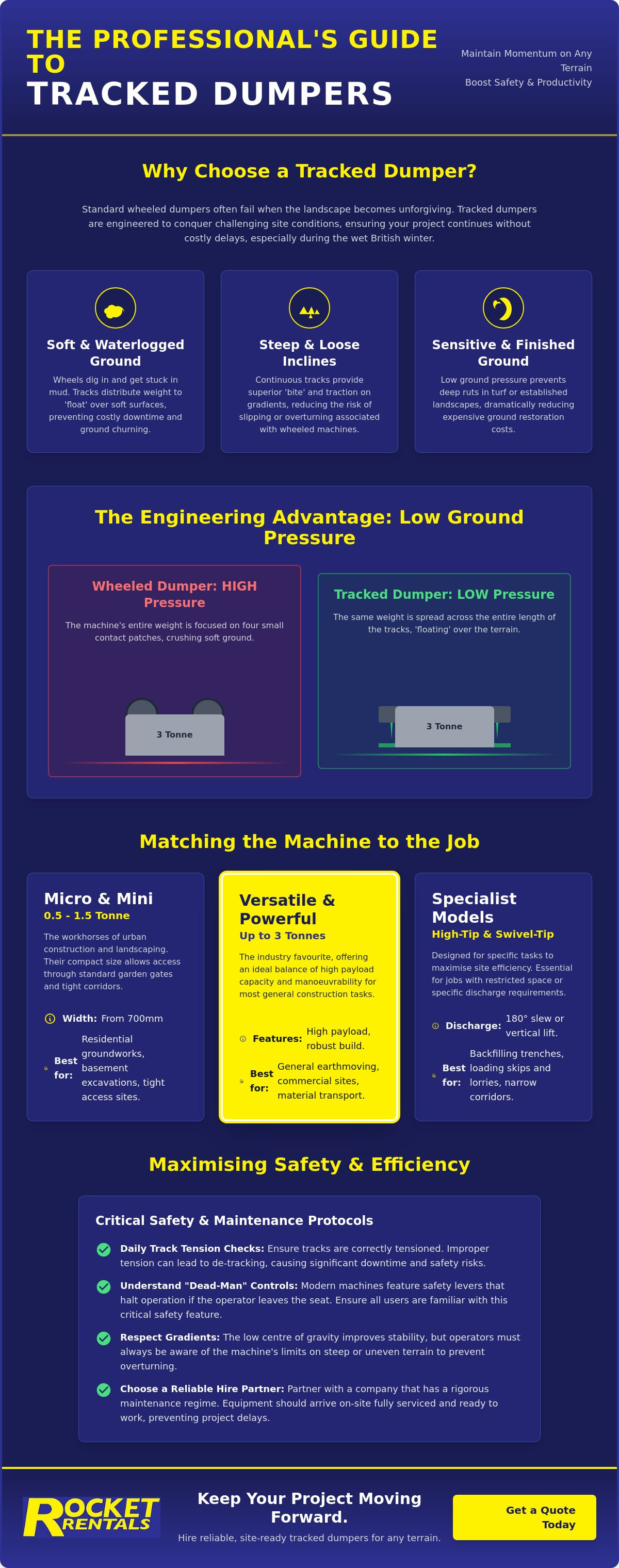
There are three primary site conditions where tracks become a necessity rather than a luxury. First is soft mud or waterlogged soil, where wheels simply dig themselves into a hole. Second is the presence of steep, loose inclines that require constant traction to prevent sliding. Third is the need to work on sensitive turf or established landscapes where deep ruts would lead to expensive restoration fees. Without the right equipment, these challenges can bring a project to a standstill, especially during the wet British winter.
Choosing tracked machinery effectively extends your construction season. Whilst many contractors are forced to pause groundworks in November, those utilising tracked dumpers can maintain momentum. These machines don't rely on a dry surface to provide grip; they create their own stable platform as they move. This reliability ensures that project timelines remain intact even when the environment is working against you.
The Engineering Advantage: Low Ground Pressure
The core benefit of this machinery lies in its footprint. Consider a 3-tonne wheeled dumper; its entire weight, plus its payload, is concentrated on four small patches of rubber. This creates intense pressure points that can easily crush underground services or compact soil so tightly that drainage is ruined. A 3-tonne tracked dumper spreads that same load across the entire length of its tracks, significantly reducing the force exerted on any single point. Ground pressure is defined as the total weight of the vehicle and its load divided by the surface area of the tracks in contact with the ground. This low-pressure approach allows the machine to "float" over soft surfaces that would swallow a wheeled alternative.
Stability and Traction on Gradients
Safety on-site is often a matter of centre of gravity. Tracked designs are inherently lower and wider than their wheeled counterparts, providing a much more stable base for moving heavy loads on uneven ground. When working on embankments or hilly terrain, the tracks provide a constant "bite" into the surface. Unlike rubber tyres, which can lose friction and spin on wet grass or loose scree, tracks use multiple lugs to lock into the terrain. This provides the operator with a higher degree of control and confidence, reducing the risk of sideways slips or overturning on challenging gradients.
Exploring the Fleet: From Compact Barrows to Heavy-Duty Slew Dumpers
Selecting the right tracked dumper involves more than just picking a weight class. It's about matching the machine’s discharge mechanism and physical dimensions to the specific constraints of your site. Professional fleets generally range from 500kg micro-units to heavy-duty 3-tonne models, each designed with a specific material-handling task in mind. For residential groundworks, the 1-tonne to 3-tonne range remains the industry favourite, offering a balance of high payload and compact manoeuvrability.
Understanding discharge configurations is vital for site efficiency. Standard skip-tip models are perfect for general earthmoving where you have plenty of room to manoeuvre. High-tip variants prove invaluable when you need to discharge material directly over the side of a skip or into a small lorry. Swivel-tip machines allow for 180-degree tipping, which is essential for backfilling trenches or working in narrow corridors where the machine cannot turn around to face the dump site.
Micro and Mini Tracked Dumpers (500kg - 1.5 Tonne)
These compact units are the workhorses of urban construction. With widths often starting as narrow as 700mm, they can pass through a standard garden gate or navigate the tight confines of a basement excavation. Their light weight makes them easy to transport on a standard plant trailer, reducing logistical costs for smaller projects. Despite their size, many micro models feature high-tip mechanisms, ensuring that even on a restricted garden clearance, you can load waste directly into a waiting skip without manual double-handling.
The Power of 360-Degree Slew Technology
One of the most significant advancements in mid-sized plant is the introduction of 360-degree slew technology. Unlike traditional models, a slew dumper allows the operator to rotate the entire skip independently of the tracks. This eliminates the need for multi-point turns, which can damage the ground and waste valuable time. It's an ideal solution for Maximising Site Safety, as the operator can always remain facing the direction of travel, even when discharging to the side. For contractors working in high-density areas or on narrow roadworks, this level of precision is a major advantage. If you're planning a complex project, exploring the versatile fleet options at Rocket Rentals ensures you have the exact specification required for peak productivity.
Tracked vs. Wheeled Dumpers: A Decision Framework for Site Managers
Success in plant selection isn't about finding the "best" machine; it's about identifying the most task-specific tool for your site's current reality. Whilst wheeled dumpers are the traditional choice for long-haul transfers across established hard-standing or dry haul roads, they quickly lose their utility when ground conditions deteriorate. A tracked dumper is designed specifically for those short, difficult hauls where traction is more valuable than top-end speed. The decision shouldn't be based solely on hire rates but on the total cost of operation, including the risk of delays and the eventual cost of ground restoration.
Wheeled machines offer higher travel speeds on firm surfaces, making them efficient for moving large volumes of material across expansive sites. However, if your project involves navigating clay-heavy soils or silt during a typical British autumn, a wheeled unit can become a liability. In these scenarios, tracks are Essential for Challenging Terrain. They provide the necessary flotation to keep moving whilst a wheeled alternative would be spinning its tyres, creating deep ruts that require expensive remediation work at the end of the project.
When to Choose Tracked Over Wheeled
Site managers should use a clear checklist when deciding between these two configurations. If your soil analysis shows high clay or silt content, or if the weather forecast predicts consistent rainfall, tracks are the safer investment. You must also consider the gradient; wheeled dumpers often struggle on slopes exceeding 15% when the surface is loose. The "Restoration Factor" is another critical metric. If you're working on a landscaped park or a residential site where ground damage must be minimised, the higher daily hire rate of a tracked dumper is easily offset by the thousands of pounds saved in turf replacement and soil de-compaction later on.
Operational Synergy: Pairing Tracks with Excavators
Maximum site efficiency is achieved when your dumper capacity matches your excavator's output. A mismatch here leads to "dead time" where one machine sits idle. When you're coordinating mini excavator hire for a project, ensure the dumper skip can accommodate three to five bucket loads. This ratio minimises waiting times and keeps the loading cycle fluid. In wet conditions, using tracked machinery helps maintain a cleaner loading area, as tracks don't churn the soil into a slurry as aggressively as tyres do. This discipline keeps your site safer for foot traffic and reduces the amount of debris tracked onto public highways by delivery vehicles.
Maximising Site Safety and Efficiency with Tracked Machinery
Safety on a professional site isn't a passive state; it's the result of rigorous maintenance and precise operation. While a tracked dumper is inherently more stable than a wheeled model, its mechanical complexity demands specific attention to ensure both operator safety and machine longevity. Daily pre-start checks are non-negotiable. You must inspect the track tension and the condition of the bottom rollers every morning before work begins. A track that's too loose risks "throwing" during a sharp turn, which can lead to significant downtime. Conversely, a track that's too tight places excessive strain on the drive motors and idlers, leading to premature wear.
Modern professional units feature "dead-man" controls and safety cut-outs that ensure the machine comes to an immediate halt if the operator releases the joysticks. For work on embankments or hilly terrain, Roll-Over Protective Structures (ROPS) are essential. One of the most significant metrics for sensitive sites is the specific ground pressure. A typical 1-tonne tracked dumper exerts approximately 0.25 kg/cm² (roughly 3.5 PSI). In contrast, a standard wheeled dumper can exert over 2.0 kg/cm² (30 PSI) when fully loaded. This massive difference is why tracks are the only viable choice for working over delicate underground services or high-value landscaping where soil compaction must be avoided.
Track Maintenance and Site Hygiene
Debris management is essential for machine health. Mud and stones trapped in the undercarriage act as an abrasive, grinding down the drive sprockets and rollers. We recommend clearing the track frames at the end of every shift to prevent buildup. Rubber tracks offer a distinct environmental advantage; they are non-marking and won't shatter block paving or tear up tarmac like steel-tracked machinery. When loading the skip, always ensure the payload is centred. An uneven load places undue stress on one side of the machine, which can affect stability when you're navigating a slope.
Operator Competency and Training
Transitioning from a wheeled vehicle to a tracked unit requires a psychological shift. Most modern tracked machines use joystick or skid-steer controls rather than a traditional steering wheel. This allows for incredible precision in tight spaces but requires a steady hand to avoid jerky movements. On private projects, self-drive hire is common, but commercial sites usually mandate recognised CPCS or NPORS certification. Regardless of your experience, you must read the specific operator's manual for your hired unit. Every manufacturer has slight variations in safety cut-out sequences and emergency stop locations. If you're ready to secure a reliable machine for your next project, you can view our fully maintained dumper hire options today.
Sourcing Reliable Tracked Dumper Hire with Rocket Rentals
Choosing a plant hire partner is as much about the relationship as it is about the machinery. At Rocket Rentals Ltd, we position ourselves as a dependable partner for high-quality, self-drive plant hire, providing the technical expertise required to keep your project moving. We understand that on-site productivity relies on equipment that works first time, every time. This is why our approach is built on transparency and professional reliability, ensuring you have the support needed for even the most challenging UK landscapes. Whether you're navigating a wet winter project or a sensitive heritage site, we provide the stability your project demands.
Every tracked dumper in our fleet undergoes a meticulous maintenance regime before it is dispatched to your site. This isn't just a cursory wash; it's a comprehensive mechanical inspection that ensures every roller, track tensioner, and safety sensor is in peak condition. By prioritising a "site-ready" standard, we help you avoid the frustration of mechanical failures that lead to costly downtime. As an independent specialist provider, we offer a level of technical support that goes beyond a simple transaction. We provide clear guidance on machine capabilities and safety protocols, ensuring your operators feel confident from the moment the machine arrives.
Our Commitment to Quality and Reliability
We believe in a "Safe Pair of Hands" philosophy, where trust forms the foundation of our service. Our fleet is comprised of modern machinery equipped with the latest safety technology, including ROPS and FOPS compliant cabins as standard on larger models. This commitment to modern, fuel-efficient equipment ensures your site remains compliant with current UK safety regulations whilst minimising your environmental footprint. Our national coverage means that whether you're managing a single residential groundwork project or multiple infrastructure sites, you can expect a consistent standard of equipment and care. We invest heavily in the latest Tier 5 engines to ensure our machines are as efficient as they are powerful.
How to Organise Your Next Rental
Organising your equipment shouldn't be a hurdle. We've refined our process to make opening a trade account and booking your plant as straightforward as possible. If you're unsure which machine fits your site best, our team provides expert advice to help you decide. We can guide you through the technical differences between a 1-tonne high-tip for narrow access and a 3-tonne swivel model for larger-scale earthmoving. We take the time to understand your specific site constraints before recommending a solution. To get started, Contact the Rocket Rentals Ltd team today to discuss your site requirements and ensure your project stays on track with the right machinery.
Securing Your Project Momentum in All Conditions
Choosing the right plant is the difference between a project that stalls and one that thrives. By prioritising low ground pressure and superior traction, you ensure that your site remains accessible and safe, regardless of soil type or weather. Integrating a tracked dumper into your fleet is a strategic move that pays dividends through reduced ground restoration costs and significantly lower site downtime. It is about working smarter to protect both your project timeline and the landscape.
Since 1988, Rocket Rentals has operated as an independent plant hire specialist, providing the technical support and modern, fuel-efficient machinery needed for professional success. Our commitment to meticulous maintenance and national delivery ensures you receive equipment that is ready to work from the moment it arrives. We provide a safe pair of hands so you can focus on the job at hand.
Explore our full range of tracked dumpers and request a quote today to see how our expert team can support your next project. We look forward to helping you navigate your most challenging terrain with confidence.
Frequently Asked Questions
Do I need a special licence to hire a tracked dumper?
You don't necessarily need a specific plant licence for use on private land, but professional construction sites usually require a CPCS or NPORS competency card. For domestic projects on your own property, a standard Category B car licence is typically sufficient. We provide a thorough handover to ensure you're comfortable with the controls before you begin work.
Can tracked dumpers be used on public roads?
Most tracked dumpers are not road-legal and must stay within the boundaries of your site. To operate on a public highway, the machine would need to be registered with the DVLA, fitted with road-legal lighting, and covered by specific insurance. For almost all projects, it's safer and simpler to transport the unit between sites using a suitable trailer or delivery vehicle.
What is the difference between rubber tracks and steel tracks?
Rubber tracks are the standard choice for most hire applications because they protect finished surfaces like tarmac and block paving. They offer a smoother ride and are much quieter during operation on hard ground. Steel tracks are generally reserved for extreme environments, such as demolition sites or quarries, where sharp rocks or metal debris would quickly tear through rubber.
How much weight can a 3-tonne tracked dumper actually carry?
A 3-tonne tracked dumper is engineered to carry a maximum payload of 3,000kg. It's vital to respect this limit, as overloading the skip can dangerously shift the machine's centre of gravity. You should always consult the manufacturer's data plate on the specific machine you've hired to confirm its exact carrying capacity before loading heavy materials like wet clay or concrete.
Can I use a tracked dumper on a steep hill?
Tracked machinery is far superior to wheeled models on gradients, but you must still operate within the manufacturer’s specified limits, which are often between 20 and 25 degrees. You should always drive straight up or down a slope rather than across it. This technique keeps the weight distributed evenly across both tracks and prevents the machine from tipping or sliding sideways.
Will a tracked dumper damage my driveway or lawn?
While a tracked dumper has low ground pressure to prevent deep ruts, it can still cause surface scuffing during tight turns. Because the machine turns by "skidding" one track, it can mark decorative driveways or tear soft turf if you turn too sharply. We recommend using ground protection mats or making wide, gradual turns to keep the surface of your property in pristine condition.
What happens if the tracks come off during operation?
If you "throw a track," you must stop the engine immediately to avoid damaging the rollers or the drive motor. This usually happens if the track tension is too loose or if you've been working in deep, sticky debris. You shouldn't attempt to force the track back on yourself; instead, contact our technical support team so a fitter can correctly adjust the hydraulic tensioner.
How do I choose between a high-tip and a swivel-tip tracked dumper?
Your choice depends entirely on where you need to deposit the material. A high-tip model is essential if you're loading waste directly into a skip or over a wall, as the skip lifts vertically before tipping. A swivel-tip model is better for trench filling or working in narrow corridors, as it allows you to rotate the skip 90 degrees to either side to discharge material without repositioning the tracks.


Comments